Georgia Law Professor Desirée LeClercq participates in UC Berkeley Law webinar on gender-based violence in the maritime industry

University of Georgia School of Law Professor Desirée LeClercq served as a panelist in the virtual discussion “Inequalities and Violence at Sea.” This panel, moderated by Furaha Joy Sekai Saungweme and Costanza Hermanin, was part of a webinar series hosted by the Gender Justice and Harassment Working Group of UC Berkeley Law’s Center on Comparative Equality & Anti-Discrimination Law. The series was launched in recognition of the International Day for Women in Maritime, an annual observance on May 18 that highlights the contributions of women across the maritime industry.

LeClercq discussed her recent article, “Gender-Based Violence and Harassment at Sea”, which examines the Maritime Labour Convention (2006). She was joined by panelist Tim Springett, Policy Director of the United Kingdom Chamber of Shipping, as they explored the gendered dimensions of labor, safety, and inclusion in the maritime sector.

LeClercq joined the University of Georgia School of Law in 2024 as an assistant professor. She teaches International Trade and Workers Rights, International Labor Law, International Law and U.S. Labor Law. This semester, LeClercq is overseeing the International Law Colloquium, a for-credit course designed to introduce students to international economic law through engagement with scholars in the international legal field. She also serves as a faculty co-director of the Dean Rusk International Law Center and as the faculty adviser for the Georgia Journal of International and Comparative Law.

Rutgers Law professor Sarah Dadush presents working paper at final session of Georgia Law’s 2025 International Law Colloquium

The University of Georgia School of Law’s spring 2025 International Law Colloquium welcomed Sarah Dadush, Professor of Law at Rutgers Law School, who presented her working paper, “Shared Responsibility in Contract Law.” Professor Christopher Bruner, Stembler Family Distinguished Professor in Business Law and Faculty Co-Director of the Dean Rusk International Law Center at Georgia Law, served as her faculty discussant. Dadush’s presentation marks the conclusion of the 2025 International Law Colloquium.

Dadush’s scholarly focus lies in business and human rights, consumer law, and social enterprise law. She also serves as the Director of the Responsible Contracting Project (RCP), a project designed to advocate for human rights and environmental due diligence in contract drafting. The RCP is located within the Rutgers Law School’s Center for Corporate Law and Governance.

Below is an abstract of Dadush’s working paper:

At first, the notion that there is such a thing as shared responsibility in American contract law may sound fanciful, if not absurd. A key reason why parties contract in the first place is to allocate risks and responsibilities between them and to clarify who must do what to move the collaboration forward. As such, contractual obligations are understood to be binary, belonging either to one party or the other, not both. In practice, this means that, if there is a breach, only the obligated party will be held responsible, not both. And, if remedies are awarded, they will flow only from the breaching to the non-breaching party, not between them. Thus, the notion that the parties might be contractually responsible not just for their own obligations, but also for those of their counterparty, seems incoherent.

And yet, as this Article shows, it is not uncommon for courts to go beyond the express terms of the contract to make the parties share responsibility for the performance of one another’s obligations. Thus shared responsibility: Each party is held responsible for the other’s contractual (non)performance, even in the absence of an express commitment to share responsibility for performance.

This Article “goes fishing” for shared responsibility in three key areas of contract law: The contents of the contract, breach, and remedies. It demonstrates that shared responsibility is brought to bear to resolve contract disputes more often and with greater legal effect than the simple, binary understanding of contract might predict. When it enters the judicial analysis, shared responsibility can drastically change the answers to the questions: Who had the obligation to perform? Who breached? And, finally, whose harm should be remedied and how?

Having shown that shared responsibility is already a prominent, if overlooked, feature of American contract law, this Article argues that, in certain situations, courts should employ shared responsibility as a default rule. Specifically, courts should employ a shared responsibility default (SRD) when the contract was breached, or otherwise failed, and (1) both parties contributed to the failure, and (2) the failure could, or has already, generated high social costs (e.g., public endangerment, human rights violations in supply chains, consumer deception). In such situations, the SRD would activate the tort law principles of comparative negligence and proximate cause in contract, holding both parties accountable for their respective contributions to the contract’s failure and related social costs. In doing so, the SRD would equip courts to resolve contract disputes in a manner that attends to both contract policy and public policy objectives.

This year, Professor Desirée LeClercq led the colloquium, which was designed to introduce students to features of international economic law through engagement with scholars in the international legal field. To view the full list of International Law Colloquium speakers, visit our website.

This program w made possible through the Kirbo Trust Endowed Faculty Enhancement Fund and the Talmadge Law Faculty Fund.

Duke Law Professor Rachel Brewster presents working paper at Georgia Law’s International Law Colloquium

The University of Georgia School of Law’s spring 2025 International Law Colloquium welcomed Duke University School of Law’s Professor Rachel Brewster, who presented her working paper, “The Rise of Global FCPA Settlements.” Assaf Harpaz, Assistant Professor of Law at Georgia Law, served as Brewster’s faculty discussant.

Brewster is the Jeffrey and Bettysue Hughes Distinguished Professor of Law at Duke University School of Law. Her scholarly focus lies in international economic law, international dispute settlement, World Trade Organization (WTO) law, anti-corruption law, and international relations theory. Brewster currently serves as the co-director of Duke’s Center for International and Comparative Law and is co-chair of Duke’s JD-LLM in International and Comparative Law Program.

Below is an abstract of Brewster’s working paper:

For the last two decades, the United States has been the dominant enforcer of anti-bribery norms worldwide.  Using the broad extraterritorial jurisdiction granted by the Foreign Corrupt Practices Act (FCPA), the Department of Justice and the Securities and Exchange Commission have prosecuted domestic and foreign corporations for bribing foreign government officials. This transnational enforcement system has been described as a negative comity regime: foreign governments defer to American prosecutions even if the case involves their nationals. This system has created a robust enforcement environment but often faces foreign resistance to the perceived “American dominance” of the regime.

This Article analyzes the recent rise of a new enforcement model: the global FCPA settlement, where multiple governments enter into parallel deferred prosecution agreements or other non-trial resolutions with corporate entities. This enforcement model is now the principal form for concluding “blockbuster” FCPA cases and has significant implications for the evolution of the transnational anti-bribery law regime. The Article argues that the rise of global settlements results from (1) a greater demand by foreign governments to be involved in foreign bribery resolutions when their national firms are on trial and (2) American prosecutors’ willingness to accommodate this demand when it results in more effective prosecutions (i.e., new cases, more claims, or stronger evidence). This Article contends that the rise of global FCPA settlements marks a significant shift in the international anti-bribery enforcement regime, transitioning from a negative comity to a coordinated comity regime. The global resolution model addresses some of the concerns of the negative comity regime by permitting multiple governments to have a voice in negotiating the level of the penalties, the distribution of the penalties, and any structural reforms that the firm will be required to adopt. It also can potentially increase the effectiveness of the enforcement regime by expanding the geographic scope of the investigations and quality of evidence. The Article concludes by discussing the importance of this Article to the Trump Administration’s recent executive order on FCPA enforcement.

This year, Professor Desirée LeClercq is overseeing the colloquium, which is designed to introduce students to features of international economic law through engagement with scholars in the international legal field. To view the full list of International Law Colloquium speakers, visit our website.

This program is made possible through the Kirbo Trust Endowed Faculty Enhancement Fund and the Talmadge Law Faculty Fund.

Temple Law professor Trang (Mae) Nguyen presents working paper at Georgia Law’s International Law Colloquium

The University of Georgia School of Law’s spring 2025 International Law Colloquium recently hosted Temple Law’s Trang (Mae) Nguyen, who presented her working paper, “Goods’ Nationalities.” Pamela Foohey, Allen Post Professor of Law at Georgia Law, served as Nguyen’s faculty discussant.

Nguyen is an Associate Professor of Law at the Temple University Beasley School of Law and is an Affiliated Scholar at the U.S.-Asia Law Institute at the New York University School of Law. Her research focuses on business law, contracts, transnational law, and international law. Nguyen also previously held research appointments at the University of Hong Kong Faculty of Law, the National University of Singapore Centre for Asian Legal Studies, and the Singapore Management University Yong Pung How School of Law.

Below is an abstract of Nguyen’s working paper:

Products’ nationalities are at the center of today’s fast-changing global order. The Trump administration’s liberal use of tariffs against friends and foes, sanctions against Russian products, the banning of Chinese goods, and efforts to revitalize American manufacturing, to name just a few, all hinge on classifications of where a product is deemed “from.” But in today’s globalized economy, what exactly makes something “American” or “Chinese” or of any other nationality, for that matter?

This Article reexamines how goods acquire their designated nationalities at a time when such designation matters well beyond traditional commerce. It advances two main arguments. First, a product’s nationality is not fixed; rather, it is malleable and can vary depending upon the substantive legal regime under which the good is regulated—once predominantly trade law but now increasingly through a trade-security nexus and a trade-human rights nexus. Second, such malleability occurs through what I call an “attribute selection” process. In effect, each legal regime pivots the nationality analysis on certain “attributes” of a product, swapping and switching them as befit underlying interests and policy goals. The construction of product nationality thus occurs through mapping two separate sets of variables: first, the bundle of attributes of a product, and second, the “prisms” through which laws place significance on these attributes.

This Article makes several contributions. First, descriptively, it charts an updated account on product nationality’s expanded use, particularly in trade law’s nexus with national security and human rights. Second, conceptually, building on this updated descriptive account, it advances a novel framework—the attribute selection process—to unpack the making of product nationality. Third, normatively, it underscores how the need to use product nationality as proxy fits uneasily with the reality of global production, and how efforts to move away from nationality-based rules are likely vulnerable to similar challenges. Ultimately, while the Article makes clear that the concept of nationality is doing heavy lifting across various legal fields, it does not take a strong normative stand, opting instead to explain why taking a strong normative position is premature during fast evolving developments. Finally, the Article offers some practical considerations for policymakers, businesses, and other stakeholders as they consider product-nationality regulations going forward.

This year, Professor Desirée LeClercq is overseeing the colloquium, which is designed to introduce students to features of international economic law through engagement with scholars in the international legal field. To view the full list of International Law Colloquium speakers, visit our website.

This program is made possible through the Kirbo Trust Endowed Faculty Enhancement Fund and the Talmadge Law Faculty Fund.

Michigan Law Professor Julian Arato presents working paper at Georgia Law’s International Law Colloquium

The University of Georgia School of Law’s spring 2025 International Law Colloquium recently welcomed Michigan Law’s Professor of Law Julian Arato, who presented his working paper, “The Institutions of Exceptions.” Timothy Meyer, Professor of International Business Law at Duke University School of Law, served as Arato’s faculty discussant.

Arato currently serves as the Faculty Director of the Center for International and Comparative Law at the University of Michigan School of Law. His research focuses on public international law, international investment law and arbitration, international trade, contracts, corporations, and private law theory. Arato is also a member of the board of editors of the American Journal of International Law.

Below is an abstract of Arato’s working paper:

International economic law binds states’ hands in the interest of liberalizing markets in various ways, including cross border trade in goods and services (trade) and capital (investment). The treaty regimes for both trade and investment do this by disciplining states through legal rules, while preserving a modicum of governmental power over policy. Though not always recognized as such, the preservation of policy space in these regimes typically involves exceptions-style reasoning by adjudicators – formally in the case of most trade and some investment treaties, and informally in the investment treaty regime more generally. This “exceptions paradigm” of justification has worked well in the trade regime, where it has been especially key to securing a workable balance between market disciplines and regulatory policy space in the WTO/GATT context. But it has been less successful at striking a reasonable balance in the investment regime – irrespective of whether the paradigm has been formally codified in an exceptions clause. This Article seeks to explain why, by focusing on the institutions within which this mode of justification is embedded. Certain institutional differences between these regimes help explain the varied success of exceptionalism in trade and investment, in particular: the right of action (public vs private); the degree of judicial centralization (ad hoc arbitration vs court system); and the available remedies (retrospective compensation vs prospective injunctive relief). I argue that it is trade law’s public-oriented institutions that have made the exceptions clause workable – not the other way around. By contrast, investment law’s private-oriented institutions make that system particularly inhospitable to exceptions-style justification.

This year, Professor Desirée LeClercq is overseeing the colloquium, which is designed to introduce students to features of international economic law through engagement with scholars in the international legal field. To view the full list of International Law Colloquium speakers, visit our website.

This program is made possible through the Kirbo Trust Endowed Faculty Enhancement Fund and the Talmadge Law Faculty Fund.

Schulich School of Law professor Olabisi D. Akinkugbe presents working paper at Georgia Law’s International Law Colloquium

The University of Georgia School of Law’s spring 2025 International Law Colloquium welcomed Schulich School of Law, Dalhousie University Professor Olabisi D. Akinkugbe, who presented his working paper, “Trade and Development in an Era of Geopolitics: A Third  World  View.” Tim Samples, Associate Professor of Legal Studies in the Terry College of Business at the University of Georgia, served as Akinkugbe’s faculty discussant.

Akinkugbe is the Purdy Crawford Chair in Business Law and Associate Professor at the Schulich School of Law, Dalhousie University. His research covers several topics on issues in and at the intersection of public international law, international economic law, human rights, law and development, international courts, and regional economic integration in Africa. He explores these issues from the national, regional, and international contexts. Akinkugbe’s research draws on critical traditions such as Socio-legal approaches to law, Post-colonialism, and Third World Approaches to International Law (TWAIL) among others.

Below is an abstract of the working paper Akinkugbe presented:

This chapter examines the relationship between trade and development. Centering the heterogeneity of developing states within the World Trade Organization (WTO), the chapter briefly analyses some of the trade law interests that are most important to these different types of developing countries. It then turns to the question: how has international trade law accommodated the needs of different types of developing countries through special and differential treatment? The Chapter contends that the structure of the rules of the global economic order and the WTO in relation to trade were developed and are being implemented in the shadow of a fiercely contested geopolitical and power struggle. Despite the flexibilities in the WTO, developing and small island developing states’ trade interests are significantly marginalized in their implementation. Given the rise of conflicts in geopolitics and trade interests within the power WTO Member States, the Chapter contends that without fundamentally centering and reimagining the inequities in our international trade regime, mere “window dressing” or adoption of new rules of trade would only further marginalize the trade interests of the developing countries and SIDS in a non-inclusive way.

This year, Professor Desirée LeClercq is overseeing the international law colloquium, which is designed to introduce students to features of international economic law through engagement with scholars in the international legal field. To view the full list of International Law Colloquium speakers, visit our website.

This program is made possible through the Kirbo Trust Endowed Faculty Enhancement Fund and the Talmadge Law Faculty Fund.

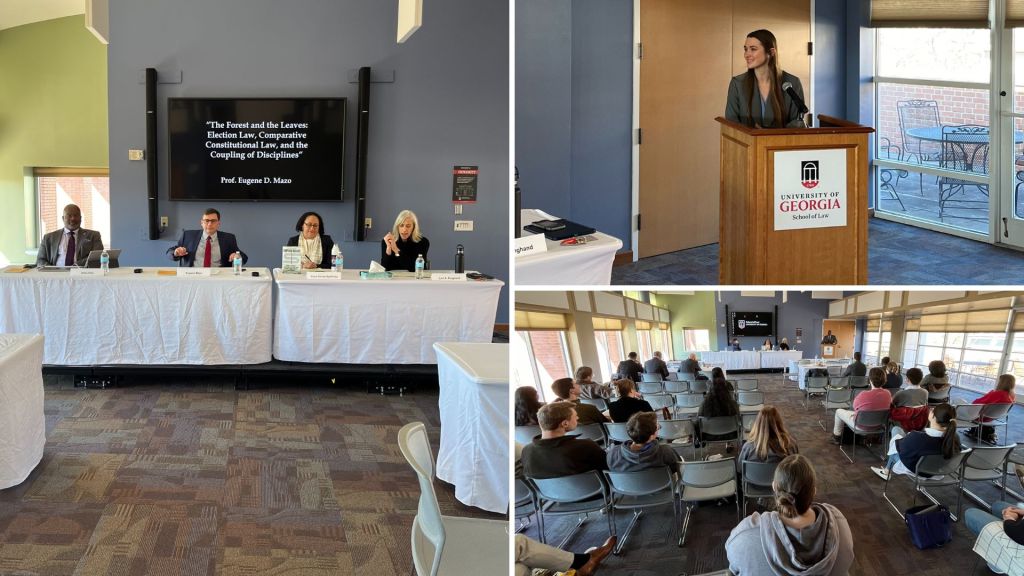
Georgia Law hosts annual Georgia Journal of International and Comparative Law conference, “Defending Democracy: A Comparative Perspective”

The annual conference of the University of Georgia School of Law’s Georgia Journal of International and Comparative Law, entitled “Defending Democracy: A Comparative Perspective,” took place last week.

As posted previously, this event brought together comparative law scholars from across the country to discuss a range of issues involving democracy, democratic backsliding, and comparative constitutional protections of democratic norms and institutions. Discussions included comparative lessons in “militant democracy,” the role of judges in defining or protecting democracy and democratic participation, democratic protections in the American constitutional system and how they differ from other nations, democracy and free speech, and lessons from recent elections around the world. University of Georgia School of Law Professor Lori A. Ringhand, J. Alton Hosch Professor of Law & Josiah Meigs Distinguished Teaching Professor, worked with GJICL students to conceptualize the conference theme and panels.

The panels from the conference are outlined below:

Panel 1: Democracy and Institutional Legitimacy: Panelists included Richard Albert, Hines H. Baker and Thelma Kelley Baker Chair in Law, University of Texas at Austin School of Law; Zachary Elkins, Professor, University of Texas at Austin; and moderator Taher S. Benany, Associate Director, Dean Rusk International Law Center, University of Georgia School of Law

Panel 2: Democratic Governance and Constitutional Design: Panelists included David E. Landau, Mason Ladd Professor and Associate Dean for International Programs, Florida State University College of Law; David S. Law, E. James Kelly, Jr., Class of 1965 Research Professor of Law, University of Virginia; Miguel Schor, Class of 1977 Distinguished Scholar and Professor of Law, Drake University Law School; and moderator Joseph S. Miller, Ernest P. Rogers Chair of Intellectual Property and Unfair Competition Law, University of Georgia School of Law

Panel 3: Individual Rights and Democratic Participation: Panelists included Ciara Torres-Spelliscy, Professor of Law, Stetson Law; Eugene D. Mazo, Associate Professor of Law, Duquesne University; Atiba Ellis, Laura B. Chisholm Distinguished Research Scholar and Professor of Law, Case Western Reserve School of Law; and moderator Lori A. Ringhand, J. Alton Hosch Professor of Law & Josiah Meigs Distinguished Teaching Professor, University of Georgia School of Law

Georgia Law Dean Usha R. Rodrigues, University Professor & M.E. Kilpatrick Chair of Corporate Finance and Securities Law, provided introductory remarks for the conference. Jasmine Furin, Editor in Chief, Georgia Journal of International and Comparative Law, gave a closing address. Professor Desirée LeClercq serves as the journal’s Faculty Adviser.

This event was cosponsored by the Dean Rusk International Law Center.

Georgetown Law professor Katrin Kuhlmann presents working paper at International Law Colloquium

The University of Georgia School of Law’s spring 2025 International Law Colloquium welcomed Professor Katrin Kuhlmann, who presented her working paper, “Micro International Law.” Greg Day, Associate Professor in the Terry College of Business at the University of Georgia, served as Kuhlmann’s faculty discussant.

Kuhlmann is the Faculty Director and Co-founder of the Center on Inclusive Trade and Development at Georgetown Law. Her scholarly focus lies in international law, development, inclusive and sustainable international trade law, regional trade agreements, agricultural law and food security, comparative economic law, African trade and development law and corridors, and the interdisciplinary connections between law and development.

Below is an abstract of Kuhlmann’s working paper:

International law has long been viewed as the domain of countries and capitals, not fields or factories, but this overly top-down perspective misses a critical and under-studied part of the picture. Underneath the macro level of standardized legal norms, international law is much more nuanced, with multiple sites of influence, production, design, adoption, and decision-making that scholars have largely neglected but which need to be better understood. Models stemming from legal systems in less powerful states, smaller-scale stakeholder interests, and local solutions are often treated as one-off anecdotes or isolated case studies without broader implications.

Capturing these lessons, cataloging them, and building a methodology around them could be transformational at a time when international law needs a refresh to make it more responsive to a new set of global challenges ranging from inequality to food insecurity to climate change.

This paper presents a conceptual and methodological framework for “micro international law” as a sub-field of international law. Adding a micro dimension to international law would bring it in line with other disciplines that recognize the importance of studying smaller-scale, more granular interventions. It would also make a significant contribution to the international legal field by integrating theoretical and empirical approaches to focus on the impact innovations within domestic legal systems and the interests of individuals have on international law (and the impact of international law on these systems and stakeholders), ultimately providing a framework for designing international law differently to equitably address more specialized needs and positively impact the lives of those international law aims to serve and benefit.

This year, Professor Desirée LeClercq is overseeing the colloquium, which is designed to introduce students to features of international economic law through engagement with scholars in the international legal field. To view the full list of International Law Colloquium speakers, visit our website.

This program is made possible through the Kirbo Trust Endowed Faculty Enhancement Fund and the Talmadge Law Faculty Fund.

Georgia Law Professor Desirée LeClercq featured in ACF Report by Johns Hopkins University

University of Georgia School of Law Professor Desirée LeClercq contributed to the annual report published by Johns Hopkins University’s Institute for America, China, and the Future of Global Affairs (ACF) entitled “Getting China Right at Home.” LeClercq authored the article “A Pragmatic Approach to U.S.-China Labor Tensions,” which centers on the importance of the International Labor Organization in improving worker’s rights in China.

Below is an excerpt from the article:

“Tensions with the People’s Republic of China (PRC) concerning its treatment of workers have featured prominently in U.S. trade and diplomatic policies. The new administration must draw lessons from the failure of policies employed to date to entice the PRC to align its labor policies with international legal standards, not least because residual noncompliance in China has impacted domestic interests in the United States. Instead, the International Labor Organization (ILO), as a neutral intermediary, could better engender incremental changes in the treatment of workers.”

LeClercq joined the University of Georgia School of Law in 2024 as an assistant professor. She teaches International Trade and Workers Rights, International Labor Law, International Law and U.S. Labor Law. She also serves as a faculty co-director of the Dean Rusk International Law Center and as the faculty adviser for the Georgia Journal of International and Comparative Law.
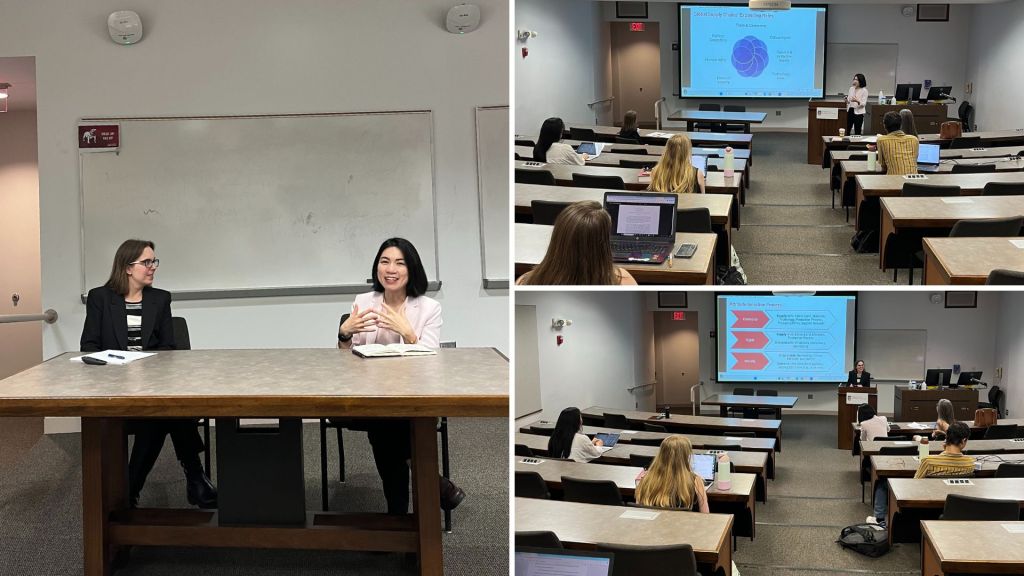
Georgia Law professor Christopher Bruner presents working paper at International Law Colloquium

The University of Georgia School of Law’s spring 2025 International Law Colloquium welcomed Professor Christopher Bruner, who presented his working paper, “Sustainable Corporate Governance and Prospects for a US Value Chain Due Diligence Law.” Joshua Barkan, Associate Professor in the Department of Geography at the University of Georgia, served as Bruner’s faculty discussant.

Bruner is the Stembler Family Distinguished Professor in Business Law at the University of Georgia School of Law and serves as a faculty co-director of the Dean Rusk International Law Center. Bruner’s scholarship centers around corporate law, corporate governance, comparative law and sustainability.

Below is an abstract of Bruner’s working paper:

Laws requiring multinational companies to undertake due diligence to detect, prevent, and mitigate human rights and environmental abuses in their value chains have proliferated across Europe, and the European Union has adopted a directive to harmonise such national laws. This chapter assesses the prospects for enactment of such a value chain due diligence law in the United States.

Although such laws are often conceptualised as an extension of corporate law, they can just as readily be conceptualised as an extension of trade law – and the latter approach offers real potential to sidestep anti-ESG and anti-sustainability sentiment among the US political right. Packaged as a trade initiative, the prospects for bipartisanship improve because the political left and right can each embrace the effort by reference to policy preferences resonating with their respective bases. To the progressive left, such laws raise labour and environmental standards globally, while to the conservative right, such laws protect domestic industry from unfair foreign competition.

The chapter first examines corporate politics in the United States, discussing how fundamental corporate governance debates revolve around thorny ideological issues that strongly polarise the political left and right, diminishing the prospects for a value chain due diligence law conceptualised as an extension of corporate law. It then examines trade politics in the United States, discussing how framing by reference to trade improves the prospects for a US value chain due diligence law by sidestepping such ideological issues and giving both the political left and right plausible ways to view such a law as a victory for their respective bases. The chapter concludes with discussion of trade-offs raised by these differing modes of legal strategy and institutionalisation, observing that the corporate law approach offers broader reach with weaker enforcement while the trade law approach offers narrower reach with stronger enforcement.

This year, Professor Desirée LeClercq is overseeing the colloquium, which is designed to introduce students to features of international economic law through engagement with scholars in the international legal field. To view the full list of International Law Colloquium speakers, visit our website.

This program is made possible through the Kirbo Trust Endowed Faculty Enhancement Fund and the Talmadge Law Faculty Fund.