LeClercq joined the University of Georgia School of Law in 2024 as an assistant professor. She teaches Contracts, International Trade and Workers Rights, International Labor Law, U.S. Labor Law, and Public International Law. She also serves as a faculty co-director of the Dean Rusk International Law Center and as the faculty adviser for the Georgia Journal of International and Comparative Law and the Labor and Employment Student Association.
In the post, LeClercq analyzes the International Court of Justice’s proceedings connected to the International Labour Organization’s request for an advisory opinion on whether the right to strike is protected under Convention No. 87. She focuses on how non-binding ILO principles interact with binding conventions, and what that distinction could mean for interpreting Convention No. 87 in international law and in related policy contexts.
LeClercq joined the University of Georgia School of Law in 2024 as an assistant professor. She teaches Contracts, International Trade and Workers Rights, International Labor Law, U.S. Labor Law, and Public International Law. She also serves as a faculty co-director of the Dean Rusk International Law Center and as the faculty adviser for the Georgia Journal of International and Comparative Law and the Labor and Employment Student Association.
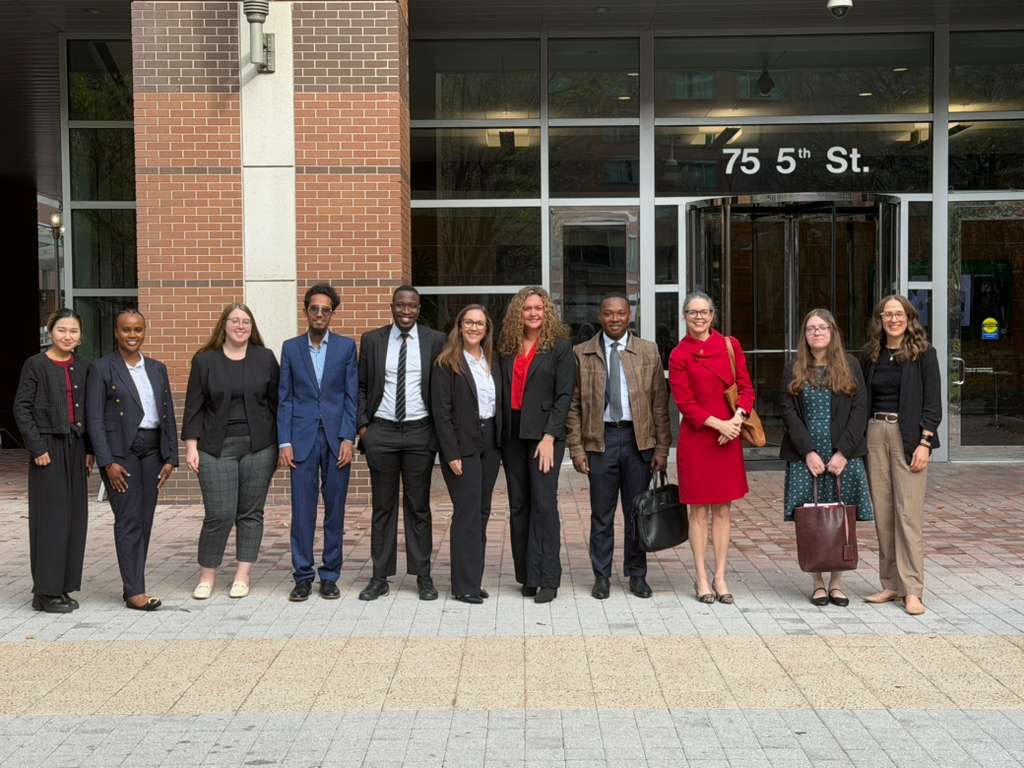
In November, University of Georgia School of Law Professor Desirée LeClercq traveled to Atlanta with a group of students as the culmination of their semester-long exploration of international trade.
15 students, including J.D., LL.M., and Graduate Certificate in International Law students, spent the semester examining potential trade and investment opportunities between the State of Georgia and the United Kingdom from an interdisciplinary perspective. They researched and wrote a paper examining key export and import sectors in Georgia and the United Kingdom, and then prepared a hypothetical Memorandum of Understanding (MoU) between the two. The students spent the day in Atlanta presenting to, and fielding technical questions from, three different audiences: representatives from the state of Georgia, transactional and international lawyers from Eversheds Sutherland, and foreign diplomats from the U.K. consulate.
Georgia Department of Economic Development
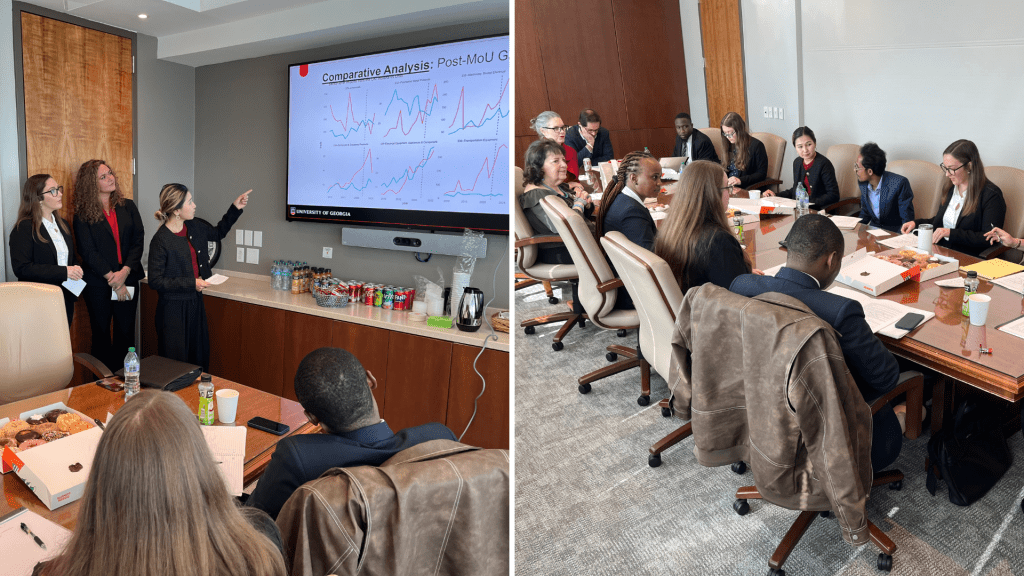
The group’s first stop of the day was hosted by the Georgia Department of Economic Development (GDEcD), the state’s sales and marketing arm, and had in attendance other state representatives.
At the GDEcD, Madina Bekisheva (GCIL student), Sutton Eady (J.D. ’27), Md. Asaduzzaman Jabin (GCIL student), and Jalyn Ross (J.D. ’27) worked together to present their portion of the hypothetical legal instrument. In their presentation, the group argued for greater collaboration and synergies between the state and the United Kingdom to attract, facilitate, and potentially grow trade. Their arguments centered on export and import data from similarly situated states and novel predictive models they had built demonstrating how enhanced collaborations with the United Kingdom could increase trade and job opportunities in Georgia. The students used the model to identify specific sectors in industry, renewable energy, commerce, and agriculture, among others, where Georgia’s economy and workers could benefit.
Eversheds Sutherland
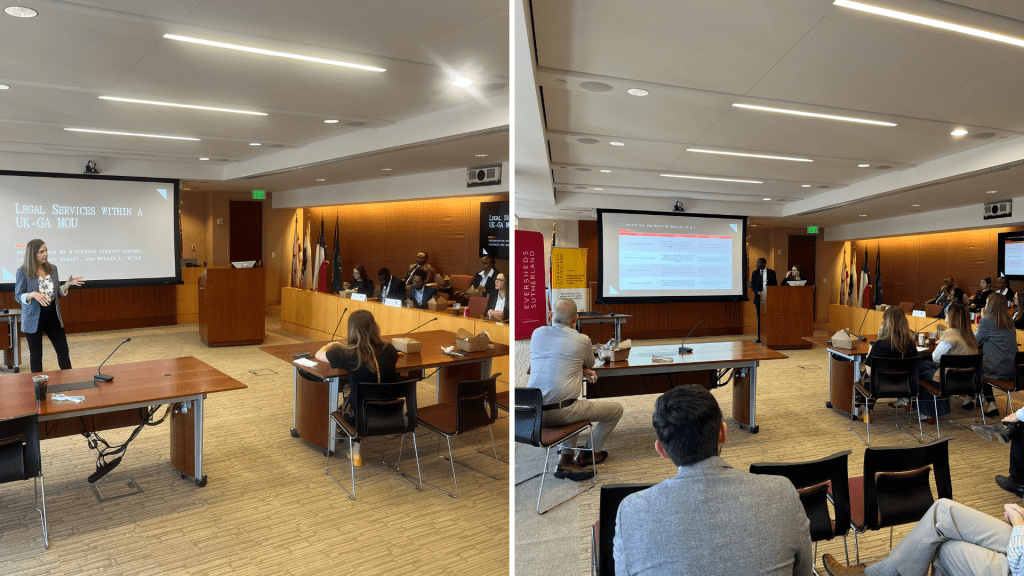
The group’s second stop of the day was the Atlanta office of Eversheds Sutherland, a global law firm specializing in corporate, energy, litigation, tax, and real estate. This firm has a meaningful relationship with the UK, as it is where the Eversheds law firm originated prior to their 1988 merger with Sutherland. The firm’s global headquarters is located in London, and its historic ties to the country are evident in their presence throughout the British legal market. Students Leighlee Mahony (J.D. ’26) and N’Guessan “Clement” Kouame (LL.M. ’24, J.D. ’26) presented. Both students argued that enhanced trade and investment collaboration between Georgia and the United Kingdom could offer reciprocity in sectors, including legal services.
The students were hosted by Jenny Lambert, Partner, and attended by several practicing attorneys in transactional and international work. The students benefitted both from the lunch that Eversheds Sutherland generously provided, as well as in-depth and vigorous questioning by the firm’s attorneys.
British Consulate General Atlanta
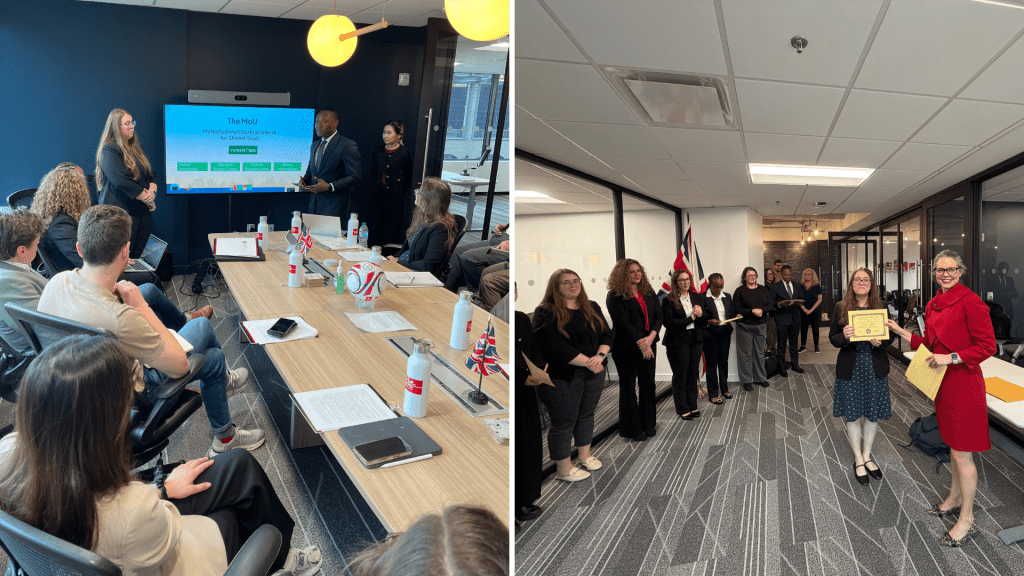
The group’s third and final stop of the day was the British Consulate General Atlanta. Students Maya Roper (J.D. ’27), Victor Azure (LL.M. ’26), Wambui Kamau (LL.M. ’26), and Madina Bekisheva (GCIL student) presented the group’s data and modeling to U.K. diplomats and officials. The group again walked the audience through specific trade and industry sectors, with a special focus on battery production for electric vehicles, the Georgia aerospace industry’s advantage, and veterinary medicine.
Student Reflections
“Coming from a non-law background in Computer Science, I learned that successful trade and partnerships do not thrive on innovation alone. They must be shaped by policy and political realities, economic conditions, population needs, national interests, and stakeholder relationships. The Atlanta trip made this clear by showing how quickly trade negotiations can shift based on context, not on the brilliance of the technology or business itself.” – Md. Asaduzzaman Jabin (GCIL student)
“This course was a great blend of theory and practice, requiring intensive and insightful legal research to understand and gather the materials, as well as concise, precise, and clear drafting of the MoU. The most significant site visit for me was the visit to the Georgia Department of Economic Development. It was a great experience to compare our findings with the department’s work and its vision for improvement. It was also interesting to know that people at the GDDE were doubtful about the use of models for the prediction of growth or value from MoUs. It shows how sometimes new technology may face skepticism for its implementation and convince people to advance or improve their old methods.” – N’Guessan “Clement” Kouame (LL.M. ’24, J.D. ’26)
UGA’s Office of Research, in partnership with the Office of the Provost, provides “pre-seed” funding to facilitate the formation of faculty teams and collaboration around critical areas of research expertise or emerging research topics. The goal is to stimulate large-scale research team formation and position UGA faculty groups to be more competitive in attracting resources for collaborative research, including internal UGA seed grants and ultimately, external grant support.
LeClercq joined the University of Georgia School of Law in 2024 as an assistant professor. She teaches Contracts, International Trade and Workers Rights, International Labor Law, International Law and U.S. Labor Law, and Public International Law. She also serves as a faculty co-director of the Dean Rusk International Law Center and as the faculty adviser for the Georgia Journal of International and Comparative Law.
University of Georgia School of Law Professor Desirée LeClercq was featured in Inside U.S. Trade regarding rapid-response mechanism petitions under the U.S.-Mexico-Canada Agreement. The article titled “RRM ‘black boxing’ spurs solidarity among tri-national labor reps” was written by Margaret Spiegelman and published 10/14/25.
LeClercq joined the University of Georgia School of Law in 2024 as an assistant professor. She teaches Contracts, International Trade and Workers Rights, International Labor Law, International Law and U.S. Labor Law, and Public International Law. She also serves as a faculty co-director of the Dean Rusk International Law Center and as the faculty adviser for the Georgia Journal of International and Comparative Law.
University of Georgia School of Law Professor Desirée LeClercq recently delivered a presentation for the Foreign, Commonwealth & Development Office’s Trade & Economic Diplomacy Faculty entitled “Growing Employment Through Trade: The Role of Fair Labour Standards.”
LeClercq discussed the evolution of international labor standards, noting how rules once designed to protect workers and improve living conditions are now used by countries such as the United States to enforce rights abroad and reshape global supply chains. Drawing on her experience as director of labour affairs at the Office of the U.S. Trade Representative and as a legal officer at the International Labour Organization, she illustrated this trend through examples from the United States-Mexico-Canada Agreement (USMCA).
LeClercq joined the University of Georgia School of Law in 2024 as an assistant professor. She teaches Contracts, International Trade and Workers Rights, International Labor Law, International Law and U.S. Labor Law, and Public International Law. She also serves as a faculty co-director of the Dean Rusk International Law Center and as the faculty adviser for the Georgia Journal of International and Comparative Law.
The daylong conference will take place on Friday, November 7 in the Larry Walker Room of Dean Rusk Hall at the University of Georgia School of Law. CLE credit is available for both in-person and virtual attendance. Registration information can be found on the conference webpage.
Sponsoring along with GJICL, a student-edited journal established more than 50 years ago, is the law school’s Dean Rusk International Law Center. GJICL Editor in Chief, Casey Smith (J.D. ’26) and Executive Conference Editor Kellianne Elliot (J.D. ’26) worked Georgia Criminal Law Review Editor in Chief Kerolls Gadelrab (J.D. ’26); Professor Jason A. Cade, J. Alton Hosch Professor of Law & Community Health Law Partnership Clinic Director; Center staff Sarah Quinn, Director; Catrina Martin, Global Practice Preparation Assistant; Taher S. Benany, Center Associate Director; and with the GJICL’s Faculty Advisor, Professor Desirée LeClercq, who is Assistant Professor of Law & Faculty Co-Director of the Dean Rusk International Law Center.
Below is the concept note of the conference:
Political and legal developments have precipitated a convergence of the fields of criminal law and immigration law. Now commonly referred to as crimmigration, this merger of previously distinct practice areas already has profoundly reshaped the legal and social terrain for migrants in the United States. While entry and removal decisions remain essentially administrative, enforcement practices and rhetoric increasingly embrace the punitive logic and carceral reach of the criminal legal system, but with fewer due process protections. As new legislation vastly expands detention authorization and other enforcement resources, it seems apparent that the rhetoric and mechanics of crimmigration will continue to dominate immigration policy in the United States for the foreseeable future.
This symposium, jointly sponsored by the Dean Rusk International Law Center, the Georgia Journal of International and Comparative Law, and the Georgia Criminal Law Review, invites scholars, immigration attorneys and judges to engage with these developments. We hope panelists will collectively address a number of important questions, such as the following: How does the new crimmigration landscape impact immigrants and communities in the Southeast and beyond? What new burdens does it put on the judiciary, and what role do federal courts have today in determining and upholding constitutional and statutory protections for migrants? Does the durability and continued expansion of crimmigration pose new challenges for immigration and criminal law attorneys; and, if so, how are the immigration and criminal law bars responding to those challenges? As crimmigration tactics expand, what new legal threats face U.S. citizens, including family members, employers, and immigrant advocates? Does the crimmigration paradigm contend with or obscure the structural forces that drive migration, particularly from the global south? Are there reasons to hope or expect the emergence of alternatives to crimmigration as the governing paradigm for the regulation of immigrants in the United States?
These conversations will occur through three panels and a lunchtime keynote speaker.
The day’s events are as follows:
9:30am | Opening Remarks
Usha Rodrigues, Dean, University Professor & M.E. Kilpatrick Chair of Corporate Finance and Securities Law
9:35am | Panel 1: Introduction to Crimmigration & the Current State of Affairs
Abel Rodríguez, Assistant Professor of Law, Wake Forest Law
Shalini Ray, Associate Professor of Law and Director of Faculty Research, Alabama Law
Gracie Willis, Attorney, National Immigration Project
Moderator: Christian Turner, Associate Professor of Law, University of Georgia School of Law
10:35am | Break
10:45am| Panel 2: The Impact of Crimmigration Policies on Communities and Advocates
Jessica Vosburgh, Senior Staff Attorney, Center for Constitutional Rights
Jenny R. Hernandez, Lead Senior Attorney at Immigration Defense Unit, City of Atlanta Office of the Public Defender
Carolina Antonini, Founding Partner, Antonini & Cohen Immigration Law
Moderator: Elizabeth Taxel, Clinical Associate Professor & Criminal Defense Practicum Director, University of Georgia School of Law
12:00pm | Keynote Introduction
Jason A. Cade, J. Alton Hosch Professor of Law & Community Health Law Partnership Clinic Director, University of Georgia School of Law
12:05 Keynote Address
Judge Ana C. Reyes, United States District Court, District of Columbia
1:00pm | Panel 3: Challenging the Legality of Migration Controls & Envisioning Reform
Daniel I. Morales, Associate Professor of Law; Dwight Olds Chair, The University of Houston Law Center
Rebecca A. Sharpless, Associate Dean for Experiential Learning, Professor of Law, Director, Immigration Clinic, University of Miami School of Law
Emily Torstveit Ngara, Director of Clinical Programs, Associate Clinical Professor and Director, Immigration Clinic, Center for Access to Justice, Immigration Law Clinic, Georgia State University College of Law
Moderator: Jason A. Cade J. Alton Hosch Professor of Law & Community Health Law Partnership Clinic Director, University of Georgia School of Law
2:00 | Closing Remarks
Casey Smith, Editor in Chief, Georgia Journal of International and Comparative Law
University of Georgia School of Law Professor Desirée LeClercq and former U.S. diplomat Christina Hardaway discussed their career trajectories and experiences working internationally in a recent law school panel discussion, “Working in Public International Law and Diplomacy.”
After introducing themselves and outlining their academic and professional paths, LeClercq and Hardaway took questions from the audience. They talked about the importance of soft skills in diplomatic work, how to develop your expertise in domestic affairs to make yourself more marketable overseas, the challenges of living abroad, and detailed both the rewards and complexities of committing to a career in public service.
Hardaway is a former diplomat (Foreign Service Officer) for the U.S. Department of State with a 14-year career spanning Latin America, Europe, and Africa. She most recently completed a diplomatic assignment at the U.S. Consulate General in Nuevo Laredo, Mexico, where she advanced U.S. economic, security, and commercial priorities on the U.S.-Mexico border. Prior to that, Hardaway served as Deputy Chief of the Political-Economic Section at the U.S. Embassy in Cameroon leading the mission’s economic and commercial portfolio. Her previous assignments include gender and entrepreneurship officer in the Bureau of African Affairs, energy and environment officer at the U.S. Embassy in The Hague, consular officer at the U.S. Consulate General in Monterrey, Mexico, and a detail at the U.S. African Development Foundation.
LeClercq joined the University of Georgia School of Law in 2024 as an assistant professor. She teaches Contracts, International Trade and Workers Rights, International Labor Law, International Law and U.S. Labor Law, and Public International Law. She also serves as a faculty co-director of the Dean Rusk International Law Center and as the faculty adviser for the Georgia Journal of International and Comparative Law. From 2016 to 2020, she served as a director of labor affairs in the Office of the U.S. Trade Representative (USTR). Before joining USTR, LeClercq worked for nearly a decade as a legal officer at the International Labor Organization in Geneva, Switzerland, and served as staff counsel for the chairman of the National Labor Relations Board.
This event was part of the Dean Rusk International Law Center’s ongoing Consular Series, which presents students, staff, and faculty with global perspectives on international trade, cooperation, development, and policy.
University of Georgia School of Law Professor Desirée LeClercq recently organized and funded (through a grant won at Cornell University) a transnational conference of U.S., Mexican, and Canadian labor unions and leaders at Flacso Mexico in Mexico City. Patricia Campos-Medina (WI-ILR Cornell University), Alex Covarrubias (El Colegio de Sonora), and Cirila Quintero (El Colegio de la Frontera Norte) served as conference co-organizers.
This one-day transnational labor conference solicited the views of labor unions, non-governmental organizations (NGOs), organizers, and workers on the United States-Mexico-Canada Agreement (USMCA)’s Rapid Response Mechanism (RRM) in light of current geopolitical dynamics. Participants identified current challenges in filing petitions under the RRM, aligned strategic approaches to the 2026 re-negotiation of the USMCA, and discussed ways to work together notwithstanding current tensions in politics and trade. The conference was structured to first discuss the RRM on a technical level before broadening to account for political tensions and joint transnational strategies. It concluded with ways participants could remain organized and collaborate in the future.
LeClercq joined the University of Georgia School of Law in 2024 as an assistant professor. She teaches International Trade and Workers Rights, International Labor Law, International Law and U.S. Labor Law. She also serves as a faculty co-director of the Dean Rusk International Law Center and as the faculty adviser for the Georgia Journal of International and Comparative Law.
University of Georgia School of Law Professor Desirée LeClercq recently delivered a presentation on the future of multilateralism, trade, and worker rights to World Trade Organization officials and researchers in Geneva, Switzerland.
LeClercq received financial support to attend this workshop from the Dean Rusk International Law Center as a Rusk Scholar-in-Residence, an initiative promoting international opportunities for Georgia Law faculty that advance the mission of the Center.
LeClercq joined the University of Georgia School of Law in 2024 as an assistant professor. She teaches International Trade and Workers Rights, International Labor Law, International Law and U.S. Labor Law. She also serves as a faculty co-director of the Dean Rusk International Law Center and as the faculty adviser for the Georgia Journal of International and Comparative Law.


 exchange of notes