Three Georgia Law journals collaborate to host “Technology, Accountability, and Criminality in Transnational and International Conflict” (TACTIC) conference in September

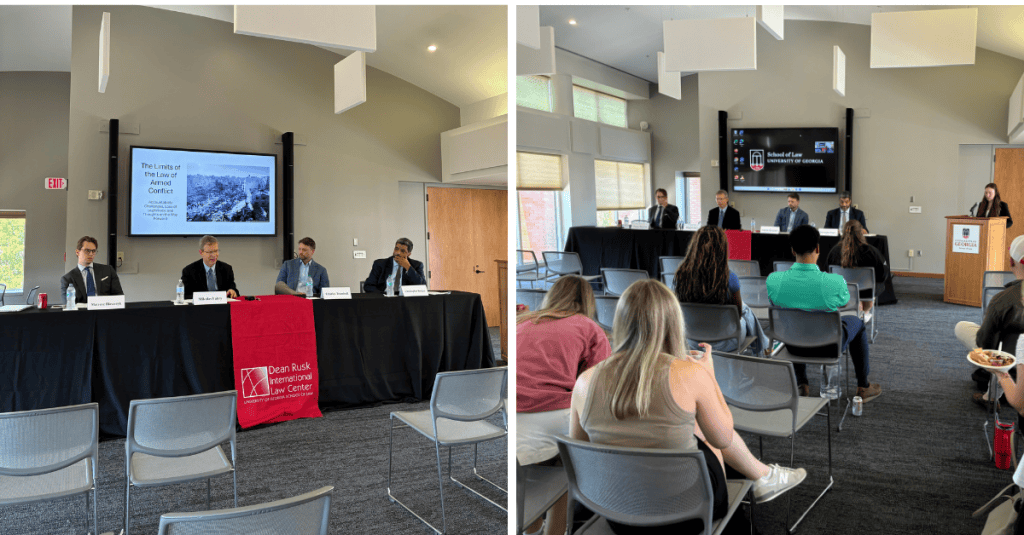
This year’s annual conference of the Georgia Journal of International and Comparative Law presented “Technology, Accountability, and Criminality in Transnational and International Conflict (TACTIC)”, in collaboration with the Georgia Criminal Law Review, the Georgia Journal of Law & Technology, and the Dean Rusk International Law Center.

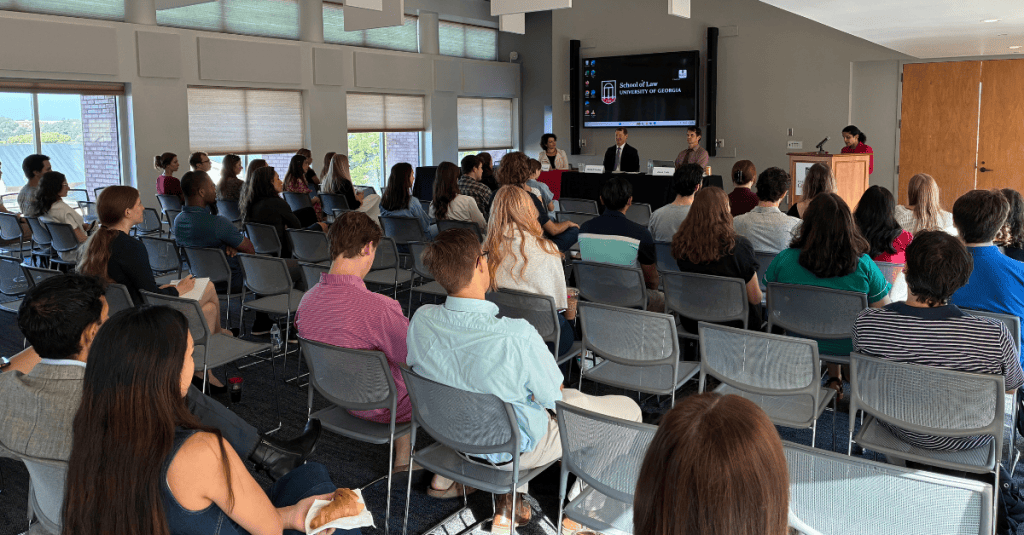
The day-long conference invited speakers representing a diverse range of doctrinal, institutional, and jurisdictional perspectives to the Georgia Law campus on Friday, September 18 to discuss how modern conflict is reshaping the relationships among state power, technological systems, and legal accountability. Across international law, technology law, and criminal law, the panels considered how contemporary conflicts expose pressure points in the rules-based international order, the governance of digital platforms and algorithmic systems, and the mechanisms available when states or individual actors violate legal norms.

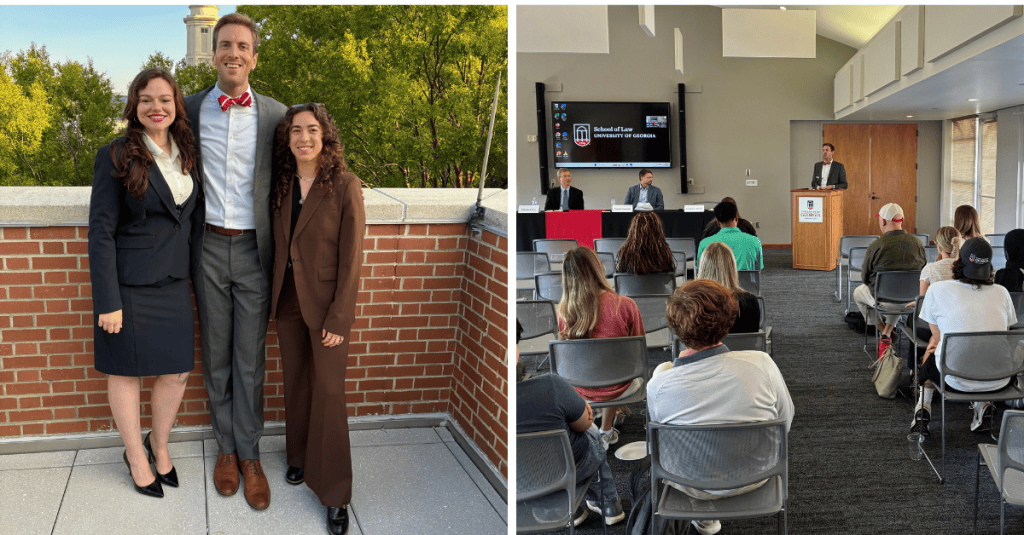
GJICL Editor-in-Chief, William Stowers (J.D. ’27) and Executive Conference Editor Samantha Northenor (J.D. ’27) worked with Georgia Criminal Law Review Editor in Chief Eli Werbel (J.D. ’27) and Georgia Journal of Law & Technology Editor in Chief Cat Wood (J.D. ’27); Professor Joseph S. Miller, Ernest P. Rogers Chair of Intellectual Property and Unfair Competition Law; Center staff Sarah Quinn, Director; Taher S. Benany, Center Associate Director; and Lindsay Weinmann, Center Administrative Specialist; and with the GJICL’s Faculty Advisor, Professor Desirée LeClercq, who is Associate Professor of Law & Faculty Co-Director of the Dean Rusk International Law Center.

After opening remarks from Usha Rodrigues, Dean, University Professor & M.E. Kilpatrick Chair of Corporate Finance and Securities Law, the panels proceeded as follows:

Panel 1: War Crimes: Accountability for Violations of International Law
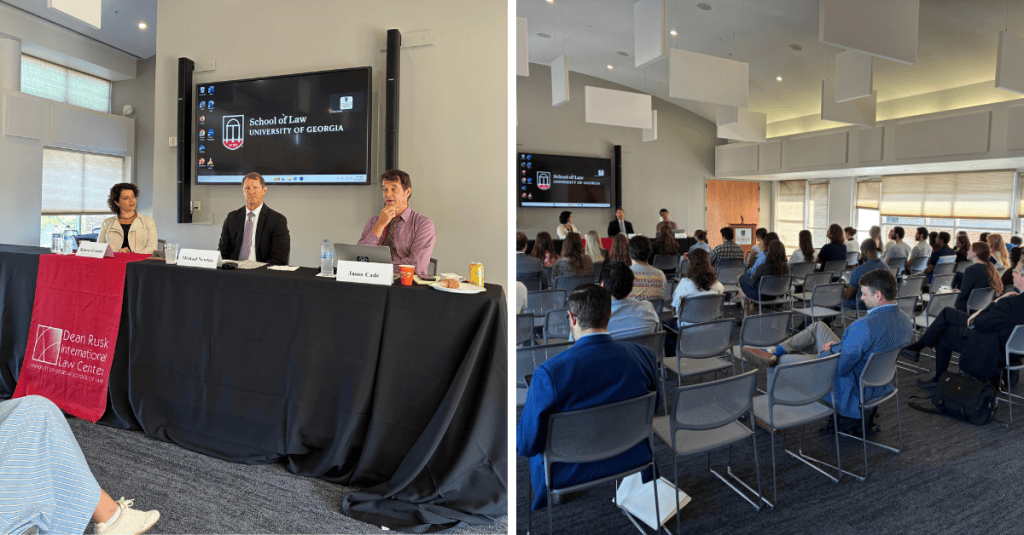
  • Michael Newton, Professor of the Practice of Law & Director, International Legal Studies Program, Vanderbilt University Law School
  • Rebecca Crootof, Nancy Litchfield Hicks Professor of Law, University of Richmond School of Law
  • Moderator: Jason A. Cade, J. Alton Hosch Professor of Law & Community Health Law Partnership Clinic Director, University of Georgia School of Law

This panel examined what accountability means when states, armed groups, or individuals violate the laws governing armed conflict. Rather than addressing accountability in the abstract, the panel focused on the legal and practical mechanisms available when actors disregard established rules on war crimes, civilian protection, cyber operations, or other atrocity-related conduct. The discussion considered ways criminal law can respond to actors who exploit gaps in current legal international frameworks. It also assessed whether existing mechanisms are sufficient to hold nations accountable, and, if not, what reforms are needed to strengthen international accountability.

Panel 2: Sovereignty in the Cloud: Data Jurisdiction, Commercialized Reconnaissance, and Critical Infrastructure
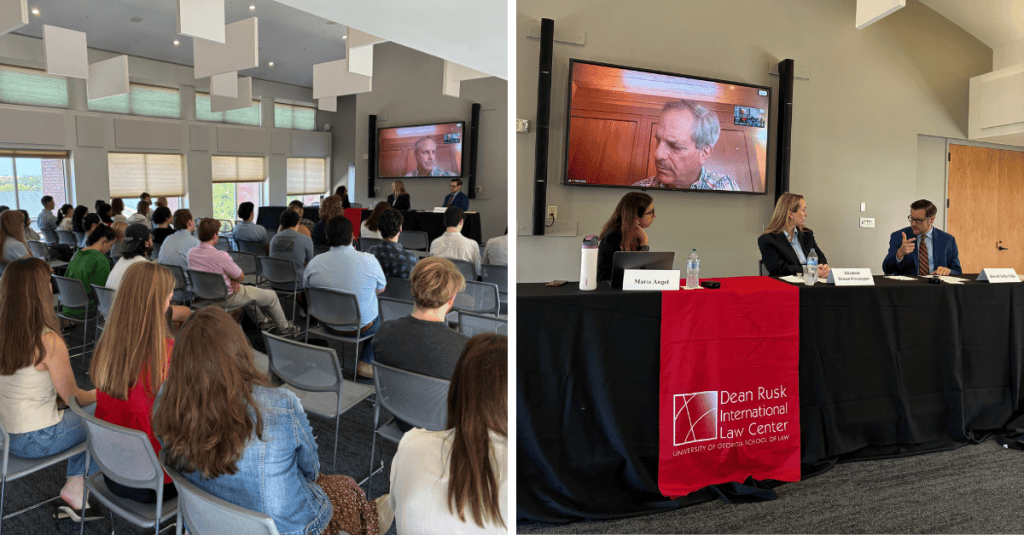
  • Peter Swire, J.Z. Liang Chair, Professor, School of Cybersecurity and Privacy, College of Computing, Georgia Institute of Technology
  • David Sella-Villa, Assistant Professor of Law, University of South Carolina Joseph F. Rice School of Law
  • Bess Hinson-Greenspan, Partner, Holland & Knight LLP
  • Moderator: María P. Angel, Assistant Professor of Law, University of Georgia School of Law

This panel examined the legal, jurisdictional, and national security crises that emerge when data capable of compromising critical infrastructure or exposing civilian populations is hosted on private cloud servers or sold on the open market. This panel explored how hostile foreign actors can exploit regulatory blind spots to buy or freely harvest operational data, facility layouts, and network vulnerabilities, alongside the consumer metadata and location histories of citizens. Finally, panelists addressed the limits of state sovereignty, individual digital privacy, and corporate liability when private data brokers and transnational cloud hosts inadvertently fuel the cyber reconnaissance phase of modern hybrid warfare.

Panel 3: The Rules-Based Order Under Fire: Sovereignty, Force, and Adaptability from Ukraine, Gaza, and Taiwan
  • Charles Trumbull, Assistant Professor of Law, University of South Carolina Joseph F. Rice School of Law
  • Christopher J. Borgen, Professor of Law and Co-Director, Center for International and Comparative Law, St. John’s University School of Law
  • Mikulas Fabry, Associate Professor and Director of Undergraduate Studies, Georgia Institute of Technology
  • Moderator: Mateusz “Matt” Blaszczyk, Assistant Professor of Law, University of Georgia School of Law

This panel examined how contemporary conflicts test the core commitments and flexibility of the international legal order, including sovereignty, territorial integrity, the prohibition on force, civilian protection, humanitarian access, and current international frameworks. Using conflicts such as Russia-Ukraine, Israel-Palestine/Gaza, and Taiwan/South China Sea as reference points, the panel asked whether international law is failing, adapting, or being selectively invoked in ways that reveal both its continuing force and its institutional fragility. The panel also considered the limits of the existing international order, assessing its capacity to respond effectively to evolving geopolitical challenges and exploring the implications for future development and enforcement of international law.

***

The conference concluded with remarks from William Stowers (J.D. ’27), Editor-in-Chief of the Georgia Journal of International and Comparative Law.
“Technology, Accountability, and Criminality in Transnational and International Conflict” September 18 Georgia Journal of International and Comparative Law annual conference

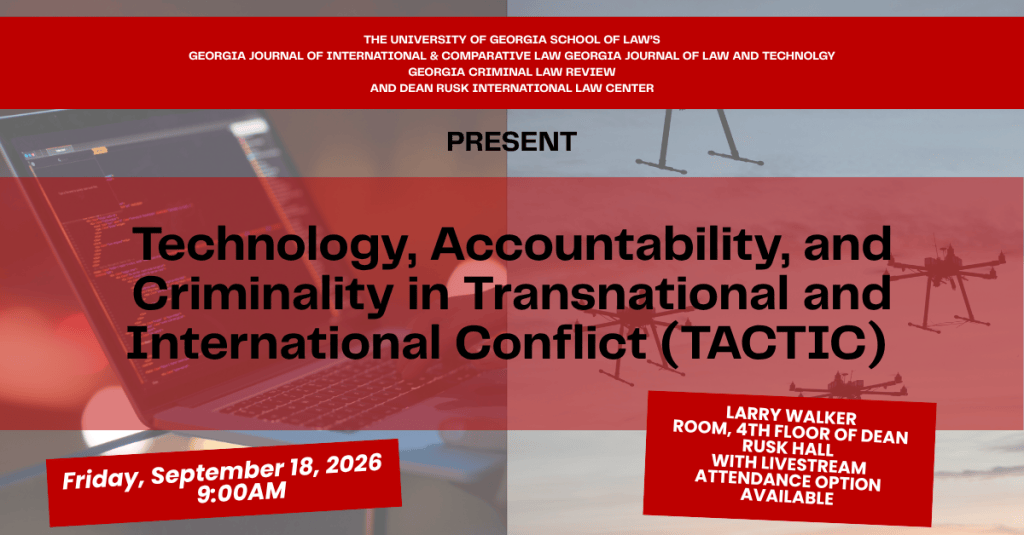
This year’s annual conference of the Georgia Journal of International and Comparative Law will present “Technology, Accountability, and Criminality in Transnational and International Conflict (TACTIC)”. The conference will be offered jointly by the GJICL, the Georgia Criminal Law Review, and the Georgia Journal of Law & Technology.

The daylong conference will take place on Friday, September 18 in the Larry Walker Room of Dean Rusk Hall at the University of Georgia School of Law. CLE credit is available for both in-person and virtual attendance. Registration information can be found here.

Sponsoring along with GJICL, a student-edited journal established more than 50 years ago, is the law school’s Dean Rusk International Law Center. GJICL Editor in Chief, William Stowers (J.D. ’27) and Executive Conference Editor Samantha Northenor (J.D. ’27) worked with Georgia Criminal Law Review Editor in Chief Eli Werbel (J.D. 27) and Georgia Journal of Law & Technology Editor in Chief Cat Wood (J.D. ’27); Professor Joseph S. Miller, Ernest P. Rogers Chair of Intellectual Property and Unfair Competition Law; Center staff Sarah Quinn, Director; Taher S. Benany, Center Associate Director; and Lindsay Weinmann, Center Administrative Specialist; and with the GJICL’s Faculty Advisor, Professor Desirée LeClercq, who is Associate Professor of Law & Faculty Co-Director of the Dean Rusk International Law Center.

Below is the concept note of the conference:

TACTIC will examine how modern conflict is reshaping the relationships among state power, technological systems, and legal accountability. Analyzing international law, technology law, and criminal law, the symposium will consider how contemporary conflicts expose pressure points in the rules-based international order, the governance of digital platforms and algorithmic systems, and the mechanisms available when states or individual actors violate legal norms. These questions and ideas will be explored throughout three panels: War Crimes: Accountability for Violations of International Law; Sovereignty in the Cloud: Data Jurisdiction, Commercialized Reconnaissance, and Critical Infrastructure; and The Rules-Based Order Under Fire: Sovereignty, Force, and Adaptability from Ukraine, Gaza, and Taiwan

The day’s events are as follows:

9:05am | Opening Remarks

Usha Rodrigues, Dean, University Professor & M.E. Kilpatrick Chair of Corporate Finance and Securities Law

9:10am | Panel 1: War Crimes: Accountability for Violations of International Law

  • Michael Newton, Professor of the Practice of Law & Director, International Legal Studies Program, Vanderbilt University Law School
  • Rebecca Crootof, Nancy Litchfield Hicks Professor of Law, University of Richmond School of Law
  • Moderator: Jason A. Cade, J. Alton Hosch Professor of Law & Community Health Law Partnership Clinic Director, University of Georgia School of Law

10:20am | Break

10:30am| Panel 2: Sovereignty in the Cloud: Data Jurisdiction, Commercialized Reconnaissance, and Critical Infrastructure

  • Peter Swire, J.Z. Liang Chair, Professor, School of Cybersecurity and Privacy, College of Computing, Georgia Institute of Technology
  • David Sella-Villa, Assistant Professor of Law, University of South Carolina Joseph F. Rice School of Law
  • Bess Hinson-Greenspan, Partner, Holland & Knight LLP
  • Moderator: María P. Angel, Assistant Professor of Law, University of Georgia School of Law

11:40am | Lunch

1:20pm | Panel 3: The Rules-Based Order Under Fire: Sovereignty, Force, and Adaptability from Ukraine, Gaza, and Taiwan

  • Charles Trumbull, Assistant Professor of Law, University of South Carolina Joseph F. Rice School of Law
  • Christopher J. Borgen, Professor of Law and Co-Director, Center for International and Comparative Law, St. John’s University School of Law
  • Mikulas Fabry, Associate Professor and Director of Undergraduate Studies, Georgia Institute of Technology
  • Moderator: Mateusz “Matt” Blaszczyk, Assistant Professor of Law, University of Georgia School of Law

2:30pm | Closing Remarks

William Stowers, Editor in Chief, Georgia Journal of International and Comparative Law

“Crimmigration as Paradigmatic Migration Control in the United States: Exploring the Impact on Communities, Courts, and Attorneys” November 7 Georgia Journal of International and Comparative Law and Georgia Criminal Law Review annual conference

This year’s annual conference of the Georgia Journal of International and Comparative Law will present “Crimmigration as Paradigmatic Migration Control in the United States: Exploring the Impact on Communities, Courts, and Attorneys“. The conference will be offered jointly by the GJICL and the Georgia Criminal Law Review.

The daylong conference will take place on Friday, November 7 in the Larry Walker Room of Dean Rusk Hall at the University of Georgia School of Law. CLE credit is available for both in-person and virtual attendance. Registration information can be found on the conference webpage.

Sponsoring along with GJICL, a student-edited journal established more than 50 years ago, is the law school’s Dean Rusk International Law Center. GJICL Editor in Chief, Casey Smith (J.D. ’26) and Executive Conference Editor Kellianne Elliot (J.D. ’26) worked Georgia Criminal Law Review Editor in Chief Kerolls Gadelrab (J.D. ’26); Professor Jason A. Cade, J. Alton Hosch Professor of Law & Community Health Law Partnership Clinic Director; Center staff Sarah Quinn, Director; Catrina Martin, Global Practice Preparation Assistant; Taher S. Benany, Center Associate Director; and with the GJICL’s Faculty Advisor, Professor Desirée LeClercq, who is Assistant Professor of Law & Faculty Co-Director of the Dean Rusk International Law Center.

Below is the concept note of the conference:

Political and legal developments have precipitated a convergence of the fields of criminal law and immigration law. Now commonly referred to as crimmigration, this merger of previously distinct practice areas already has profoundly reshaped the legal and social terrain for migrants in the United States. While entry and removal decisions remain essentially administrative, enforcement practices and rhetoric increasingly embrace the punitive logic and carceral reach of the criminal legal system, but with fewer due process protections. As new legislation vastly expands detention authorization and other enforcement resources, it seems apparent that the rhetoric and mechanics of crimmigration will continue to dominate immigration policy in the United States for the foreseeable future. 

This symposium, jointly sponsored by the Dean Rusk International Law Center, the Georgia Journal of International and Comparative Law, and the Georgia Criminal Law Review, invites scholars, immigration attorneys and judges to engage with these developments. We hope panelists will collectively address a number of important questions, such as the following: How does the new crimmigration landscape impact immigrants and communities in the Southeast and beyond? What new burdens does it put on the judiciary, and what role do federal courts have today in determining and upholding constitutional and statutory protections for migrants? Does the durability and continued expansion of crimmigration pose new challenges for immigration and criminal law attorneys; and, if so, how are the immigration and criminal law bars responding to those challenges? As crimmigration tactics expand, what new legal threats face U.S. citizens, including family members, employers, and immigrant advocates? Does the crimmigration paradigm contend with or obscure the structural forces that drive migration, particularly from the global south? Are there reasons to hope or expect the emergence of alternatives to crimmigration as the governing paradigm for the regulation of immigrants in the United States? 

These conversations will occur through three panels and a lunchtime keynote speaker. 

The day’s events are as follows:

9:30am | Opening Remarks

Usha Rodrigues, Dean, University Professor & M.E. Kilpatrick Chair of Corporate Finance and Securities Law

9:35am | Panel 1: Introduction to Crimmigration & the Current State of Affairs

  • Abel Rodríguez, Assistant Professor of Law, Wake Forest Law
  • Shalini Ray, Associate Professor of Law and Director of Faculty Research, Alabama Law
  • Gracie Willis, Attorney, National Immigration Project
  • Moderator: Christian Turner, Associate Professor of Law, University of Georgia School of Law

10:35am | Break

10:45am| Panel 2: The Impact of Crimmigration Policies on Communities and Advocates 

  • Jessica Vosburgh, Senior Staff Attorney, Center for Constitutional Rights
  • Jenny R. Hernandez, Lead Senior Attorney at Immigration Defense Unit, City of Atlanta Office of the Public Defender
  • Carolina Antonini, Founding Partner, Antonini & Cohen Immigration Law
  • Moderator: Elizabeth Taxel, Clinical Associate Professor & Criminal Defense Practicum Director, University of Georgia School of Law

12:00pm | Keynote Introduction

Jason A. Cade, J. Alton Hosch Professor of Law & Community Health Law Partnership Clinic Director, University of Georgia School of Law

12:05     Keynote Address

Judge Ana C. Reyes, United States District Court, District of Columbia

1:00pm | Panel 3: Challenging the Legality of Migration Controls & Envisioning Reform

  • Daniel I. Morales, Associate Professor of Law; Dwight Olds Chair, The University of Houston Law Center
  • Rebecca A. Sharpless, Associate Dean for Experiential Learning, Professor of Law, Director, Immigration Clinic, University of Miami School of Law
  • Emily Torstveit Ngara, Director of Clinical Programs, Associate Clinical Professor and Director, Immigration Clinic, Center for Access to Justice, Immigration Law Clinic, Georgia State University College of Law
  • Moderator: Jason A. Cade J. Alton Hosch Professor of Law & Community Health Law Partnership Clinic Director, University of Georgia School of Law

2:00 | Closing Remarks

Casey Smith, Editor in Chief, Georgia Journal of International and Comparative Law