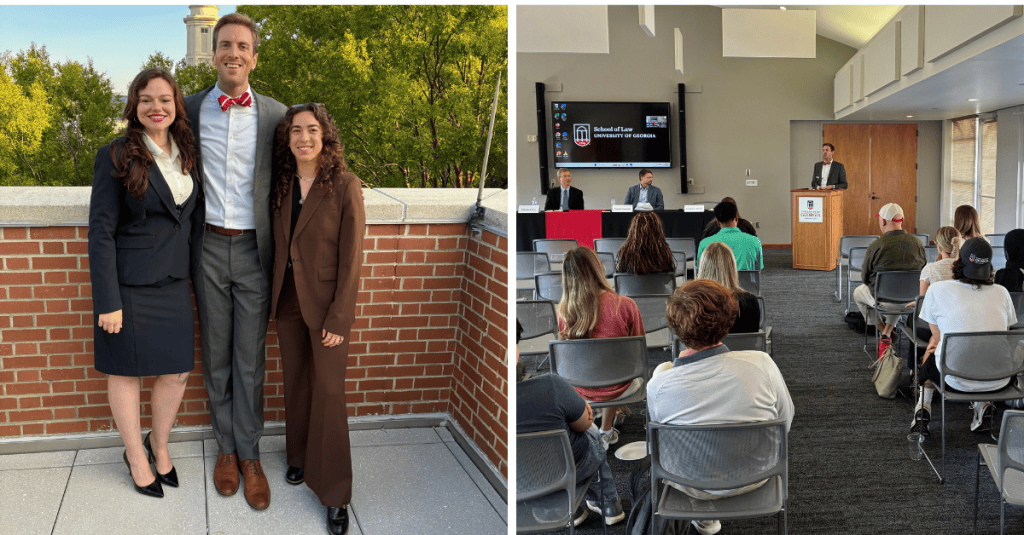
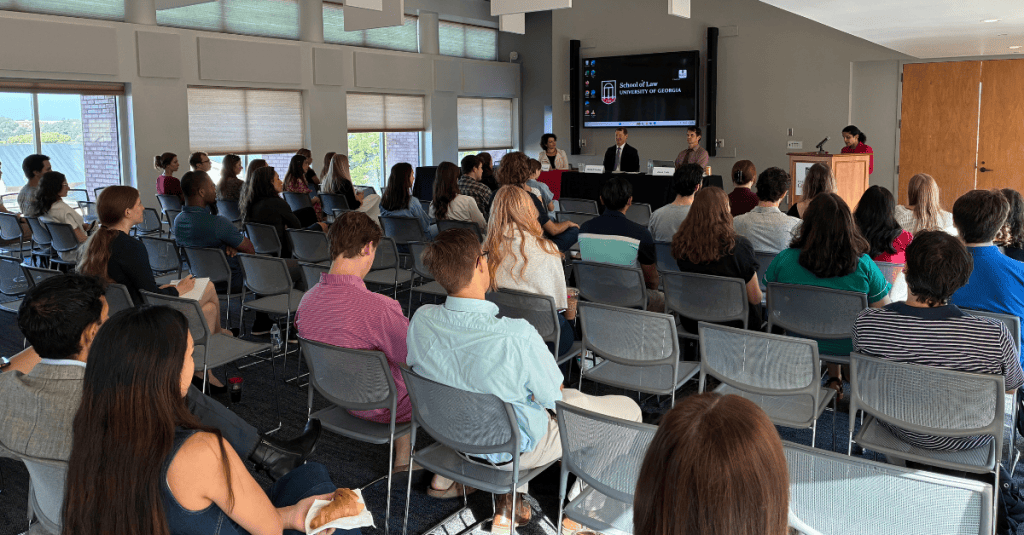
This year’s annual conference of the Georgia Journal of International and Comparative Law presented “Technology, Accountability, and Criminality in Transnational and International Conflict (TACTIC)”, in collaboration with the Georgia Criminal Law Review, the Georgia Journal of Law & Technology, and the Dean Rusk International Law Center.
The day-long conference invited speakers representing a diverse range of doctrinal, institutional, and jurisdictional perspectives to the Georgia Law campus on Friday, September 18 to discuss how modern conflict is reshaping the relationships among state power, technological systems, and legal accountability. Across international law, technology law, and criminal law, the panels considered how contemporary conflicts expose pressure points in the rules-based international order, the governance of digital platforms and algorithmic systems, and the mechanisms available when states or individual actors violate legal norms.
GJICL Editor-in-Chief, William Stowers (J.D. ’27) and Executive Conference Editor Samantha Northenor (J.D. ’27) worked with Georgia Criminal Law Review Editor in Chief Eli Werbel (J.D. ’27) and Georgia Journal of Law & Technology Editor in Chief Cat Wood (J.D. ’27); Professor Joseph S. Miller, Ernest P. Rogers Chair of Intellectual Property and Unfair Competition Law; Center staff Sarah Quinn, Director; Taher S. Benany, Center Associate Director; and Lindsay Weinmann, Center Administrative Specialist; and with the GJICL’s Faculty Advisor, Professor Desirée LeClercq, who is Associate Professor of Law & Faculty Co-Director of the Dean Rusk International Law Center.
After opening remarks from Usha Rodrigues, Dean, University Professor & M.E. Kilpatrick Chair of Corporate Finance and Securities Law, the panels proceeded as follows:
Panel 1: War Crimes: Accountability for Violations of International Law
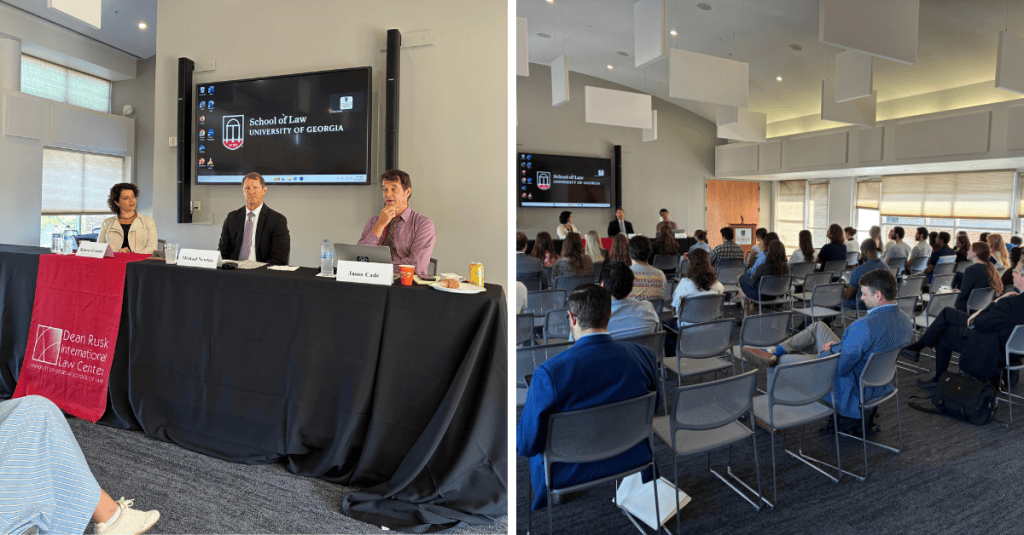
- Michael Newton, Professor of the Practice of Law & Director, International Legal Studies Program, Vanderbilt University Law School
- Rebecca Crootof, Nancy Litchfield Hicks Professor of Law, University of Richmond School of Law
- Moderator: Jason A. Cade, J. Alton Hosch Professor of Law & Community Health Law Partnership Clinic Director, University of Georgia School of Law
This panel examined what accountability means when states, armed groups, or individuals violate the laws governing armed conflict. Rather than addressing accountability in the abstract, the panel focused on the legal and practical mechanisms available when actors disregard established rules on war crimes, civilian protection, cyber operations, or other atrocity-related conduct. The discussion considered ways criminal law can respond to actors who exploit gaps in current legal international frameworks. It also assessed whether existing mechanisms are sufficient to hold nations accountable, and, if not, what reforms are needed to strengthen international accountability.
Panel 2: Sovereignty in the Cloud: Data Jurisdiction, Commercialized Reconnaissance, and Critical Infrastructure
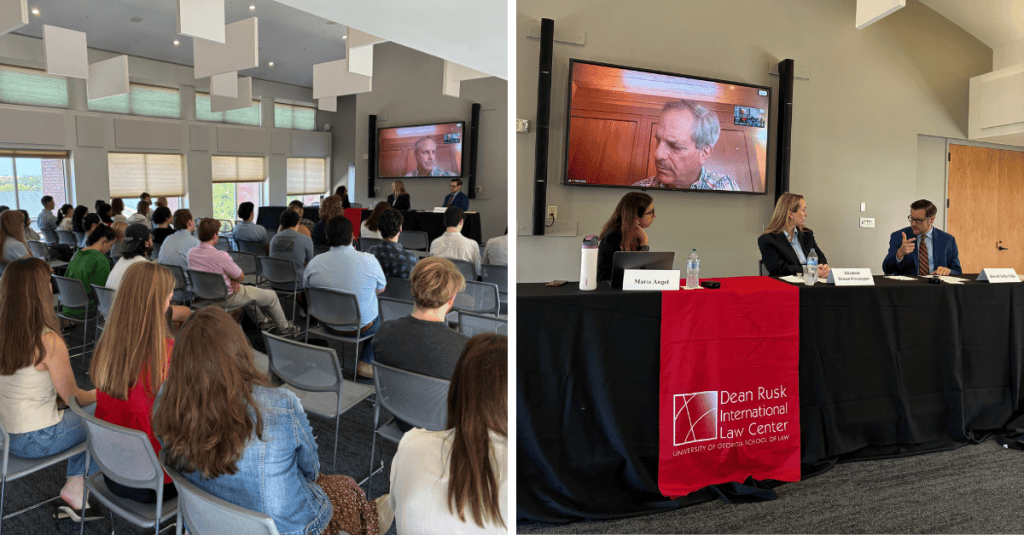
- Peter Swire, J.Z. Liang Chair, Professor, School of Cybersecurity and Privacy, College of Computing, Georgia Institute of Technology
- David Sella-Villa, Assistant Professor of Law, University of South Carolina Joseph F. Rice School of Law
- Bess Hinson-Greenspan, Partner, Holland & Knight LLP
- Moderator: María P. Angel, Assistant Professor of Law, University of Georgia School of Law
This panel examined the legal, jurisdictional, and national security crises that emerge when data capable of compromising critical infrastructure or exposing civilian populations is hosted on private cloud servers or sold on the open market. This panel explored how hostile foreign actors can exploit regulatory blind spots to buy or freely harvest operational data, facility layouts, and network vulnerabilities, alongside the consumer metadata and location histories of citizens. Finally, panelists addressed the limits of state sovereignty, individual digital privacy, and corporate liability when private data brokers and transnational cloud hosts inadvertently fuel the cyber reconnaissance phase of modern hybrid warfare.
Panel 3: The Rules-Based Order Under Fire: Sovereignty, Force, and Adaptability from Ukraine, Gaza, and Taiwan
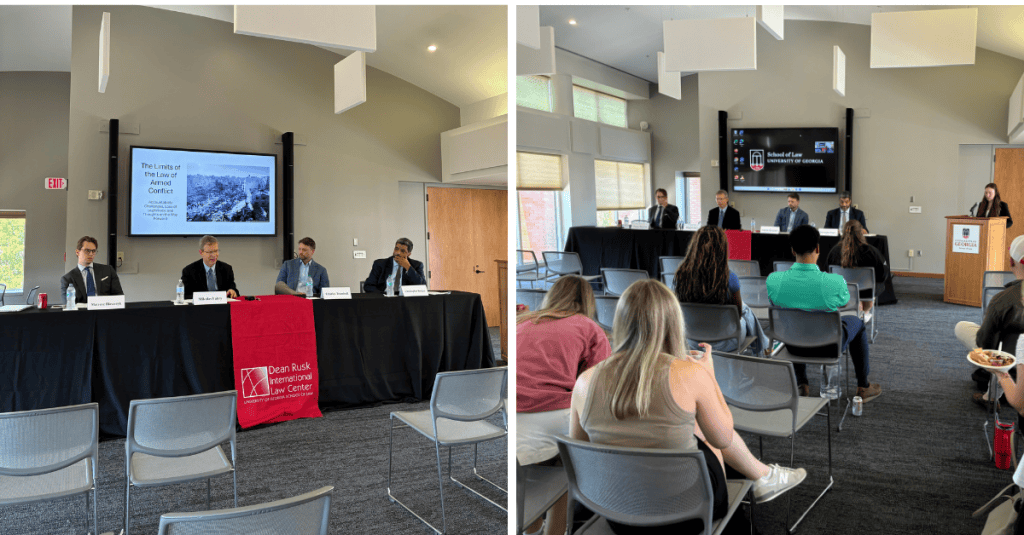
- Charles Trumbull, Assistant Professor of Law, University of South Carolina Joseph F. Rice School of Law
- Christopher J. Borgen, Professor of Law and Co-Director, Center for International and Comparative Law, St. John’s University School of Law
- Mikulas Fabry, Associate Professor and Director of Undergraduate Studies, Georgia Institute of Technology
- Moderator: Mateusz “Matt” Blaszczyk, Assistant Professor of Law, University of Georgia School of Law
This panel examined how contemporary conflicts test the core commitments and flexibility of the international legal order, including sovereignty, territorial integrity, the prohibition on force, civilian protection, humanitarian access, and current international frameworks. Using conflicts such as Russia-Ukraine, Israel-Palestine/Gaza, and Taiwan/South China Sea as reference points, the panel asked whether international law is failing, adapting, or being selectively invoked in ways that reveal both its continuing force and its institutional fragility. The panel also considered the limits of the existing international order, assessing its capacity to respond effectively to evolving geopolitical challenges and exploring the implications for future development and enforcement of international law.
***
The conference concluded with remarks from William Stowers (J.D. ’27), Editor-in-Chief of the Georgia Journal of International and Comparative Law.