Georgia Law Professor Diane Marie Amann presents “Child-Taking Justice and Forced Residential Schooling of Indigenous Americans” at Washington University School of Law

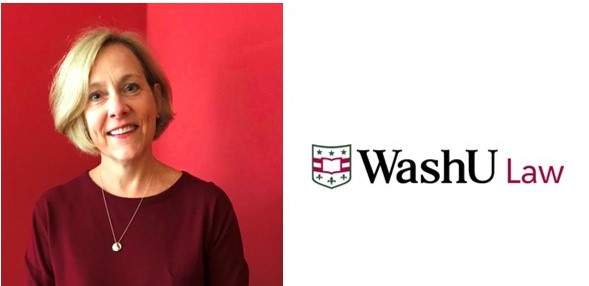
University of Georgia School of Law Professor Diane Marie Amann recently spoke on “Child-Taking Justice and Forced Residential Schooling of Indigenous Americans” at Washington University School of Law in St. Louis.

Her presentation was part of a spring semester WashU Law International Law Colloquium organized by Professor MJ Durkee, who is the William Gardiner Hammond Professor of Law and Director of the Whitney R. Harris World Law Institute. Durkee joined that faculty in 2023, after serving as an Allen Post Professor, Associate Dean for International Programs, and Director of the Dean Rusk International Law Center here at Georgia Law.

The discussant for Amann’s paper was Lecturer Steve Alagna, who is an enrolled citizen of the Iowa Tribe of Kansas and Nebraska, and whose WashU Law Appellate Clinic just filed an amicus brief in federal appellate litigation which seeks redress, under the United States’  Native American Graves Protection and Repatriation Act, for survivors of Indigenous children who died and were buried at a former residential school site.

Amann is Regents’ Professor of International Law, Emily & Ernest Woodruff Chair in International Law, and a Faculty Co-Director of our Dean Rusk International Law Center here at Georgia Law. The paper she presented at WashU builds upon research that she published as “Child-Taking,” 45 Michigan Journal of International Law 305 (2024).

Georgia Law Professor Diane Marie Amann presents working paper at International Law Colloquium

The University of Georgia School of Law’s spring 2025 International Law Colloquium welcomed Professor Diane Marie Amann, who presented her working paper, “Child-Taking Justice and Forced Residential Schooling of Indigenous Americans.”

Amann is Regents’ Professor of International Law, Emily & Ernest Woodruff Chair in International Law, and a Faculty Co-Director of our Dean Rusk International Law Center here at Georgia Law. Amann served as International Criminal Court Prosecutor Fatou Bensouda’s Special Adviser on Children in & affected by Armed Conflict and is a member of the Bring Kids Back UA Task Force.

Her presentation drew upon her recently-published article, “Child-Taking,” 45 Michigan Journal of International Law 305 (2024). Esra Mirze Santesso, Professor in the Department of English at the University of Georgia, as Amann’s faculty discussant. 

This year, Professor Desirée LeClercq is overseeing the colloquium, which is designed to introduce students to features of international economic law through engagement with scholars in the international legal field. To view the full list of International Law Colloquium speakers, visit our website.

This program is made possible through the Kirbo Trust Endowed Faculty Enhancement Fund and the Talmadge Law Faculty Fund

Eva Keïta speaks with Georgia Law students about experience at the International Court of Justice

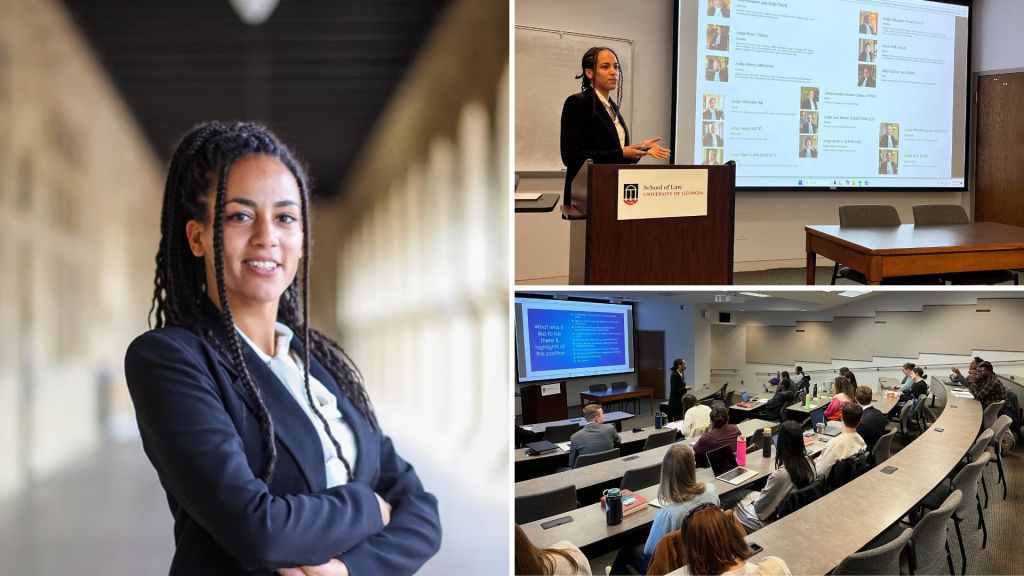
The University of Georgia School of Law welcomed international lawyer Eva Keïta to campus this week to discuss her experience at the International Court of Justice (ICJ) with students in Professor Diane Marie Amann‘s Public International Law course.

Keïta provided students with an overview of the ICJ, where she was an Associate Legal officer and a Judicial Fellow assisting a judge on various public international law matters. She spoke about the makeup of the ICJ, the role of members on each of the Judges’ teams, and how students can make themselves more competitive for open positions. Keïta then took questions from students, detailing her own professional journey as an international dispute settlement lawyer and providing advice for those interested in pursuing international legal careers.

Before her time at the ICJ, Keïta honed her expertise in international arbitration and litigation and handled complex international disputes at two international law firms in Paris. Keïta also has significant experience handling pro bono and international human rights matters. She provided legal representation to an inmate serving a life sentence under California’s Three Strikes Law in post-conviction proceedings, assisted human trafficking victims in compensation proceedings in front of French courts, and volunteered for four months in Togo, providing legal assistance to inmates through a local NGO.

Prior to her legal career, Keïta pursued a bachelor’s and master’s degree in political science, specializing in international relations, from the Sorbonne. In addition, Keïta holds a LL.M. in international economic law, business & policy from Stanford Law School and her first law degree from Sciences Po in Paris.

Georgia Law’s International Law Colloquium hosts Harlan Cohen, Fordham Law, as first speaker

The University of Georgia School of Law’s spring 2025 International Law Colloquium began last week with Professor Harlan Cohen of Fordham University School of Law. For more than a decade, the International Law Colloquium Series has brought leading scholars to Georgia Law, where they have presented works in progress and invited discussion and comments from students as well as faculty discussants.

This year, Professor Desirée LeClercq is overseeing the colloquium, which is designed to introduce students to features of international economic law through engagement with scholars in the international legal field. The course broadly defines “international economic law,” to include traditional approaches (trade and investment agreements) as well as non-traditional, emerging approaches (examining the effects of international economic law on marginalized communities and considering re-distributional policies).

Cohen presented his working paper titled, “The International Order, International Law, and the Definition of Security.” Cohen, who previously served as the Gabriel M. Wilner/UGA Foundation Professor in International Law at the University of Georgia School of Law and Faculty co-Director of the Dean Rusk International Law Center, specializes in international trade, international law, international legal theory, global governance, and U.S. foreign relations law.

Dean Usha Rodrigues opened the colloquium (recording of opening remarks available here). Professor Diane Marie Amann served as Cohen’s faculty discussant. 

Below is an abstract of Cohen’s working paper:

As economic security has seemingly moved to the center of American and European foreign policy, both the United States and the European Union have broadened their interpretation of international law rules governing security, coercion, and intervention.  These broadened interpretations have supported a bevy of new sanctions, trade restrictions, investment controls, and industrial policies that have turned the global economy into an increasingly weaponized space.  But these interpretations are not exactly new, echoing developing state interpretations of international law that developed states had long ago seemingly rejected.  How are these once moribund interpretations of security, force, and coercion being brought back to life?

This essay argues that these interpretative shifts highlight the role of the international order as an interpretative mechanism within international law.  Borrowing from the work of Robert Cover, it explains the ways that the international order acts as a jurispathic agent within the system, judging which interpretations live on and which are cast aside.  As global power shifts, the international order shifts with it, potentially reopening interpretative fights over international law.  Today’s fights over the meaning of security, force, and coercion thus reflect both the realities of a changing order and the battle to shape the one to come.

To view the full list of International Law Colloquium speakers, visit our website.

This program is made possible through the Kirbo Trust Endowed Faculty Enhancement Fund and the Talmadge Law Faculty Fund.

Georgia Law Professor Diane Marie Amann publishes in Temple symposium on Sands’ Chagos book

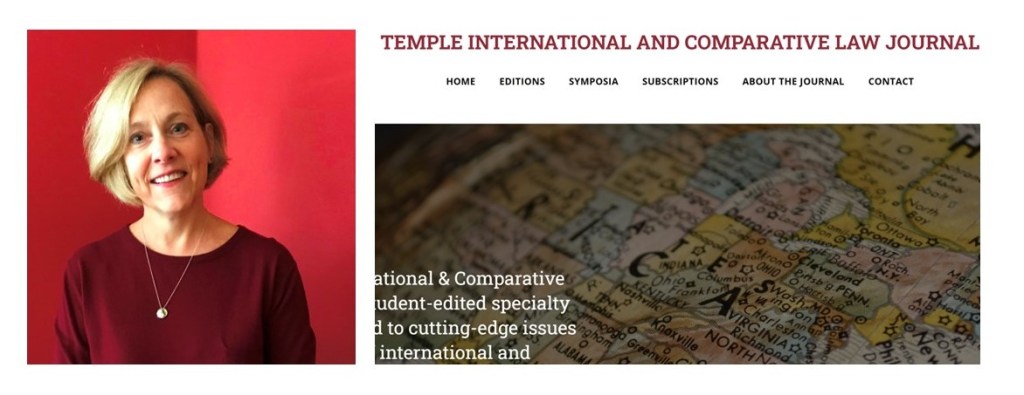
“What Figures Lurk on Madame Elysé’s Path? Reflections on Philippe Sands’ The Last Colony,” an article by University of Georgia School of Law Professor Diane Marie Amann, has just been published at 38 Temple International & Comparative Law Journal 91 (2024).

Amann is Regents’ Professor of International Law, Emily & Ernest Woodruff Chair in International Law, and a Faculty Co-Director of our Dean Rusk International Law Center here at Georgia Law.

The “What Figures”  article is her contribution to the journal’s symposium issue based on a book about the Chagos Islands and the International Court of Justice advisory opinion, written by University College London Law Professor Philippe Sands, who was a barrister in those proceedings.

The issue also includes a foreword by Sands and a co-authored dialogue between Diane F. Orentlicher and Morton H. Halperin, as well as articles by Dan Bodansky, Christopher J. Borgen, Jorge Contesse, Peter G. Danchin, Jeffrey Dunoff, Margaret M. deGuzman, Mark A. Drumbl, Jean Galbraith, Rachel López, Jonathan H. Marks, Elizabeth Nwarueze, Obiora Chinedu Okafor, Ayodeji Kamau Perrin, and Sebastian von Massow.

Here’s the abstract for Amann’s article, which is available here:

“One person’s life forms the core around which Philippe Sands’ The Last Colony explores the events leading up to the advisory opinion on the Legal Consequences of Chagos Archipelago from Mauritius in 1965. That person is Liseby Bertrand Elysé, who was born in 1953 in Chagos, then forcibly removed to Mauritius in 1973. Her efforts to return home eventually brought her to a 2018 hearing at The Hague, where she spoke to the International Court of Justice bench by means of a subtitled video. This essay, which appears in a symposium issue on Sands’ book, investigates the ethics, the effectiveness, and the emancipatory potential of the author’s telling of the story of the Chagossian woman he most often calls ‘Madame Elysé.’”

Georgia Law Professor Diane Marie Amann presents on child-taking and Nuremberg-era witnesses in workshops at University of Oxford

University of Georgia School of Law Professor Diane Marie Amann closed out her Fall 2024 research visit at the University of Oxford, where she was a Research Visitor at the Oxford Faculty of Law Bonavero Institute of Human Rights and Visiting Fellow at Exeter College Oxford, by giving two presentations at Oxford. She:

Lectured on “Women Bearing Witness in the Nuremberg Trials Project” in the Oxford Faculty of Law Public International Law Discussion Group. Tsvetelina van Benthem, Research Officer at the Blavatnik School of Government, moderated. Amann’s talk, which was delivered at All Souls College and live online, concluded the Group’s Michaelmas Term series.

Presented her work in progress, “Child-Taking Justice and Forced Residential Schooling of Indigenous Peoples,” as part of the Bonavero Perspectives workshop series at the Oxford Faculty of Law Bonavero Institute of Human Rights. Moderating was another Bonavero Research Visitor, Professor Eva Marie Belser of the University of Fribourg in Switzerland.

Amann is Regents’ Professor of International Law, Emily & Ernest Woodruff Chair in International Law, and a Faculty Co-Director of our Dean Rusk International Law Center here at Georgia Law, where she teaches Public International Law, Constitutional Law, and various upper-division courses exploring interrelations between national and international legal frameworks.

Georgia Law Professor Diane Marie Amann publishes in European Journal of International Law

A Nuremberg Woman and the Hague Academy,” an essay by University of Georgia School of Law Professor Diane Marie Amann, has just been published at European Journal of International Law 813 (2024).

Amann is Regents’ Professor of International Law, Emily & Ernest Woodruff Chair in International Law, and a Faculty Co-Director of our Dean Rusk International Law Center here at Georgia Law.

Her article, which draws upon her ongoing research into lawyers and other women professionals played at post-World War II trials, forms part of the journal’s special review series marking the centenary of the Hague Academy of International Law.

Available here, the article focuses on the life of one “Nuremberg woman,” Dr. Aline Chalufour, who attended the Academy in 1937 and again in 1957. Her experiences both shed light on how marginalized groups fared in the Academy’s first 100 years, and also call upon the Academy, and the field it promotes, to do better in the next 100 years.

Georgia Law Professor Diane Marie Amann presents on child-taking and Nuremberg-era witnesses at Trinity College Dublin and Queen’s University Belfast law schools

University of Georgia School of Law Professor Diane Marie Amann gave a series of public lectures in mid-November at Irish law schools.

While a Visiting Research Scholar at Trinity College Dublin School of Law, she:

The moderator for both events was Trinity Law Professor Michael A. Becker, who sponsored Professor Amann’s visit.

Professor Amann also presented “Child-Taking Justice and Forced Residential Schooling of Indigenous Peoples” at the Centre for Human Rights, Queen’s University Belfast School of Law.

Amann is Regents’ Professor of International Law, Emily & Ernest Woodruff Chair in International Law, and a Faculty Co-Director of our Dean Rusk International Law Center here at Georgia Law. She has pursued a research-intensive semester this autumn, primarily as a Research Visitor at the Oxford Faculty of Law Bonavero Institute of Human Rights and Visiting Fellow at Exeter College Oxford.

Georgia Law Professor Diane Marie Amann presents “Child-Taking” at UK’s University of Reading School of Law

University of Georgia School of Law Professor Diane Marie Amann recently gave a public lecture entitled “Child-Taking: Unlawful Transfer plus Identity Alteration, in Ukraine and Beyond,” at the University of Reading School of Law in Reading, United Kingdom, as part of that law school’s Global Law at Reading (GLAR) lecture series.

Her presentation drew upon her just-published article, “Child-Taking,” 45 Michigan Journal of International Law 305 (2024).

Amann is Regents’ Professor of International Law, Emily & Ernest Woodruff Chair in International Law, and a Faculty Co-Director of our Dean Rusk International Law Center here at Georgia Law. This fall, she is spending a research-intensive semester in the United Kingdom, where she is a Research Visitor at the Oxford Faculty of Law Bonavero Institute of Human Rights and Visiting Fellow at Exeter College Oxford.

Georgia Law Professor Diane Marie Amann takes part in Warwick Law seminar on feminist histories of international law

University of Georgia School of Law Professor Diane Marie Amann participated last week in “How to Write Feminist Histories of International Law,” the first in a seven-session online seminar series entitled “Thinking Gender, History & International Law” hosted by the University of Warwick School of Law in Coventry, England.

Also joining in the conversation were: Professor Maria Drakopoulou, University of Kent Law School; Professor Gina Heathcote, Newcastle University Law School; Professor Aoife O’Donoghue, Queen’s University Belfast School of Law; and the seminar’s organizers, Dr. Paola Zichi and Dr. Aisel Omarova, both at Warwick Law.

Topics discussed included: what it means to apply feminist approaches to the history of international law; whether and how feminist viewpoints may enhance the writing of history; and what are the relations among feminist values, historical research, and theory or philosophy. (Register for future seminar sessions here.)

Amann, who has several publications broaching such issues, is Regents’ Professor of International Law, Emily & Ernest Woodruff Chair in International Law, and a Faculty Co-Director of our Dean Rusk International Law Center here at Georgia Law. This fall, she is spending a research-intensive semester in the United Kingdom, where she is a Research Visitor at the Oxford Faculty of Law Bonavero Institute of Human Rights and Visiting Fellow at Exeter College Oxford.