Georgia Law Professor Desirée LeClercq and former U.S. diplomat Christina Hardaway discuss careers in public international law and diplomacy

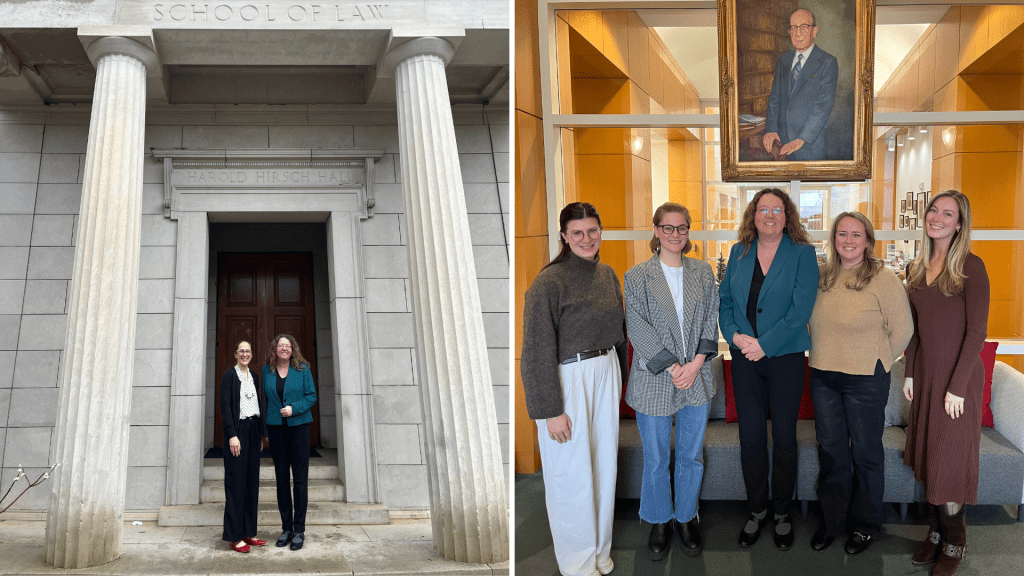
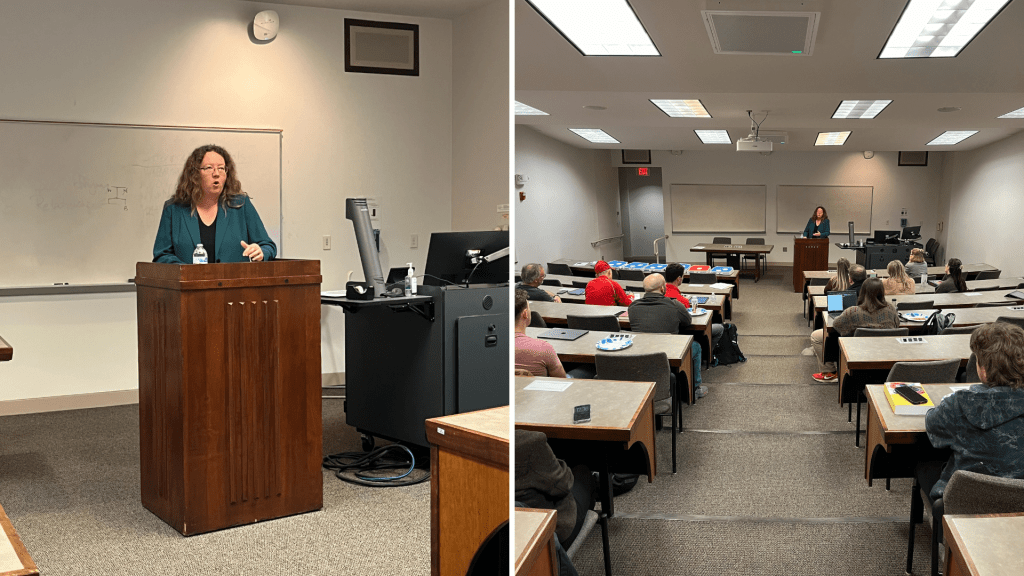
University of Georgia School of Law Professor Desirée LeClercq and former U.S. diplomat Christina Hardaway discussed their career trajectories and experiences working internationally in a recent law school panel discussion, “Working in Public International Law and Diplomacy.”

After introducing themselves and outlining their academic and professional paths, LeClercq and Hardaway took questions from the audience. They talked about the importance of soft skills in diplomatic work, how to develop your expertise in domestic affairs to make yourself more marketable overseas, the challenges of living abroad, and detailed both the rewards and complexities of committing to a career in public service.

Hardaway is a former diplomat (Foreign Service Officer) for the U.S. Department of State with a 14-year career spanning Latin America, Europe, and Africa.  She most recently completed a diplomatic assignment at the U.S. Consulate General in Nuevo Laredo, Mexico, where she advanced U.S. economic, security, and commercial priorities on the U.S.-Mexico border. Prior to that, Hardaway served as Deputy Chief of the Political-Economic Section at the U.S. Embassy in Cameroon leading the mission’s economic and commercial portfolio. Her previous assignments include gender and entrepreneurship officer in the Bureau of African Affairs, energy and environment officer at the U.S. Embassy in The Hague, consular officer at the U.S. Consulate General in Monterrey, Mexico, and a detail at the U.S. African Development Foundation.

LeClercq joined the University of Georgia School of Law in 2024 as an assistant professor. She teaches Contracts, International Trade and Workers Rights, International Labor Law, International Law and U.S. Labor Law, and Public International Law. She also serves as a faculty co-director of the Dean Rusk International Law Center and as the faculty adviser for the Georgia Journal of International and Comparative Law. From 2016 to 2020, she served as a director of labor affairs in the Office of the U.S. Trade Representative (USTR). Before joining USTR, LeClercq worked for nearly a decade as a legal officer at the International Labor Organization in Geneva, Switzerland, and served as staff counsel for the chairman of the National Labor Relations Board.

This event was part of the Dean Rusk International Law Center’s ongoing Consular Series, which presents students, staff, and faculty with global perspectives on international trade, cooperation, development, and policy.

Haidy Ahmed, Diplomat with the Egyptian Ministry of Foreign Affairs, speaks at Georgia Law

Haidy Ahmed, Diplomat with the Permanent Mission of the Arab Republic of Egypt to the African Union in Addis Ababa, Ethiopia, delivered a talk in February at the University of Georgia School of Law entitled: “Careers in International Law and Diplomacy.”

Ahmed discussed her role as part of Egypt’s legal team before the International Court of Justice in the advisory opinions related to climate change, law of the sea, and other international issues. She answered questions from students about her educational and professional background and provided insight regarding the pursuit of careers in public international law and diplomacy.

In her current position, Ahmed has been in charge of thematic issues such as women, peace, and security at the Peace & Security Council of the African Union. She is an alternate member of the Committee to facilitate implementation and promote compliance under the Paris Agreement (PAICC). She served as Egypt’s representative at the fifth resumed session of the Intergovernmental Conference on an international legally binding instrument under the United Nations Convention on the Law of the Sea on the conservation and sustainable use of marine biological diversity of areas beyond national jurisdiction (the BBNJ). Before joining Egypt’s foreign service, Ahmed worked as a Trainee at Simmons & Simmons in Paris and a Junior Associate at Shalakany in Cairo, Egypt. She received her LL.B. from Cairo University in Egypt and her Master of Laws from Paris I Panthéon Sorbonne University, Paris, France.

This event was part of the Dean Rusk International Law Center’s ongoing Consular Series, which presents students, staff, and faculty with global perspectives on international trade, cooperation, development, and policy.

Rachel Galloway, British consul general in Atlanta, speaks at Georgia Law

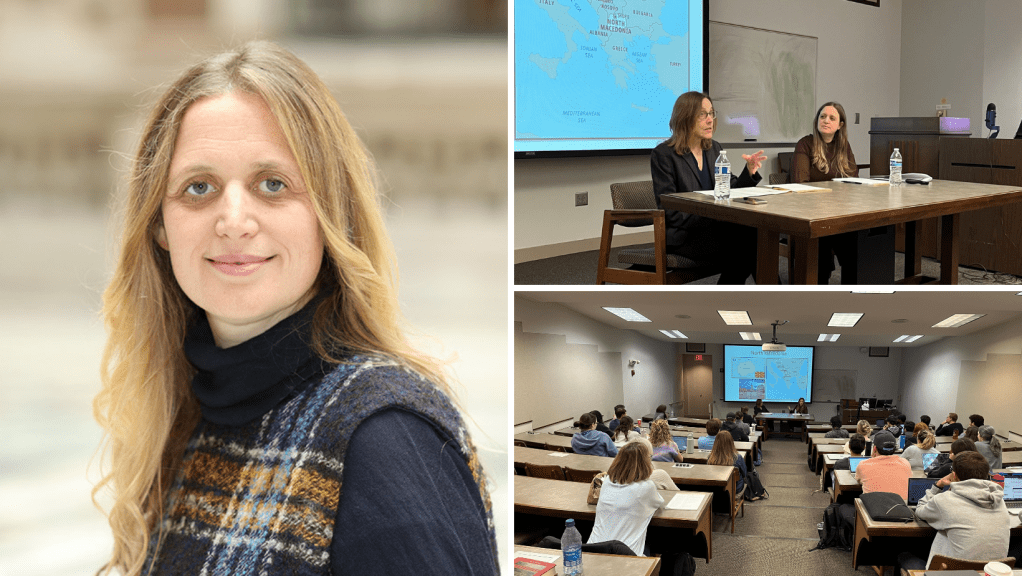
In March, the British consul general in Atlanta, Rachel Galloway, delivered a lecture at the University of Georgia School of Law, “From Alexander the Great to NATO, reflections on four years as the UK’s Ambassador to North Macedonia.”

Galloway spoke with students about her diplomatic career, including her post as the United Kingdom’s Ambassador to North Macedonia. She was joined in conversation by Diane Marie Amann, Regents’ Professor of International Law, Emily & Ernest Woodruff Chair in International Law, Faculty Co-Director of the Dean Rusk International Law Center. Galloway’s talk was the most recent installment of the Dean Rusk International Law Center’s ongoing Consular Series, which presents students, staff, and faculty with global perspectives on international trade, cooperation, development, and policy.

Galloway assumed her current post as the British consul general in Atlanta in 2022, replacing former consul general Andrew Staunton. Staunton gave a presentation at Georgia Law in 2019 as part of the Center’s ongoing Consular Series. Galloway has more than 20 years of diplomatic experience; she started her career with the Foreign, Commonwealth and Development Office in 2000 and spent three years chairing the Maghreb working group at the European External Action Service. She has also held roles as the U.K. Permanent Representation to Brussels (2012-15), deputy head of the FCO’s International Organisations Department (2008-11) and head of the Darfur section of the Sudan unit in the FCO’s international development department (2007-08). Galloway spent a brief stint on a provincial reconstruction team in Helmand, Afghanistan, in 2006, that same year serving on the counter-terrorism review team in Her Majesty’s Treasury. Her only prior posting in the U.S. prior to her current role was a four-year assignment in Washington as second secretary in the political section at the British Embassy from 2002-06.

Reflections on Global Atlanta Event, “Georgia and Japan: 50 Years of Commerce and Culture — Debriefing on the 2023 SEUS-Japan Conference”

One of the Dean Rusk International Law Center’s current Visiting Research Scholars, Daesun Kim, Esq., attended this week’s Global Atlanta event, “Georgia and Japan: 50 Years of Commerce and Culture — Debriefing on the 2023 SEUS-Japan Conference.” Global Atlanta is one of the Center’s institutional partners. Below are some of Kim’s reflections of the event.

Global Atlanta, Baker Donelson, and the Japan-America Society of Georgia gathered on November 30 to discuss the October 2023 SEUS-Japan Conference. Around 50 economic and development leaders from Georgia participated in the October conference, which took place in Tokyo for the first time since COVID and included representatives from the 16 states in the Southeastern United States (SEUS). The visit by the Georgia delegation, in particular, holds significant meaning as it coincides with the 50th anniversary, commemorating the longstanding tradition and history between Japan and the state of Georgia.

The speakers at this week’s event, who reflected on their experience visiting Japan as part of this delegation, included:

  • Bob Johnson, immigration attorney at Baker Donelson, and board member of the Japan-America Society of Georgia
  • Trevor Williams, Managing Editor at Global Atlanta (moderator)
  • Jim Whitcomb, Chair of the Japan-America Society of Georgia
  • Jessica Cork, VP of Community Engagement and Communications at YKK, who was honored with the Busbee Award
  • Mellissa Takeuchi, Project Manager at the Georgia Department of Economic Development

The panelists’ takeaways from the SEUS-Japan Conference included the level of significance attributed to developing and maintaining personal connections with various government high-level officials. Georgia is a hub for Japanese businesses in the southeastern United States, with currently more than 500 Japanese-affiliated companies operating in the state, including YKK (USA) America, Inc., Kubota Manufacturing of America Corp., NACOM Corporation, and Yamaha Motor Mfg. Corp. of America. These officials see their establishment of personal and professional connections as significant contributors to the enhancement of economic and diplomatic cooperation.

These relationships are of particular importance for Georgia, whose Savannah Port acts as a gateway between Japan and the southeastern region of the U.S and thus plays a crucial role in the auto-EV-battery supply chain. It is anticipated that all states within SEUS will contribute to this industry’s growth; in particular, the panelists saw the development of certain business relationships, such as Toyota’s automotive and EV battery ventures, as important outcomes of the SEUS-Japan Conference.

Takeuchi highlighted the significance of the longstanding 50-year collaboration between SEUS and Japan. She noted a renewed energy from Japan to engage more actively and collaborate further with SEUS following the recent Japan visit. Additionally, she noted the importance of the Georgia-kai, a Georgia-based organization of Japanese expatriates, which holds a pivotal role in the state’s continued engagement with both existing and prospective Japanese industries.

The panelists agreed that Georgia and Japan’s growing relationship across economic, business, diplomatic, and cultural sectors is a direct result of this mutual investment in sustained communication and relationship building, the direct result of initiatives like the SEUS-Japan Conference.

South Korean Consul General Suh featured at Global Atlanta Consular Conversation

One of the Dean Rusk International Law Center’s current Visiting Research Scholars, Daesun Kim, Esq., attended last week’s Consular Conversation with Sangpyo Suh, the Consul General of Korea in Atlanta. This event, organized by one of the Center’s institutional partners, Global Atlanta, is part of an ongoing series presented by Miller & Martin PLLC. Below are some of Kim’s reflections of the event.

Consul General of South Korea in Atlanta Sangpyo Suh serves as his country’s top diplomatic in the Southeastern United States. In a wide-ranging conversation with Trevor Williams, Global Atlanta’s managing editor, Suh detailed his diplomatic service before his arrival in Atlanta, including: Korea’s Ambassador to the OECD; Korea’s Ambassador to Gabon; Head of Energy, Climate Change and Environment, United Nations Mission; and, most recently, Korea’s Ambassador to Pakistan.

Suh explained that he first came to Atlanta in the mid-90s to study English as a diplomat at Georgia State University. During that time, the population of Koreans in Georgia was around 10,000. Now, in 2023, the population exceeds 150,000 and is growing. Korean investments in Georgia reflect this trend, with over $12.5 billion allocated towards foreign direct investment projects in Georgia alone as part of the $30 to $40 billion annually invested in the United States. The Hyundai electric vehicle plant project, currently under construction near Savannah, is worth more than $7 billion alone. The number of Korean companies in Georgia has increased dramatically in recent years, and Suh hopes to continue to strengthen the economic ties between the Southeast and Korea.

Suh is aware of more than 250 Korean companies in the Southeast, including 150 in Georgia. Outside of automotive investment, there has been trade and investment activity in response to the IRA/ CHIPS Act, with collaborations focusing on semiconductors, EVs, and batteries. He believes that the region serves as an important regional base for these key industries of the future.

This year marks the 70th anniversary of the U.S.-ROK alliance. While the economic partnership between the U.S. and Korea has grown, so have the countries’ cultural ties. Suh talked about how the number of students in the U.S. studying the Korean language is exploding. He credits this in no small part to the soft power of what is known as K-culture, including Korean “K-pop” music, Korean cinema, and television. Suh views part of his role as Consul General to promote these cultural ties and find ways to further develop them.

Dr. Elaine Grant-Bryan, Jamaica’s Honorary Consul General, speaks at Georgia Law on investment opportunities

The Honorary Consul General of Jamaica in Atlanta, Dr. Elaine E. Grant-Bryan, spoke on “Investment Opportunities in Jamaica” Monday here at the University of Georgia School of Law.

Her presentation was the most recent installment of our Dean Rusk International Law Center Consular Series, in which diplomats provide Georgia Law students, staff, and faculty with global perspectives on international trade, cooperation, development, and policy.

Grant-Bryan discussed opportunities for economic collaboration between Georgia and Jamaica. She described the current state of several sectors in the Jamaican economy, including Business Process Outsourcing,, entertainment, and agribusiness, and described how the Ministry of Foreign Affairs and Foreign Trade and the Jamaica Promotions Corporation facilitate these types of foreign investments and trade opportunities. The presentation closed with a question-and-answer session that emphasized the importance of future lawyers developing cross-cultural capacities, especially for students interested in international trade and business.

Born in Kingston, Jamaica, Grant-Bryan was appointed honorary consul on October 1, 2018. She has received several awards for her dedication to public service, including the Judge Glenda Hatchett Award for outstanding service in the field of education in 2005, the Atlanta Mayor Phoenix Award for outstanding achievements in Education and Service to the people of Atlanta in 2006, and, earlier this year, the U.S. Presidential Lifetime Achievement Award in recognition of her thousands of hours of service to the Jamaican diaspora, the Caribbean, and the United States. She is the first Caribbean-born person in Georgia to receive this award.

Consul General’s talk on Mexico’s federal lawsuit against arms makers opens 2022-2023 events calendar at Georgia Law’s Dean Rusk International Law Center

Our schedule of 2022-2023 events here at the University of Georgia School of Law Dean Rusk International Law Center opened yesterday with a compelling presentation by the Consul General of Mexico in Atlanta.

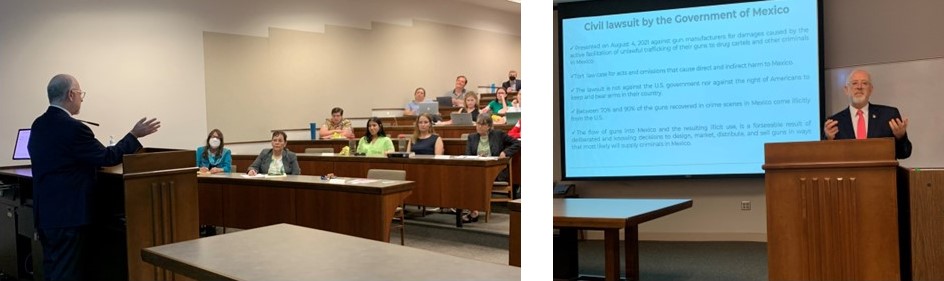
In a talk entitled “Institutional Structure of the U.S.-Mexico Relations and Key Bilateral Issues: Mexico’s Legal Case Against U.S. Gun Manufacturers,” Ambassador Javier Díaz de León began by outlining ways that Mexico and the United States – often along with their neighbor to the north, Canada – discuss and seek solutions to common problems.

One concern, of course, is security; in Mexico’s case, the southward flow of firearms and money that enable drug cartels to operate. After providing statistics on the high proportion of weapons confiscated in Mexico that have been manufactured or distributed in the United States, Ambassador Díaz turned to what he rightly called the “landmark” step that his government took on August 4, 2021, when it filed Estados Unidos Mexicanos v. Smith & Wesson Brands et al. in the U.S. District Court for the District of Massachusetts. That civil tort suit alleges that Smith & Wesson and 10 other firearms manufacturers or distributors unlawfully permitted U.S. weapons to enter Mexico, where firearms are, for the most part, prohibited. According to Ambassador Díaz, a federal judge heard argument on defendants’ motion to dismiss last spring, but has not yet ruled on that motion, and discovery is under way.

Following his presentation, Georgia Law Regents’ Professor Diane Marie Amann, one of our Center’s Faculty Co-Directors, moderated questions from the audience, composed mostly of students.

This marked the ambassador’s second visit to our University of Georgia School of Law Dean Rusk International Law Center; in 2018, also as part of our Consular Series, he spoke on “Mexico’s Relation with Georgia: Connecting Paths.”

Cosponsoring yesterday’s event with our Center were the Latin American & Caribbean Studies Institute at the University of Georgia, as well as two Georgia Law student groups, the Hispanic Law Students Association and the International Law Society.

Follow this webpage or our Twitter feed to learn about upcoming events.

Benjamin Zawacki, author of Thailand: Shifting Ground between the US and a Rising China, to speak at Georgia Law on Tuesday, March 20

Benjamin Zawacki bookWe at the University of Georgia School of Law Dean Rusk International Law Center are delighted to welcome Benjamin Zawacki, a Bangkok-based human rights researcher and advocate, to campus to discuss his recently-released book, Thailand: Shifting Ground between the US and a Rising China. He will be speaking tomorrow, March 20, 2018, from 11:45-1:00 p.m. in the Larry Walker Room in Dean Rusk Hall.

Joining him in conversation will be UGA Department of History history_faculty_08Professor Ari Levine, an expert in China. Zawacki will discuss Thailand’s recent pivot towards China following decades as a key strategic ally of the United States, as well as what that means for a new administration in Washington. Levine will pose key questions and moderate a discussion with attendees.

Benji headshot

Zawacki has lived in Thailand for the past 15 years. In 2015, he was a visiting fellow in the Human Rights Program at Harvard Law School and a term member on the Council of Foreign Relations. He previously served as the Senior Legal Advisor for Southeast Asia with the International Commission of Jurists, the Acting Regional Representative of the International Development Law Organization, and Amnesty International’s Myanmar, Thailand, and Asian Emergencies Researcher.

The event is co-sponsored by the law school’s Dean Rusk International Law Center, the Department of History, and the International Law Society. It is presented as part of the Center’s United Nations Academic Impact partnership.

Belgian Consul General de Baets featured at Global Atlanta luncheon

willem

Pictured at front, from right: Belgian Consul General William de Baets and Phil Bolton and Trevor Williams, respectively, publisher and managing editor of Global Atlanta.

For decades, we at the University of Georgia School of Law have welcomed collaboration with Belgium and its people and institutions. Even before 1978, when Belgium’s national airline became the 1st foreign carrier to fly nonstop to Atlanta, a Belgian attorney became the 1st foreign-trained lawyer to earn Georgia Law’s Master of Laws (LL.M.) degree. And thanks to the hard work and generosity of Georgia Law professors like Gabriel Wilner and our Center’s namesake, former U.S. Secretary of State Dean Rusk, we’ve partnered with leading Belgian universities to offer summer seminars on issues related to international  law and policy, often with a focus on European Union and transatlantic cooperation. That tradition will continue via this summer’s global governance school at the home of our partner, the Leuven Centre for Global Governance at the University of Leuven, one of Europe’s premier research institutions.

Thus it was a special pleasure to attend last Friday’s “Consular Conversations: Luncheon Interview With Belgium’s Consul General,” held at the Atlanta office of Miller & Martin, where Tom Harrold, Georgia Law alumnus and member of our Dean Rusk International Law Center Council, leads the International/World downloadLaw practice group. The event was part of a series of conversations sponsored by another Center partner, Global Atlanta.

Guest of honor was William de Baets, who’s served since last April as Belgium’s top diplomat in the Southeastern United States. In a wide-ranging conversation with Phil Bolton and Trevor Williams, Global Atlanta’s publisher and managing editor, de Baets explained he’d joined Belgium’s foreign service following 9 years as a Navy officer. Postings before his arrival at Atlanta included deputy head of mission in Côte d’Ivoire, Ethiopia, and Venezuela, and political counselor at Belgium’s embassy in Washington, D.C.

De Baets said that his office provides consular services and also engages in public and economy diplomacy; Friday’s conversation fulfilled the latter role. He spoke to a full house – a testament to the fact that Belgium ranks among the top 10 foreign investors in Georgia, which is home to more than 70 Belgian companies and more than 5,000 Belgian nationals.

Asked about Belgium’s renown as the home of Tintin and the Smurfs, not to mention 20th C. surrealists like René Magritte, de Baets recalled an artistic tradition that reaches back to the 16th C. Flemish master, Peter Paul Rubens. Additionally, Belgium did not gain independence until 1830; before that “the territory kept changing hands and was ruled by other people,” he noted. “We couldn’t speak up too much. We were saying yes and thinking no, or saying yes and doing what we wanted to do. It was a source of our humor – we couldn’t take ourselves too seriously.”

Again answering a question, de Baets spoke of his father’s participation in the resistance during Germany’s occupation of Belgium during World War II.
Flags of the 28 NATO member countries

Conversation then turned to Belgium’s role in contemporary matters. Regarding Brussels-based NATO (right), the defense alliance established 68 years ago by the North Atlanta Treaty, de Baets noted apparent disagreement within the new U.S. administration. Indeed, earlier in the week the South Carolina Governor tapped to become U.S. Ambassador to the United Nations, Nikki Haley, had called NATO “important.”

Although the United States can defend itself without NATO, Europe cannot, and so de Baets advocated strengthening the European Union’s security pillar to offset any weakening of NATO. Such alliances are essential for countries like Belgium and its neighbor, Luxembourg. Yet de Baets acknowledged difficulty in achieving the goal, given disagreement among EU member states – including Britain, even before its people voted in favor of Brexit.

Dubbing compromise a “Belgian export,” de Baets indicated that his country could a key role in aiding Europe’s efforts to resolve crises in financial and security sectors, as well as migration. The goal, he said, is to “strengthen our security without giving up our values.”

“Africa’s time”: Team members reflect on SE Model African Union summit

logoIt’s our pleasure today to publish this post, jointly written by the Georgia Law team that last week was named Best Delegation at the Southeast Model African Union, and so is eligible to compete in the 35th annual national competition in February in Washington, D.C. The 6 students on the team each won individual achievement awards at the event, which was hosted by the University of Georgia African Studies Institute and cosponsored by the law school’s Dean Rusk International Law Center. They write:

Introduction

“This is Africa’s time.”

So said the keynote speaker and Honorary Consul of Sierra Leone, Cynthia Jarrett-Thorpe, to delegates at the 20th Annual Southeast Model African Union, This was the beginning of what turned out to be an eventful competition. Over the course of the next 2-1/2 days we would be tasked with working together in various negotiations, in order to provide solutions to complex situations on behalf of the country we represented, the Republic of Niger.

wackym_lgr

► Rebecca Wackym left, listens to statement by delegate from South Sudan

Rebecca Wackym, 1L, Executive Council

My role as a delegate for the Republic of Niger in the Executive Council was not only as an advocate for the interests of Niger, but also a servant to the interests of the entirety of the African Union. As a member of the Executive Council, I was not required to draft or advocate for a resolution. I introduced a hypothetical crisis situation caused by Boko Haram to the committees, who then had to create resolutions to solve the crisis.

Regarding the process, I had to work with other delegates in the Executive Council to first decide on how to setup the crisis in a way that would guide them to a solution while simultaneously, allowing each committee to achieve the goals set forth in the Union’s Agenda 2063.

The Executive Council ferociously debated how we wanted to achieve these goals in the context of the Boko Haram crisis. For example, we contemplated:

  • Would we ask the Committee on Peace and Security to involve states with more resources to combat Boko Haram?
  • Would we rather rely on our own resources, even though we had far less than the Americans?

I had to advocate for a position that struck a balance between safety and sovereignty of Niger and the goals of the Agenda. We eventually negotiated an agreement to ask the committees to formulate plans in a tiered manner, which put the African Union’s sovereignty first, but allowed for support outside of the Union.

However, our work did not end with tasking the committees. We also were tasked with creating a final report, called a “communiqué.” We had discretion to adopt an entire committee’s resolution, or certain parts, or to scrap the entire resolution and draft our own. At this point, we divided into groups so that we could discuss the edits, if any, that we wanted to make to the resolution. I was asked to look over the Committee on Democracy, Governance, and Human Rights’ resolution because the other delegates believed that my whole t3 months in law school afforded me more expertise in regards to judicial reform in the African Union. Drafting the communiqué might have been one of most hectic couple of hours, but with exceptional teamwork we churned out a comprehensive report.

My takeaway from this experience is that the diplomatic system works well when all the parties decide put the interest in solving the crisis above their own individual interests. The Executive Council ran efficiently when we all saw each other as colleagues working towards a common goal rather than a competition of whose interest would be given most prominence.

20161105_120118

From left, team members Shummi Chowdhury, Amanda Hoefer, and Chanel Chauvet

Amanda Hoefer, 1L, Committee on Democracy, Governance and Human Rights

I was fortunate enough to be able to participate in the 2016 Southeastern Model African Union Competition held at UGA, with the support of both the Dean Rusk International Law Center and the UGA Department of African Studies. I represented the Republic of Niger in the Committee on Democracy, Governance, and Human Rights, and helped with the drafting of four resolutions, addressing a wide spectrum of issues, including the scope and jurisdiction of the African Court on Human and Peoples’ Rights, the use of transitional justice as a means of compensating victims of human rights abuses, the reduction of corruption throughout the continent, and the African Union’s role in promoting economic growth throughout the diaspora.

The most rewarding aspect of this experience was working with undergraduate students with little experience in mock diplomacy; having participated in Model United Nations in high school, I was able to use my rusty knowledge of parliamentary procedure to help steer my fellow delegates to a rewarding and enriching resolution. Diplomacy competitions are an incredible opportunity to flex your teamwork muscles and to collaborate on creative solutions to complex problems; in a word, competitions like SEMAU are empowering. I enjoyed watching those in my committee who had never participated in a similar competition become increasingly confident in their public speaking and critical thinking skills, and loved having a chance to dig into complicated diplomatic problems myself.

I also enjoyed having the chance to learn about African culture and politics, having never had a particular opportunity to immerse myself in the topic before this competition. While preparing for the competition during the Fall semester of my 1L year was a bit stressful, my inner-diplomacy nerd jumped at the opportunity to do some research about Niger and the AU, and to delve into the complex policy problems that we were asked to face. I’m incredibly grateful to both Georgia Law’s Dean Rusk International Law Center and the University of Georgia African Studies Institute for their patronage and support in this endeavor, and look forward to competing again at the national competition in February.

img_0855

On behalf of Niger, Johann Ebongom (center) joins in discussion

Johann Ebongom, LLM, Committee on Economic Matters

The Model African Union is known as a competition in which student delegates represent their selected countries and develop an understanding of African issues from an African perspective. Practically speaking, the Model African Union is a simulation of the African Union Summit which occurs twice a year in Africa.

At the 20th annual Southeastern Model African Union competition, I had the opportunity to participate in the Economic Matters Committee. We convened on the afternoon of November 3, to discuss on two main agenda topics:

  • Promoting a balanced and inclusive economic growth: aspirations and implementation
  • Promoting a sustainable ecosystem and climate resilient economies: aspirations and implementation

The objective was to debate and engage in diplomatic principles and standards to ultimately resolve major economic issues currently harming African countries. Some of these issues include concerns of water resources and agricultural development, management of mineral resources, debt relief, energy and development, multilateral trade negotiations, and food security. The committee created a resolution that represented the majority opinion of the different countries present. Following negotiations, we presented the resolution to Heads of State and Government during the General Assembly on the last day of the event for their final approval.

The Delegation of Niger recognized that despite a sustained agricultural productivity growth, a large number of households continue to face food insecurity and malnutrition problems due to on-site effects of soil degradation and the mismanagement of revenues from the exportation of the continent’s natural resources. At this point, it was clear that our challenge would not only be that of enhancing our agricultural production to meet the increased food demands of the expanding population, but also to focus on the judicious use of soils in order to promote a sustained productivity in the foreseeable future.

Niger promoted the implementation of a tax, on the total revenue from natural and agricultural resources exportation, which would be deposited and managed at the level of the African Union through an African Fund for Development. The funds would then be distributed back across the continent to support integration-related projects which will lead to the inclusive economic growth of the continent. Niger supported this motion using the slogan:

“Give what you own for the benefit of the continent!”

Niger also reminded the delegation about the importance of a collective solution that would benefit the 54 African countries. We also urged the honorable house to vote for a resolution that will take into account the effects of the current Boko Haram security issue, which directly affects the economy of a number of western African countries, including Nigeria, Cameroon, Chad, and Niger. Niger was leading the negotiations and after long hours, a compromise was found! The resolution was adopted by a 2/3 majority of the house.

I had the honor of being promoted by the organizers of the competition as a “Parliamentarian Dais” for the rest of the session. As such, my role was to ensure the respect of for the rules and proceedings during the working session, and advise the Chair in maintaining the parliamentary order during the debates. I also had the opportunity to fill this role during the General Assembly of Heads of State and Government on November 5, 2016.

img_0851

► Nelly Ndounteng, right, seeks to intervene on behalf of Niger

Nelly Ndounteng, LLM, Committee on Social Matters

The 20th Southeast Model African Union (SEMAU) competition was a noble experience for me. I am delighted to have represented the law school as the Republic of Niger in this conference. As the representative for the Committee on Social Matters, I was tasked with the responsibility of providing a solution to:

  • Empowering the African Woman and Eliminating All Forms of Violence and Discrimination (Social Economic, Political) Against Women and Girls.
  • Eliminating Youth Unemployment and Promoting the Creativity, Energy and Innovation of African Youth as the Driving Force Behind the Continent’s Transformation.

I was especially excited to work on the sub-topic that dealt with African women because it required the committee to resolve matters concerning hardship, inequality and degradation suffered as a result of male counterparts.
It was my first experience using parliamentary procedure, and I must say I enjoyed every bit of it. During the first session, I decided to observe the proceedings in order to see how procedure was carried out. Once I was comfortable, I began participating, and later, took the lead, which made the whole experience more exciting for me.

My sincere appreciation goes to the founder of SEMAU, the organizers and most importantly, the Dean Rusk International Law Center for allowing me this great opportunity to promote Africa’s development.

Shummi Chowdhury, 1L, Committee on Pan-Africanism and Continental Unity

The Southeast Model African Union Competition (SEMAU) proved to be an eventful and rich learning experience to kick off my 1L career. I participated on the Pan-Africanism Committee as the delegate for the Republic of Niger. One of the important tasks we faced on the first two days of the competition was to read and scrutinize the resolutions from all the countries represented, and then engage in debate over the merits and drafting of the resolutions. Having been exposed to the concise and effective style of legal writing, I took an active role in drafting the two main consolidated resolutions that passed through our committee. This competition helped me reflect on my newly acquired skills and for the first time appreciate that all the work spent on my courses thus far actually have substantial application outside the classroom.

nigerThe part I enjoyed most during the competition however was in the negotiations that occurred. Everyone had a resolution, or an idea that they wished to promote. For me, I focused on human trafficking as it affects Niger, particularly in light of the Boko Haram crisis. In order to get my ideas drafted into a resolution, I had to work the room and speak to different delegates to find common ground and similar interests. I thoroughly enjoyed the process of negotiating and coming together with distinct parties to draft a resolution that satisfactorily acknowledged differing goals in a coherent manner.

Though the competition occurred in November, which is a very busy time for 1L students, I have no regrets and am thankful to have had the opportunity to participate. It really forced me to manage my time, so that I could focus on the competition and also stay on top of all the schoolwork and studying that is required to be successful in law school.

Chanel Chauvet, 2L, Committee on Peace and Security

As the delegate for the Republic of Niger in the Committee on Peace and Security, I was engaged in the intricate task of educating and debating my fellow delegates about the impact of Boko Haram and al-Qaeda within my state. According to the United Nations, more than 20,000 people have been killed, and 2.2 million people have been internally displaced as a result of the Boko Haram and al-Qaeda.

My primary focus however, involved the potential remedies that the African Union could provide through the use of education. One of the solutions that Niger emphasized in accordance to the “Achieving Freedom From Armed Conflict, Terrorism, Extremism and Intolerance by 2063: Aspirations and ecowasImplementation” topic was the implementation of international humanitarian law (IHL) within school and military curriculums. The International Committee of the Red Cross (ICRC) and Economic Community of West African States (ECOWAS) have considered how treaties related to IHL can be strengthened through the legal system, as detailed here; however, the organizations have yet to explore these other avenues of implementation. Educating the youth about the legal protections and obligations of parties involved and affected by conflict would ultimately serve to generate respect for treaties that promote IHL and prevent conflict.

Perhaps, what was the most difficult part about the committee process for me was the need to use of parliamentary procedure in order to communicate my points effectively to the other delegates. This required extensive knowledge of the rules and procedure, in order to redirect the committee to certain point favorable to my country. Fortunately, our team had laboriously practiced parliamentary procedure in the weeks leading up to the competition, so we were well-prepared.

Conclusion

Overall, we are grateful for this experience, and pleased with our team performance. We managed to earn the “Best Delegation” award, in addition to numerous individual awards.

We would like to express our sincere gratitude to the Dean Rusk International Law Center at the University of Georgia School of Law and our faculty advisor for extending this opportunity to us. We would also like to thank the African Studies Institute at UGA and its Director for his assistance.