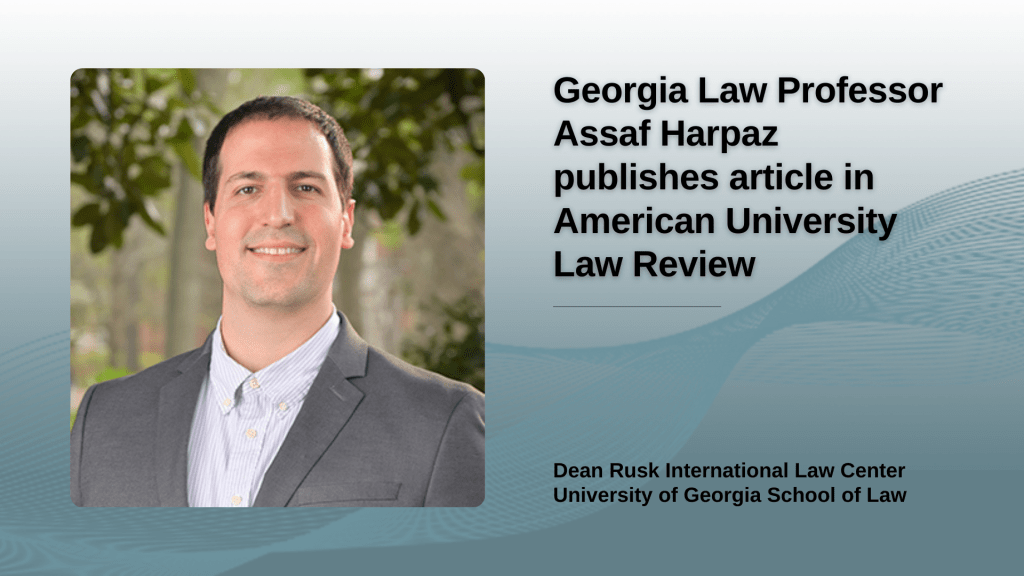
Georgia Law Professor Assaf Harpaz publishes article in American University Law Review

University of Georgia School of Law Professor Assaf Harpaz published “Global Tax Wars in the Digital Era” in the American University Law Review (Vol. 75, 2025). The article explores the global conflict over tax governance, particularly the tensions between OECD-led Global North countries and the UN-backed Global South. It argues for a shift toward source-based taxation that would allow countries to tax online businesses that have a “significant economic presence” without a physical one.

The article’s abstract can be found below:

The digital economy fundamentally disrupts international tax principles that rely on physical presence. When a business earns income abroad, the country of residence (where the taxpayer resides) and the country of source (where income is generated) both have legitimate, competing claims to tax that income. The international tax system tends to favor residence-based taxation. The source country has the right to tax business profits only if the enterprise carries on a permanent establishment within its borders, which typically requires physical presence. The permanent establishment standard becomes flawed in a digital economy where profit shifting practices are abundant and businesses no longer need a physical presence in the location of their online consumer markets.

An upcoming United Nations Framework Convention on International Tax Cooperation recognizes these challenges and is overwhelmingly supported by Global South economies. However, the Global North has historically dominated the international tax regime through the Organization for Economic Co-operation and Development (OECD), informally known as the “World Tax Organization.” A U.N. framework convention creates potential conflict in international tax policymaking and would need to bridge the underlying North-South divide.

This Article explores the “tax wars” surrounding the leadership for global tax governance, contrasting the taxing powers and interests of the OECD-led Global North with those of the U.N.-backed Global South. It argues for a shift toward source-based taxation by revisiting the permanent establishment standard. To achieve this, the Article promotes a significant economic presence doctrine that would expand the permanent establishment criteria to include online businesses. This proposal addresses longstanding inequities and is increasingly warranted in a digital economy that does not depend on physical presence.

Harpaz joined the University of Georgia School of Law as an assistant professor in summer 2024 and teaches classes in federal income tax and business taxation. Harpaz’s scholarly focus lies in international taxation, with an emphasis on the intersection of taxation and digitalization. He explores the tax challenges of the digital economy and the ways to adapt 20th-century tax laws to modern business practices.
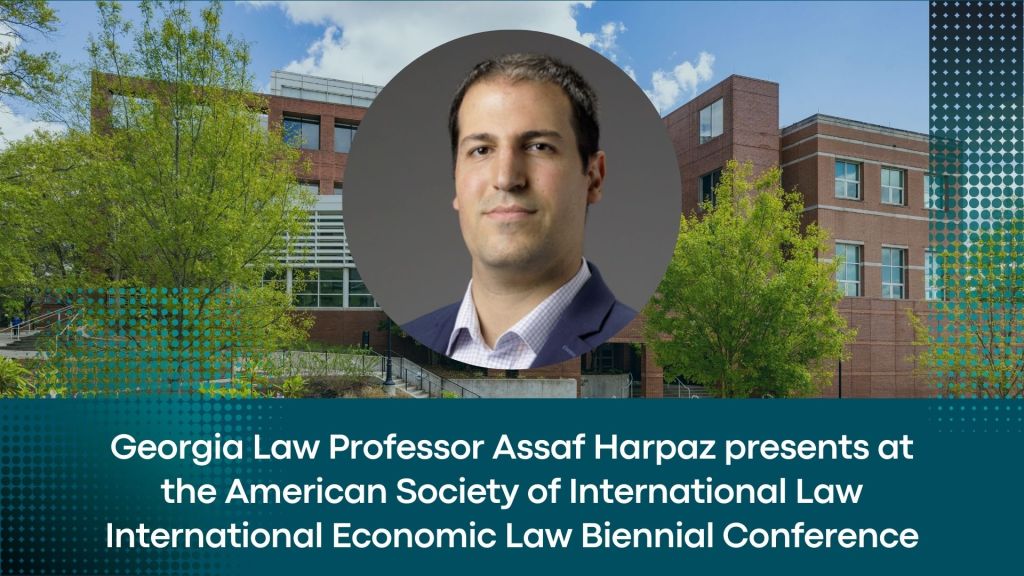
Georgia Law Professor Assaf Harpaz presents at the American Society of International Law International Economic Law Biennial Conference

University of Georgia School of Law Professor Assaf Harpaz virtually presented his forthcoming paper, Global Tax Wars in the Digital Era, 75 Am. U. L. Rev., at the American Society of International Law International Economic Law Biennial Conference.

Below is an abstract of the paper:

The digital economy fundamentally disrupts traditional international tax principles that rely on physical presence. When a business earns income abroad, the country of residence (where the taxpayer resides) and the country of source (where income is generated) both have legitimate, competing claims to tax that income. The international tax system favors residence-based taxation. The source country has the right to tax business profits only if the enterprise carries on a permanent establishment within its borders, which typically requires a physical presence. The permanent establishment standard becomes flawed in a digital economy where profit shifting practices are abundant and businesses no longer need a physical presence in the location of their online consumer markets.

An upcoming United Nations (UN) Framework Convention on International Tax Cooperation recognizes these challenges and is overwhelmingly supported by Global South economies. However, the Global North has historically dominated the international tax regime through the Organization for Economic Co-operation and Development (OECD), informally known as the “World Tax Organization.” A UN framework convention creates potential conflict in international tax policymaking and would need to bridge the underlying North-South divide.

This article explores the “tax wars” surrounding the leadership for global tax governance, contrasting the taxing powers and interests of the OECD-led Global North with those of the UN-backed Global South. It argues for a shift toward source-based taxation by revisiting the permanent establishment standard. To achieve this, the article promotes the significant economic presence doctrine that would expand the permanent establishment criteria to include online businesses. This proposal addresses longstanding inequities and is increasingly warranted in a digital economy that does not depend on physical presence.

Harpaz joined the University of Georgia School of Law as an assistant professor in summer 2024 and teaches classes in federal income tax and business taxation. Harpaz’s scholarly focus lies in international taxation, with an emphasis on the intersection of taxation and digitalization. He explores the tax challenges of the digital economy and the ways to adapt 20th-century tax laws to modern business practices.

Rutgers Law professor Sarah Dadush presents working paper at final session of Georgia Law’s 2025 International Law Colloquium

The University of Georgia School of Law’s spring 2025 International Law Colloquium welcomed Sarah Dadush, Professor of Law at Rutgers Law School, who presented her working paper, “Shared Responsibility in Contract Law.” Professor Christopher Bruner, Stembler Family Distinguished Professor in Business Law and Faculty Co-Director of the Dean Rusk International Law Center at Georgia Law, served as her faculty discussant. Dadush’s presentation marks the conclusion of the 2025 International Law Colloquium.

Dadush’s scholarly focus lies in business and human rights, consumer law, and social enterprise law. She also serves as the Director of the Responsible Contracting Project (RCP), a project designed to advocate for human rights and environmental due diligence in contract drafting. The RCP is located within the Rutgers Law School’s Center for Corporate Law and Governance.

Below is an abstract of Dadush’s working paper:

At first, the notion that there is such a thing as shared responsibility in American contract law may sound fanciful, if not absurd. A key reason why parties contract in the first place is to allocate risks and responsibilities between them and to clarify who must do what to move the collaboration forward. As such, contractual obligations are understood to be binary, belonging either to one party or the other, not both. In practice, this means that, if there is a breach, only the obligated party will be held responsible, not both. And, if remedies are awarded, they will flow only from the breaching to the non-breaching party, not between them. Thus, the notion that the parties might be contractually responsible not just for their own obligations, but also for those of their counterparty, seems incoherent.

And yet, as this Article shows, it is not uncommon for courts to go beyond the express terms of the contract to make the parties share responsibility for the performance of one another’s obligations. Thus shared responsibility: Each party is held responsible for the other’s contractual (non)performance, even in the absence of an express commitment to share responsibility for performance.

This Article “goes fishing” for shared responsibility in three key areas of contract law: The contents of the contract, breach, and remedies. It demonstrates that shared responsibility is brought to bear to resolve contract disputes more often and with greater legal effect than the simple, binary understanding of contract might predict. When it enters the judicial analysis, shared responsibility can drastically change the answers to the questions: Who had the obligation to perform? Who breached? And, finally, whose harm should be remedied and how?

Having shown that shared responsibility is already a prominent, if overlooked, feature of American contract law, this Article argues that, in certain situations, courts should employ shared responsibility as a default rule. Specifically, courts should employ a shared responsibility default (SRD) when the contract was breached, or otherwise failed, and (1) both parties contributed to the failure, and (2) the failure could, or has already, generated high social costs (e.g., public endangerment, human rights violations in supply chains, consumer deception). In such situations, the SRD would activate the tort law principles of comparative negligence and proximate cause in contract, holding both parties accountable for their respective contributions to the contract’s failure and related social costs. In doing so, the SRD would equip courts to resolve contract disputes in a manner that attends to both contract policy and public policy objectives.

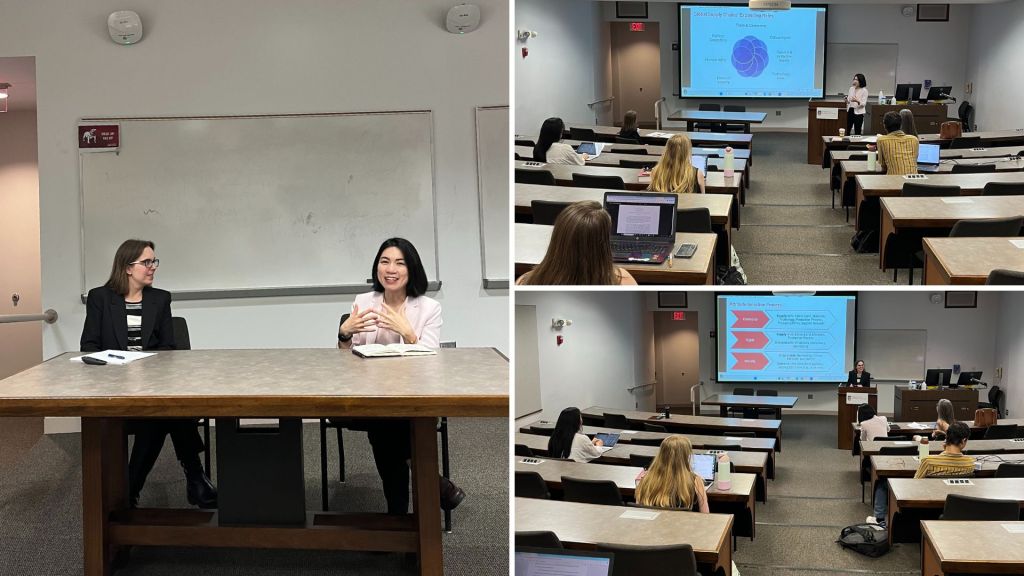
This year, Professor Desirée LeClercq led the colloquium, which was designed to introduce students to features of international economic law through engagement with scholars in the international legal field. To view the full list of International Law Colloquium speakers, visit our website.

This program w made possible through the Kirbo Trust Endowed Faculty Enhancement Fund and the Talmadge Law Faculty Fund.

Duke Law Professor Rachel Brewster presents working paper at Georgia Law’s International Law Colloquium

The University of Georgia School of Law’s spring 2025 International Law Colloquium welcomed Duke University School of Law’s Professor Rachel Brewster, who presented her working paper, “The Rise of Global FCPA Settlements.” Assaf Harpaz, Assistant Professor of Law at Georgia Law, served as Brewster’s faculty discussant.

Brewster is the Jeffrey and Bettysue Hughes Distinguished Professor of Law at Duke University School of Law. Her scholarly focus lies in international economic law, international dispute settlement, World Trade Organization (WTO) law, anti-corruption law, and international relations theory. Brewster currently serves as the co-director of Duke’s Center for International and Comparative Law and is co-chair of Duke’s JD-LLM in International and Comparative Law Program.

Below is an abstract of Brewster’s working paper:

For the last two decades, the United States has been the dominant enforcer of anti-bribery norms worldwide.  Using the broad extraterritorial jurisdiction granted by the Foreign Corrupt Practices Act (FCPA), the Department of Justice and the Securities and Exchange Commission have prosecuted domestic and foreign corporations for bribing foreign government officials. This transnational enforcement system has been described as a negative comity regime: foreign governments defer to American prosecutions even if the case involves their nationals. This system has created a robust enforcement environment but often faces foreign resistance to the perceived “American dominance” of the regime.

This Article analyzes the recent rise of a new enforcement model: the global FCPA settlement, where multiple governments enter into parallel deferred prosecution agreements or other non-trial resolutions with corporate entities. This enforcement model is now the principal form for concluding “blockbuster” FCPA cases and has significant implications for the evolution of the transnational anti-bribery law regime. The Article argues that the rise of global settlements results from (1) a greater demand by foreign governments to be involved in foreign bribery resolutions when their national firms are on trial and (2) American prosecutors’ willingness to accommodate this demand when it results in more effective prosecutions (i.e., new cases, more claims, or stronger evidence). This Article contends that the rise of global FCPA settlements marks a significant shift in the international anti-bribery enforcement regime, transitioning from a negative comity to a coordinated comity regime. The global resolution model addresses some of the concerns of the negative comity regime by permitting multiple governments to have a voice in negotiating the level of the penalties, the distribution of the penalties, and any structural reforms that the firm will be required to adopt. It also can potentially increase the effectiveness of the enforcement regime by expanding the geographic scope of the investigations and quality of evidence. The Article concludes by discussing the importance of this Article to the Trump Administration’s recent executive order on FCPA enforcement.

This year, Professor Desirée LeClercq is overseeing the colloquium, which is designed to introduce students to features of international economic law through engagement with scholars in the international legal field. To view the full list of International Law Colloquium speakers, visit our website.

This program is made possible through the Kirbo Trust Endowed Faculty Enhancement Fund and the Talmadge Law Faculty Fund.

Temple Law professor Trang (Mae) Nguyen presents working paper at Georgia Law’s International Law Colloquium

The University of Georgia School of Law’s spring 2025 International Law Colloquium recently hosted Temple Law’s Trang (Mae) Nguyen, who presented her working paper, “Goods’ Nationalities.” Pamela Foohey, Allen Post Professor of Law at Georgia Law, served as Nguyen’s faculty discussant.

Nguyen is an Associate Professor of Law at the Temple University Beasley School of Law and is an Affiliated Scholar at the U.S.-Asia Law Institute at the New York University School of Law. Her research focuses on business law, contracts, transnational law, and international law. Nguyen also previously held research appointments at the University of Hong Kong Faculty of Law, the National University of Singapore Centre for Asian Legal Studies, and the Singapore Management University Yong Pung How School of Law.

Below is an abstract of Nguyen’s working paper:

Products’ nationalities are at the center of today’s fast-changing global order. The Trump administration’s liberal use of tariffs against friends and foes, sanctions against Russian products, the banning of Chinese goods, and efforts to revitalize American manufacturing, to name just a few, all hinge on classifications of where a product is deemed “from.” But in today’s globalized economy, what exactly makes something “American” or “Chinese” or of any other nationality, for that matter?

This Article reexamines how goods acquire their designated nationalities at a time when such designation matters well beyond traditional commerce. It advances two main arguments. First, a product’s nationality is not fixed; rather, it is malleable and can vary depending upon the substantive legal regime under which the good is regulated—once predominantly trade law but now increasingly through a trade-security nexus and a trade-human rights nexus. Second, such malleability occurs through what I call an “attribute selection” process. In effect, each legal regime pivots the nationality analysis on certain “attributes” of a product, swapping and switching them as befit underlying interests and policy goals. The construction of product nationality thus occurs through mapping two separate sets of variables: first, the bundle of attributes of a product, and second, the “prisms” through which laws place significance on these attributes.

This Article makes several contributions. First, descriptively, it charts an updated account on product nationality’s expanded use, particularly in trade law’s nexus with national security and human rights. Second, conceptually, building on this updated descriptive account, it advances a novel framework—the attribute selection process—to unpack the making of product nationality. Third, normatively, it underscores how the need to use product nationality as proxy fits uneasily with the reality of global production, and how efforts to move away from nationality-based rules are likely vulnerable to similar challenges. Ultimately, while the Article makes clear that the concept of nationality is doing heavy lifting across various legal fields, it does not take a strong normative stand, opting instead to explain why taking a strong normative position is premature during fast evolving developments. Finally, the Article offers some practical considerations for policymakers, businesses, and other stakeholders as they consider product-nationality regulations going forward.

This year, Professor Desirée LeClercq is overseeing the colloquium, which is designed to introduce students to features of international economic law through engagement with scholars in the international legal field. To view the full list of International Law Colloquium speakers, visit our website.

This program is made possible through the Kirbo Trust Endowed Faculty Enhancement Fund and the Talmadge Law Faculty Fund.

Temple Law professor J. Benton Heath presents working paper at Georgia Law’s International Law Colloquium

The University of Georgia School of Law’s spring 2025 International Law Colloquium welcomed Temple University, Beasley School of Law Professor J. Benton Heath, who presented his working paper, “Sanctions and Sanctuary: Refuge, Violence, and the Legal Ordering of (Economic) Warfare.” Laura Phillips-Sawyer, Jane W. Wilson Associate Professor in Business Law at Georgia Law, served as Heath’s faculty discussant.

Heath’s primary research interests include international trade, investment law, dispute resolution, global health, administrative law, public international law, and the national security dimensions of trade and investment. He teaches Civil Procedure and International Arbitration.

Heath previously practiced international law and arbitration at the U.S. State Department, and at Curtis, Mallet-Prevost, Colt & Mosle. He has represented governments and state-owned enterprises before the International Court of Justice, the Iran-United States Claims Tribunal, other international arbitral tribunals, and the federal courts. His work at the State Department also included bilateral claims negotiations with the Republic of Cuba, matters relating to embargoes and economic sanctions, and U.S. court cases brought against foreign governments by victims of terrorism. He also served as a clerk to Judge Robert D. Sack of the U.S. Court of Appeals for the Second Circuit.

Below is the introduction to the working paper Heath presented:

This project is about the relationship of concepts of sanctuary and violence to economic warfare. I am interested in what I think of as “spaces of sanctuary” (or refuge) that provide a break from conflict and place spatial boundaries on the exercise of violence and coercion. My argument, for now, is that the concept of sanctuary is a critical tool for structuring a legal regime of controlled violence, and that this applies also to economic warfare. A key point of departure here is that sanctuary is not simply the negation of violence. Rather, sanctuary spaces control the flow of violence, displacing it where it “doesn’t belong” and channeling violence to spaces where the use of force or coercion is naturalized or even deemed legitimate. By setting the criteria for who can access sanctuary and under what conditions, the law further establishes a normative and spatial order for the continuation of violence at a level, and in a direction, that the law deems tolerable. Sanctuary is thus intertwined with, rather than apart from, violence. Nevertheless, if we are interested in fundamentally reconsidering who has access to safety and security and under what conditions, we should want to think carefully about how to reconstruct spaces of sanctuary—either real or virtual—to resist the totalizing world of economic warfare in which we currently find ourselves.

This year, Georgia Law Professor Desirée LeClercq is overseeing the international law colloquium, which is designed to introduce students to features of international economic law through engagement with scholars in the international legal field. To view the full list of International Law Colloquium speakers, visit our website.

Schulich School of Law professor Olabisi D. Akinkugbe presents working paper at Georgia Law’s International Law Colloquium

The University of Georgia School of Law’s spring 2025 International Law Colloquium welcomed Schulich School of Law, Dalhousie University Professor Olabisi D. Akinkugbe, who presented his working paper, “Trade and Development in an Era of Geopolitics: A Third  World  View.” Tim Samples, Associate Professor of Legal Studies in the Terry College of Business at the University of Georgia, served as Akinkugbe’s faculty discussant.

Akinkugbe is the Purdy Crawford Chair in Business Law and Associate Professor at the Schulich School of Law, Dalhousie University. His research covers several topics on issues in and at the intersection of public international law, international economic law, human rights, law and development, international courts, and regional economic integration in Africa. He explores these issues from the national, regional, and international contexts. Akinkugbe’s research draws on critical traditions such as Socio-legal approaches to law, Post-colonialism, and Third World Approaches to International Law (TWAIL) among others.

Below is an abstract of the working paper Akinkugbe presented:

This chapter examines the relationship between trade and development. Centering the heterogeneity of developing states within the World Trade Organization (WTO), the chapter briefly analyses some of the trade law interests that are most important to these different types of developing countries. It then turns to the question: how has international trade law accommodated the needs of different types of developing countries through special and differential treatment? The Chapter contends that the structure of the rules of the global economic order and the WTO in relation to trade were developed and are being implemented in the shadow of a fiercely contested geopolitical and power struggle. Despite the flexibilities in the WTO, developing and small island developing states’ trade interests are significantly marginalized in their implementation. Given the rise of conflicts in geopolitics and trade interests within the power WTO Member States, the Chapter contends that without fundamentally centering and reimagining the inequities in our international trade regime, mere “window dressing” or adoption of new rules of trade would only further marginalize the trade interests of the developing countries and SIDS in a non-inclusive way.

This year, Professor Desirée LeClercq is overseeing the international law colloquium, which is designed to introduce students to features of international economic law through engagement with scholars in the international legal field. To view the full list of International Law Colloquium speakers, visit our website.

This program is made possible through the Kirbo Trust Endowed Faculty Enhancement Fund and the Talmadge Law Faculty Fund.

Georgia Law’s International Law Colloquium hosts Harlan Cohen, Fordham Law, as first speaker

The University of Georgia School of Law’s spring 2025 International Law Colloquium began last week with Professor Harlan Cohen of Fordham University School of Law. For more than a decade, the International Law Colloquium Series has brought leading scholars to Georgia Law, where they have presented works in progress and invited discussion and comments from students as well as faculty discussants.

This year, Professor Desirée LeClercq is overseeing the colloquium, which is designed to introduce students to features of international economic law through engagement with scholars in the international legal field. The course broadly defines “international economic law,” to include traditional approaches (trade and investment agreements) as well as non-traditional, emerging approaches (examining the effects of international economic law on marginalized communities and considering re-distributional policies).

Cohen presented his working paper titled, “The International Order, International Law, and the Definition of Security.” Cohen, who previously served as the Gabriel M. Wilner/UGA Foundation Professor in International Law at the University of Georgia School of Law and Faculty co-Director of the Dean Rusk International Law Center, specializes in international trade, international law, international legal theory, global governance, and U.S. foreign relations law.

Dean Usha Rodrigues opened the colloquium (recording of opening remarks available here). Professor Diane Marie Amann served as Cohen’s faculty discussant. 

Below is an abstract of Cohen’s working paper:

As economic security has seemingly moved to the center of American and European foreign policy, both the United States and the European Union have broadened their interpretation of international law rules governing security, coercion, and intervention.  These broadened interpretations have supported a bevy of new sanctions, trade restrictions, investment controls, and industrial policies that have turned the global economy into an increasingly weaponized space.  But these interpretations are not exactly new, echoing developing state interpretations of international law that developed states had long ago seemingly rejected.  How are these once moribund interpretations of security, force, and coercion being brought back to life?

This essay argues that these interpretative shifts highlight the role of the international order as an interpretative mechanism within international law.  Borrowing from the work of Robert Cover, it explains the ways that the international order acts as a jurispathic agent within the system, judging which interpretations live on and which are cast aside.  As global power shifts, the international order shifts with it, potentially reopening interpretative fights over international law.  Today’s fights over the meaning of security, force, and coercion thus reflect both the realities of a changing order and the battle to shape the one to come.

To view the full list of International Law Colloquium speakers, visit our website.

This program is made possible through the Kirbo Trust Endowed Faculty Enhancement Fund and the Talmadge Law Faculty Fund.

Georgia Law Professor Desirée LeClercq cited in Financial Times 

University of Georgia School of Law Professor Desirée LeClercq‘s report “Enforcement of the United States-Mexico-Canada Agreement (“USMCA”) Rapid Response Mechanism: Views from Mexican Auto Sector Workers” was cited in the article “How the Democrats Worker-Centred Trade Policy Failed” in the Financial Times.

Below is the article’s abstract:

This study examines whether the RRM empowers workers’ voices in the Mexican auto sector. To this end, between January and March 2024, we interviewed 130 workers across seven supplier facilities (auto plants facilities and logistics facilities) and five assembly plants, for a total of 12 facilities. Three of the facilities were not unionized; nine facilities were unionized. Three of the twelve plants had used the RRM (“RRM facilities”), addressing various violations of labor rights, voting processes to approve or reject collective contracts, voting processes to elect independent unions, and dismissals and intimidation of workers in union activism. All three RRM cases were remediated through plans requiring the facility to hold a new legitimization vote and union election and offer worker-level trainings. Our preliminary results problematize some assumptions that drove RRM implementation. The Biden administration and members of the United States Congress have promoted the RRM as a way to strengthen the Mexican government’s efforts to implement Mexican labor law reform, empower workers in productive export sectors, and give them a voice over their labor conditions. Our results suggest that, four years after the implementation of the USMCA and the reforms of Mexico’s labor legislation, a little more than half of the workers are aware of the labor law reform, and opinions are divided on whether it is strengthening labor rights. Some workers thought the reforms were going well, while many thought the reform process was going poorly or did not know how it was going. The majority of workers we interviewed revealed that they did not understand the new democratic procedures to legitimize their collective bargaining agreements, nor that they could access the RRM platform to express their complaints. Nevertheless, the workers we interviewed at RRM facilities tended to be more knowledgeable of the labor law reforms and its attendant rights and processes than those at facilities that have not undergone RRM investigation and remediation, and they tended to view their bargaining representative and conditions of work more favorably. Our study suggests that when workers are given the opportunity to participate in democratic elections under international supervision, after receiving training on the shop floor about their rights and election procedures, they gain knowledge and ownership over their working conditions.

LeClercq joined the University of Georgia School of Law in 2024 as an assistant professor. She teaches International Trade and Workers Rights, International Labor Law, International Law and U.S. Labor Law, as well as the International Law Colloquium. She also serves as a faculty co-director of the Dean Rusk International Law Center and as the faculty adviser for the Georgia Journal of International and Comparative Law.

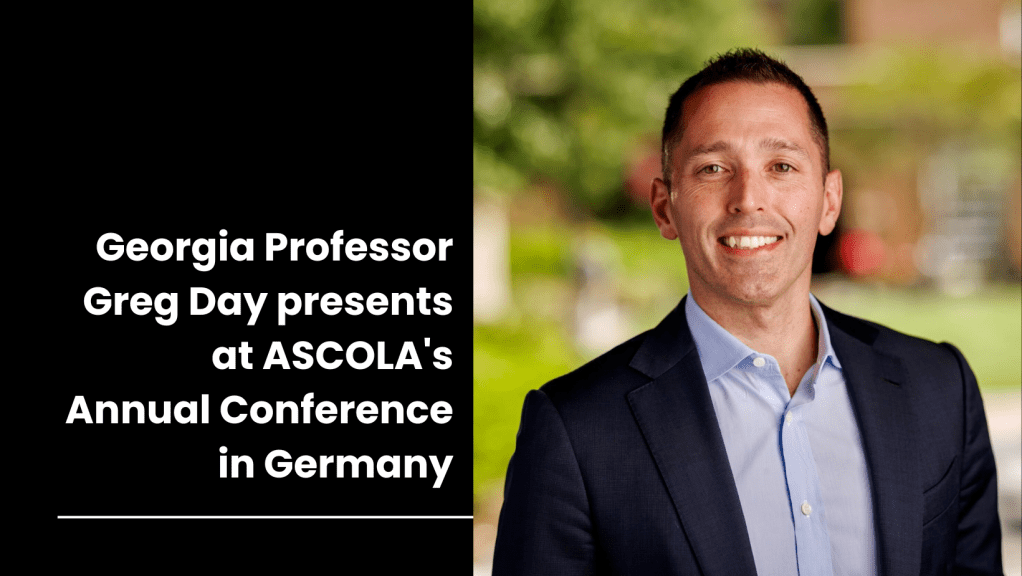
Georgia Professor Greg Day presents at ASCOLA’s Annual Conference in Germany

University of Georgia Associate Professor of Legal Studies Greg Day recently presented research at the 19th American Society for Competition Law (ASCOLA) Annual Conference in Würzburg, Germany. The conference brings together about 120 scholars doing research in competition law, economics or policy from all over the world. 

Greg Day is an Associate Professor of Legal Studies at the Terry College of Business and holds a courtesy appointment in the School of Law. He is also an Affiliated Fellow at Yale Law School’s Information Society Project as well as the University of North Carolina’s Center for Information, Technology, and Public Life. His research has primarily focused on the intersection of competition, technology, innovation, and privacy as well as the disparate impact of anticompetitive conduct.