Georgetown Law professor Katrin Kuhlmann presents working paper at International Law Colloquium

The University of Georgia School of Law’s spring 2025 International Law Colloquium welcomed Professor Katrin Kuhlmann, who presented her working paper, “Micro International Law.” Greg Day, Associate Professor in the Terry College of Business at the University of Georgia, served as Kuhlmann’s faculty discussant.

Kuhlmann is the Faculty Director and Co-founder of the Center on Inclusive Trade and Development at Georgetown Law. Her scholarly focus lies in international law, development, inclusive and sustainable international trade law, regional trade agreements, agricultural law and food security, comparative economic law, African trade and development law and corridors, and the interdisciplinary connections between law and development.

Below is an abstract of Kuhlmann’s working paper:

International law has long been viewed as the domain of countries and capitals, not fields or factories, but this overly top-down perspective misses a critical and under-studied part of the picture. Underneath the macro level of standardized legal norms, international law is much more nuanced, with multiple sites of influence, production, design, adoption, and decision-making that scholars have largely neglected but which need to be better understood. Models stemming from legal systems in less powerful states, smaller-scale stakeholder interests, and local solutions are often treated as one-off anecdotes or isolated case studies without broader implications.

Capturing these lessons, cataloging them, and building a methodology around them could be transformational at a time when international law needs a refresh to make it more responsive to a new set of global challenges ranging from inequality to food insecurity to climate change.

This paper presents a conceptual and methodological framework for “micro international law” as a sub-field of international law. Adding a micro dimension to international law would bring it in line with other disciplines that recognize the importance of studying smaller-scale, more granular interventions. It would also make a significant contribution to the international legal field by integrating theoretical and empirical approaches to focus on the impact innovations within domestic legal systems and the interests of individuals have on international law (and the impact of international law on these systems and stakeholders), ultimately providing a framework for designing international law differently to equitably address more specialized needs and positively impact the lives of those international law aims to serve and benefit.

This year, Professor Desirée LeClercq is overseeing the colloquium, which is designed to introduce students to features of international economic law through engagement with scholars in the international legal field. To view the full list of International Law Colloquium speakers, visit our website.

This program is made possible through the Kirbo Trust Endowed Faculty Enhancement Fund and the Talmadge Law Faculty Fund.

Georgia Professor Assaf Harpaz selected as laureate at the Journal of International Economic Law Junior Faculty Forum

University of Georgia School of Law assistant professor Assaf Harpaz has been selected as a laureate to present his paper titled “Global Tax Wars and the Shift to Source-Based Taxation” at the Journal of International Economic Law Junior Faculty Forum (JIEL JFF).

Below is an abstract of the paper:

Current debates in international taxation often focus on how to fairly allocate taxing rights between jurisdictions. When an enterprise earns income abroad, both the country of residence (where the taxpayer resides) and the country of source (where income is generated) have legitimate, competing claims to tax that income. The issue is further complicated in a digital economy where tax avoidance and profit shifting practices are abundant.

Income tax treaties have traditionally favored residence-based taxation. Now, the international tax framework is at a crossroads with intergovernmental organizations battling to redefine the principles of cross-border taxation. The regime has been dominated by the Global North through the Organisation for Economic Co-operation and Development (OECD), which has drawn backlash due to its undemocratic procedure and unfavorable outcomes for developing countries. The United Nations has held a relatively peripheral role in global tax governance, yet this could change with an upcoming UN Framework Convention on International Tax Cooperation – an initiative overwhelmingly supported by developing countries. This article conceptualizes the international tax discourse as “tax wars,” contrasting the taxing powers and interests of the OECD-led Global North with those of the UN-backed Global South. It highlights the distributive effects of tax treaties and argues for a shift toward source-based taxation. To do so, it proposes revisiting the permanent establishment standard in model treaty language, creating an opportunity for broader taxation of business profits in the source country. This transition will address longstanding disparities and is increasingly warranted in a digital economy that does not rely on physical presence

Assaf Harpaz joined University of Georgia School of Law as an assistant professor in summer 2024 and will teach classes in federal income tax and business taxation. Harpaz’s scholarly focus lies in international taxation, with an emphasis on the intersection of taxation and digitalization. He explores the tax challenges of the digital economy and the ways to adapt 20th-century tax laws to modern business practices.

Georgia Law Professor Bruner presents on national identity and economic development at Princeton University “Post-Colonial Era” symposium

“National Identity and Economic Development in Market-Dominant Small Jurisdictions” is the title of the workshop paper that Christopher Bruner, the Stembler Family Distinguished Professor in Business Law here at the University of Georgia School of Law, presented last Friday at Princeton University.

Bruner’s talk was part of a symposium on “Law, Identity, and Economic Development in the Post-Colonial Era: The Case of the Northern Atlantic and Larger Caribbean Regions,” hosted by the Princeton School of Public and International Affairs. The university’s Liechtenstein Institute on Self-Determination co-sponsored the event.

Georgia Law Professor Cohen takes part in AALS roundtable on law, international economic security


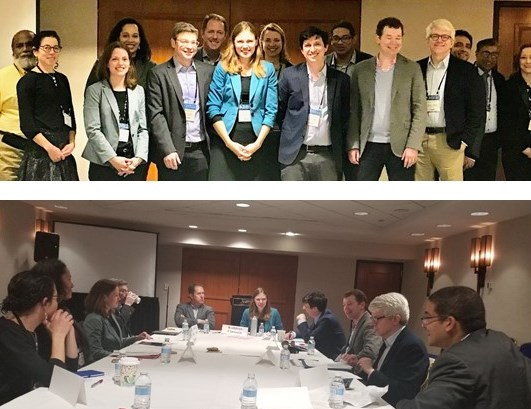
Harlan G. Cohen, Gabriel M. Wilner/UGA Foundation Professor in International Law and Faculty Co-Director of Dean Rusk International Law Center, participated in a roundtable on “Changing Concepts of International Economic Security & the Law” at the Annual Meeting of the Association of American Law Schools.

Organized by Kathleen Claussen (University of Miami School of Law), other participants in the AALS roundtable included: Anupam Chander (Georgetown University Law Center), Jennifer Daskal (American University, Washington College of Law), Kristen Eichensehr (University of California, Los Angeles School of Law), J. Benton Heath (New York University School of Law), Jide O. Nzelibe (Northwestern University Pritzker School of Law), Aaron D. Simowitz (Willamette University College of Law), Anna Spain Bradley (University of Colorado Law School), and Edward T. Swaine (The George Washington University Law School). (credit for photos)

Participants convened to discuss emergent global tensions between economics and national security and how the relevant legal regimes – trade, investment, development, finance, and national security – might respond. Among the topics of discussion were two papers by Professor Cohen:

one that discusses domestic national security delegations to the Executive Branch in the United States; and

another, “Nations and Markets,” that attempts to diagnose the causes of current global conflicts over jobs, data, climate change, and beyond (prior post).

Brexit and international trade expert, Dr. Hanspeter Tschaeni, to speak at Georgia Law

The Dean Rusk International Law Center at the University of Georgia School of Law is pleased to host Dr. Hanspeter Tschaeni for Coffee and Conversation: International Trade and Economic Law this afternoon.

Hanspeter Tschaeni

Dr. Tschaeni is Chief Trade Adviser at Trade Advisers, a consulting firm engaged in activities relating to the British exit from the European Union. He also serves on several World Trade Organization dispute settlement panels.

Previously, Dr. Tschaeni served for more than thirty years in the Swiss Federal Administration, where he was Head of Section on International Economic Law and Deputy Head of Division on Foreign Economic Services, with the rank of ambassador. In that capacity, he participated as legal counsel and headed delegations in negotiations with the European Union and in free-trade agreement negotiations with numerous countries around the globe.

Co-sponsors of the event include Georgia Law’s Business Law Society and the International Law Society.

Details here.