
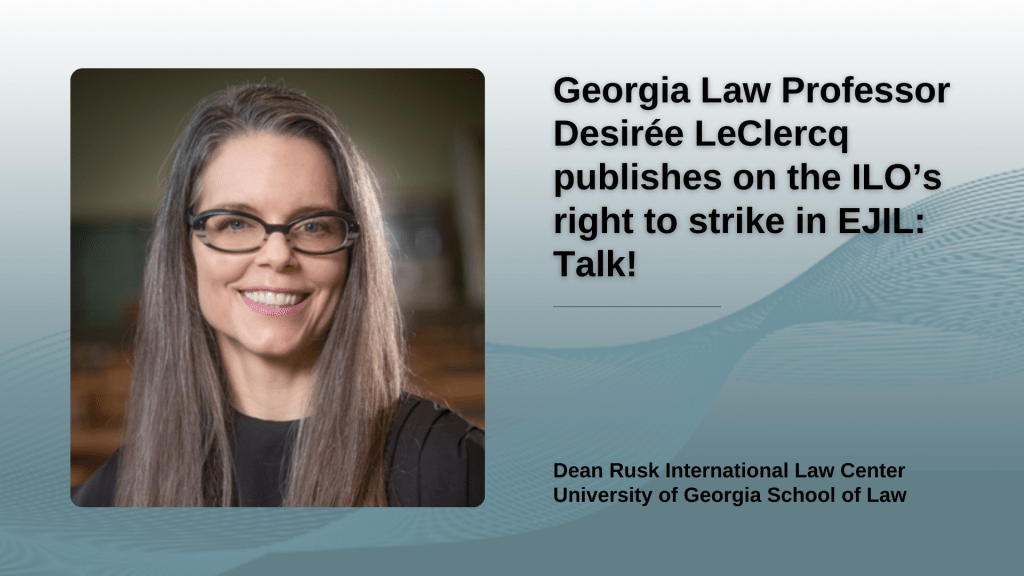
University of Georgia School of Law Professor Desirée LeClercq published “The ILO’s Right to Strike: Distinguishing Non-Binding Principles from Binding Conventions at the ICJ” in EJIL: Talk!, the blog of the European Journal of International Law.
In the post, LeClercq analyzes the International Court of Justice’s proceedings connected to the International Labour Organization’s request for an advisory opinion on whether the right to strike is protected under Convention No. 87. She focuses on how non-binding ILO principles interact with binding conventions, and what that distinction could mean for interpreting Convention No. 87 in international law and in related policy contexts.
LeClercq joined the University of Georgia School of Law in 2024 as an assistant professor. She teaches Contracts, International Trade and Workers Rights, International Labor Law, U.S. Labor Law, and Public International Law. She also serves as a faculty co-director of the Dean Rusk International Law Center and as the faculty adviser for the Georgia Journal of International and Comparative Law and the Labor and Employment Student Association.

 exchange of notes