Provost Pamela Whitten to speak at Georgia Law event on women’s leadership at AALS annual meeting

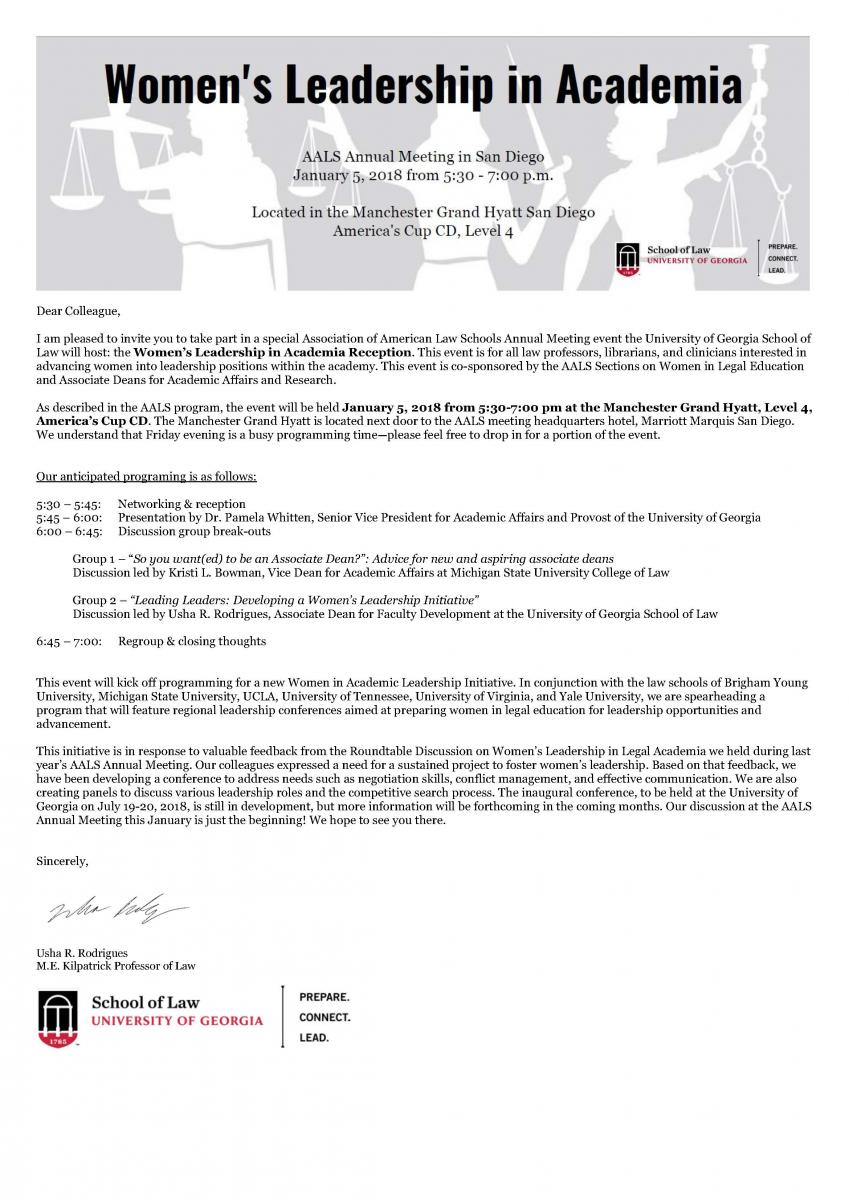
Law professors, librarians, and clinicians “interested in advancing women into leadership positions within the academy” are invited to take part in a special University of Georgia School of Law reception at next week’s annual meeting of the Association of American Law Schools.

As described in the AALS program, the event will be held January 5, 2018 from 5:30-7:00 pm at the Manchester Grand Hyatt, Level 4, America’s Cup CD, San Diego, California.

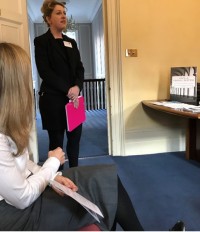
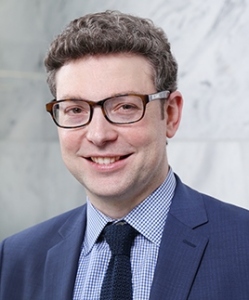
University of Georgia Provost Pamela Whitten (left) will give a presentation at the reception, which will also feature breakout discussions led by Kristi L. Bowman (right), Vice Dean for Academic Affairs at Michigan State University College of Law, and Usha R. Rodrigues (below right), Associate Dean for Faculty Development at the University of Georgia School of Law.

o-sponsoring are the AALS Section on Women in Legal Education and the AALS Section Associate Deans for Academic Affairs and Research.

Kudos to my colleague Usha, the principal organizer of this event. It’s a followup to the Roundtable Discussion on Women’s Leadership in Legal Academia that Georgia Law hosted at last year’s AALS one of many Georgia Women in Law Lead (Georgia WILL) events last academic year. As Usha explains in her invitation:

“This event will kick off programming for a new Women in Academic Leadership Initiative. In conjunction with the law schools of Brigham Young University, Michigan State University, UCLA, University of Tennessee, University of Virginia, and Yale University, we are spearheading a program that will feature regional leadership conferences aimed at preparing women in legal education for leadership opportunities and advancement.

“This initiative is in response to valuable feedback from the Roundtable Discussion on Women’s Leadership in Legal Academia we held during last year’s AALS Annual Meeting. Our colleagues expressed a need for a sustained project to foster women’s leadership. Based on that feedback, we have been developing a conference to address needs such as negotiation skills, conflict management, and effective communication. We are also creating panels to discuss various leadership roles and the competitive search process. The inaugural conference, to be held at the University of Georgia on July 19-20, 2018 …”

Details here and here.

Important essays on myriad international law subfields in OUP book coedited by Professor Amann, “Arcs of Global Justice: Essays in Honour of William A. Schabas”

LONDON – Building on yesterday’s post about the magical London conference launching Arcs of Global Justice: Essays in Honour of William A. Schabas (Margaret M. deGuzman and Diane Marie Amann eds.), today’s post profiles the book itself, which, thanks to excellent assistance from John Louth, Blake Ratcliff, and their staff, has just been published by Oxford University Press. (The hardback may be ordered via OUP or Amazon, and the book’s also available on Kindle.)

Not least because Professor Schabas delivered two talks here at the University of Georgia School of Law in 2013, I’m very pleased to have coedited this volume with my colleague Meg. The concept, in our words:

Martin Luther King, Jr. once said ‘the arc of the moral universe is long, but it bends toward justice.’ Testing the optimism of that claim were the many fits and starts in the struggle for human rights that King helped to catalyze. The same is true of other events in the last half-century, from resistance to apartheid and genocide to equal and fair treatment in domestic criminal justice systems, to the formation of entities to prevent atrocities and to bring their perpetrators to justice. Within this display of myriad arcs may be found the many persons who helped shape this half-century of global justice-and prominent among them is William A. Schabas. His panoramic scholarship includes dozens of books and hundreds of articles, and he also has served as an influential policymaker, advocate, and mentor.

This work honours William A. Schabas and his career with essays by luminary scholars and jurists from Africa, Asia, Europe, and the Americas. The essays examine contemporary, historical, cultural, and theoretical aspects of the many arcs of global justice with which Professor Schabas has engaged, in fields including public international law, human rights, transitional justice, international criminal law, and capital punishment.

In all, the book includes 29 contributions by 35 academics, advocates, and jurists, as detailed in the table of contents below. Providing jacket-cover testimonials were Steven Kay QC, Philippe Sands QC, Professor and former Ambassador David Scheffer, and Judge Christine Van den Wyngaert. We hope that you’ll follow their recommendations and give these important, substantive essays a very good read.

Arcs of Global Justice:
Essays in Honour of William A. Schabas

Foreword by Diane Marie Amann and Margaret M. deGuzman, coeditors
Introduction: William Schabas: Portrait of a Scholar/Activist Extraordinaire by Roger S. Clark, Board of Governors Professor of Law, Rutgers University School of Law

Human Rights
Human Rights and International Criminal Justice in the Twenty First Century: The End of the Post-WWII Phase and the Beginning of an Uncertain New Era by M. Cherif Bassiouni (He died at age 79 in September, just weeks after he completed final changes on this essay; as posted, our conference included a memorial to him. At the time of his death, he was Emeritus Professor of Law, DePaul University College of Law; Honorary President, Siracusa Institute for Criminal Justice and Human Rights; and Honorary President, L’Association internationale de droit pénal.)
William Schabas, the Canadian Charter of Rights and Freedoms and International Human Rights Law by Justice Thomas A. Cromwell, Supreme Court of Canada, and Bruno Gélinas-Faucher, formerly a law clerk on that court and now a Cambridge PhD candidate
The International Convention on the Protection of All Persons from Enforced Disappearance, as a Victim-Oriented Treaty by Emmanuel Decaux, Professor Emeritus, Université Paris 2 (Panthéon-Assas), and former President, Committee on Enforced Disappearances
The Politics of Sectarianism and its Reflection in Questions of International Law & State Formation in The Middle East by Kathleen Cavanaugh, Senior Lecturer at the Irish Centre for Human Rights, National University of Ireland Galway, and  Joshua Castellino, Professor of Law & Dean of the School of Law, as well as the Business School, at Middlesex University, London

Capital Punishment
International Law and the Death Penalty: A Toothless Tiger, or a Meaningful Force for Change? by Sandra L. Babcock, Clinical Professor of Law at Cornell Law School and Faculty Director of the Cornell Center on the Death Penalty Worldwide
The UN Optional Protocol on the Abolition of the Death Penalty by Marc Bossuyt, Fellow at the Stellenbosch Institute for Advanced Study, Emeritus Professor of the University of Antwerp, Emeritus President of the Constitutional Court of Belgium, and former Chairman of the UN Commission on Human Rights
The Right to Life and the Progressive Abolition of the Death Penalty by Christof Heyns, formerly the UN Special Rapporteur on extrajudicial, summary or arbitrary executions from 2010 through 2016, and now a member of the UN Human Rights Committee and Professor of Human Rights Law at the University of Pretoria, Thomas Probert, Research Associate, Centre of Governance & Human Rights, University of Cambridge, and Tess Borden, Aryeh Neier Fellow at Human Rights Watch and the American Civil Liberties Union, and former researcher for the UN Special Rapporteur on extrajudicial, summary or arbitrary execution
Progress and Trend of the Reform of the Death Penalty in China by Zhao Bingzhi, Dean of the College for Criminal Law Science of Beijing Normal University, President of the Criminal Law Research Association of China, Vice-President of the International Association of Penal Law, and President of that association’s Chinese National Group

International Criminal Law
Criminal Law Philosophy in William Schabas’ Scholarship by Margaret M. deGuzman, Professor of Law at Temple University’s Beasley School of Law
Is the ICC Focusing too Much on Non-State Actors? by Frédéric Mégret, Associate Professor and Dawson Scholar, Faculty of Law, McGill University
The Principle of Legality at the Crossroads of Human Rights and International Criminal Law by Shane Darcy, Senior Lecturer at the Irish Centre for Human Rights, National University of Ireland Galway
Revisiting the Sources of Applicable Law Before the ICC by Alain Pellet, Emeritus Professor at the University of Paris Nanterre, former Chairperson of the UN International Law Commission, President of the French Society for International Law, Member of the Institut de droit international, as well as Counsel and Advocate before the International Court of Justice, the International Tribunal for the Law of the Sea, and other forums
The ICC as a Work in Progress, for a World in Process by Mireille Delmas-Marty, Member, Institut de France, and Professor Emerita, Collège de France de Paris
Legacy in International Criminal Justice by Carsten Stahn, Professor of International Criminal Law and Global Justice, Leiden University
Torture by Private Actors and ‘Gold Plating’ the Offence in National Law: An Exchange of Emails in Honour of William Schabas by Andrew Clapham, Professor of Public International Law at the Graduate Institute of International and Development Studies in Geneva, and Paola Gaeta, Professor of International Law and International Criminal Law at the Graduate Institute of International and Development Studies, Geneva

Genocide and Crimes Against Humanity
Secrets and Surprises in the Travaux Préparatoires of the Genocide Convention by Hirad Abtahi, First Legal Adviser, Head of the Legal and Enforcement Unit, at the Presidency of the International Criminal Court, and Philippa Webb, Reader (Associate Professor) in Public International Law at King’s College London and a barrister at 20 Essex Street Chambers
Perspectives on Cultural Genocide: From Criminal Law to Cultural Diversity by Jérémie Gilbert, Professor of International and Comparative Law, University of East London
Crimes Against Humanity: Repairing Title 18’s Blind Spots by Beth Van Schaack, Leah Kaplan Visiting Professor in Human Rights at Stanford Law School and Visiting Scholar at the Center for International Security & Cooperation at Stanford University
A New Global Treaty on Crimes Against Humanity: Future Prospects by Leila Nadya Sadat, James Carr Professor of International Criminal Law and Director of the Whitney R. Harris World Law Institute at Washington University School of Law, Special Adviser to the ICC Prosecutor on Crimes Against Humanity, and Director of the Crimes Against Humanity Initiative

Transitional Justice and Atrocity Prevention
Justice Outside of Criminal Courtrooms and Jailhouses by Mark A. Drumbl, Class of 1975 Alumni Professor of Law and Director, Transnational Law Institute, Washington and Lee University School of Law
Toward Greater Synergy between Courts and Truth Commissions in Post-Conflict Contexts: Lessons from Sierra Leone by Charles Chernor Jalloh, Professor of Law, Florida International University, and a member of the International Law Commission
International Criminal Tribunals and Cooperation with States: Serbia and the provision of evidence for the Slobodan Milosevic Trial at the ICTY by Geoffrey Nice QC, a barrister since 1971, formerly at the International Criminal Tribunal for the Former Yugoslavia, and Nevenka Tromp, Lecturer in East European Studies at the University of Amsterdam and former member of the ICTY Leadership Research Team
The Arc toward Justice and Peace by Mary Ellen O’Connell, the Robert and Marion Short Chair in Law at the University of Notre Dame Law School
The Maintenance of International Peace and Security through Prevention of Atrocity Crimes: The Question of Co-operation between the UN and regional Arrangements by Adama Dieng, UN Under-Secretary-General and Special Adviser on the Prevention of Genocide, as well as former Registrar of the International Criminal Tribunal for Rwanda and former Secretary-General of the International Commission of Jurists

Justice in Culture and Practice
Law and Film: Curating Rights Cinema by Emma Sandon, Senior Lecturer in Film and Television at Birkbeck, University of London, and a Research Fellow to the Chair for Social Change, University of Johannesburg
The Role of Advocates in Developing International Law by Wayne Jordash QC, international human rights and humanitarian lawyer and founding partner of Global Rights Compliance
Bill the Blogger by Diane Marie Amann, Emily and Ernest Woodruff Chair in International Law and Faculty Co-Director of the Dean Rusk International Law Center at the University of Georgia School of Law

(Cross-posted from Diane Marie Amann)
Optimism about “Arcs of Global Justice” at London launch of Professor Amann’s coedited OUP essay collection honouring William A. Schabas

LONDON – “Optimism” was the byword for Friday’s magical conference launching Arcs of Global Justice: Essays in Honour of William A. Schabas, the just-published Oxford University Press collection coedited by Margaret M. deGuzman and myself.

The event took place in a Christmas-tree-lighted conference room at 9 Bedford Row, the London chambers where our honouree, Bill Schabas (above center), is a door tenant.

Professor Schabas is well known at the University of Georgia. During a 2013 visit to the Athens campus, he presented “The Drafting and Significance of the Universal Declaration of Human Rights,” the opening chapter of a then-forthcoming treatise, as part of the International Law Colloquium, a University of Georgia School of Law course. Additionally, Bill gave a public lecture entitled “Human Rights and Culture,” cosponsored by the law school and by the university’s Willson Center for Humanities & Arts.

At Friday’s London launch, Bill and his wife, Penelope Soteriou, were joined by several of the 35 women and men whose 29 contributions comprise the volume, many friends, colleagues, PhD students, and relatives.

Gillian Higgins (left), Head of the International Practice Group at 9 Bedford Row, opened with a warm message of welcome and congratulations. Then followed a celebration that combined lighthearted anecdotes with serious presentations of scholarship. Topics ranged as far and wide as Schabas’ multifaceted career, which includes current appointments as Professor of International Law at Middlesex University, London, Professor of International Criminal Law and Human Rights at Leiden University, and Emeritus Professor of Human Rights Law and Honorary Chairman of the Irish Centre for Human Rights, National University of Ireland Galway; service as a member of the Sierra Leone Truth and Reconciliation Commission and as a consultant on capital punishment for the United Nations Office of Drugs and Crime; and authorship of hundreds of books, chapters, and articles.

A sobering moment came in Birkbeck Lecturer Emma Sandon‘s discussion of Schabas’ role as an organizer of and speaker at human rights film festivals. Sandon (above) concluded with a clip from Judgment at Nuremberg (1961). All fell silent while watching the characters in the video courtroom watch actual footage from the Allied liberations of concentration camps like Buchenwald.

Also moving was the memorial that Northwestern University Law Professor David Scheffer gave on behalf of contributor Cherif Bassiouni, who died at age 79 in September, not long after finishing his chapter, entitled “Human Rights and International Criminal Justice in the Twenty-First Century: The End of the Post-WWII Phase and the Beginning of an Uncertain New Era.” (Bassiouni also penned a dedication for our conference programme, available in PDF here.) Scheffer described the essay in light of his own and Schabas’ writings, and concluded on a optimistic note regarding the future of human rights.

That same note sounded in Schabas’ own interventions throughout the day. On issues ranging from the International Criminal Court to abolition of the death penalty, he assured his audience that even in these times, when the day-to-day “weather” may seem grim, the overall “climate” offers much room for optimism.

Here’s order of the day (full PDF programme here; additional contributors in attendance included Middlesex Law Dean Joshua Castellino and Cambridge PhD candidate Bruno Gélinas-Faucher):

Arcs of Global Justice:
Conference Launching Essay Collection in Honour of William A. Schabas
Friday, 8 December 2017, 9 Bedford Row, London

Opening
“Welcome” by Gillian Higgins, Head of the International Practice Group at 9 Bedford Row
“In Memoriam for Cherif Bassiouni” by David Scheffer, Mayer Brown/Robert A. Helman Professor of Law and Director of the Center for International Human Rights at Northwestern University Pritzker School of Law, Chicago
“Introduction to Arcs of Global Justice” by coeditors Diane Marie Amann and Margaret M. deGuzman

International Law & Criminal Justice
“The Principle of Legality at the Crossroads of Human Rights & International Criminal Law” by Shane Darcy, Senior Lecturer at the Irish Centre for Human Rights, National University of Ireland Galway
“Criminal Law Philosophy in William Schabas’s Scholarship” by Margaret M. deGuzman, Professor of Law at Temple University’s Beasley School of Law
“Perspectives on Cultural Genocide: From Criminal Law to Cultural Diversity” by Jérémie Gilbert, Professor of International and Comparative Law, University of East London
“Toward Greater Synergy between Courts & Truth Commissions in Post-Conflict Context: Lessons from Sierra Leone” by Charles Chernor Jalloh, Professor of Law, Florida International University, and a member of the International Law Commission
Moderator: Kathleen Cavanaugh, Senior Lecturer at the Irish Centre for Human Rights, National University of Ireland Galway

Justice / Scholarship / Culture / Practice
“Bill the Blogger” by Diane Marie Amann, Emily and Ernest Woodruff Chair in International Law and Faculty Co-Director of the Dean Rusk International Law Center at the University of Georgia School of Law
“Advocates, Scholars & Maintaining the International Criminal Law Momentum” by Wayne Jordash QC, international human rights and humanitarian lawyer and founding partner of Global Rights Compliance
“Law & Film: Curating Rights Cinema” by Emma Sandon, Senior Lecturer in Film and Television at Birkbeck, University of London, and a Research Fellow to the Chair for Social Change, University of Johannesburg
Moderator: Michelle Farrell, Senior Lecturer in Law in the School of Law and Social Justice, University of Liverpool

Abolition of the Death Penalty
“International Law & the Death Penalty: A Toothless Tiger, or a Meaningful Force for Change?” by Sandra L. Babcock, Clinical Professor of Law at Cornell Law School and Faculty Director of the Cornell Center on the Death Penalty Worldwide
The Right to Life & the Progressive Abolition of the Death Penalty by Thomas Probert, Research Associate, Centre of Governance & Human Rights, University of Cambridge (on behalf of himself & co-authors Christof Heyns & Tess Borden)
Moderator: Jon Yorke, Professor of Human Rights and Director of the Centre for Human Rights at Birmingham City School of Law

Closing
Introduction by John Louth, Editor-in-Chief of Academic Law at Oxford University Press
Remarks by William A. Schabas OC MRIA

Reception

With thanks to our host, 9 Bedford Row, & cosponsor, Oxford University Press

◊ ◊ ◊

Cross-posted at Diane Marie Amann. Tomorrow’s post: Details on Arcs of Justice: Essays in Honour of William A. Schabas (Margaret M. deGuzman and Diane Marie Amann, eds.) (OUP 2018) (The hardback may be ordered via OUP or Amazon, and the book’s also available on Kindle.)

Professor Amann publishes AJIL essay on ICJ’s nuclear weapons rulings

Professor Diane Marie Amann‘s most recent publication appears in the latest print edition of the American Journal of International Law, in the section that analyzes recent judgments. Entitled “International Decisions: Obligations Concerning Negotiations Relating to Cessation of the Nuclear Arms Race and to Nuclear Disarmament,” it may be found at 111 AJIL 439 (2017).

The essay sets forth key aspects of 3 judgments (available here) that the International Court of Justice issued in October 2016 – as well as the response to those rulings by one party, the United Kingdom. It offers thoughts on potential future nuclear disarmament efforts. (It went to press before adoption of one such effort, the 2017 Treaty on the Prohibition of Nuclear Weapons, which at this writing has 3 states parties and 53 signatories, none of them nuclear weapons states.)

Here at the University of Georgia School of Law, Amann holds the Emily & Ernest Woodruff Chair in International Law and serves as Faculty Co-Director of the Dean Rusk International Law Center. Her article, which also forms part of Georgia Law’s Dean Rusk International Law Center Research Paper Series at SSRN, may be downloaded at this SSRN link.
Here’s the abstract:

“In a trio of decisions, the International Court of Justice rejected the applications in which the Republic of the Marshall Islands claimed that three large states known to possess nuclear weapons, India, Pakistan, and the United Kingdom, had breached their international obligations to undertake and conclude negotiations leading to nuclear disarmament. This essay discusses those decisions, as well as the United Kingdom’s subsequent limitation of the circumstances under which it will accept the ICJ’s jurisdiction over such complaints. This development, coupled with the Court’s own narrowing of circumstances in which such an application will be accepted, make the likelihood of an eventual ruling on the nuclear disarmament issue quite remote.”

Professor Bruner presents at Law, Finance and Sustainability conference at University of Sheffield, England

Christopher Bruner, J. Alton Hosch Professor of Law at the University of Georgia School of Law, took part on Monday at a global conference on “Law, Finance & Sustainability” in Sheffield, England.

Hosted by the Institute of Corporate and Commercial Law at the University of Sheffield, and cosponsored by the Sustainable Market Actors for Responsible Trade (SMART) initiative at the University of Oslo, Norway, the event brought together an international group of scholars and practitioners to discuss financial dimensions of corporate sustainability.

Professor Bruner’s scholarship scholarship focuses on corporate, securities and financial law, including international and comparative dimensions. At the Sheffield conference, he presented a working paper titled “Corporate Governance Reform in Post-Crisis Financial Firms: Two Fundamental Tensions.”

“The Next Generation of International Trade Agreements”: September 18 Georgia Law conference to feature trade law scholars, practitioners

Eugene Talmadge Memorial Bridge over the Savannah River, at the Port of Savannah, Georgia, the largest single container terminal in the United States. Photo (1998) by Jonas N. Jordan, U.S. Army Corps of Engineers.

“The Next Generation of International Trade Agreements” is the timely title of this year’s annual conference organized by the Georgia Journal of International & Comparative Law and Dean Rusk International Law Center, University of Georgia School of Law. Set for Monday, September 18, 2017, the daylong conference will celebrate the 40th anniversary of the Center.

Scholars and practitioners from North America and Europe will come together to discuss one of the most pressing topics in today’s international arena. Panels, which will follow introductory remarks by Georgia Law Dean Peter B. “Bo” Rutledge and Center Director Kathleen A. Doty, are as follows:

Setting the Negotiating Agenda: C. Donald Johnson (Georgia Law JD’73), Emeritus Director of the Dean Rusk International Law Center and former U.S. Ambassador, Office of the U.S. Trade Representative; Professor Kathleen Claussen, Miami Law; Nicolas Lamp, Professor at Queen’s University Law, Canada, and former Dispute Settlement Lawyer, Appellate Body Secretariat, World Trade Organization; and Professor Timothy Meyer, Vanderbilt Law.

Changing Dynamics in Global Trade Negotiations: Professor Gregory Shaffer, California-Irvine Law; Professor Mark Wu, Harvard Law; and Professor Padideh Ala’i, American University Law. Moderating will be Tina Termei (Georgia Law JD’10), Corporate Counsel for Global Trade at Amazon.

Industry Roundtable Luncheon Conversation: Ling-Ling Nie, Chief Compliance Officer & Assistant General Counsel, Panasonic North America; Stewart Moran, Assistant General Counsel, Carter’s | OshKosh B’gosh; and Travis Cresswell, Senior Managing Counsel, The Coca-Cola Co.

Pluralism/Regionalism/Fragmentation: Professor Antonia Eliason, Mississippi Law; Professor Markus Wagner, Warwick Law, England; and Professor Robert Howse, New York University Law. Moderating will be Harlan G. Cohen, Gabriel M. Wilner/UGA Foundation Professor in International Law and Faculty Co-Director, Dean Rusk International Law Center, University of Georgia School of Law.

Delivering closing remarks will be Victoria A. Barker, Editor-in-Chief of the Georgia Journal of International & Comparative Law. Additional speakers are invited but not yet confirmed: invited: Terry Smith Labat (Georgia Law JD’77), U.S. Department of Commerce; Audrey Winter (Georgia Law JD’80), Deputy Assistant U.S. Trade Representative for China, Office of the U.S. Trade Representative; and Professor Saxby Chambliss, Sanders Political Leadership Scholar at Georgia Law, partner at DLA Piper, and former U.S. Senator.

Issues these experts will explore include, as described in the concept note:

“International trade law is at inflection point. Until quite recently, international trade agreements appeared to be moving along a relatively predictable trajectory. Reforms and changes were discussed and negotiated, but mostly along the margins of a supposed consensus about the general direction of the field. Political events of the past year, though – Brexit, the United States’ abandonment of TPP, calls to renegotiate NAFTA, accelerating negotiations of RCEP, and China’s roll out of its One Belt One Road initiative, among others – have challenged that trajectory and sent policymakers and trade lawyers in search of a new trade compass. A new period of negotiation and renegotiation, however, is on the horizon. While this is a source for many of anxiety, it is also an opportunity for progress, reform, and creative thinking. This conference will bring together top scholars and practitioners in the field to discuss the directions forward for international agreements. What should be on the table as old agreements are reopened and new ones are negotiated? What changes are needed to adapt trade agreements to new economic and technological realities? And how can the next generation of trade agreements respond to globalization’s discontents?”

Cosponsoring the conference are the law school’s Business Law Society, Corsair Law Society, and International Law Society, along with the University of Georgia School of Public & International Affairs.

Details and registration here for the conference, for which CLE credit is available.

Professor Cohen explores American international law and legal realism

Harlan Grant Cohen, the Gabriel M. Wilner/UGA Foundation Professor in International Law and Faculty Co-Director of our Dean Rusk International Law Center at the University of Georgia School of Law, has posted a chapter entitled “Are We (Americans) All International Legal Realists Now?,” which will appear in the forthcoming Cambridge University Press volume Concepts on International Law in Europe and the United States, edited by Chiara Giorgetti and Guglielmo Verdirame.

The manuscript, which forms part of our Dean Rusk International Law Center Research Paper Series at SSRN, may be downloaded at this SSRN link.

Here’s the abstract:

“Is American international law distinctly legal realist? The claim is often made, but underexplored. What would it mean for American international law scholarship and practice to be legal realist in its orientation? Where would such an orientation come from, and what do those origin stories mean for current international law work? Are there common realist-inspired approaches within the varied schools of American international law scholarship? Does wielding those approaches produce distinctly American views on international law doctrine, its operation, or its function? And if American international law scholarship and practice is, in these ways, somewhat distinct, what does it mean for the broader, global project of international law?

“This chapter takes the claim seriously and explores the ways in which American international law may in fact be tinged with legal realism. It explores how a number of intellectual trends—American jurisprudential legal realism, post-World War II international relations scholarship, utopian strands in American foreign policy thinking, and U.S.-specific foreign relations law—converged to bring a series of specific methods or attitudes to the forefront in American approaches international law. Perhaps provocatively, this chapter argues that all the major schools of American international law—New Haven, International Legal Process, Transnational Legal Process, Law and Economics, International Relations and International Law, and others—have picked up these methods, attitudes, or approaches—enough to warrant labeling all of them as essentially ‘legal realist.’

“And it explores how legal realism translates into four noticeable trends in American approaches to international law:

(1) a focus on norms rather than rules,

(2) a focus on process rather than doctrine,

(3) a focus on institutions and power rather than substantive rules, and

(4) an emphasis on pragmatism and practicality.”

Legal Spanish Study Group resumes

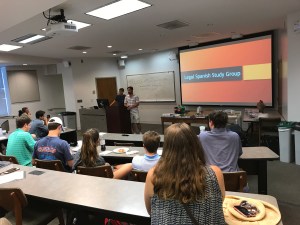
A feature of our second week of our fall semester was yesterday’s launch of the Legal Spanish Study Group, an initiative of the Dean Rusk International Law Center at the University of Georgia School of Law.

Leading the lunchtime session were the Group’s  co-coordinators, Georgia Law 2Ls Matthew Poletti and Brian Griffin. Both are Spanish speakers who were Global Externs Overseas this past summer – Matt at Araoz & Rueda Abogados in Madrid, Spain, and Brian at PwC in Milan, Italy. (Brian also attended our Global Governance Summer School.) They continue a tradition begun by the Group’s founding coordinator, Pedro Dorado (JD’17/LLM’15). Professor Diane Marie Amann, Emily & Ernest Woodruff Chair in International Law and a Faculty Co-Director of the Center, will serve as the Group’s faculty advisor.

This will be the 2d consecutive year that this Group convenes, most timely given yesterday’s New York Times report on the entrenchment of Spanish in the United States – which has more Spanish speakers than Spain – and the world – where more countries have Spanish as the majority language than any other language.

In the words of Matt and Brian:

“In our ever-more interconnected world, and especially in today’s legal field, proficiency in a second language is a skill in high demand. It might even make the difference in landing your dream job. We invite all law students to join us in our endeavor to improve our Spanish language skills, develop a better understanding of the Hispano-American legal world, and prepare for a globalized legal practice.”

Many students accepted that invitation, promising great Study Group meetings each week throughout the semester.

Georgia Journal of International and Comparative Law kicks off 2017–2018

Monday was orientation day for the students who’ll work on the 46th volume of the Georgia Journal of International & Comparative Law here at the University of Georgia School of Law.

Editor-in-Chief Victoria Barker reports that at orientation, the GJICL Editorial Board (pictured above) heard from Dean Peter B. “Bo” Rutledge about the importance of journal membership. Professor Harlan G. Cohen, a Dean Rusk International Law Center Faculty Co-Director and the Faculty Advisor for GJICL, and Kathleen A. Doty, the Center’s Director, spoke about international law opportunities for Georgia Law students. Speakers about careers and research techniques, respectively, included Laura E. Woodson, Associate Director of Career Development, and Anne Burnett, Foreign & International Law Librarian.

Among the year’s highlights will be the annual GJICL conference, set for Monday, September 18. Entitled “The Next Generation of International Trade Agreements,” it will feature more than a dozen specialists in trade, including 4 Georgia Law alums: the 1st woman to serve as GJICL Editor-in-Chief, Terry Labat; former GJICL Articles Editors Audrey Winter and C. Donald Johnson, Director Emeritus of our Center; and Tina Termei. Joining them will be other academic and practitioner experts from around the world.

This daylong event will celebrate the 40th anniversary of the law school’s Dean Rusk International Law Center, a cosponsor.

Leading GJICL‘s efforts this academic year will be these Executive Board members: Victoria Aynne Barker, Editor in Chief; Michael D. Aune, Executive Managing Editor; Shreya Praful Desai, Executive Articles Editor; Evan C. Dunn, Senior Articles Editor; Margaret Anne Christie and Caroline Anne Jozefczyk, Executive Editors; Michael Lawrence Baker, Executive Conference Editor; Jamie McDowell, Executive Online Editor; Spencer Newton Davis, Senior Managing Editor; Hannah E. Ponders, Executive Notes Editor; and Wheaton P. Webb, Senior Notes Editor.

Collaborating with them will be these members of the Managing Board: Jeremy Hall Akin and Caroline Frances Savini, Conference Editors; Justin T. Conway, Megan Colleen Dempsey, William Neal Hollington, Robert P. Mangum, Shawn Eric McKenzie, Anne Parks Minor, Ryan Holder Shriver, and Adam J. Sunstrom, Submissions and Online Editors; Kaitlyn Claire Fain, Ian M. Lamb, Ethan Keith Morris, Andrew F. Newport, Nichole Novosel, William Blake Ogden, Claire H. Provano, Katherine Nicole Reynolds, and Devon Gayle Zawko, Articles Editors; Matthew J. Courteau, Taylor Shea Eisenhaur, William Carroll Hart, Dana Lohrberg, Steven Chase Parker, Laney J. Riley, Beverly Elizabeth Tarver, and Max Mathew Wallace II, Notes Editors.

Joining the 3L editors just named will be an Editorial Board composed of these members of the 2L class: Deena A.S. Agamy, Dymond Alexis Anthony, Philicia Crystal Armbrister, Ezekiel Arthur, Samuel Baker, Lauren Elizabeth Brown, Amy Elizabeth Buice, Austin Chad Cohen, Keelin Cronin, Jacob Donald Davis, Erin Elizabeth Doyle, Garret Joseph Drogosch, Sarah Lanier Flanders, Simone Iman Ford, Laura Rose Golden, Allison Jean Gowens, Kathryn Cho Hagerman, Wade W. Herring, Evans Fuller Horsley, Ted Smith Huggins, Tammy Le, Zachariah Weston Lindsey, Karla Lissette Martinez, Jacob Thomas McClendon, Elizabeth Kate Modzeleski, Savannah Harrison Moon, Joseph A. Natt, Hayley Alexandra Nicolich, Lyddy Ellen O’Brien, Kyle James Paladino, Garrett B. Peters, Morgan Renee Podczervinski, Connor Jay Rose, Taylor Ann Samuels, Emily E. Seaton, Timia Andrielle Skelton, Nicholas Alan Steinheimer, Adam C. Taylor, Michael Lee Thompson, John James Van Why, Eric M.A. Wilder, Sydney Rebecca Wilson.

Looking forward to another great year!

Doty named Director of Georgia Law’s Dean Rusk International Law Center; Amann and Cohen Faculty Co-Directors

Kathleen A. Doty is the new Director of the Dean Rusk International Law Center at the University of Georgia School of Law. Assisting her are two Faculty Co-Directors, Diane Marie Amann and Harlan G. Cohen. The appointments took effect on August 1.

Since May 2017, Doty (left) has served as the Center’s Interim Director. She joined the law school in 2015, serving first as the Center’s Associate Director of Global Practice Preparation and then as Director of Global Practice Preparation. Her portfolio included: planning and the implementation of lectures, conferences and other events; research projects; advising students interested in global legal practice; administering Global Externships Overseas and At-Home; and coordinating and serving as a faculty member in the Global Governance Summer School, a 10-day offering in Europe conducted in partnership with the Leuven Centre for Global Governance Studies at the University of Leuven, Belgium.

As Director, Doty will oversee both global practice preparation and international professional education, including the Master of Laws, or LL.M., degree for foreign-trained lawyers. Her duties as a member of the law faculty will include teaching the Legal System of the United States course to LL.M. candidates.

Dean Peter B. “Bo” Rutledge said:

“We are very pleased that Kate Doty has agreed to take on this leadership role at the law school. I am confident that the center will benefit from her energy and extensive experience in the practice of international law.”

This autumn, the Center will celebrate its 40th birthday. Its namesake is Dean Rusk, who served as a law professor at the University of Georgia after serving as Secretary of State to Presidents John F. Kennedy and Lyndon B. Johnson. The Center serves as the law school’s international law and policy nucleus for education, scholarship, and other collaborations among faculty and students, the law school community, and diverse local and global partners. U.S. News & World Report ranks the law school’s international law curriculum 18th among U.S. law schools.

Doty will be the fifth person to lead the Dean Rusk International Law Center, following in the footsteps of Fredrick W. Huszagh, Thomas J. Schoenbaum, Gabriel M. Wilner, C. Donald Johnson Jr., and, most recently, Diane Marie Amann (left).

Professor Amann, who holds the Emily & Ernest Woodruff Chair in International Law, has just completed a term as Georgia Law’s Associate Dean for International Programs & Strategic Initiatives. An expert in public international law, she is a Counsellor of the American Society of International Law and serves as Special Adviser to the International Criminal Court Prosecutor on Children in & affected by Armed Conflict.

Amann will serve as Faculty Co-Director with Professor Cohen (right), holder of the Gabriel M. Wilner/UGA Foundation Professorship in International Law and an international economic law expert who is the Managing Editor of AJIL Unbound, the online platform of the American Journal of International Law.

In Dean Rutledge’s words:

“Diane provided excellent leadership for the Center over the past two-plus years, creating a strong foundation on which Kate and her team, assisted by Harlan and Diane, will build. I am confident the law school’s influence in the area of international law and policy will continue to grow.”

Before joining the Dean Rusk International Law Center, Doty practiced treaty law in Washington, D.C., as Assistant Counsel for Arms Control & International Law at the Office of the General Counsel, Strategic Systems Programs, U.S. Department of the Navy. Before that, she was Attorney-Editor at the D.C.-based American Society of International Law, where her duties included managing the American Journal of International Law and editing publications like ASIL Insights, International Law in Brief, International Legal Materials and the Benchbook on International Law. Her published writings cover issues such as the European Court of Human Rights, refugee law, transitional justice and the U.S. military commissions at Guantánamo.

She serves in leadership roles for the American Society of International Law (with which Georgia Law is an Academic Partner), as Chair of ASIL’s Non-Proliferation, Arms Control, and Disarmament Interest Group and Vice Chair of its Lieber Society on the Law of Armed Conflict. In 2016, Doty was selected as a Young Leaders Fellow by the World Affairs Council of Atlanta and joined other fellows in a professional development tour of China.

While earning her J.D. degree at the University of California, Davis School of Law, she competed in the international rounds of the Philip C. Jessup International Law Moot Court Competition. After serving as a judicial clerk on the Hawaiʻi Intermediate Court of Appeals, she was the inaugural Fellow of the California International Law Center at Cal-Davis Law. She received her undergraduate degree from Smith College, with a major in Latin American Studies and a minor in Film Studies, and studied abroad at La Universidad de la Habana in Cuba. She is fluent in Spanish and proficient in French.