Christopher M. Bruner is the Stembler Family Distinguished Professor in Business Law at the University of Georgia School of Law and serves as a faculty co-director of the Dean Rusk International Law Center.
Attendees included 3Ls Gloria Maria Correa, Madison Graham, and Tiffany Torchia, and Masters of Laws (LL.M.) students Dzmitry Liasovich, Zulma Perez, Christian Schneider, and Fabienne Taller. Graham was one of 5 students selected to serve as a Student Ambassador for the event. All seven students received a Louis B. Sohn Professional Development Fellowship to support their attendance of this conference. Awarded by the law school’s Dean Rusk International Law Center, Sohn Fellowships enable students to attend professional development opportunities related to international law.
International law faces an existential threat as history unfolds at unprecedented speed worldwide. Indeed, international law and international institutions at times appear incapable of protecting vulnerable persons against war, disease, hunger, exploitation, climate change, and other human and natural catastrophes. Some people–both individually and collectively–are openly eschewing legal values and frameworks in order to pursue results through other means, including dangerous and destabilizing ones. Is international law, in fact, powerless or does it remain a source of power that vulnerable persons can utilize to protect and advance their rights and interests? This year’s ILW is focused on engaged, interactive, and inclusive discussions about how international law can transcend perceptions and misperceptions of its powerlessness and fulfill its aspirations of balancing power through principles of justice, equality, and dignity.
Reflecting on the overall takeaways from the conference, Graham said:
As a student, this conference re-instilled the importance of the research process to me…I was reminded of how important it is to immerse yourself in the big ideas that other people are considering, learning about their work. Even in topics we may already be familiar with, there will always be someone who knows more – or, at the very least, is considering new angles. Put another way, I think conferences like this are integral to ensuring we are continuing to push the mental boundaries we inadvertently place on ourselves when we get into routines and habits of regular school and work lives. Conferences like these help us stay curious, and accordingly, help us re-examine what the law is capable of moving forward.
In describing the ways in which this experience benefitted her professionally, Perez said:
ABILA ILW 2024 was an extraordinary experience on many levels. Personally, I had the opportunity to connect with other professionals and leaders in the legal industry, reinforcing the valuable education I am receiving at Georgia Law by sharing insights with other attendees. Academically and professionally, it sparked my interest about some subjects that I hadn’t previously explored, and I am eager to explore further and apply this knowledge in my career. I now have a clearer understanding of how public and private sectors interact in a various issue, and I can see the professional opportunities that arise from this collaboration.
When asked about her favorite panel from the conference, Correa explained:
My favorite panel discussion was “Arbitrating with International Organizations” because the topic was completely novel to me. The panel discussed some relevant provisions on the International Law Commission’s work on “settlement of disputes to which international organizations are parties,” the practice of arbitral institutions like the Permanent Court of Arbitration, and how arbitration could be a useful tool to overcome barriers like immunity in disputes with international organizations.
To read prior posts about Georgia Law students using Sohn Fellowships to attend professional development opportunities, please click here and here.
University of Georgia School of Law Professor Diane Marie Amann participated last week in “How to Write Feminist Histories of International Law,” the first in a seven-session online seminar series entitled “Thinking Gender, History & International Law” hosted by the University of Warwick School of Law in Coventry, England.
Also joining in the conversation were: Professor Maria Drakopoulou, University of Kent Law School; Professor Gina Heathcote, Newcastle University Law School; Professor Aoife O’Donoghue, Queen’s University Belfast School of Law; and the seminar’s organizers, Dr. Paola Zichi and Dr. Aisel Omarova, both at Warwick Law.
Topics discussed included: what it means to apply feminist approaches to the history of international law; whether and how feminist viewpoints may enhance the writing of history; and what are the relations among feminist values, historical research, and theory or philosophy. (Register for future seminar sessions here.)
Amann, who has several publications broaching such issues, is Regents’ Professor of International Law, Emily & Ernest Woodruff Chair in International Law, and a Faculty Co-Director of our Dean Rusk International Law Center here at Georgia Law. This fall, she is spending a research-intensive semester in the United Kingdom, where she is a Research Visitor at the Oxford Faculty of Law Bonavero Institute of Human Rights and Visiting Fellow at Exeter College Oxford.
During the week of November 18, the University of Georgia School of Law will host events during the lunch hour to highlight International Education Week (IEW) 2024. IEW is a joint initiative between the U.S. Department of State and the U.S. Department of Education that promotes programs that prepare Americans for a global environment and attract future leaders from abroad to study, learn, and exchange experiences.
All events will take place from 12-1pm, unless noted below. Exact locations can be found in the event hyperlinks. The events for the week are as follows:
This event will allow 1Ls and 2Ls to have one-on-one discussions with their peers who have completed both summer and semester-long Global Externships Overseas (GEO). GEOs are work placements around the world that offer law students the opportunity to gain practical knowledge and legal experience in an international setting. Students present will include:
Georgia Law alumnus and adjunct professor Dr. Kannan Rajarathinam will discuss his recently published book, The DMK Years: Ascent, Descent, Survival (India Viking, 2024). The DMK Years tells the story of how India’s democracy has accommodated the cultural nationalist aspirations of the Tamils. The conversation will be co-facilitated by Professor Laura Phillips-Sawyer of Georgia Law and Dr. Laura Zimmermann of the School of Public and International Affairs.
Tuesday, November 19: Unlocking Your Global Legal Career: Discover the Dean Rusk International Law Center at UGA Law
Join the University of Georgia School of Law’s Admissions team for an informative webinar on the Dean Rusk International Law Center. Learn about the center’s unique offerings, including global externships, study abroad programs, and student experiences. Hear directly from Sarah Quinn, Director of the Dean Rusk International Law Center, Assistant Director of Admissions and Student Experience Diana DeJesus, and current law students Tiffany Torchia (J.D. 2025) and Benjamin Privitera (J.D. 2026). This webinar will provide valuable insights into the application process and how to pursue a global legal career.
Join the International Law Society for a brown bag lunch with Desirée LeClercq. LeClercq joined the University of Georgia School of Law in 2024 as an assistant professor. She teaches International Trade and Workers Rights, International Labor Law, International Law and U.S. Labor Law. She also serves as a faculty co-director of the Dean Rusk International Law Center and as the faculty adviser for the Georgia Journal of International and Comparative Law.
This event will offer perspectives on the importance of international experience on a law student’s resume and how to market that during the interview process. Featuring a panel of current students, recent grads, and career development professionals, this event will prepare you for taking part in one of the law school’s international opportunities.
Join current Master of Laws (LL.M.) students from Iran for a panel discussion about their experiences as women lawyers. The panel will include Sara Dorbahani and Paria Keramatkhah and will be moderated by Dr. Laura Kagel, Director of International Professional Education.
LeClercq’s article reviews two books that examine trade and labor rights, the development of the United States-Mexico-Canada Agreement (USMCA) and the Rapid Response Mechanism.
Below is an excerpt from the article:
Over the past decade, trade lawyers and legal researchers have had to take a crash course in international labor law and the so-called ‘sustainable development’ framework. Trade bans across the Atlantic punish governments and corporations for engaging in forced labor. The European Union (EU) recently revised its trade agenda to ensure that commitments to trade agreements with sustainable development provisions are enforceable through sanctions. The United States adopted a ‘worker-centered’ trade policy foregrounding international labor law, the International Labor Organization (ILO), and conceptions of workplace democracy, choice, and voice. The trade and labor linkage, long the source of dispute, is apparently with us to stay, with its attendant implications for trade, political relationships, and international economic law. Namely, who establishes the rules? Governments? International organizations? Civil society? And who decides whether and how those rules are violated?
LeClercq joined the University of Georgia School of Law in 2024 as an assistant professor. She teaches International Trade and Workers Rights, International Labor Law, International Law and U.S. Labor Law. She also serves as a faculty co-director of the Dean Rusk International Law Center and as the faculty adviser for the Georgia Journal of International and Comparative Law.
Attendees included 3L Jacob Wood and Master of Laws (LL.M.) students Sara Dorbahani, Michael Faleye, Paria Keramatkhah, Neethu James, Fatemeh Khouei, Samuel Kuo, and Zulma Perez. Five of these students (Wood, Dorbahani, Faleye, Keramatkhah, and Khouei) received Louis B. Sohn Professional Development Fellowships to support their attendance of this conference. Awarded by the law school’s Dean Rusk International Law Center, Sohn Fellowships enable students to attend professional development opportunities related to international law.
Conference attendees attended a number of talks and events designed for practitioners and students involved in international arbitration, including the ICC Young Arbitration & ADR Forum, the AtlAS Young Practitioners Group, networking lunches, and panel discussions. Georgia Law Dean Peter B. “Bo” Rutledge led a fireside chat with alumnus and current President of AtlAS, Christof Siefarth (LL.M. ’86).
Reflecting on the variety of panels and speakers in attendance, Keramatkhah said:
My favorite [discussion] was the panel on the “Top 10 Developments in Arbitration” and Dean Rutledge’s speech. This panel covered key trends in international arbitration, such as the rise of the Borneo Arbitration Center, and UNCITRAL procedural amendments. It also highlighted the growing importance of the new IBA Rules of Disclosure and updates to the 1996 English Arbitration Act. Differences between US and European arbitration were discussed, particularly in witness handling, cross-examination, and the judge’s role. I found this panel very interesting as it was very helpful in understanding the current and future challenges of arbitration. As it regards Dean Rutledge’s speech, since I was involved in [the] research of his speech, I appreciated that it provided deep insights into dispute resolution.
In describing the ways in which this experience benefitted him professionally, Wood said:
Attending the AtlAS conference reaffirmed my desire to practice in the field of international arbitration and aided in my pursuit of this goal. I was able to meet and converse with a variety of practitioners and arbitrators from across the globe.
When asked about her favorite moment from the conference, Dorbahani explained:
One of the standout sessions delved into the art of writing for a multicultural audience. As international arbitration becomes more diverse, mastering the nuances of cross-cultural legal advocacy is vital. It emphasizes how language can either clarify or complicate arbitration across borders. Coming from a Civil Law background, I found this especially relevant, as it highlighted the delicate balance needed to communicate effectively in a global legal landscape.
To read prior posts about Georgia Law students using Sohn Fellowships to attend professional development opportunities, please click here and here.
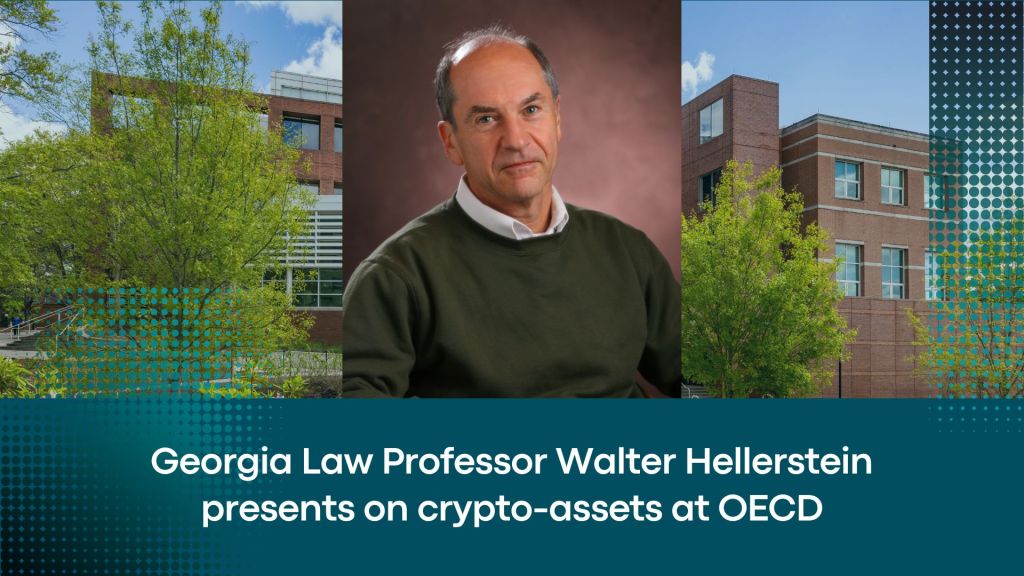
Distinguished Research Professor & Shackelford Distinguished Professor in Taxation Law Emeritus Walter Hellerstein co-presented as part of the VAT/GST Treatment of Activities Involving Crypto-Assets at the Organization for Economic Cooperation and Development Technical Advisory Group to Working Party No. 9 on Consumption Taxes meeting in Paris, France, in October.
The Working Party No. 9 on Consumption Taxes is a forum for the discussion of consumption tax policy and administration, working with both Members and non-Members of the OECD to develop appropriate and effective taxation outcomes. To read more about Professor Hellerstein’s previous presentation at the OECD, click here.
Hellerstein, a recipient of the National Tax Association’s Daniel M. Holland Medal for outstanding lifetime contributions to the study and practice of public finance, is widely regarded as the nation’s leading academician on state and local taxation. He has authored numerous books, textbooks, and law review articles, and has practiced extensively in the field. Hellerstein is currently a Visiting Professor at the Vienna University of Economics and Business, and he remains actively involved in his scholarship, consulting, and, in particular, his work as an academic advisor to the OECD.
Amann discussed the significance of the warrants, which had charged Russia’s President and another Presidential official of the war crimes of child deportation, and which were issued just days before the 2023 Annual Meeting. The remarks spurred her to further research on the topic, resulting in her article “Child-Taking,” also published this month, at 45 Michigan Journal of International Law 305 (2024) (prior post).
Also on the panel were: Professor Saira Mohamed, University of California-Berkeley School of Law; Professor Javier S. Eskauriatza, University of Nottingham Scholl of Law; and Professor Marko Milanović, University of Reading School of Law. Katherine Gallagher, Senior Staff Attorney at the Center for Constitutional Rights and an Adjunct Professor of Clinical Law at New York University School of Law, moderated. The panelists’ remarks in full are here.
Amann is Regents’ Professor of International Law, Emily & Ernest Woodruff Chair in International Law, and a Faculty Co-Director of our Dean Rusk International Law Center here at Georgia Law. She served from 2012 to 2021 as International Criminal Court Prosecutor Fatou Bensouda’s Special Adviser on Children in & affected by Armed Conflict. This Fall 2024 semester she is at the University of Oxford in the United Kingdom, serving as a Research Visitor at the Faculty of Law Bonavero Institute of Human Rights and as a Visiting Fellow at Exeter College.
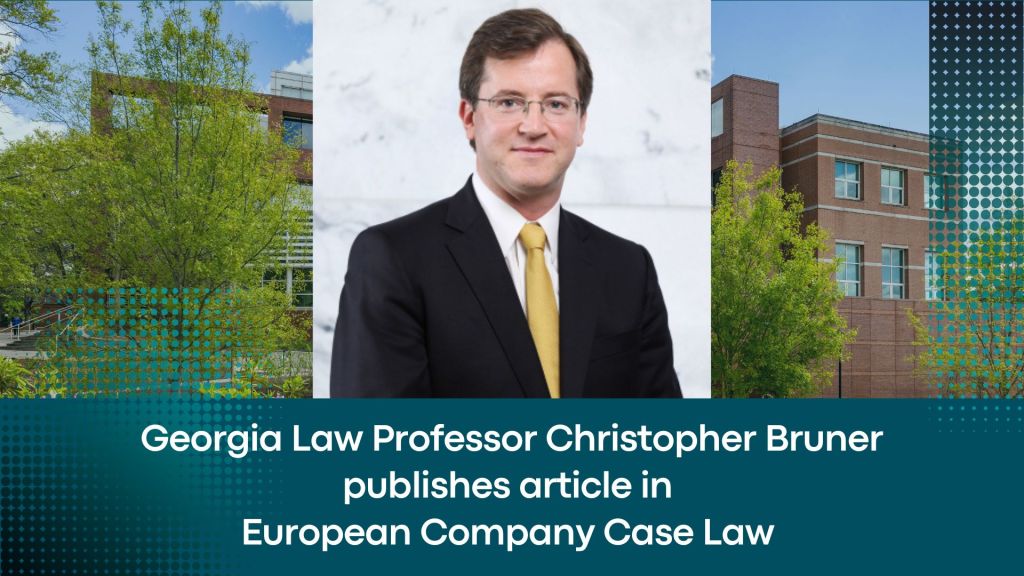
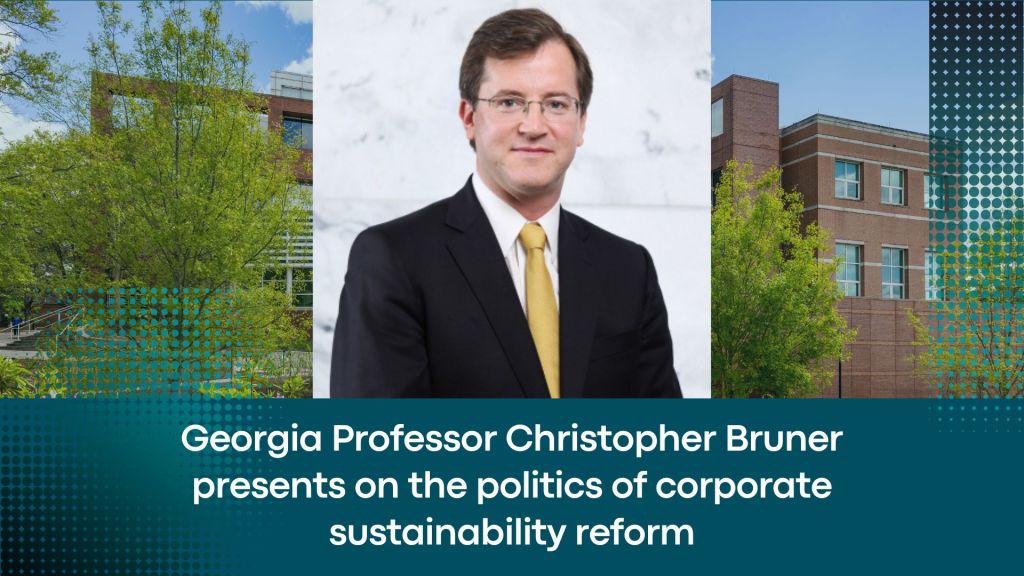
University of Georgia School of Law professor Christopher M. Bruner presented “A Political Economy of Corporate Sustainability Reform in the United States” at an online event hosted by the University of Oslo Faculty of Law in October. The event was organized by Oslo’s Sustainability Law research group and convened by Professor Beate Sjåfjell.
Below is an abstract of the presentation:
Conservative backlash against sustainability initiatives and environmental, social, and governance (ESG) investment policies has been particularly intense in the United States – to the point that these issues have become mired in the broader ‘culture wars’ that increasingly characterize American public life and permeate policymaking. Today, initiatives styled as corporate sustainability or ESG are often rejected outright by conservative federal and state actors opposed to intrusion of what they regard as ‘woke’ progressive policies into economic law. In response, A Political Economy of Corporate Sustainability Reform in the United States tackles two related challenges in the US context – (1) how to advance first-best corporate governance reforms in the long-term, and (2) how to advance second-best alternatives in the near-term.
Christopher M. Bruner is the Stembler Family Distinguished Professor in Business Law at the University of Georgia School of Law and serves as a faculty co-director of the Dean Rusk International Law Center.
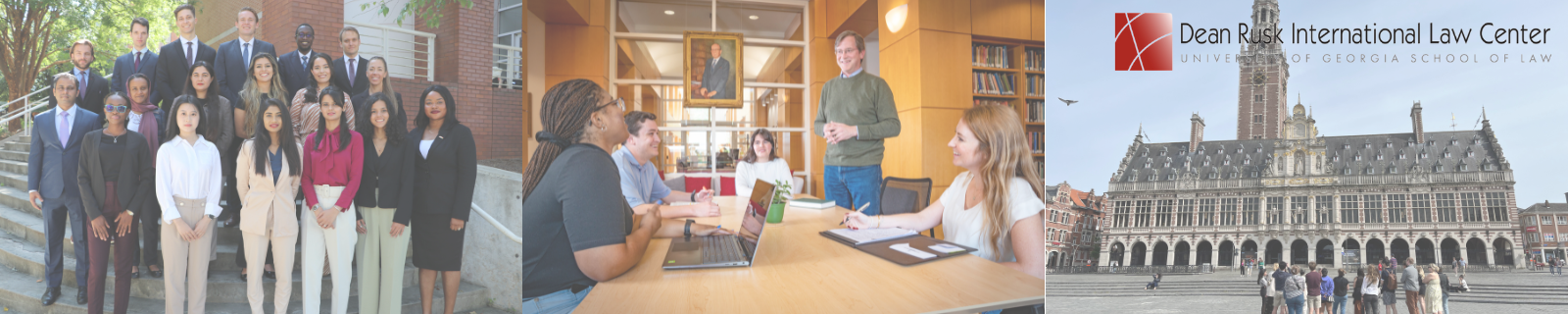
This group of 18 hails from 13 different countries in Africa, Asia, Europe, and the Americas, including Pakistan, Brazil, Iran, Nigeria, India, the Republic of Georgia, Turkey, the United Kingdom, Belarus, Peru, Venezuela, Switzerland, and Germany. Among them are lawyers specializing in a wide range of fields including business law, human rights law, administrative law, international arbitration, data privacy law, tax law, cryptocurrency law, criminal law, intellectual property law, business immigration and labor law, environmental law, and education law.
They are pictured above, standing on the steps of Dean Rusk Hall. From the left to right – top row: Carolina Ruiz, Paria Keramatkhah, Fatemeh Khouei, João Felipe Villa do Miu, Samuel Kuo, Danish Ali; middle row: Christian Schneider, Sara Dorbahani, Dzmitry Liasovich, Michael Faleye, Fabienne Taller, Bekir Kerabekmez; bottom row: Irakli Kakubava, Assis José Couto do Nascimento, Ramakrishna Ruthwik Palepu, Ana Luiza Couto do Nascimento, Neethu James, Zulma Perez.
This Class of 2025 joins a tradition that began at the University of Georgia School of Law in the early 1970s, when a Belgian lawyer became the first foreign-trained practitioner to earn a Georgia Law LL.M. degree. In the ensuing four decades, the law school and its Dean Rusk International Law Center have produced around 600 LL.M. graduates, with ties to nearly 100 countries and every continent in the world.
Side by side with J.D. candidates, LL.M.s follow a flexible curriculum tailored to their own career goals – goals that may include preparation to sit for a U.S. bar examination, or pursuit of a concentration affording advancement in their home country’s legal profession or academic institutions.
The application for the LL.M. Class of 2026 is now open; for information or to apply for LL.M. studies, see here.






 exchange of notes