Georgia Law at top in international law, Center-administered NATO externship featured in national preLaw magazine

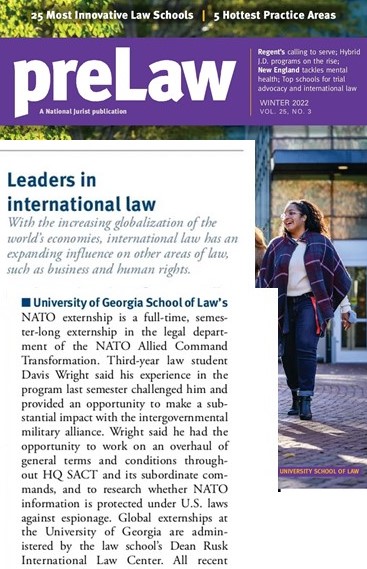
The just-released issue of preLaw magazine places the University of Georgia School of Law among the United States’ top international law curriculums; in so doing, it features an initiative of our Dean Rusk International Law Center.

In an article entitled “25 Most Innovative Law Schools,” author Michelle Weyenberg reports (page 42) on a valued partnership which Georgia Law entered several years ago with the North Atlantic Treaty Organization. Georgia Law’s “NATO externship,” she writes, “is a full-time, semester-long externship in the legal department of the NATO Allied Command Transformation.” She then describes experiences by our most recent extern, 3L Davis Wright, who worked in-person in Norfolk, Virginia, throughout the Fall 2021 semester (prior post):

“Third-year law student Davis Wright said his experience in the program last semester challenged him and provided an opportunity to make a substantial impact with the intergovernmental military alliance. Wright said he had the opportunity to work on an overhaul of general term and conditions throughout HQ SACT and in its subordinate commands, and to research whether NATO information is protected under U.S. laws against espionage.”

The NATO externship is one of many with international components in Georgia Law’s D.C. Semester in Practice initiative, directed by Georgia Law Professor Jessica Heywood, and also one of our Center’s many Global Externships Overseas and At-Home (GEO/GEA), administered by Sarah Quinn, our Center’s Associate Director for Global Practice Preparation.
Georgia Law Appellate Litigation Clinic secures final relief for client in case invoking Convention Against Torture

The U.S. Board of Immigration Appeals has granted relief to the petitioner in Arellano Herrera, a case on which the Appellate Litigation Clinic at the University of Georgia School of Law has worked for over two years.

As detailed in prior posts here and here, in September 2020, Georgia Law students in the Clinic briefed and argued the case, Arellano Herrera v. Barr, to a panel of the U.S. Court of Appeals for the Ninth Circuit. Their argument turned on the non-refoulement, or non-return, obligations the United States took on when it ratified the 1984 Convention Against Torture, or CAT. Two months later, the appellate court held that the Board of Immigration Appeals incorrectly had applied the clear error standard when reversing the Immigration Judge’s decision to grant petitioner’s request for withholding of removal.

Subsequently, on remand before the Board of Immigration Appeals, the Clinic argued that the Immigration Judge did not clearly err in findings key to the CAT-based claim:

  • 1st, that if returned to Mexico, the petitioner would more likely than not be tortured by cartel members, with the acquiescence of one or more public officials; and
  • 2d, it would be unreasonable to expect the petitioner to relocate within Mexico in order to avoid that torture.

A Board of Immigration Appeals panel has just agreed, thus reinstating the Immigration Judge’s original decision and, as a result, finally affording the petitioner the relief she long had sought.

The Clinic team included 3 students, since graduated from Georgia Law: Jason N. Sigalos, Mollie M. Fiero and John Lex Kenerly IV. They worked under the supervision of Thomas V. Burch, the Clinic’s Director, and Anna White Howard, the Clinic’s Counselor in Residence.

Georgia Law Professor Bruner presents on corporate sustainability disclosure to law students in Ireland and Minnesota

Christopher M. Bruner, the Stembler Family Distinguished Professor in Business Law here at the University of Georgia School of Law, co-presented an online seminar for law students in the United States and Ireland last week, on the subject of corporate sustainability disclosures. Bruner’s presentation was titled “Non-Financial Disclosure Around the World.”

Bruner co-presented the seminar session with with Professor Brett McDonnell, who holds the Dorsey & Whitney Chair in Law at the University of Minnesota Law School. Convening the event were another member of the Minnesota Law faculty, Professor Claire Hill, holder of the James L. Krusemark Chair in Law, and Professor Joe McGrath, a member of the faculty of the Sutherland School of Law, University College Dublin.

Dean Rusk International Law Center hosts “International Law and the Ukraine-Russia Conflict,” featuring Georgia Law Professors Amann, Cohen, and Durkee

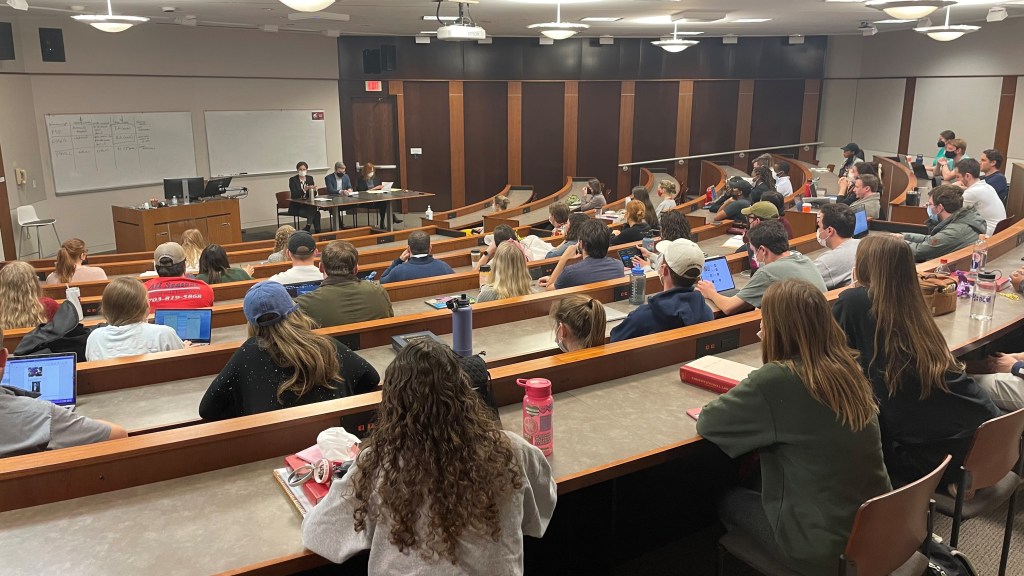
Nearly a hundred members of the University of Georgia School of Law community took part Wednesday in “International Law and the Ukraine-Russia Conflict,” a forum hosted by our Dean Rusk International Law Center and presented by three international law experts on the law school’s faculty.

The armed conflict began on February 24, 2022, when Russian military troops invaded the neighboring state of Ukraine, entering the latter country at points on its northern, eastern, and southern borders. At this writing just a week later, thousands of persons, civilians and combatants alike, reportedly had been killed, and, according to UN High Commissioner for Refugees Filippo Grandi, more than a million Ukrainians had been forcibly displaced.

At Wednesday’s forum, each of the three Georgia Law professors first offered a brief overview of a particular aspect of the armed conflict:

  • Our Center’s Director, Melissa J. “MJ” Durkee, who is also Associate Dean for International Programs and Allen Post Professor, began by outlining the international rules that have outlawed aggressive war – that is, one country’s unjustified invasion of another – since the adoption of the 1945 Charter of the United Nations. She explained why reasons that Russia has put forward do not constitute legally valid justifications for the invasion, and further emphasized the threat that Russia’s actions place on the international rules-based order that came into being after the Allied victory in World War II. In so doing, Durkee cited a UN General Assembly resolution, adopted Wednesday by a huge majority of votes, which condemned Russia’s actions as violative of this order.
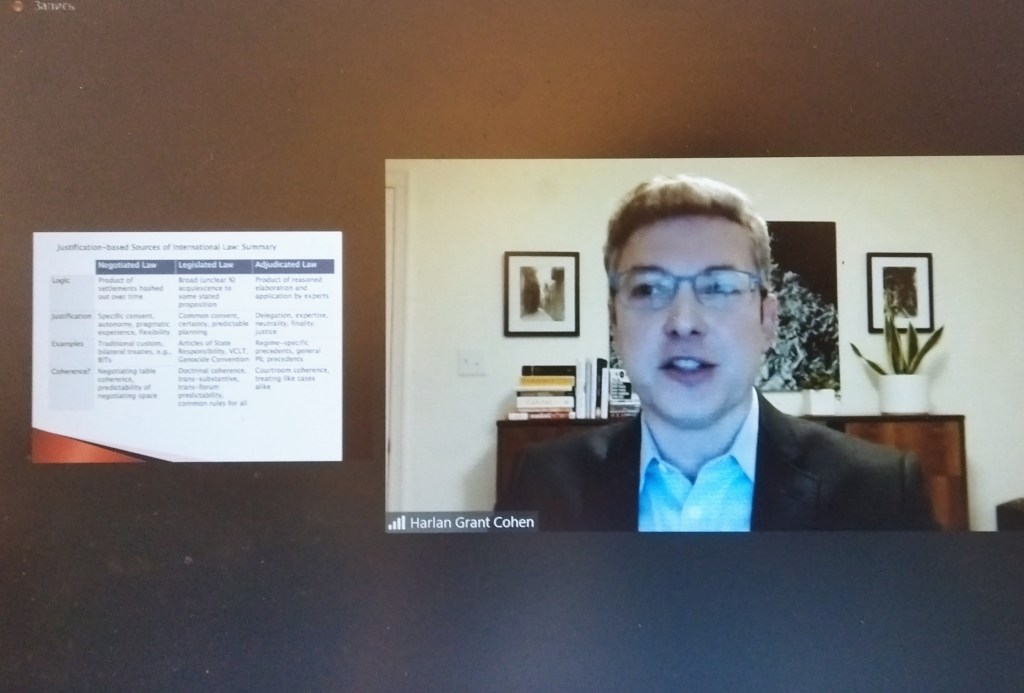
  • Next came Harlan Grant Cohen, who is Gabriel M. Wilner/UGA Foundation Professor in International Law and one of our Center’s 2 Faculty Co-Directors. Cohen focused on economic sanctions that have been levied against Russia in the last week, by individual countries including the United States and also by international organizations including the European Union. While noting that these types of economic actions had been developed in response to Iran’s nuclear program, Cohen stressed that the extent and impact of the sanctions already imposed against Russia is unprecedented.
  • Then followed our Center’s other Faculty Co-Director, Diane Marie Amann, who is also Regents’ Professor of International Law and Emily & Ernest Woodruff Chair in International Law. She addressed international humanitarian law, the body of law concerned with the ways that armies and armed groups actually conduct the war. She underscored that this body of law concerns itself with all sides of the conflict, regardless of who started the conflict: fighters on either side may be found liable for violations, and thus charged with war crimes. Amann concluded with a look at forums already engaged to review legal issues arising out of the war, among them the European Court of Human Rights, International Criminal Court, and International Court of Justice.

The forum concluded with a lively and wide-ranging question-and-answer period.

Georgia Law Professor Cohen publishes introduction to AJIL Unbound symposium

Harlan Grant Cohen, who is Gabriel M. Wilner/UGA Foundation Professor in International Law and Faculty Co-Director of the Dean Rusk International Law Center here at the University of Georgia School of Law, published “Introduction to the Symposium on Gregory Shaffer, ‘Governing the Interface of U.S.-China Trade Relations'” in 116 AJIL Unbound 38 (2022).

Professor Cohen also helped organize and edit the symposium, in which numerous scholars offer commentary on a 2021 American Journal of International Law article by Shaffer, who is Chancellor’s Professor of Law and Political Science at the University of California-Irvine, and President-Elect of the American Society of International Law.

Georgia Law Professor Diane Marie Amann to keynote, and alumna Lauren Brown to present, at upcoming European Society of International Law Research Forum in Glasgow, Scotland

The University of Georgia School of Law will be well represented at the annual Research Forum of the European Society of International Law, to be held March 31-April 1, 2022, at the University of Glasgow, Scotland. This year’s host, the Glasgow Centre for International Law & Security, has chosen a timely theme given the ongoing Ukraine-Russia conflict: “International Law an Global Security: Regulating an Illusion?” Among the many scholars exploring that topic will be:

  • Georgia Law Professor Diane Marie Amann (above left), who is scheduled to deliver the keynote address, entitled No Exit at Nuremberg: The Postwar Order as Stage for 21st-Century Global Insecurity, during the session beginning at 9 a.m. GMT/4 a.m. Eastern on Thursday, March 31. Amann is Regents’ Professor of International Law, Emily & Ernest Woodruff Chair in International Law, and Faculty Co-Director of the Dean Rusk International Law Center at Georgia Law; served from 2012 to 2021 as International Criminal Court Prosecutor Fatou Bensouda’s Special Adviser on Children in & affected by Armed Conflict; and is a member of the Coordinating Committee of ESIL’s Interest Group on International Criminal Justice. She is writing a book, under contract with Oxford University Press, on lawyers and other women professionals at the first post-World War II international criminal trial, held from 1945 to 1946 in Nuremberg, Germany.
  • Lauren Brown (above right), who earned her Georgia Law J.D. degree magna cum laude and was elected to the Order of the Coif in 2019, will present Keys to the Kingdom: Export Controls and What They Really Mean at 1:30 p.m. GMT/8:30 a.m. Eastern on Wednesday, March 30, as part of a panel entitled “International Economic Law and New Frontiers of Global Security.” Brown, who is an Associate in the International Trade Practice at the Squire Patton Boggs law firm in Washington, D.C., also holds a master’s degree from the University of Edinburgh, Scotland, as well as a bachelor’s degree from the University of North Carolina at Chapel Hill.

Registration to attend this event, either in-person or online, is free and available here.

Georgia Law coursework begins for inaugural class of students seeking Graduate Certificate in International Law

Graduate Certificate in International Law students tour Hirsch Hall at the University of Georgia School of Law Friday, in anticipation of the new semester beginning this week.

This New Year marks the arrival of the inaugural class of Graduate Certificate in International Law students here at the University of Georgia School of Law.

Through the initiative of the law school’s Dean Rusk International Law Center, postgraduate students from other disciplines within the university will earn this academic certificate following their successful completion, in classes alongside J.D., LL.M., and M.L.S. students, of fifteen credit hours chosen from among the law school’s rich comparative, transnational, and international law curriculum; courses include Public International Law, International Human Rights, International Trade Law, Immigration Law, International Law Colloquium, and Global Governance.

The seven students comprising the first class include:

  • Four doctoral students: from the School of Public and International Affairs, Alma Bajramović, a Ph.D. candidate who is researching conflict and conflict resolution, with a focus on the Balkans; from the Mary Frances Early College of Education, Leslyn Beckles, candidate for a Ph.D. in Learning, Leading, and Organization Development, whose research concentrates on women political leaders in the Caribbean; and from the Franklin College of Arts and Sciences, Isaac Torres, a Ph.D. candidate in Bioinformatics who examines artificial intelligence and statistical models to address complex biology problems, and Jasmine Underwood, a Ph.D. candidate in Sociology interested in gender, development and social change, and political sociology.
  • Three master’s students, all from the School of Public and International Affairs: Megan Gerken and Nelson Millan Nales, both pursuing Master of Public Administration degrees, and Michael Sway, a candidate for the Master of International Policy degree.

Details on application of and matriculation toward the Graduate Certificate in International Law are available here and by contacting the initiative’s administrator, Sarah Quinn, Associate Director for Global Practice Preparation at the Dean Rusk International Law Center, squinn[at]uga.edu.

Georgia Law Professor Amann joins Wisconsin historian Hirsch in “Understanding Nuremberg” podcast

“Understanding Nuremberg” is the title of a new podcast with Professor Diane Marie Amann, a Faculty Co-Director of our Dean Rusk International Law Center here at the University of Georgia School of Law, and University of Wisconsin Professor Francine Hirsch.

Their conversation appears as Episode 53 of Asymmetrical Haircuts: Your International Justice Podcast, hosted by the Hague-based journalists Janet Anderson and Stephanie van den Berg. To quote the hosts, Amann and Hirsch discussed

“what we think we know (and what we don’t) about Nuremberg trials.”

Amann, who also is Regents’ Professor of International Law and the Emily & Ernest Woodruff Chair in International Law here at Georgia Law, is writing Nuremberg Women, a book about the roles that lawyers and other women professionals played at the first post-World War II war crimes trial, before the International Military Tribunal composed of judges and prosecutors from 4 Allied countries: France, Great Britain, the United States, and the Soviet Union.

Hirsch, who is the Vilas Distinguished Achievement Professor of History at the University of Wisconsin-Madison, published an account of the work of that last country in 2020. Her award-winning book is called Soviet Judgment at Nuremberg: A New History of the International Military Tribunal After World War II.

Their full podcast conversation about these previously understudied participants, and about how including their stories may challenge conventional understandings of the Nuremberg trials and their legacy, is here.

Georgia Law’s Community HeLP Clinic and Project South release report on harms from spike in state-federal jailhouse immigration enforcement

Negative effects of three Southern states’ collaboration with federal immigration officials are detailed in a report just published by the Community Health Law Partnership here at the University of Georgia School of Law and Project South, a 35-year-old, Atlanta-based nongovernmental organization.

Entitled Escalating Jailhouse Immigration Enforcement, the 52-page report focuses on “ICE holds” – the nonbinding request, placed by U.S. Immigration and Customs Enforcement, that local jails detain certain detainees. Based on records obtained through the U.S. Freedom of Information Act, the report reveals that between fiscal years 2016 and 2018:

  • The number of ICE holds nearly quadrupled in Georgia, nearly tripled in South Carolina, and doubled in North Carolina.
  • On average, persons subject to ICE holds were held more than two weeks in Georgia, about three weeks in South Carolina, and more than a month in North Carolina.
  • In at least half of these more than 18,000 detainer cases, the person named was taken into ICE custody.
  • At least 189 persons, including at least 29 U.S. citizens, were erroneously detained.

Co-authors of the report were our Clinic’s Director, Georgia Law Professor Jason A. Cade, (pictured above), along with Priya Sreenivasan and Azadeh Shahshahani of Project South. Cade said:

“The findings in Escalating Jailhouse Immigration Enforcement should encourage state and local governments to take their own steps to disentangle local policing from immigration policy. Enacting laws and practices that decrease the fiscal and human costs of lengthy incarcerations that rip families apart – usually just following minor traffic violations – will also go a long towards reducing immigrant communities’ fear of interaction with law enforcement in these southern states.”

Numerous Georgia Law students enrolled in the Clinic made important contributions to various stages of this project, including initial data collection, legal research, and data analytics: Onur Yildirin, Sarah Mirza and Michael Aune in Spring 2018; Caitlin Felt, Carter Thomas and Roger Grantham in Spring 2019; and Andrea Aldana, Stroud Baker, Lisa Garcia, and Farishtay Yamin in Spring 2020.

The full report is available here.

Georgia Law Professor Cohen presents “Court-Custom Paradox” in conference on customary international law

“Coherence in the interpretation of CIL is a process, not an outcome!” Professor Cohen stated, as reported in a TRICI-Law live tweet.

Harlan Cohen, who is Gabriel M. Wilner/UGA Foundation Professor in International Law and Faculty Co-Director of the Dean Rusk International Law Center here at the University of Georgia School of Law, presented Friday on “The Court-Custom Paradox” as part of “Interpretation of CIL: Methods, Interpretative Choices and the Role of Coherence,” a 2-day global conference.

Hosting the online gathering was TRICI-Law (“The Rules of Interpretation of Customary International Law”), a 5-year European Research Council Starting Grant project. Co-organizers were the PluriCourts-Centre for the Study of the Legitimate Roles of the Judiciary in the Global Order at the University of Oslo, Norway, and the Department of Transboundary Legal Studies at the University of Groningen in the Netherlands.

In addition to Professor Cohen, the conference featured Judge Liu Daqun of the International Residual Mechanism for Criminal Tribunals as well as scholars based in Austria, Canada, France, Germany, Greece, Italy, the Netherlands, Norway, Singapore, Switzerland, and the United Kingdom.