Georgia Law Associate Dean MJ Durkee, our Center’s Director, gives online webinar to law students in Bangladesh

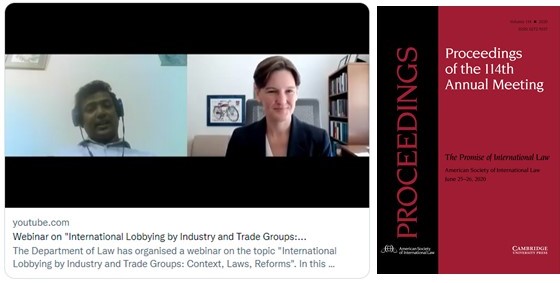
Melissa J. “MJ” Durkee, who is Associate Dean for International Programs, Director of the Dean Rusk International Law Center, and Allen Post Professor here at Georgia Law, gave an online presentation on Friday, entitled “International Lobbying by Industry and Trade Groups: Context, Laws, Reforms,” to students at the Department of Law of North South University in Dhaka, Bangladesh.

She delivered the webinar by invitation of North South Law Professor Md. Rizwanul Islam, whose own scholarship includes examinations of the operation of international economic law in South Asia.

In her presentation, Durkee observed that COP26, the 2-week international climate change conference just concluded in Glasgow, Scotland, spotlighted difficulties in designing rules and processes that welcome nongovernmental organizations and business groups into global governance. She explored the adequacy vel non of conceptualizations of this challenge, and further considered possible designs for reform.

The webinar built on “Welcoming Participation, Avoiding Capture: A Five-Point Framework,” remarks that Durkee published in the Proceedings of the American Society of International Law Annual Meeting of 2020, available here.

Video of last Friday’s webinar may be found here.

Georgia Law Professor Walter Hellerstein presents on value added tax in International Monetary Fund webinar

Walter Hellerstein, Distinguished Research Professor & Shackelford Distinguished Professor in Taxation Law Emeritus here at the University of Georgia School of Law, presented last Tuesday in a webinar entitled “VAT and the Digital Economy,” organized by the International Monetary Fund as part of its ongoing VAT Webinar Series. More than 500 participants from countries around the world attended.

Hellerstein spoke on “Taxing digital economy: VAT vs. CIT and DST,” as part of a panel moderated by Katherine Baer of the IMF. Also on the panel were experts based in Australia, Panama, and South Africa.

The webinar program is here.

Stockholm Declaration conference: link to video of Shelton keynote and panel on international environmental law’s future

This image has an empty alt attribute; its file name is panel3.png

A superb third panel and keynote speech concluded “The 1972 Stockholm Declaration at 50: Reflecting on a Half-Century of International Environmental Law” conference that we at the Dean Rusk International Law Center and the Georgia Journal of International and Comparative Law at the University of Georgia School of Law hosted on October 8.

Following on our prior posts outlining the first and second parts of our daylong conference, we’re pleased in this post to recap the final segment, video of which is available here. (The full series, meanwhile, is available here.)

It begins with the third panel of the conference, entitled “International Environmental Law’s Future,” and moderated by MJ Durkee, Associate Dean for International Programs, Director of the Dean Rusk International Law Center, and Allen Post Professor at Georgia Law (pictured above, middle right). Joining her were 4 panelists (pictured clockwise from bottom center): Lakshman D. Guruswamy, Nicholas Doman Professor of International Environmental Law at Colorado Law; Jutta Brunnée, Dean, University Professor, and James Marshall Tory Dean’s Chair at the University of Toronto Faculty of Law in Canada; Cymie Payne, Associate Professor in the Department of Human Ecology and the School of Law, Rutgers University; and Rebecca M. Bratspies, Professor and Director of the Center for Urban Environmental Reform at CUNY Law.

Together, they consider the part of Principle 1 of the Stockholm Declaration that declares:

“[Humankind] bears a solemn responsibility to protect and improve the environment for present and future generations.”

In light of that statement, panelists examined the major successes and failures of the last half-century of international environmental law, and, imagining a “2022 Stockholm Declaration,” they considered how to prioritize environmental protection efforts going forward.

Then follows “Stockholm Plus 50: Glass Half Full, Half Empty, or Shattered?,” the keynote address by Dinah L. Shelton, Manatt/Ahn Professor of International Law Emeritus at George Washington University School of Law. In it, Shelton sounds an urgent call to action to ensure protection from the worst effects of climate change, especially for the most vulnerable populations.

Kimberlee Styple, GJICL Editor-in-Chief, then delivers closing remarks.

Professor Natalia Pires de Vasconcelos to speak Tuesday on inequality and health litigation amid pandemic in Brazil

Professor Natalia Pires de Vasconcelos, who was a Visiting Scholar here at the University of Georgia School of Law Dean Rusk International Law Center earlier this year, will discuss legal challenges to inequities in health care in Brazil in an online presentation that our Center will host from 12 noon to 1 p.m. next Tuesday, November 9.

Pires is Assistant Professor of Law at Insper São Paulo, Brazil, and a Senior Research Fellow at the Solomon Center for Health Law and Policy, Yale Law School. She is a founding member of the Center for the Analysis of Liberty and Authoritarianism, a Brazilian thinkthank known by its acronym, LAUT. She holds a Ph.D. in Public Law from the University of São Paulo, Brazil, and an LL.M. from Yale Law School. Her scholarship concerns social and economic rights in Latin America, with a focus on the right to health and health litigation.

In her presentation Tuesday, Pires will discuss “Business as Usual: Inequality and Health Litigation during the COVID-19 Pandemic in Brazil.” Here’s her précis:

Brazil’s active judicial system has the power to define the constitutional content of the country’s healthcare policy by forcing the government to embrace equal protection of the right to health. In this talk, I present the results of an upcoming chapter in which I compare the pandemic’s effect on the judicial protection of the right to health for those incarcerated and those who are free. In both cases, courts had serious incentives to take the pandemic seriously and consider its disproportionate impact on marginalized communities. The judicial system, however, has approached the COVID-19 pandemic as mostly ‘business as usual.’ For those who are free, courts endorsed a ‘right to everything,’ granting patients’ requests regardless of the potentially disruptive effects on public policy, unequal access to judicial services, and pressing priorities related to the pandemic. For those incarcerated, judges upheld a long-lasting ‘right to nothing,’ remaining indifferent to the public-health risks presented by overcrowded and unsanitary conditions of Brazilian prisons and denying thousands of early-release and house-arrest requests by people in prisons.

Register here to attend Pires’ online presentation.

Scholarly achievements, vibrant initiatives highlighted in newsletter of Dean Rusk International Law Center, University of Georgia School of Law

For a recap of the year’s research and global practice accomplishments, have a look at the just-published newsletter of the Dean Rusk International Law Center at the University of Georgia School of Law. Features include:

► Welcome to our new professor, Zohra Ahmed, as well as scholarly achievements of our Center Director, Melissa J. Durkee, and our many other globally minded faculty, including Diane Marie Amann, Christopher Bruner, Jason Cade, Harlan G. Cohen, Walter Hellerstein, Thomas Kadri, Jonathan Peters, Peter B. “Bo” Rutledge, and Laura Phillips Sawyer.

► The return of our International Law Colloquium in Spring 2022, a course featuring works-in-progress conversations with authors; this year’s edition will include international law scholars based in Latin America and Europe as well as the United States.

► Recent events, including our day-long conferences on international environmental law and on global healthcare governance cosponsored with the Georgia Journal of International & Comparative Law, our Consular Series of talks with diplomats, presentations by Visiting Scholars and other distinguished lawyers, our cohosting of International Law Weekend South with the American Branch of the International Law Association, and participation in panels at the American Society of International Law and other global meetings, as well as academic and civil-society roundtables.

Initiatives aimed at preparing our J.D. and LL.M. students for global legal practice, including our NATO Externship, our Global Externships, and the Global Governance Summer School we host in partnership with the Leuven Centre for Global Governance at Belgium’s University of Leuven, plus support for internationally minded students’ organizations, journal, and advocacy teams.

The full newsletter is here.

University of Georgia School of Law, School of Public & International Affairs scholars on panels at annual ASIL Midyear Meeting Research Forum

Scholars at the University of Georgia School of Law, as well as the university’s School of Public & International Affairs, will take part next week in the Midyear Meeting of the American Society of International Law.

This year’s Midyear Meeting will be held online. As an ASIL Academic Partner, we at the University of Georgia Dean Rusk International Law Center are honored to have hosted this annual event in Athens and Atlanta in 2012.

The 2021 Midyear, to take place November 11 and 12, will include a Research Forum featuring discussions among more than 70 international law scholars and a Practitioners’ Forum.

University of Georgia representation at the Research Forum includes these panels:

4:45-6:15 p.m., Thursday, November 11: Climate Change

Melissa J. “MJ” Durkee, who is Associate Dean for International Programs, Director of the Dean Rusk International Law Center, and Allen Post Professor (pictured above left), will serve as discussant during this live panel for 2 papers:

  • “Climate Displacement: Revisions to the international legal framework to address refugees resulting from future climate crises,” by Christian Jorgensen and Eric Schmitz, American Red Cross
  • “A Parisian Consensus,” by Frederic Sourgens, Washburn University School of Law

4:45-6:15 p.m., Thursday, November 11: International Criminal Court

Diane Marie Amann, who is Regents’ Professor of International Law, Emily & Ernest Woodruff Chair in International Law, and Faculty Co-Director of our Center (above second from left), will serve as discussant during this prerecorded panel for 3 papers:

  • “The Use of African Law at the International Criminal Court,” by Stewart Manley, University of Malaya
  • “From Hadžihasanović to Bemba and Beyond: Revisiting the application of command responsibility to armed groups,” by Joshua Niyo, The Graduate Institute of International and Development Studies, Geneva
  • “Dominic Ongwen: Sentencing and mitigation at the ICC,” Milena Sterio, Cleveland-Marshall College of Law

2:45-4:15 p.m., Friday, November 12: Courts and Tribunals

Harlan G. Cohen, who is Gabriel M. Wilner/UGA Foundation Professor in International Law and Faculty Co-Director of the Dean Rusk International Law Center at Georgia Law (above right), and who holds a courtesy appointment at the University of Georgia School of Public and International Affairs (SPIA), will co-present a paper with a SPIA colleague, Professor Ryan Powers (above second from right), entitled “Judicialization and Public Support for Compliance with International Commitments.”

Mark Pollack, Temple University Beasley School of Law, will serve as discussant during this live panel for the Cohen-Powers paper and these 2 others:

  • “Does the Court Really Know the Law? The jura novit curia principle in fragmented international adjudication,” by Barbara Bazanth, New York University School of Law
  • “The Habre Effect? How An African Trial Shaped Justice Norms,” by Margaret deGuzman, Temple University Beasley School of Law

Georgia Law professors also are scheduled to take part in ASIL leadership meetings during the Midyear: Associate Dean Durkee in the meetings of the ASIL Executive Council and of the Board of Editors, American Journal of International Law; Professor Amann, an ASIL Counsellor, in the Executive Council meeting; and Professor Cohen in the meeting of the Board of Editors, American Journal of International Law.

Details, including the full ASIL Midyear program, and registration, which is free to students at Academic Partner schools like Georgia Law, are available here.
Stockholm Declaration conference: link for “Anti-Racism, Decolonization, Environmental Protection” panel video

This image has an empty alt attribute; its file name is panel2.png

High-level speeches and other events at COP26, the 26th UN Climate Change Conference of the Parties now under way in Glasgow, Scotland, underscores the timeliness of “The 1972 Stockholm Declaration at 50: Reflecting on a Half-Century of International Environmental Law” conference that we at the Dean Rusk International Law Center and the Georgia Journal of International and Comparative Law at the University of Georgia School of Law hosted on October 8.

And so, following on last week’s post outlining the first part of our daylong conference, we’re pleased in this post to recap the second segment, video of which is available here. (The full series, meanwhile, is available here.)

Featured in this segment is the day’s second panel, “Anti-Racism, Decolonization and Environmental Protection,” moderated by Harlan G. Cohen, Gabriel M. Wilner/UGA Foundation Professor in International Law and Faculty Co-Director of the Dean Rusk International Law Center at Georgia Law (pictured above, top right). Joining him were 4 panelists (pictured clockwise from middle right): Sumudu Anopama Atapattu, Director of Research Centers and Senior Lecturer at Wisconsin Law; Robin Bronen, Executive Director of the Alaska Institute for Justice; Usha Natarajan, Edward W. Said Fellow at Columbia University; and Sarah Riley Case, Boulton Junior Fellow at McGill University Faculty of Law in Canada.

Together, they consider the part of Principle 1 of the Stockholm Declaration that declares:

“In this respect, policies promoting or perpetuating apartheid, racial segregation, discrimination, colonial and other forms of oppression and foreign domination stand condemned and must be eliminated.”

In view of that statement, panelists ask inter alia: whether and to what extent the substantive protections of international environmental law addresses environmental racism; whether and to what extent indigenous peoples, racial and ethnic minorities, or formerly colonized peoples can access, use, or affect the development of international environmental law; and whether and to what extent international environmental law has incorporated the concept of consent by affected communities.

Stay tuned for our video recap of the final conference segment.

Georgia Law Professor Bruner presents “Comparative Analysis of Common-Law Countries” in University of Oslo PhD Seminar on Companies and Markets

Christopher M. Bruner, the Stembler Family Distinguished Professor in Business Law here at the University of Georgia School of Law, co-presented a seminar entitled “Comparative Analysis of Common-Law Countries” as part of the PhD Seminar on Company and Markets that was hosted online in October by the Research Group on Companies, Markets and Sustainability, a unit of the Faculty of Law, Department of Private Law, at the University of Oslo in Norway.

Joining Bruner in presenting the seminar was Professor Carol Liao, Director of the Centre for Business Law at the Peter A. Allard School of Law, University of British Columbia, Vancouver, Canada. Scholars from Denmark, Finland, Germany, Greece, Italy, Lithuania, the Netherlands, Norway, Portugal, Singapore, Spain, Sweden, and the United Kingdom also presented in the course of the weeklong University of Oslo event.

Stockholm Declaration conference: link available to video of conference start, including panel on rights-based approach

Miss the opportunity to see our “The 1972 Stockholm Declaration at 50: Reflecting on a Half-Century of International Environmental Law” live on October 8?

No worries: We at the Dean Rusk International Law Center and the Georgia Journal of International and Comparative Law, University of Georgia School of Law, are happy to provide videolinks.

This daylong conference addressed, in the words of MJ Durkee, the Georgia Law faculty member who conceptualized it,

“one of the foremost challenges of our time: What the international community can do about the crises facing our environment and the link between environmental health and human flourishing.”

Durkee, who is Associate Dean for International Programs, Director of our Dean Rusk International Law Center, and Allen Post Professor, further noted the timeliness of the conference:


“The Stockholm Declaration, in addition to launching the field of international environmental law 50 years ago, was also among the first to articulate the idea of a human right to a healthy environment, and to elevate this as a matter of world concern. Just today, in Geneva, the UN Human Rights Council has been deliberating over a resolution recognizing that this human right to a healthy environment has matured into an internationally recognized human right.”

This image has an empty alt attribute; its file name is panel1.jpg

Also in this segment is the first of three panels, entitled “The Rights-Based Approach to Environmental Protection,” and featuring a global array of panelists: Nnimmo Bassey, Director, Health of Mother Earth Foundation, pictured at bottom center; Tyler Giannini, Clinical Professor and Co-Director of the Harvard Human Rights Program and the International Human Rights Clinic at Harvard Law, top right; Kate Mackintosh, Executive Director, Promise Institute for Human Rights, UCLA Law, middle left; Katie O’Bryan, Lecturer, Monash University, Australia, middle right; and moderator Diane Marie Amann, Regents’ Professor of International Law, Emily & Ernest Woodruff Chair in International Law and Faculty Co-Director of the Dean Rusk International Law Center at Georgia Law, top left.

Her welcome, as well as introductory remarks from Georgia Law Dean Peter B. “Bo” Rutledge and Eva Hunnius Ohlin, Senior Advisor for Energy and Environment at the Embassy of Sweden in Washington, D.C., appear in the first of three conference video segments, available here.

Principle 1 of the Stockholm Declaration begins:

“Man has the fundamental right to freedom, equality and adequate conditions of life, in an environment of a quality that permits a life of dignity and well-being …”

Considering that claim in relation to “humankind,” panelists explored a range of issues, including: the utility, or not, of the rights-based approach; comparison of the rights-based approach with others, including the rights of nature and harmony with nature; and the recent civil-society promulgation of a definition of the international crime of ecocide, with the aim of amending the 1998 Rome Statute of the International Criminal Court to include this crime.

Interested in other segments of our Stockholm conference? Stay tuned.

(Update: The full series of links is available here.)

Georgia Law Professor Harlan Cohen talks “Sources of International Law” in Borderline Justice podcast

Harlan Cohen, who is Gabriel M. Wilner/UGA Foundation Professor in International Law and Faculty Co-Director of the Dean Rusk International Law Center here at the University of Georgia School of Law, discusses “Sources of International Law” in a podcast released this month.

He appeared on Borderline Jurisprudence, a podcast devoted to “philosophy and jurisprudence of international law,” in the words of its founders, Başak Etkin, Teaching and Research Fellow at Université Paris 2 Panthéon-Assas, France, and Kostia Gorobets, Assistant Professor at the University of Groningen in the Netherlands.

The conversation with Cohen covered an array of issues, including sources of international law, precedent, opinio juris, fragmentation, pluralism, and behavioral approaches to international law. Writings by Cohen and others, detailed in a bibliography available here, formed a foundation for the talk.

The 53-minute podcast may be accessed at Anchor FM, Apple Podcasts, and Spotify.
