“Crimmigration as Paradigmatic Migration Control in the United States: Exploring the Impact on Communities, Courts, and Attorneys” November 7 Georgia Journal of International and Comparative Law and Georgia Criminal Law Review annual conference

This year’s annual conference of the Georgia Journal of International and Comparative Law will present “Crimmigration as Paradigmatic Migration Control in the United States: Exploring the Impact on Communities, Courts, and Attorneys“. The conference will be offered jointly by the GJICL and the Georgia Criminal Law Review.

The daylong conference will take place on Friday, November 7 in the Larry Walker Room of Dean Rusk Hall at the University of Georgia School of Law. CLE credit is available for both in-person and virtual attendance. Registration information can be found on the conference webpage.

Sponsoring along with GJICL, a student-edited journal established more than 50 years ago, is the law school’s Dean Rusk International Law Center. GJICL Editor in Chief, Casey Smith (J.D. ’26) and Executive Conference Editor Kellianne Elliot (J.D. ’26) worked Georgia Criminal Law Review Editor in Chief Kerolls Gadelrab (J.D. ’26); Professor Jason A. Cade, J. Alton Hosch Professor of Law & Community Health Law Partnership Clinic Director; Center staff Sarah Quinn, Director; Catrina Martin, Global Practice Preparation Assistant; Taher S. Benany, Center Associate Director; and with the GJICL’s Faculty Advisor, Professor Desirée LeClercq, who is Assistant Professor of Law & Faculty Co-Director of the Dean Rusk International Law Center.

Below is the concept note of the conference:

Political and legal developments have precipitated a convergence of the fields of criminal law and immigration law. Now commonly referred to as crimmigration, this merger of previously distinct practice areas already has profoundly reshaped the legal and social terrain for migrants in the United States. While entry and removal decisions remain essentially administrative, enforcement practices and rhetoric increasingly embrace the punitive logic and carceral reach of the criminal legal system, but with fewer due process protections. As new legislation vastly expands detention authorization and other enforcement resources, it seems apparent that the rhetoric and mechanics of crimmigration will continue to dominate immigration policy in the United States for the foreseeable future. 

This symposium, jointly sponsored by the Dean Rusk International Law Center, the Georgia Journal of International and Comparative Law, and the Georgia Criminal Law Review, invites scholars, immigration attorneys and judges to engage with these developments. We hope panelists will collectively address a number of important questions, such as the following: How does the new crimmigration landscape impact immigrants and communities in the Southeast and beyond? What new burdens does it put on the judiciary, and what role do federal courts have today in determining and upholding constitutional and statutory protections for migrants? Does the durability and continued expansion of crimmigration pose new challenges for immigration and criminal law attorneys; and, if so, how are the immigration and criminal law bars responding to those challenges? As crimmigration tactics expand, what new legal threats face U.S. citizens, including family members, employers, and immigrant advocates? Does the crimmigration paradigm contend with or obscure the structural forces that drive migration, particularly from the global south? Are there reasons to hope or expect the emergence of alternatives to crimmigration as the governing paradigm for the regulation of immigrants in the United States? 

These conversations will occur through three panels and a lunchtime keynote speaker. 

The day’s events are as follows:

9:30am | Opening Remarks

Usha Rodrigues, Dean, University Professor & M.E. Kilpatrick Chair of Corporate Finance and Securities Law

9:35am | Panel 1: Introduction to Crimmigration & the Current State of Affairs

  • Abel Rodríguez, Assistant Professor of Law, Wake Forest Law
  • Shalini Ray, Associate Professor of Law and Director of Faculty Research, Alabama Law
  • Gracie Willis, Attorney, National Immigration Project
  • Moderator: Christian Turner, Associate Professor of Law, University of Georgia School of Law

10:35am | Break

10:45am| Panel 2: The Impact of Crimmigration Policies on Communities and Advocates 

  • Jessica Vosburgh, Senior Staff Attorney, Center for Constitutional Rights
  • Jenny R. Hernandez, Lead Senior Attorney at Immigration Defense Unit, City of Atlanta Office of the Public Defender
  • Carolina Antonini, Founding Partner, Antonini & Cohen Immigration Law
  • Moderator: Elizabeth Taxel, Clinical Associate Professor & Criminal Defense Practicum Director, University of Georgia School of Law

12:00pm | Keynote Introduction

Jason A. Cade, J. Alton Hosch Professor of Law & Community Health Law Partnership Clinic Director, University of Georgia School of Law

12:05     Keynote Address

Judge Ana C. Reyes, United States District Court, District of Columbia

1:00pm | Panel 3: Challenging the Legality of Migration Controls & Envisioning Reform

  • Daniel I. Morales, Associate Professor of Law; Dwight Olds Chair, The University of Houston Law Center
  • Rebecca A. Sharpless, Associate Dean for Experiential Learning, Professor of Law, Director, Immigration Clinic, University of Miami School of Law
  • Emily Torstveit Ngara, Director of Clinical Programs, Associate Clinical Professor and Director, Immigration Clinic, Center for Access to Justice, Immigration Law Clinic, Georgia State University College of Law
  • Moderator: Jason A. Cade J. Alton Hosch Professor of Law & Community Health Law Partnership Clinic Director, University of Georgia School of Law

2:00 | Closing Remarks

Casey Smith, Editor in Chief, Georgia Journal of International and Comparative Law

Georgia Law Professor Christopher Bruner presents keynote at University of Turin (Italy) symposium   

University of Georgia School of Law Professor Christopher Bruner presented the keynote address for a symposium titled “Sustainability is (Still) Possible! Governing Market Actors for a Safe and Just Space” at the University of Turin (Italy) in September. Bruner’s keynote was titled “Corporate Sustainability and Anti-ESG Backlash” and the symposium was co-sponsored by Turin’s Department of Law and Department of Economics and Statistics. 

Bruner is the Stembler Family Distinguished Professor in Business Law at the University of Georgia School of Law and serves as a faculty co-director of the Dean Rusk International Law Center.

Harlan G. Cohen, former Georgia Law Professor and Rusk Center Faculty Co-Director, elected Editor-in-Chief of American Journal of International Law

We at the University of Georgia School of Law Dean Rusk International Law Center are delighted to congratulate our longtime colleague Harlan G. Cohen, whom the American Journal of International Law has just elected an Editor-in-Chief, along with Professor Neha Jain of Northwestern’s Pritzker School of Law. The new editors’ tenure will start in April 2026.

Having joined the Georgia Law faculty in 2007, Professor Cohen was appointed its inaugural Gabriel M. Wilner/UGA Foundation Professor in International Law in 2016. That same year he also was appointed a Faculty Co-Director of the Dean Rusk International Law Center, serving in that role with Georgia Law Professor Diane Marie Amann. Cohen held both positions until his move at the end of 2023 to New York’s Fordham School of Law, where he is a Professor of Law.

While at Georgia Law, Cohen taught and published in fields including Public International Law, International Trade, Foreign Affairs & National Security Law, and Global Governance. He also served as the Faculty Advisor for the Georgia Journal of International & Comparative Law and as an advisor to the Jessup International Law Moot Court team.

Cohen’s election followed his many years of service as a member of the editorial board of AJIL, a leading, century-old, peer-reviewed quarterly of the American Society of International Law (of which Cohen is a Vice President). AJIL features articles, essays, editorial comments, current developments, and book reviews by pre-eminent scholars and practitioners from around the world addressing developments in public and private international law and foreign relations law. Along with the online publication AJIL Unbound, AJIL is indispensable for all professionals in international law, economics, trade, and foreign affairs.

Georgia Law Professor Desirée LeClercq and former U.S. diplomat Christina Hardaway discuss careers in public international law and diplomacy

University of Georgia School of Law Professor Desirée LeClercq and former U.S. diplomat Christina Hardaway discussed their career trajectories and experiences working internationally in a recent law school panel discussion, “Working in Public International Law and Diplomacy.”

After introducing themselves and outlining their academic and professional paths, LeClercq and Hardaway took questions from the audience. They talked about the importance of soft skills in diplomatic work, how to develop your expertise in domestic affairs to make yourself more marketable overseas, the challenges of living abroad, and detailed both the rewards and complexities of committing to a career in public service.

Hardaway is a former diplomat (Foreign Service Officer) for the U.S. Department of State with a 14-year career spanning Latin America, Europe, and Africa.  She most recently completed a diplomatic assignment at the U.S. Consulate General in Nuevo Laredo, Mexico, where she advanced U.S. economic, security, and commercial priorities on the U.S.-Mexico border. Prior to that, Hardaway served as Deputy Chief of the Political-Economic Section at the U.S. Embassy in Cameroon leading the mission’s economic and commercial portfolio. Her previous assignments include gender and entrepreneurship officer in the Bureau of African Affairs, energy and environment officer at the U.S. Embassy in The Hague, consular officer at the U.S. Consulate General in Monterrey, Mexico, and a detail at the U.S. African Development Foundation.

LeClercq joined the University of Georgia School of Law in 2024 as an assistant professor. She teaches Contracts, International Trade and Workers Rights, International Labor Law, International Law and U.S. Labor Law, and Public International Law. She also serves as a faculty co-director of the Dean Rusk International Law Center and as the faculty adviser for the Georgia Journal of International and Comparative Law. From 2016 to 2020, she served as a director of labor affairs in the Office of the U.S. Trade Representative (USTR). Before joining USTR, LeClercq worked for nearly a decade as a legal officer at the International Labor Organization in Geneva, Switzerland, and served as staff counsel for the chairman of the National Labor Relations Board.

This event was part of the Dean Rusk International Law Center’s ongoing Consular Series, which presents students, staff, and faculty with global perspectives on international trade, cooperation, development, and policy.

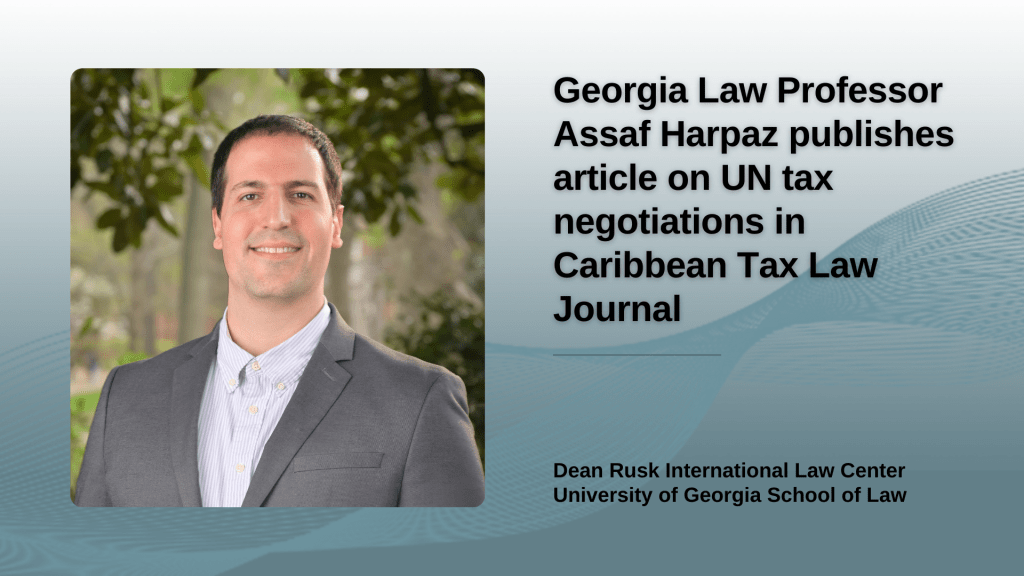
Georgia Law Professor Assaf Harpaz publishes article on UN tax negotiations in Caribbean Tax Law Journal

University of Georgia School of Law Professor Assaf Harpaz published the article “UN Tax Negotiations: North–South Tensions and the Challenge of Institutional Legitimacy” for the Caribbean Tax Law Journal special issue on international tax cooperation at the United Nations.

The article abstract can be found below:

The drafting process for a United Nations Framework Convention on International Tax Cooperation, along with two early protocols, is now underway. A UN framework convention represents a Global South effort to shift international tax policymaking from the OECD to the UN. For developing countries, the UN has long been viewed as a more inclusive space for tax policy negotiations, producing more favorable but historically less influential standards compared to the OECD.

Support for the UN framework convention, including its terms of reference, has been sharply divided across traditional Global North-South lines. The backlash following the OECD’s recent two-pillar reform triggered the UN initiative, as Global South countries quickly turned to the UN to begin a new chapter in cross-border taxation. Nonetheless, the UN framework convention faces an uphill battle as the Global North and South fundamentally diverge on questions of choice of forum, tax principles, and the desired scope of the convention. The U.S.’s recent withdrawal from the UN negotiation process casts further doubt on the institution’s capacity to achieve universality and compete with the OECD for the informal title of “World Tax Organization.

This article examines the ongoing UN tax negotiations, focusing on the Global North-South tensions and the historical context of the UN forum shift. It argues that the North-South divide remains a barrier to garnering institutional legitimacy, potentially undermining the framework convention’s viability.

Harpaz joined the University of Georgia School of Law as an assistant professor in summer 2024 and teaches classes in federal income tax and business taxation. Harpaz’s scholarly focus lies in international taxation, with an emphasis on the intersection of taxation and digitalization. He explores the tax challenges of the digital economy and the ways to adapt 20th-century tax laws to modern business practices.

Georgia Law alumna Anita Ninan (LL.M. ’91) presents at partner institution O.P. Jindal Global Law School in Sonipat, India

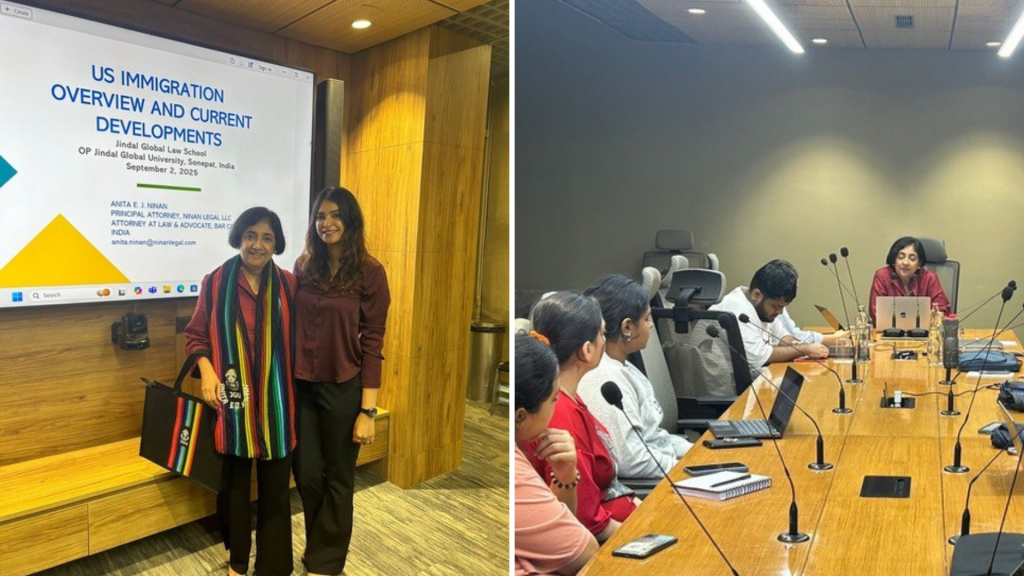
Today, we welcome a guest post by Georgia Law alumna Anita Ninan, who graduated with her Master of Laws (LL.M.) degree in 1991. Ninan recently gave presentations at Georgia Law’s partner institution in India, top-ranked O.P. Jindal Global Law School. Ninan is a dual licensed attorney admitted to practice in the State of Georgia, USA and a certified lawyer admitted to practice in India. She is the Founder and Principal Attorney of Ninan Legal LLC based in Marietta, Georgia, and serves as a member of the Dean Rusk International Law Center’s Advisory Council. Prior to her launching her own legal practice, Ninan worked in the US with leading national and international law firms. Previously, Anita served as Legal Counsel with Standard Chartered Bank in Mumbai and Delhi, India, in their Legal and Compliance Division. While there, she advised the bank on legal and regulatory issues related to commercial banking in India, advised and coordinated the bank’s external counsel to manage litigation arising from banking operations, and liaised with the Reserve Bank of India regarding the bank’s operation of Foreign Currency Non-Resident (FCNR) Accounts.

On September 2, 2025, I visited O.P. Jindal Global University (JGU) School of Law, in Sonipat, Haryana, while on vacation and a business trip to India. JGU is a private university that offers academic programs in diverse fields such as Law, Business, Liberal Arts, Psychology, Economics, Media, Journalism, Architecture, in India. The law school (JGLS) has established a premier reputation for itself, with top-tier Indian corporations and companies recruiting its students.

I was invited in my capacity as member of the Dean Rusk International Law Center’s Advisory Board to meet with JGLS students and aspiring Master of Laws (LL.M.) prospects. The University of Georgia School of Law and JGLS signed an MOU in late 2022 to establish international student mobility initiatives, including a bilateral student exchange for law students

My visit to JGLS was a great opportunity to interact with curious, eager, and engaging law students who wanted to know about recent developments in U.S. immigration that could impact student visa applications and work opportunities overseas.  I also served as an ambassador for Georgia Law’s LL.M. degree program.

My special thanks to Smarnika Srivastava, Associate Dean of International Collaborations, JGLS, who organized all aspects of my lovely visit, and to Kalyani Unkule, Associate Professor and Director of International Affairs and Global Initiatives, with whom I enjoyed a delicious Indian vegetarian meal in the beautiful cafeteria on campus. I also want to thank Mandy Dixon, International Professional Education Manager, and Sarah Quinn, Director of the Dean Rusk International Law Center, for meeting with me ahead of my visit and sharing detailed information about the LL.M. and bilateral exchange programs, respectively.

***

EXCHANGE APPLICANTS: Applications are open for the fall 2026 exchange semester with JGLS. All current 1Ls and 2Ls are invited to submit an application by February 15. For more information and the application, please email: ruskintlaw@uga.edu

MASTER OF LAWS (LL.M.) APPLICANTS: The application for Georgia Law’s LL.M. class of 2027 is now open. Detailed information about the degree program and how to apply can be found here. Recruiting events, both virtual and in-person, are listed here.

Georgia Law Professor Victoria J. Haneman presents at the University of Cambridge

University of Georgia School of Law Professor Victoria J. Haneman presented “The Politics of Impermanence” as part of the Perspectives on the Development and Enactment of Tax Policy Conference at the Centre for Tax Law at the University of Cambridge in the United Kingdom this summer. 

Haneman joined the University of Georgia School of Law in the fall of 2025 as the holder of the Verner F. Chaffin Chair in Fiduciary Law. Haneman comes to UGA from Creighton University, where she was a member of the law school’s faculty for seven years. In 2023, she was appointed the associate dean for research and innovation. She also held the Frank J. Kellegher Professorship of Trusts & Estates and served as the interim director of the health law program for the 2023-24 academic year. Haneman has a particular interest in tax policy, death care services, industry disruption, emerging markets, and women and the law.

Welcoming the Master of Laws (LL.M.) Class of 2026 to Georgia Law

With the Fall 2025 semester in full swing, the Dean Rusk International Law Center is proud to welcome another class of talented lawyers, now studying for our University of Georgia School of Law Master of Laws (LL.M.) degree.

This group of fourteen hails from eleven different countries in Africa, Asia, Europe, and the Americas, including Nigeria, Guatemala, Ghana, Brazil, Bangladesh, Kenya, Germany, Republic of Korea, France, Nepal, and Canada. Among them are lawyers specializing in a wide range of fields including mergers and acquisitions, oil, gas, and energy law, family law, criminal law, corporate law, human rights law; immigration law, civil litigation, international trade law, sports law, securities law, and international humanitarian law.

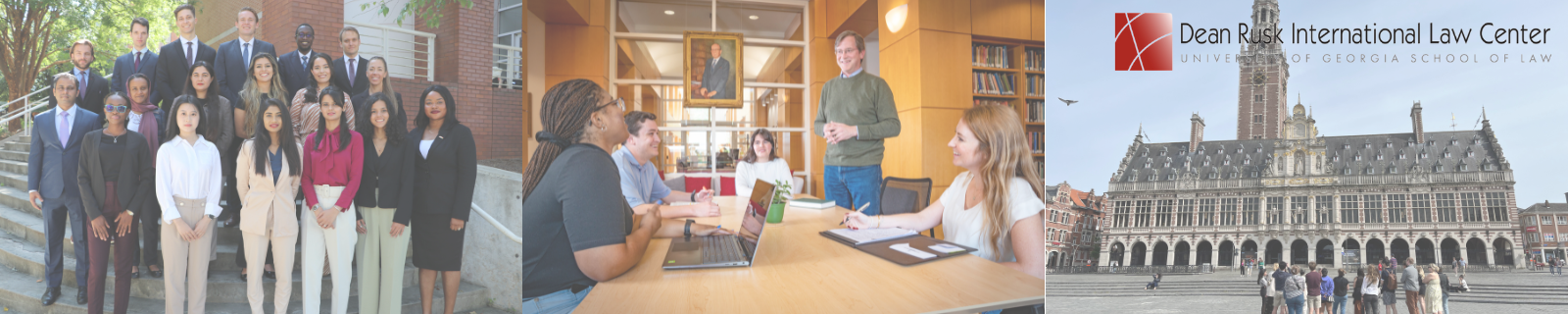
They are pictured above. From the left to right – top row: Daniel Köhl, Ofure Odia, Victor Nsoh Azure, Ane Caroline Ferri Victoria, Caroline Wambui Kamau, Ji Hun Lee, Andrei Niveaux; bottom row: Emmanuel Adetoyan, Bushra Haque, Anu Paudel, Yendira Luisa Alpirez Orantes, Shraddha Prasai, Catherine Gbikpi Benissan, Chantelle Pleasant

This Class of 2025 joins a tradition that began at the University of Georgia School of Law in the early 1970s, when a Belgian lawyer became the first foreign-trained practitioner to earn a Georgia Law LL.M. degree. In the ensuing five decades, the law school and its Dean Rusk International Law Center have produced around 600 LL.M. graduates, with ties to nearly 100 countries and every continent in the world.

Side by side with J.D. candidates, LL.M.s follow a flexible curriculum tailored to their own career goals – goals that may include preparation to sit for a U.S. bar examination, or pursuit of coursework affording advancement in their home country’s legal profession or academic institutions.

The application for the LL.M. Class of 2027 is now open; for information or to apply for LL.M. studies, visit our website and attend an upcoming recruiting event.

Georgia Law Professor Diane Marie Amann participates in discussion on statehood hosted by the World Affairs Council of Atlanta

University of Georgia School of Law Professor Diane Marie Amann served as a panelist in a recent webinar hosted by the World Affairs Council of Atlanta entitled “Defining Statehood: Law, Legitimacy, and Global Power”. Amann was joined in conversation by fellow panelist Gëzim Visoka, Associate Dean for Research in the Faculty of Humanities and Social Sciences and Associate Professor of Peace and Conflict Studies, and moderator Rickey Bevington, President of the World Affairs Council of Atlanta.

Below is a description of the webinar from the event’s webpage:

What Does It Mean to Be a State in the 21st Century? 

The definition of statehood remains one of the most complex and contested questions in international law and global politics. While the 1933 Montevideo Convention offers a four-part framework—population, territory, government, and capacity for international relations—real-world statehood is shaped just as much by recognition, legitimacy, and geopolitical power. 

In today’s multipolar world, where contested territories, partial recognition, and non-state actors challenge traditional norms, how do we define what it means to be a state?

A recording of the webinar can be accessed here.

Amann is Regents’ Professor of International Law and holds the Emily & Ernest Woodruff Chair in International Law at the University of Georgia School of Law. Also serving as a Faculty Co-Director of the Dean Rusk International Law Center, she is a former Associate Dean for International Programs & Strategic Initiatives. During summer and fall 2025, she is in the United Kingdom serving as a Visiting Academic at University College London Faculty of Laws.

Georgia Law Professor Nathan S. Chapman presents at Notre Dame Religious Liberty Summit in Dublin, Ireland

University of Georgia School of Law Professor Nathan S. Chapman presented “Adjudicating Religious Sincerity” at the Notre Dame Religious Liberty Summit in Dublin, Ireland.

From their website:

The fifth annual Notre Dame Religious Liberty Summit brought together the world’s leading defenders of religious liberty for conversation between religious leaders, scholars, and advocates about the future of religious liberty. The Summit’s theme at the 2025 Notre Dame Religious Liberty Summit is Political Authority, Civil Society, and Religious Freedom.

Over 100 leading scholars, faith leaders, and advocates gathered in Dublin, Ireland. During the three days of the summit, more than 20 speakers will participate in 6 panel discussions. Featured topics included:

  • Suppression of Religion in the Global South
  • Combating Religious Oppression by Powerful States
  • Threats to Civil Society – Religious Education
  • Threats to Civil Society – Religious Social Service Providers
  • Suppression of Religion in Hong Kong and China
  • Persecution of Christians Worldwide

Chapman currently serves as the law school’s associate dean for faculty development and holds the Cleveland Distinguished Chair of Law. He writes and teaches about constitutional law, especially constitutional rights, and law and religion. Most recently, he is the author, with Michael W. McConnell, of Agreeing to Disagree: How the Establishment Clause Promotes Religious Pluralism and Protects Freedom of Conscience (OUP, 2023).