University of Georgia School of Law professor Assaf Harpaz recently submitted comments on the Zero Draft Terms of Reference for a United Nations Framework Convention on International Tax Cooperation.
Assaf Harpaz joined University of Georgia School of Law as an assistant professor in summer 2024 and will teach classes in federal income tax and business taxation. Harpaz’s scholarly focus lies in international taxation, with an emphasis on the intersection of taxation and digitalization. He explores the tax challenges of the digital economy and the ways to adapt 20th-century tax laws to modern business practices.
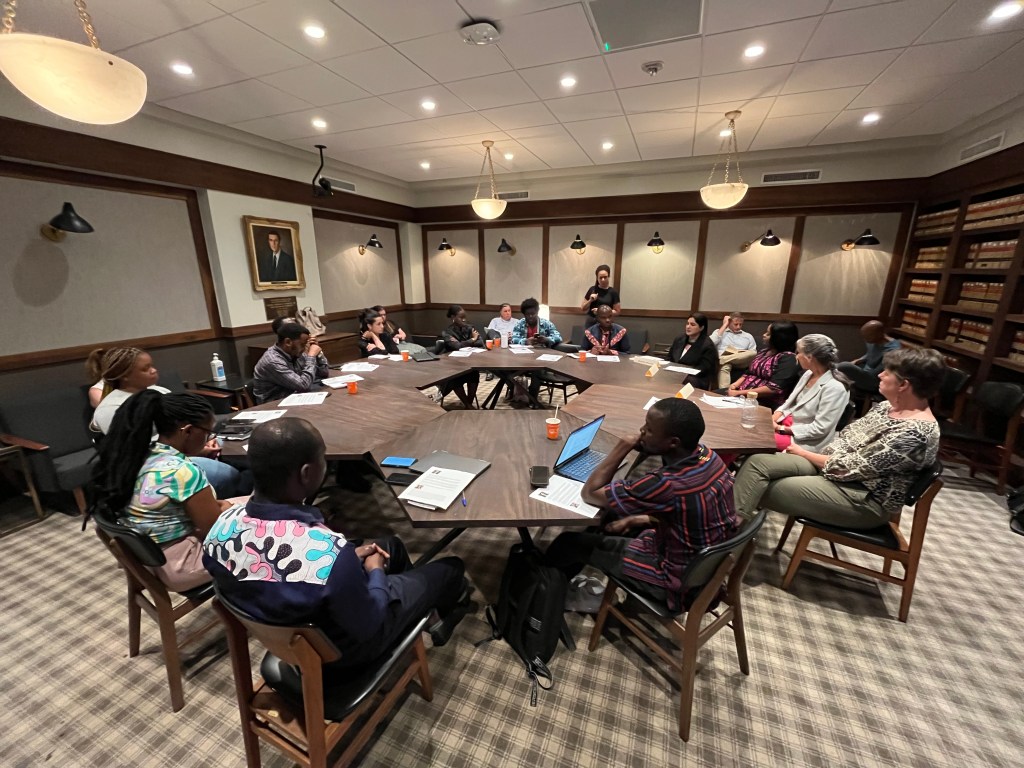
The 10 Fellows in attendance have work experience in anti-human trafficking, advocacy for women and girls, human rights, and refugee and victim assistance, among other topics. A total of 10 countries were represented in this group: The Republic of Congo, Ethiopia, Mali, South Africa, Zambia, Zimbabwe, Kenya, Burkina Faso, Uganda, and the Ivory Coast.
Scartz, Prittie, and Lartey began the roundtable by discussing their respective backgrounds and work, and then answered the Fellows’ questions. This is the second year that the law school has hosted a group of Fellows.
The Mandela Washington Fellowship for Young African Leaders is the flagship program of the U.S. government’s Young African Leaders Initiative (YALI) and sponsored by the U.S. Department of State. Since 2014, nearly 4,200 young leaders from every country in Sub-Saharan Africa have participated in the Fellowship. Mandela Washington Fellows, between the ages of 25 and 35, are accomplished innovators and leaders in their communities and countries.
University of Georgia School of Law Associate Dean & Hosch Professor Jason A. Cade was recently featured in The Atlanta Journal-Constitution regarding the Southern Poverty Law Center’s Southeast Immigrant Freedom Initiative. The article titled “For migrants in Georgia, fighting deportation will become harder. Here’s why.” was written by Lautaro Grinspan and published 6/26/24.
As stated in the article:
“Detained immigrants in Georgia tend to be held in remote areas, cut off from society, making it really difficult for them to access representation or have contact with family. [The Southern Poverty Law Center’s Southeast Immigrant Freedom Initiative] was essentially the only resource that existed to help them, and they did excellent work,” said Jason Cade, a professor at the University of Georgia School of Law, in a statement.
Jason A. Cade is Associate Dean for Clinical Programs and Experiential Learning, J. Alton Hosch Professor of Law & Community Health Law Partnership Clinic Director. In addition to overseeing the law school’s 11 in-house clinics and 7 externship programs, Cade teaches immigration law courses and directs the school’s Community Health Law Partnership Clinic (Community HeLP), in which law students undertake an interdisciplinary approach to immigrants’ rights through individual client representation, litigation, and project-based advocacy before administrative agencies and federal courts.
Read the full article here. Additional information about the Community HeLP Clinic can be found here.
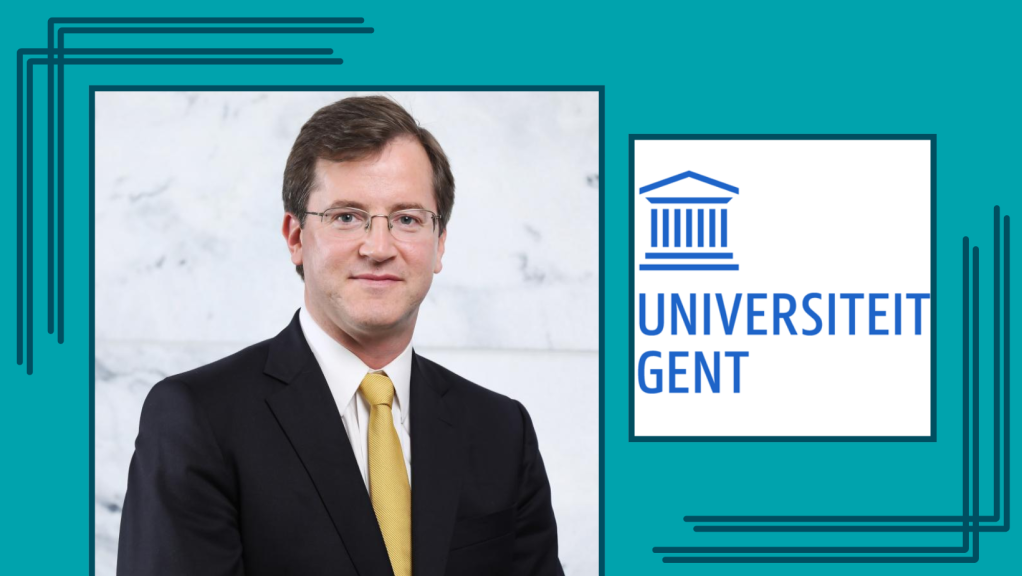
Christopher M. Bruner, Stembler Family Distinguished Professor in Business Law and Faculty Co-Director of the Dean Rusk International Law Center, gave the keynote address for a symposium on “Corporate Sustainability Due Diligence (CSDD), Sustainability, and Corporate Law” at Ghent University Law School in Belgium during May. Bruner’s keynote was titled “Developments and Debates on Corporate Sustainability in the US,” and the symposium was co-sponsored by the journal European Company Case Law (ECCL).
Groups like ABILA have been an integral part of my academic growth, and I am thrilled to have the opportunity to contribute as a student ambassador. I hope to use this position to meet other professionals across the field and give back in helping other students better understand the academic and professional opportunities available to them in studying international law
Graham is the second Georgia Law student in the last two years to be selected as an ABILA student ambassador. Last year, LL.M. student Bohdan Krivuts served in this role, detailed in a prior post (here).
Professor Diane Marie Amann recently was featured in Expresso, a newspaper based in Lisbon, Portugal, regarding efforts to hold Russian officials accountable for the war in Ukraine.
Reviewing various obstacles to these efforts, Tribuna quoted Amann as follows (in translation):
“One question, obviously, is whether this court will be able to arrest the accused leaders,” acknowledges Diane Marie Amann. Still, she points out, “this is a challenge in all criminal cases, and the magnitude of the challenge should not impede the effort to ensure justice.”
Recalling the March 17, 2023, arrest warrants issued by the International Criminal Court against Russian President Vladimir Putin and his Children’s Rights Commissioner Maria Lvova-Belova (about which Amann has written here), Tribuna wrote:
Although neither has been detained – which highlights the challenge that any legal system faces when trying to guarantee justice while the conflict is ongoing – the decision had effects, considers Amann. “It raised public awareness about the criminal allegations and encouraged states and civil society actors to call for the return of children.”
Amann is Regents’ Professor of International Law, Emily & Ernest Chair in International Law, and Faculty Co-Director of the Dean Rusk International Law Center here at the University of Georgia School of Law. She writes and teaches in areas including transnational and international criminal law, child and human rights, constitutional law, and global legal history.
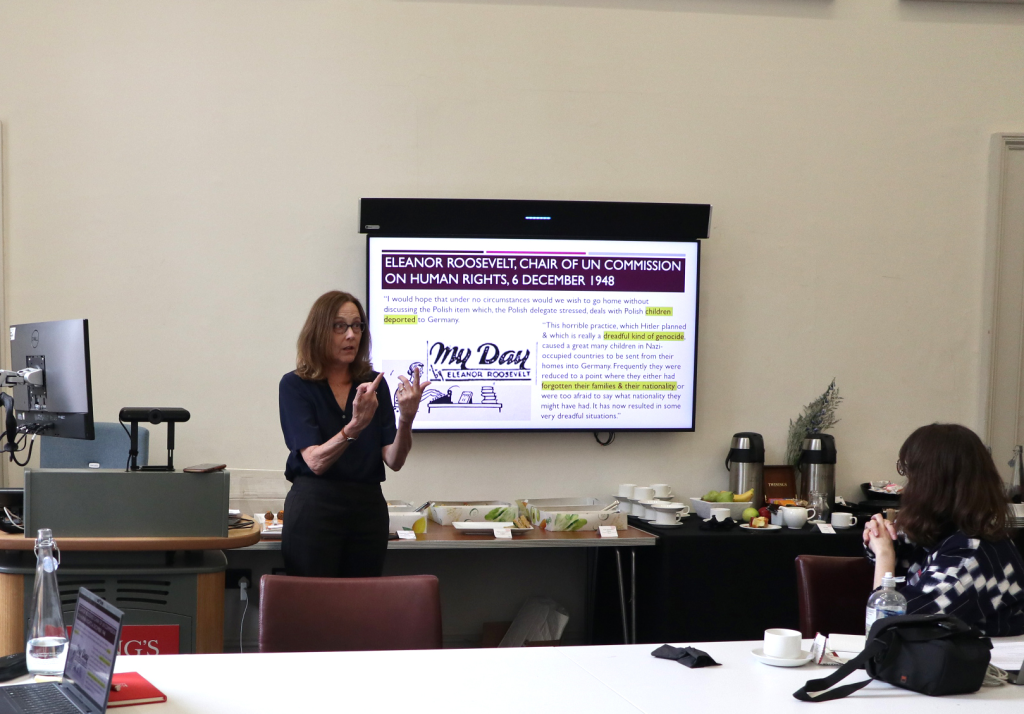
Professor Diane Marie Amann recently presented her research on “Child-Taking” during a Forced Separation Workshop at King’s College London, which cosponsored the event along with Queen’s University Belfast School of Law and the UK Gender, Justice and Security Hub.
Organizers of the workshop – Professor Fionnuala Ni Aolain, Dr. Rebekka Friedman, and Dr. Diana Florez – brought together a global array of participants who engaged in a multidisciplinary exploration of instances and consequences of separating families. Studied were contemporary and historical contexts across the globe. They included: armed conflict and similar violence; security, carceral, and migration detention; coerced schooling; enslavement; and illegal adoptions.
Amann’s talk drew from her article, “Child-Taking,” soon to be published in the Michigan Journal of International Law. (Preprint draft available at SSRN.) As Amann theorizes it, child-taking occurs when a state or similarly powerful entity abducts children from their community and then endeavors to remake the children in its own image. This conduct, involving children taken from Ukraine, lies at the heart of the International Criminal Court warrants pending against President Vladimir Putin and another top Russian official. The article also examines other examples of the phenomenon, including the Nazis’ kidnappings of non-German children during World War II and the forced placement of Indigenous children into boarding schools in North America, Australia, and elsewhere.
Amann is Regents’ Professor of International Law, Emily & Ernest Chair in International Law, and Faculty Co-Director of the Dean Rusk International Law Center here at the University of Georgia School of Law. She writes and teaches in areas including child and human rights, constitutional law, transnational and international criminal law, and global legal history.
Amann situated the crime of human trafficking within efforts to combat illicit flows of myriad goods, ranging from armaments to endangered animal species. She then considered the interplay of multilateral treaties and national statutes by comparing U.S. and British precedents on whether diplomatic immunity applies in cases alleging domestic servitude.
The talk furthered outreach efforts by the American Society of International Law, on whose Judicial Education Committee Amann serves.
Amann is Regents’ Professor of International Law, Emily & Ernest Chair in International Law, and Faculty Co-Director of the Dean Rusk International Law Center here at the University of Georgia School of Law. She writes and teaches in areas including transnational and international criminal law, child and human rights, constitutional law, and global legal history.
States increasingly use driver’s license laws to further policy objectives unrelated to road safety. This symposium contribution employs a health justice lens to focus on one manifestation of this trend—state schemes that prohibit noncitizen residents from accessing driver’s licenses and then impose criminal sanctions for driving without authorization. Status-based no-license laws not only facilitate legally questionable enforcement of local immigration priorities but also impose structural inequities with long-term health consequences for immigrants and their family members, including US citizen children. Safe, reliable transportation is a significant social determinant of health for individuals, families, and communities. Applying a health justice lens to the weaponization of no-license laws against noncitizens will both catalyze new legal challenges and create momentum for coalition building and policy reforms.
Jason A. Cade is Associate Dean for Clinical Programs and Experiential Learning, J. Alton Hosch Professor of Law & Community Health Law Partnership Clinic Director. In addition to overseeing the law school’s 11 in-house clinics and 7 externship programs, Cade teaches immigration law courses and directs the school’s Community Health Law Partnership Clinic (Community HeLP), in which law students undertake an interdisciplinary approach to immigrants’ rights through individual client representation, litigation, and project-based advocacy before administrative agencies and federal courts.
Global Externships Overseas (GEO), 4-12 week placements for rising second- and third-year law students in private-sector and public-sector law placements around the world.
Global Governance Summer School
This year’s Global Governance Summer School will focus on comparative administrative law. It is set to begin this month, when students will travel to Belgium for a week of lectures led by Georgia Law Associate Dean for Academic Affairs & J. Alton Hosch Professor of Law Kent Barnett, as well as professors from partner university KU Leuven. The first week of this for-credit course also will include professional development briefings at the North Atlantic Treaty Organization, the American Chamber of Commerce to the European Union, private law firms, and NGOs.
Then, programming shifts to The Hague, Netherlands, where Barnett will lead briefings at the International Criminal Court, the International Court of Justice, the Permanent Court of Arbitration, the International Residual Mechanism for Criminal Tribunals, and the U.S. Embassy in The Hague. Center director Sarah Quinn and Global Practice Preparation Assistant Catrina Martin will provide logistical assistance during the program.
Our Center’s Global Externship Overseas initiative places Georgia Law students in externships lasting between four and twelve weeks. It thus offers students the opportunity to gain practical work experience in a variety of legal settings worldwide. This summer, three students have opted to combine the GEO opportunity with participation in GGSS: Emily Munger, Karlie “Kara” Reed, and Benjamin Privitera.
This summer, sixteen Georgia Law students are set to pursue Global Externships Overseas, in practice areas such as privacy and technology law, intellectual property law, cultural heritage and historic preservation, environmental law, international arbitration, corporate law, and human rights law.
This year’s GEO class includes these private-sector placements:
Andrew Miller (rising 3L) – Weickmann & Weickmann; Munich, Germany







 exchange of notes