
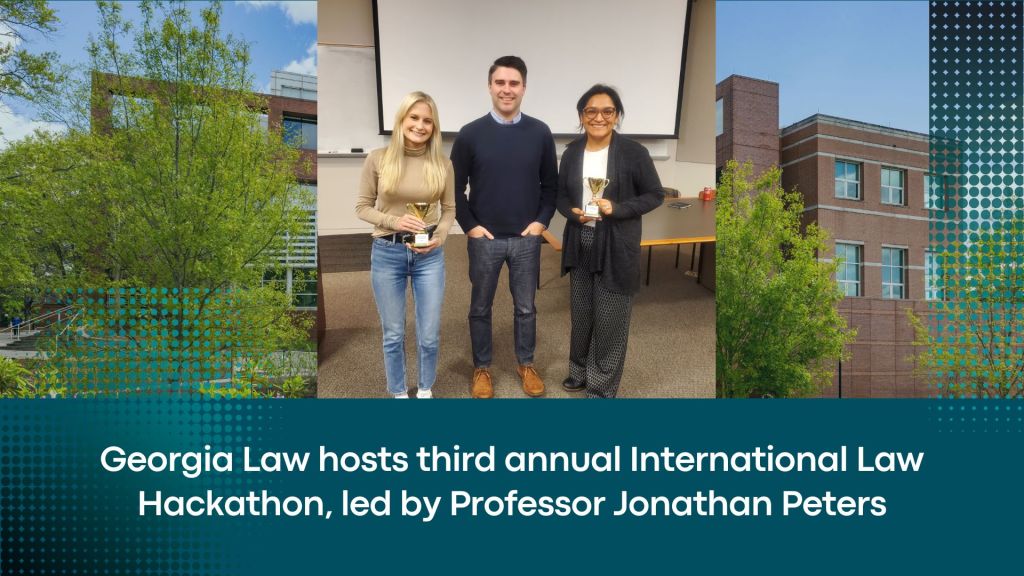
The University of Georgia School of Law hosted its third annual International Law Hackathon, led by Jonathan Peters, a media law scholar and the head of UGA’s Department of Journalism in the Grady College of Journalism and Mass Communication. Peters also holds a courtesy faculty appointment in the law school.
The International Law Hackathon is a one-credit course offered for J.D., LL.M, and graduate students participating in the Graduate Certificate in International Law. This year’s Hackathon focused on social media and the implications of privately governing speech in a globally networked society. Over the span of six weeks, students discussed content moderation and free speech principles, as well as the biggest content challenges that platforms are confronting, such as misinformation and disinformation, bullying and harassment, depictions of violence, and sexual exploitation and abuse.
The Hackathon concluded Saturday, February 15th with student presentations on the challenges posed by regulating speech on social media platforms. Then, working in groups, students proposed updates to General Comment No. 34 of the International Covenant on Civil and Political Rights (ICCPR) drafted by the United Nations Human Rights Committee. (General Comment No. 34 is an interpretive commentary on the ICCPR provision guaranteeing the freedoms of opinion and expression.) Each group delivered a presentation to a panel of judges outlining the proposed updates and how the changes would impact social media.
This year’s winning team included Zulma Perez (LL.M. ’25) and Brandtley Grace Vickery (J.D. ’25). Their proposal focused on how to reduce the presence of hate speech on YouTube.
The panel of judges included: John B. Meixner, Assistant Professor of Law; Clare R. Norins, Clinical Associate Professor & First Amendment Clinic Director; and Christina Lee, a Legal Fellow in the First Amendment Clinic.
 exchange of notes