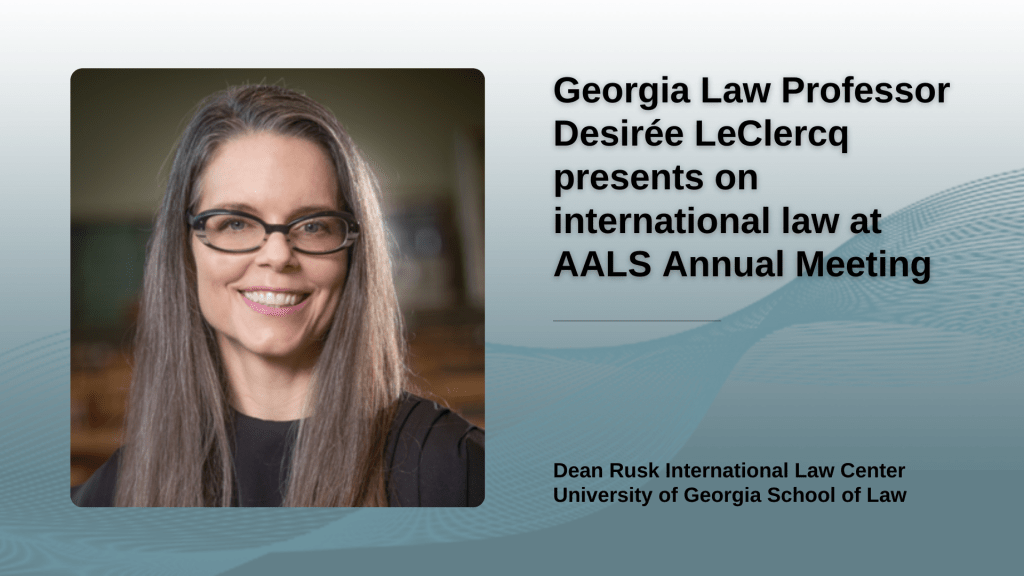
LeClercq joined the University of Georgia School of Law in 2024 as an assistant professor. She teaches Contracts, International Trade and Workers Rights, International Labor Law, U.S. Labor Law, and Public International Law. She also serves as a faculty co-director of the Dean Rusk International Law Center and as the faculty adviser for the Georgia Journal of International and Comparative Law and the Labor and Employment Student Association.
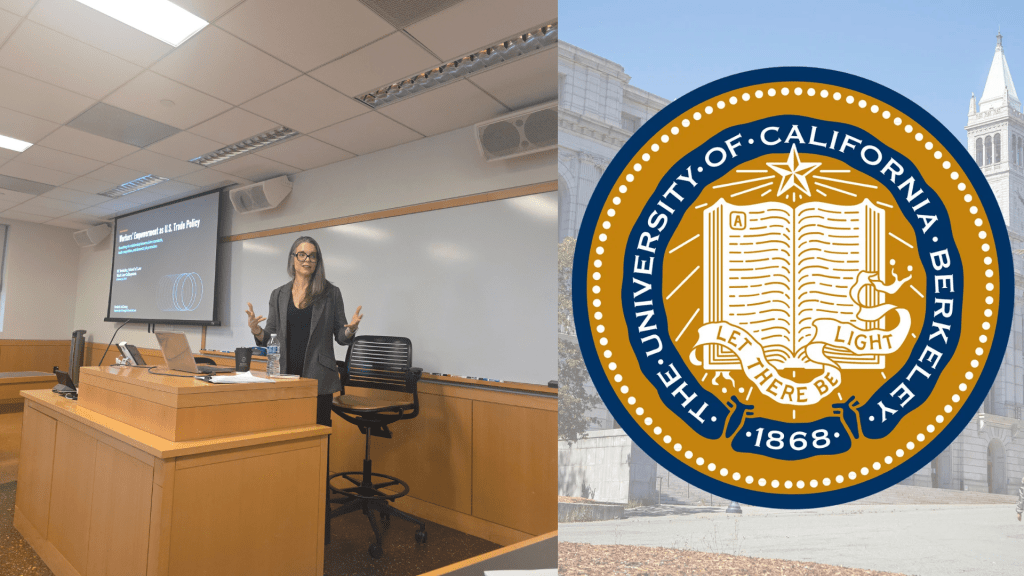
The panel focused on concerns about the second Trump administration’s impact on the international legal order, including U.S. engagement with international bodies and the potential effects on areas such as international criminal law and human rights law.
LeClercq also moderated the panel “Teaching Human Rights: From Specialized Courses to Doctrinal Integration”, which explored innovative approaches to teaching human rights, including strategies for standalone courses and ways to integrate human rights perspectives into first-year doctrinal courses and other core parts of the law school curriculum.
LeClercq joined the University of Georgia School of Law in 2024 as an assistant professor. She teaches Contracts, International Trade and Workers Rights, International Labor Law, U.S. Labor Law, and Public International Law. She also serves as a faculty co-director of the Dean Rusk International Law Center and as the faculty adviser for the Georgia Journal of International and Comparative Law and the Labor and Employment Student Association.
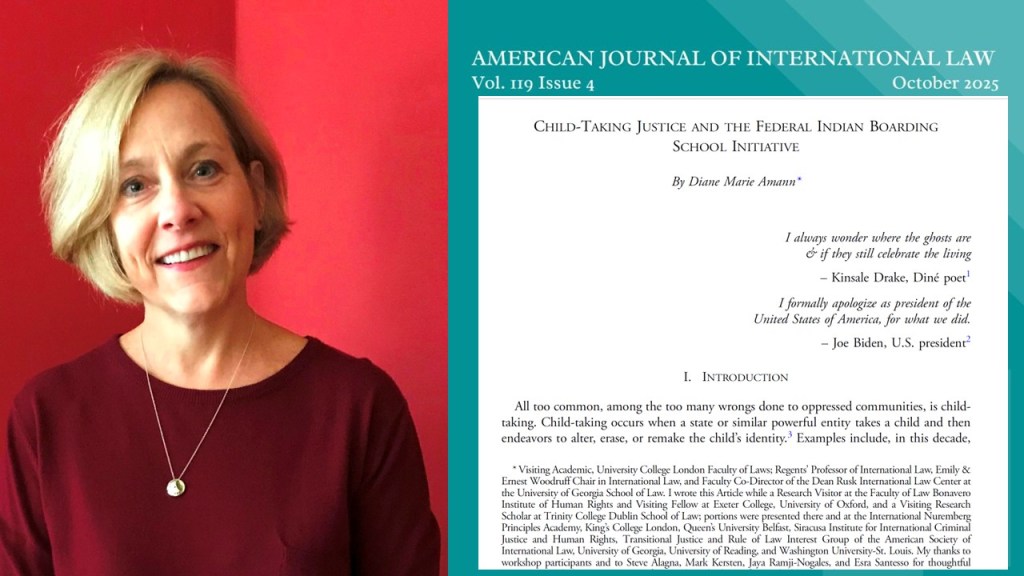
Amann is Regents’ Professor of International Law, Emily & Ernest Woodruff Chair in International Law, and a Faculty Co-Director of our Dean Rusk International Law Center here at Georgia Law. During her current research-intensive semester, she is a Visiting Academic at University College London Faculty of Laws.
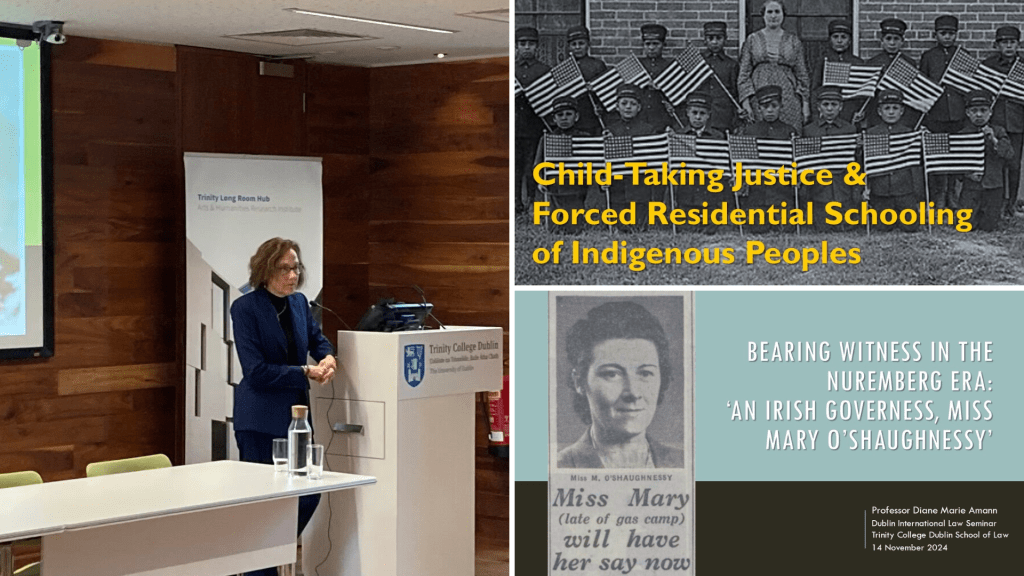
This new publication continues scholarly research that Amann first explored in her article “Child-Taking,” 45 Michigan Journal of International Law 305 (2024), and that she has presented at many universities and other learned societies in the United States, Ireland, and the United Kingdom.
The focus of this article is the 2022–2024 Federal Indian Boarding School Initiative undertaken the U.S. Executive Branch. The article chronicles this three-year process, which included sessions with survivors and their descendants, and which resulted in a two-volume report, in an apology by President Joe Biden, and in designation of a national memorial at one of the most notorious school sites. This article examines the initiative as an example of “child-taking justice”; that is, as a process of what is called “transitional justice”, done in an effort to redress the takings of children from their community, followed by efforts to alter, erase, or remake the children’s identities. The initiative shed glaring light on the past history and present effects of a centuries-old practice by which the United States took Indigenous children from their families and forced them to attend residential schools where they were compelled to submit to Westernized and Christianized notions of “civilization.”
Unfolding within the internal constitutional framework of the United States, the U.S. initiative benefited from meaningful engagement with affected communities. This article nonetheless argues for a framing that also addresses external frameworks; to be specific, one that engages fully with applicable international law and lessons learned elsewhere. The argument runs counter to the United States’ longstanding practice of holding international human rights law at arm’s length, while pressing other countries to conform to that law’s strictures. Efforts of a U.S. human-rights-at-home movement have not reversed that trend. Thus the U.S. initiative made only a hesitant overture to international issues and to three countries, Canada, Australia, and New Zealand, with which it claimed kinship. The 2025 inauguration of a President hostile to rights-based justice pointed to limitations of this approach.
University of Georgia School of Law Professor Desirée LeClercq recently organized and funded (through a grant won at Cornell University) a transnational conference of U.S., Mexican, and Canadian labor unions and leaders at Flacso Mexico in Mexico City. Patricia Campos-Medina (WI-ILR Cornell University), Alex Covarrubias (El Colegio de Sonora), and Cirila Quintero (El Colegio de la Frontera Norte) served as conference co-organizers.
This one-day transnational labor conference solicited the views of labor unions, non-governmental organizations (NGOs), organizers, and workers on the United States-Mexico-Canada Agreement (USMCA)’s Rapid Response Mechanism (RRM) in light of current geopolitical dynamics. Participants identified current challenges in filing petitions under the RRM, aligned strategic approaches to the 2026 re-negotiation of the USMCA, and discussed ways to work together notwithstanding current tensions in politics and trade. The conference was structured to first discuss the RRM on a technical level before broadening to account for political tensions and joint transnational strategies. It concluded with ways participants could remain organized and collaborate in the future.
LeClercq joined the University of Georgia School of Law in 2024 as an assistant professor. She teaches International Trade and Workers Rights, International Labor Law, International Law and U.S. Labor Law. She also serves as a faculty co-director of the Dean Rusk International Law Center and as the faculty adviser for the Georgia Journal of International and Comparative Law.
University of Georgia School of Law Professor Diane Marie Amann recently gave an online lecture entitled “Justice for Child-Taking and Other Crimes against and affecting Children” as part of “International Criminal Law, Conflict Resolution and Transitional Justice,” the week-long 24th Specialization Course in International Criminal Law for Young Penalists, held in Sicily, at the Siracusa International Institute for Criminal Justice and Human Rights, Italy.
Amann is Regents’ Professor of International Law, Emily & Ernest Woodruff Chair in International Law, and a Faculty Co-Director of our Dean Rusk International Law Center here at Georgia Law. Her Siracusa lecture drew upon her expertise on children, violence, conflict, and justice. Her most recent publication in this field is “Child-Taking,” 45 Michigan Journal of International Law 305 (2024); all her related publications are available here.
Hopenhaym and Bruner discussed the connection between environmental sustainability and human rights, exploring key dynamics, including how communities can suffer when their rights to food, clean water, and fair working conditions are compromised and how corporations are voluntarily improving their practices, but the complexity of their structures—spanning subsidiaries and global supply chains—makes full due diligence difficult. They also talked about where the U.S. stands on corporate compliance and the challenges in providing remedies for affected communities. They concluded the event by discussing the future of corporate accountability, particularly in the context of the ongoing UN Treaty on Business and Human Rights (BHR) process.
Hopenhaym is Co-Executive Director at Project on Organizing, Development, Education and Research (PODER), an organization in Latin America dedicated to corporate accountability. For twenty years, Ms. Hopenhaym has worked on economic, social and gender justice. Since 2006 Ms. Hopenhaym has been working on issues related to human rights and financial institutions and in the last ten years, she has focused specifically on business and human rights, working to advance corporate accountability and strengthen respect for human rights vis-a-vis private and public investments or development projects, and private sector operations. She has been involved in processes related to the implementation of the UN Guiding Principles, as well as in other processes regarding relevant instruments, such as the Binding Treaty negotiations and due diligence laws. She has conducted research on cases related to corporate impact on human rights and the environment and worked with and accompanied local communities affected by public/private projects in their pursuit of justice and remedy. She has conducted advocacy in the LAC region and globally to advance corporate accountability and human rights as well as leading training and capacity building on business and human rights related issues. From January 2019 to December 2021, Ms. Hopenhaym was Chair of the Board of ESCRNet, the international network for economic, social and cultural rights; she has been a board member of EarthRights International since early 2021 and an adviser to the Business and Human Rights Award Foundation since early 2020.
Georgia Law’s Environmental Law Association “seek[s] to further the development and advancement of environmental law through activities designed to increase environmental awareness among members of the community at large and the student bodies of the University of Georgia and the Georgia School of Law.” This year’s ELA President, Kellianne Elliott (J.D. ’26), and Carolina Ruiz (LL.M. ’26) organized this event.
Presented her work in progress, “Child-Taking Justice and Forced Residential Schooling of Indigenous Peoples,” as part of the Bonavero Perspectives workshop series at the Oxford Faculty of Law Bonavero Institute of Human Rights. Moderating was another Bonavero Research Visitor, Professor Eva Marie Belser of the University of Fribourg in Switzerland.
Amann is Regents’ Professor of International Law, Emily & Ernest Woodruff Chair in International Law, and a Faculty Co-Director of our Dean Rusk International Law Center here at Georgia Law, where she teaches Public International Law, Constitutional Law, and various upper-division courses exploring interrelations between national and international legal frameworks.
Amann is Regents’ Professor of International Law, Emily & Ernest Woodruff Chair in International Law, and a Faculty Co-Director of our Dean Rusk International Law Center here at Georgia Law. She has pursued a research-intensive semester this autumn, primarily as a Research Visitor at the Oxford Faculty of Law Bonavero Institute of Human Rights and Visiting Fellow at Exeter College Oxford.
Amann discussed the significance of the warrants, which had charged Russia’s President and another Presidential official of the war crimes of child deportation, and which were issued just days before the 2023 Annual Meeting. The remarks spurred her to further research on the topic, resulting in her article “Child-Taking,” also published this month, at 45 Michigan Journal of International Law 305 (2024) (prior post).
Also on the panel were: Professor Saira Mohamed, University of California-Berkeley School of Law; Professor Javier S. Eskauriatza, University of Nottingham Scholl of Law; and Professor Marko Milanović, University of Reading School of Law. Katherine Gallagher, Senior Staff Attorney at the Center for Constitutional Rights and an Adjunct Professor of Clinical Law at New York University School of Law, moderated. The panelists’ remarks in full are here.
Amann is Regents’ Professor of International Law, Emily & Ernest Woodruff Chair in International Law, and a Faculty Co-Director of our Dean Rusk International Law Center here at Georgia Law. She served from 2012 to 2021 as International Criminal Court Prosecutor Fatou Bensouda’s Special Adviser on Children in & affected by Armed Conflict. This Fall 2024 semester she is at the University of Oxford in the United Kingdom, serving as a Research Visitor at the Faculty of Law Bonavero Institute of Human Rights and as a Visiting Fellow at Exeter College.
Shannon N. Green, a UGA graduate who serves as the Assistant to the Administrator of the Bureau for Democracy, Human Rights, and Governance (DRG) at the U.S. Agency for International Development (USAID), spoke to students at the University of Georgia School of Law last week. The discussion, entitled “Building a Career in Human Rights Diplomacy,” was moderated by Dr. Amanda Murdie, Head of the Department of International Affairs and Georgia Athletic Association Professor of International Affairs.
In Green’s current role, she leads USAID’s efforts to invigorate democracy, enhance human rights and justice, and bolster governance that advances the public interest and delivers inclusive development. Previously, Green was the Senior Advisor to the Administrator and Executive Director of the Anti-Corruption Task Force where she led USAID’s historic elevation of anti-corruption and aligned the Agency’s policies, programming, and resources to counter corruption at a global scale.
Before returning to public service in 2021, Green was the Senior Director of Programs at the Center for Civilians in Conflict (CIVIC) and Director and Senior Fellow of the Human Rights Initiative at the Center for Strategic and International Studies (CSIS), where her research focused on addressing threats to democratic institutions and norms, enhancing justice and accountability, and improving security forces’ respect for human rights.
From 2004 – 2015, Green held a number of positions in the U.S. Government, including as the Senior Director for Global Engagement on the National Security Council. In that role, she spearheaded efforts to deepen and broaden U.S. engagement with critical populations overseas, including the President’s Stand with Civil Society Agenda and young leader initiatives around the world. Prior to that, Green served in the DRG Center, where she developed policies, strategies, and programs to advance political reform and human rights in the Middle East and North Africa.




 exchange of notes