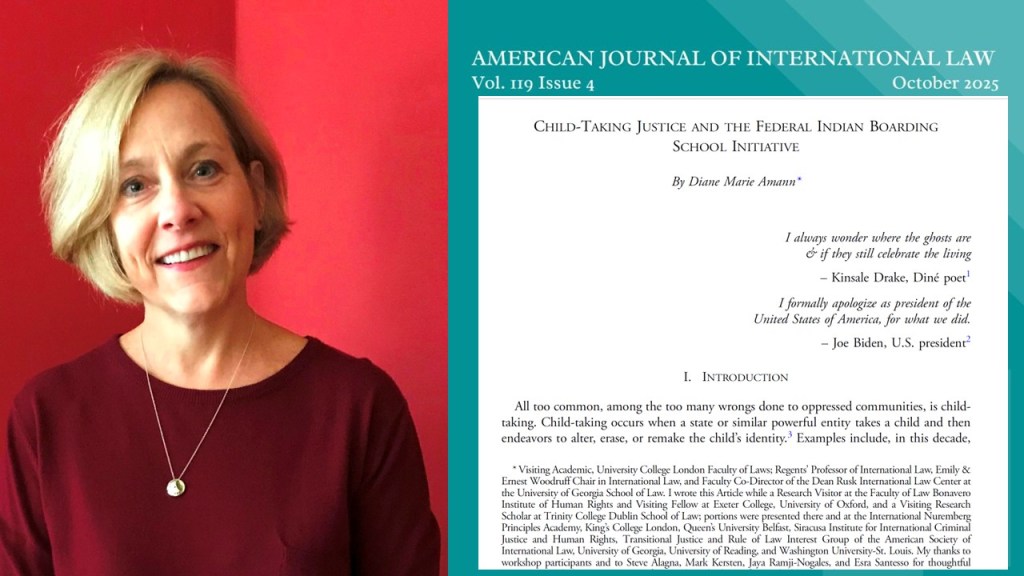
“Child-Taking Justice and the Federal Indian Boarding School Initiative,” an article by University of Georgia School of Law Professor Diane Marie Amann, has just been published in the American Journal of International Law.
Amann is Regents’ Professor of International Law, Emily & Ernest Woodruff Chair in International Law, and a Faculty Co-Director of our Dean Rusk International Law Center here at Georgia Law. During her current research-intensive semester, she is a Visiting Academic at University College London Faculty of Laws.
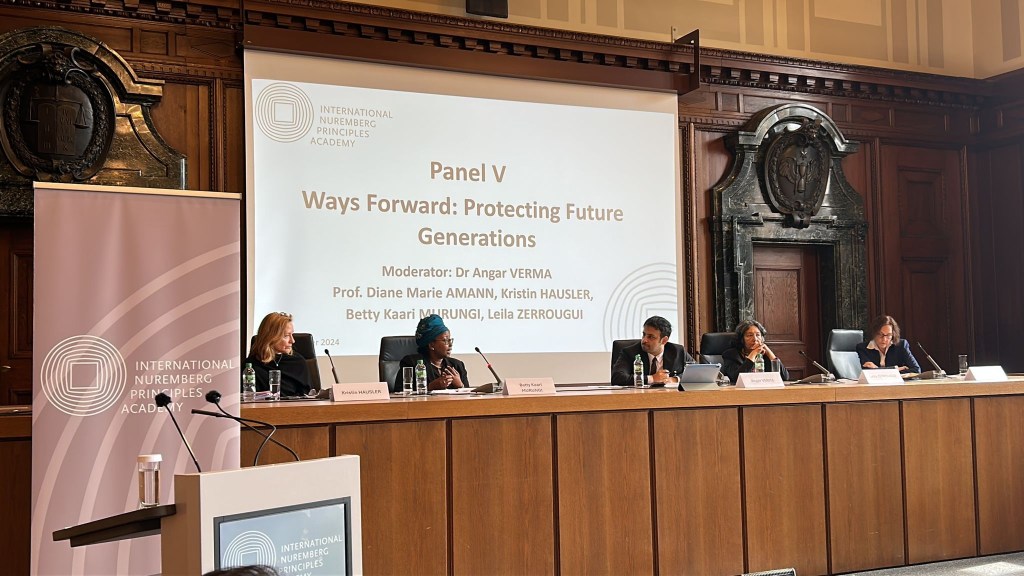
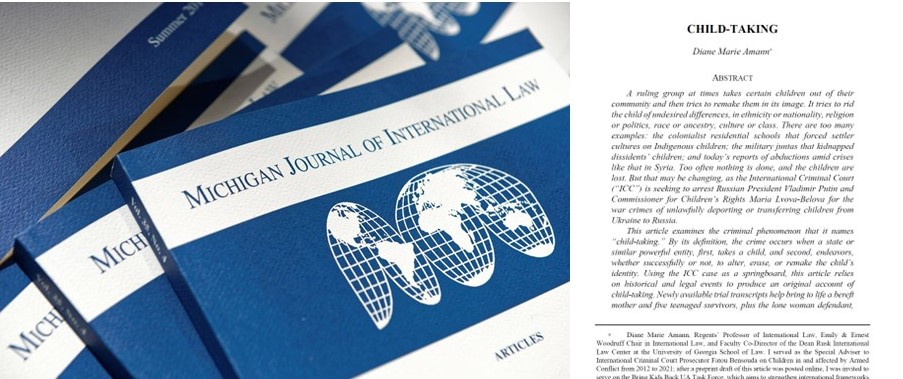
This new publication continues scholarly research that Amann first explored in her article “Child-Taking,” 45 Michigan Journal of International Law 305 (2024), and that she has presented at many universities and other learned societies in the United States, Ireland, and the United Kingdom.
Here’s an abstract for the new work:
The focus of this article is the 2022–2024 Federal Indian Boarding School Initiative undertaken the U.S. Executive Branch. The article chronicles this three-year process, which included sessions with survivors and their descendants, and which resulted in a two-volume report, in an apology by President Joe Biden, and in designation of a national memorial at one of the most notorious school sites. This article examines the initiative as an example of “child-taking justice”; that is, as a process of what is called “transitional justice”, done in an effort to redress the takings of children from their community, followed by efforts to alter, erase, or remake the children’s identities. The initiative shed glaring light on the past history and present effects of a centuries-old practice by which the United States took Indigenous children from their families and forced them to attend residential schools where they were compelled to submit to Westernized and Christianized notions of “civilization.”
Unfolding within the internal constitutional framework of the United States, the U.S. initiative benefited from meaningful engagement with affected communities. This article nonetheless argues for a framing that also addresses external frameworks; to be specific, one that engages fully with applicable international law and lessons learned elsewhere. The argument runs counter to the United States’ longstanding practice of holding international human rights law at arm’s length, while pressing other countries to conform to that law’s strictures. Efforts of a U.S. human-rights-at-home movement have not reversed that trend. Thus the U.S. initiative made only a hesitant overture to international issues and to three countries, Canada, Australia, and New Zealand, with which it claimed kinship. The 2025 inauguration of a President hostile to rights-based justice pointed to limitations of this approach.






 exchange of notes