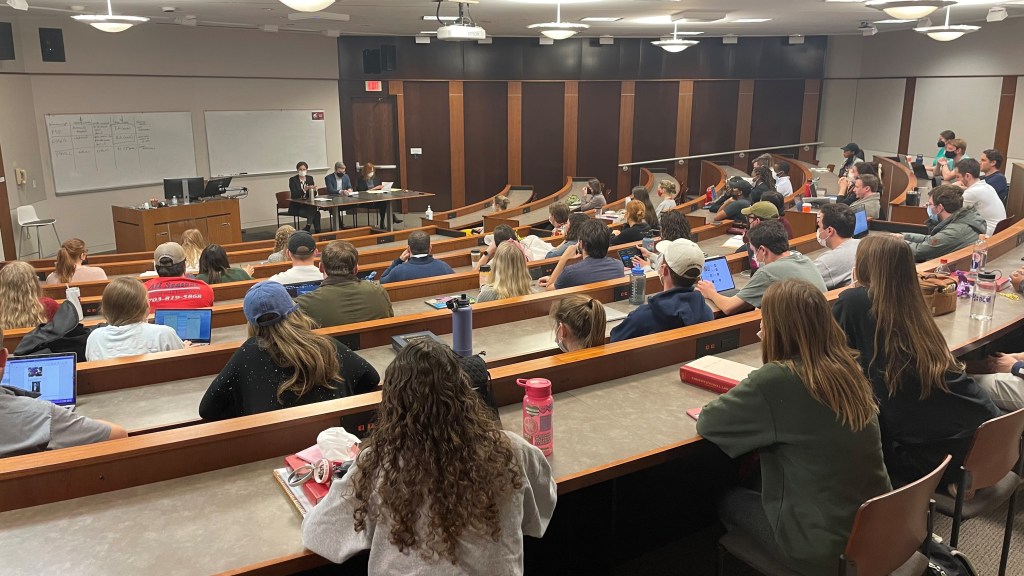
Georgia Law Professor Diane Marie Amann presents on child-taking at Hague event sponsored by Ukraine and Global Rights Compliance

University of Georgia School of Law Professor Diane Marie Amann discussed her research on child-taking at a side event occurring during the 24th annual Assembly of States Parties of the International Criminal Court, held in early December at The Hague in The Netherlands.

Entitled “Vanished Voices: The Plight of Missing Children from Ukraine, Syria and Sudan,” the event was co-sponsored by the government of Ukraine and by Global Rights Compliance, a nongovernmental organization.

In addition to Professor Amann, additional panelists included: Hala Turjman, Independent Institution on Missing Persons in the Syrian Arab Republic: Alla Perfetska, Voices of Children; and Ikhlass Ahmed Altaher Eisa, Strategic Initiatives for Women in the Horn of Africa. Ukraine’s Ambassador to The Netherlands, Andriy Kostin, provided opening and closing remarks, and Wayne Jordash KC, president of the Global Rights Compliance Foundation, moderated the panel.

Amann is Regents’ Professor of International Law, Emily & Ernest Woodruff Chair in International Law, and a Faculty Co-Director of our Dean Rusk International Law Center here at Georgia Law. During her current research-intensive semester, she is an Affiliate Academic at University College London Faculty of Laws.

From 2012 to 2021 Amann served as International Criminal Court Prosecutor Fatou Bensouda’s Special Adviser on Children in & affected by Armed Conflict. Her many publications on international child law include two that analyze the long-standing criminal phenomenon by which a state (or other powerful entity) takes a child and then endeavors to alter, erase or remake the child’s identity. These two articles are  “Child-Taking Justice and the Federal Indian Boarding School Initiative,” 119 American Journal of International Law 629 (2025), and “Child-Taking,” 45 Michigan Journal of International Law 305 (2024).

Georgia Law Professor Diane Marie Amann publishes on command responsibility in book on International Criminal Court

Weakening Command Responsibility Doctrine? The Bemba Appeals Judgment,” a chapter by University of Georgia School of Law Professor Diane Marie Amann, has just been published in The International Criminal Court: Legal, Policy, and Political Challenges.

Amann, who is Regents’ Professor of International Law, Emily & Ernest Woodruff Chair in International Law, and a Faculty Co-Director of our Dean Rusk International Law Center here at Georgia Law, is a Visiting Academic this semester at University College London Faculty of Laws.

Her commentary on Prosecutor v. Bemba, a 2018 judgment of acquittal by the ICC Appeals Chamber, first appeared as “In Bemba, Command Responsibility Doctrine Ordered to Stand Down.” It then was included in this 2025 Brill Publishers collection, edited by UCLA Law Professor Richard H. Steinberg. Also contributing to the book’s section on the Bemba judgment were attorney Nadia Carine Fornel Poutou and law professors Miles Jackson (Oxford), Michael Newton (Vanderbilt), and Leila Nadya Sadat (Washington University).

Here’s the abstract for Professor Amann’s essay:

“The acceptance of commander’s responsibility is, in effect, acceptance of authority over persons permitted to kill. With that acceptance comes a heavy burden, grown out of practical and moral concerns and reflected in longstanding legal doctrine. At odds with this burden was the judgment of acquittal that the International Criminal Court Appeals Chamber entered in Bemba in 2018. Originally appearing in an online forum, this commentary argues for a statutory construction that better would serve the purposes of the ICC and the command responsibility doctrine.”

Georgia Law Professor Diane Marie Amann’s remarks on ICC arrest warrants against Russian officials published in ASIL Annual Meeting proceedings

Remarks which University of Georgia School of Law Professor Diane Marie Amann delivered at a plenary panel of the American Society of International Law Annual Meeting have just been published.

Entitled “Children and the ICC Arrest Warrant Against the President and the Children’s Rights Commissioner of Russia,” Amann’s remarks form part of the chapter entitled “Late-Breaking Panel: ICC Arrest Warrants: Impunity in Check?” in 117 American Society of International Law Proceedings 328 (American Society of International Law, 2024).

Amann discussed the significance of the warrants, which had charged Russia’s President and another Presidential official of the war crimes of child deportation, and which were issued just days before the 2023 Annual Meeting. The remarks spurred her to further research on the topic, resulting in her article “Child-Taking,” also published this month, at 45 Michigan Journal of International Law 305 (2024) (prior post).

Also on the panel were: Professor Saira Mohamed, University of California-Berkeley School of Law; Professor Javier S. Eskauriatza, University of Nottingham Scholl of Law; and Professor Marko Milanović, University of Reading School of Law. Katherine Gallagher, Senior Staff Attorney at the Center for Constitutional Rights and an Adjunct Professor of Clinical Law at New York University School of Law, moderated. The panelists’ remarks in full are here.

Amann is Regents’ Professor of International Law, Emily & Ernest Woodruff Chair in International Law, and a Faculty Co-Director of our Dean Rusk International Law Center here at Georgia Law. She served from 2012 to 2021 as International Criminal Court Prosecutor Fatou Bensouda’s Special Adviser on Children in & affected by Armed Conflict. This Fall 2024 semester she is at the University of Oxford in the United Kingdom, serving as a Research Visitor at the Faculty of Law Bonavero Institute of Human Rights and as a Visiting Fellow at Exeter College.

Georgia Law Professor Amann presents “Child-Taking” at Yale University

Professor Diane Marie Amann recently presented her research on “Child-Taking” as a guest lecturer in a course on the Russo-Ukrainian War taught at Yale University this semester. Students from Yale’s law school, management school, and school of global affairs comprise the class, which is taught by Yale Law Professor Eugene R. Fidell and Margaret M. Donovan.

Amann is Regents’ Professor of International Law, Emily & Ernest Chair in International Law, and Faculty Co-Director of the Dean Rusk International Law Center here at the University of Georgia School of Law. She writes and teaches in areas including child and human rights, constitutional law, transnational and international criminal law, and global legal history.

Amann’s online guest lecture drew from her article, “Child-Taking,” soon to be published in the Michigan Journal of International Law. (Preprint draft available at SSRN.) As Amann theorizes it, child-taking occurs when a state or similarly powerful entity abducts children from their community and then endeavors to remake the children in its own image. This conduct, involving children taken from Ukraine, lies at the heart of the International Criminal Court warrants pending against President Vladimir Putin and another top Russian official. The article also examines other examples of the phenomenon, including the Nazis’ kidnappings of non-German children during World War II and the forced placement of Indigenous children into boarding schools in North America, Australia, and elsewhere.

Amann also has presented this scholarship at meetings of the American Society of International Law and at University College London Faculty of Laws and King’s College London Department of War Studies.

Georgia Law Professor Diane Marie Amann presents on Nuremberg woman defendant at conference in memory of FIU Law Professor Megan A. Fairlie

University of Georgia School of Law Professor Diane Marie Amann spoke last week at a conference which paid tribute to Professor Megan A. Fairlie (1971-2022), an international criminal law scholar who had presented her own work at our law school’s Dean Rusk International Law Center.

Most recently, Dr. Fairlie had taken part in a 2019 symposium entitled “International Criminal Court and the Community of Nations,” and she published her presentation, “Defense Issues at the International Criminal Court,” in the Georgia Journal of International and Comparative Law symposium issue.

In recognition of Fairlie’s scholarship on persons accused by international criminal tribunals, Amann chose to present “Inge Viermetz, Woman Acquitted at Nuremberg,” at Friday’s conference.

Entitled “Perspectives on the International Criminal Court and International Criminal Law and Procedure: A Symposium in Memory of Megan Fairlie,” the conference took place at Miami’s Florida International University College of Law. Dr. Fairlie had taught there from 2007 – the same year she earned her Ph.D. in International Human Rights Law from the Irish Centre for Human Rights, National University of Ireland-Galway – until her death in December 2022.

Amann, who is Regents’ Professor of International Law, Emily & Ernest Woodruff Chair in International Law, and Faculty Co-Director of the Dean Rusk International Law Center here at Georgia Law, has published frequently on women professionals during the post-World War II trials at Nuremberg and elsewhere.

UGA Law professor Diane Marie Amann and UCL Professor Martins Paparinskis

UGA Law Professor Amann presents “Child-Taking and the International Criminal Arrest Warrant” at University College London Faculty of Laws

University of Georgia School of Law Professor Diane Marie Amann, an expert on child and human rights, international criminal law, and the laws of war, presented a lecture entitled “Child-Taking and the International Criminal Arrest Warrant” at University College London Faculty of Laws in June.

News that the International Criminal Court is seeking the arrest of Russia’s President, Vladimir Putin, and Child Rights Commissioner, Maria Lvova-Belova, drew attention to the war crimes charged: “unlawful deportation of population (children)” and “unlawful transfer of population (children) from occupied areas.” Professor Amann’s lecture examined these and similar crimes, which she labels “child-taking.” International child-taking trials date to the Nuremberg tribunals, and have continued in modern forums like the ICC. Court records demonstrate that child-taking is no minor crime. Its present gravity and future consequences are heavy; so too, the prosecutorial burdens of securing indictments, conviction, and redress.

This presentation was chaired by UCL Professor of Public International Law, Martins Paparinskis.

Amann is the Regents’ Professor of International Law, the Emily & Ernest Woodruff Chair in International Law, and a Faculty Co-Director of the Dean Rusk International Law Center.

Georgia Law professors, alumna, students take part in annual meeting of American Society of International Law

Many members of the University of Georgia School of Law community – professors, alumna, and students – took part in last week’s 117th Annual Meeting of the American Society of International Law, the theme of which was “The Reach and Limits of International Law to Solve Today’s Challenges.”

The annual meeting took place Wednesday-Saturday at several venues in Washington, D.C.

Representatives of Georgia Law, an ASIL Academic Partner, included three scholars affiliated with the law school’s Dean Rusk International Law Center:

The Center’s Director, Melissa J. “MJ” Durkee, who is also Associate Dean for International Programs and Allen Post Professor, moderated a panel entitled “How Does International Law Change? Theories and Concepts of Legal Change.” (photo top row left) It was sponsored by ASIL’s International Legal Theory Interest Group, for which Durkee serves as Chair. Panelists were: Benedict Kingsbury, New York University; Nico Krisch, Graduate Institute of International and Development Studies in Geneva; and Sivan Shlomo Agon, Bar-Ilan University.

Durkee additionally serves on the ASIL Executive Council and the Board of Editors of the American Journal of International Law, and took part in the meetings of both those groups.

Diane Marie Amann, Regents’ Professor of International Law, Emily & Ernest Woodruff Chair in International Law, and one of our Center’s Faculty Co-Directors (above second from left), took part in a late-breaking panel, “ICC Arrest Warrant Against Putin: Impunity in Check?” (photo above left) Amann, an international child law expert and former Special Adviser to the International Criminal Court Prosecutor on Children in & affected by Armed Conflict, spoke on the significance of the fact that crimes against children form the basis of the international arrest warrant issued March 17 against the President and the Children’s Rights Commissioner of Russia. Additional panel participants were: Javier Eskauriatza, University of Nottingham; Marko Milanovic, University of Reading; Saira Mohamed, University of California-Berkeley; and moderator Katherine Gallagher, Center for Constitutional Rights. Panel video here.

Amann also attended the ASIL Executive Council meeting, completing her term as an ASIL Counsellor.

Harlan G. Cohen, Gabriel M. Wilner/UGA Foundation Professor in International Law and Faculty Co-Director of the Dean Rusk International Law Center, took the ASIL General Assembly stage: in his capacity as Chair of the 2023 Book Awards Committee, he co-presented those honors to numerous authors. (photo top row right, from left to right: ASIL President Greg Shaffer, honoree Damilola Olawuyi, ASIL Executive Director Michael Cooper, and Cohen; video 27:09)

Like Durkee, Cohen is a member of the AJIL Board of Editors and took part in the journal’s meeting. The annual meeting completed his service as Chair of ASIL’s International Legal Theory Interest Group.

A distinguished Georgia Law graduate also was featured:

Tess Davis (JD 2009), who is the Executive Director of the D.C.-based Antiquities Coalition and Dean Rusk International Law Center Council member, served as moderator for a session at the Smithsonian National Museum of Asian Art. (photo above right) Entitled “Protecting Cultural Heritage in Conflict Zones: Multi-Disciplinary Approaches,” the discussion also included: Patty Gerstenblith, DePaul University; Brooke Cuven, Cerberus Capital Management; Richard Kurin, Smithsonian Institution; and Zaydoon Zaid, American Foundation for Cultural Research.

Rounding out the contingent were four Georgia Law students, who received Louis B. Sohn Professional Development grants to serve as volunteers at the meeting: 2L Hao Chen “Bobby” Dong, 3L Collin Douglas, LLM candidate Alexandra Lampe, and 1L Mahi Patel.
Georgia Law Professor Diane Marie Amann interviewed on international law and developments in Ukraine-Russia war

An international law analysis by Georgia Law Professor Diane Marie Amann on recent developments in the Ukraine-Russia war is quoted in an article published Sunday by Voice of America Russian Service.

The Russian-language article, Юристы по международному праву: аннексия, проведенная Путиным, юридически ничтожна (that is, International Lawyers: The Annexation Carried out by Putin Is Legally Null and Void), was written by Evgenii Komarov. In addition to Amann, who is Regents’ Professor of International Law, Emily & Ernest Woodruff Chair in International Law, and Faculty Co-Director of the Dean Rusk International Law Center here at the University of Georgia School of Law, Komarov interviewed international law professors Lea Brilmayer and Zakhar Tropin, from, respectively, Yale Law School and the Shevchenko National University in Kyiv, Ukraine.

The article related particularly to last week’s assertion by Russian President Vladimir Putin that his country had annexed four regions of Ukraine that Russian troops had occupied in the months following their February 2022 invasion of the country.

Amann analyzed this development in light of international law norms set out in agreements to which Ukraine and Russia both belong, including the 1945 Charter of the United Nations, the 1949 Geneva Conventions, and human rights treaties. She also discussed the potential for accountability and international pressure, through, for instance, economic sanctions and geopolitical isolation, UN treaty bodies on human rights and anti-discrimination, the International Criminal Court, and proposals for a special tribunal.

Komarov wrote:

“The effectiveness of international law ‘depends on political will, and I think that the countries that make these decisions weigh the benefits and costs,’ states Diane Marie Amann. This leads to the fact that justice is moving very slowly.”

Dean Rusk International Law Center hosts “International Law and the Ukraine-Russia Conflict,” featuring Georgia Law Professors Amann, Cohen, and Durkee

Nearly a hundred members of the University of Georgia School of Law community took part Wednesday in “International Law and the Ukraine-Russia Conflict,” a forum hosted by our Dean Rusk International Law Center and presented by three international law experts on the law school’s faculty.

The armed conflict began on February 24, 2022, when Russian military troops invaded the neighboring state of Ukraine, entering the latter country at points on its northern, eastern, and southern borders. At this writing just a week later, thousands of persons, civilians and combatants alike, reportedly had been killed, and, according to UN High Commissioner for Refugees Filippo Grandi, more than a million Ukrainians had been forcibly displaced.

At Wednesday’s forum, each of the three Georgia Law professors first offered a brief overview of a particular aspect of the armed conflict:

  • Our Center’s Director, Melissa J. “MJ” Durkee, who is also Associate Dean for International Programs and Allen Post Professor, began by outlining the international rules that have outlawed aggressive war – that is, one country’s unjustified invasion of another – since the adoption of the 1945 Charter of the United Nations. She explained why reasons that Russia has put forward do not constitute legally valid justifications for the invasion, and further emphasized the threat that Russia’s actions place on the international rules-based order that came into being after the Allied victory in World War II. In so doing, Durkee cited a UN General Assembly resolution, adopted Wednesday by a huge majority of votes, which condemned Russia’s actions as violative of this order.
  • Next came Harlan Grant Cohen, who is Gabriel M. Wilner/UGA Foundation Professor in International Law and one of our Center’s 2 Faculty Co-Directors. Cohen focused on economic sanctions that have been levied against Russia in the last week, by individual countries including the United States and also by international organizations including the European Union. While noting that these types of economic actions had been developed in response to Iran’s nuclear program, Cohen stressed that the extent and impact of the sanctions already imposed against Russia is unprecedented.
  • Then followed our Center’s other Faculty Co-Director, Diane Marie Amann, who is also Regents’ Professor of International Law and Emily & Ernest Woodruff Chair in International Law. She addressed international humanitarian law, the body of law concerned with the ways that armies and armed groups actually conduct the war. She underscored that this body of law concerns itself with all sides of the conflict, regardless of who started the conflict: fighters on either side may be found liable for violations, and thus charged with war crimes. Amann concluded with a look at forums already engaged to review legal issues arising out of the war, among them the European Court of Human Rights, International Criminal Court, and International Court of Justice.

The forum concluded with a lively and wide-ranging question-and-answer period.

University of Georgia School of Law, School of Public & International Affairs scholars on panels at annual ASIL Midyear Meeting Research Forum

Scholars at the University of Georgia School of Law, as well as the university’s School of Public & International Affairs, will take part next week in the Midyear Meeting of the American Society of International Law.

This year’s Midyear Meeting will be held online. As an ASIL Academic Partner, we at the University of Georgia Dean Rusk International Law Center are honored to have hosted this annual event in Athens and Atlanta in 2012.

The 2021 Midyear, to take place November 11 and 12, will include a Research Forum featuring discussions among more than 70 international law scholars and a Practitioners’ Forum.

University of Georgia representation at the Research Forum includes these panels:

4:45-6:15 p.m., Thursday, November 11: Climate Change

Melissa J. “MJ” Durkee, who is Associate Dean for International Programs, Director of the Dean Rusk International Law Center, and Allen Post Professor (pictured above left), will serve as discussant during this live panel for 2 papers:

  • “Climate Displacement: Revisions to the international legal framework to address refugees resulting from future climate crises,” by Christian Jorgensen and Eric Schmitz, American Red Cross
  • “A Parisian Consensus,” by Frederic Sourgens, Washburn University School of Law

4:45-6:15 p.m., Thursday, November 11: International Criminal Court

Diane Marie Amann, who is Regents’ Professor of International Law, Emily & Ernest Woodruff Chair in International Law, and Faculty Co-Director of our Center (above second from left), will serve as discussant during this prerecorded panel for 3 papers:

  • “The Use of African Law at the International Criminal Court,” by Stewart Manley, University of Malaya
  • “From Hadžihasanović to Bemba and Beyond: Revisiting the application of command responsibility to armed groups,” by Joshua Niyo, The Graduate Institute of International and Development Studies, Geneva
  • “Dominic Ongwen: Sentencing and mitigation at the ICC,” Milena Sterio, Cleveland-Marshall College of Law

2:45-4:15 p.m., Friday, November 12: Courts and Tribunals

Harlan G. Cohen, who is Gabriel M. Wilner/UGA Foundation Professor in International Law and Faculty Co-Director of the Dean Rusk International Law Center at Georgia Law (above right), and who holds a courtesy appointment at the University of Georgia School of Public and International Affairs (SPIA), will co-present a paper with a SPIA colleague, Professor Ryan Powers (above second from right), entitled “Judicialization and Public Support for Compliance with International Commitments.”

Mark Pollack, Temple University Beasley School of Law, will serve as discussant during this live panel for the Cohen-Powers paper and these 2 others:

  • “Does the Court Really Know the Law? The jura novit curia principle in fragmented international adjudication,” by Barbara Bazanth, New York University School of Law
  • “The Habre Effect? How An African Trial Shaped Justice Norms,” by Margaret deGuzman, Temple University Beasley School of Law

Georgia Law professors also are scheduled to take part in ASIL leadership meetings during the Midyear: Associate Dean Durkee in the meetings of the ASIL Executive Council and of the Board of Editors, American Journal of International Law; Professor Amann, an ASIL Counsellor, in the Executive Council meeting; and Professor Cohen in the meeting of the Board of Editors, American Journal of International Law.

Details, including the full ASIL Midyear program, and registration, which is free to students at Academic Partner schools like Georgia Law, are available here.