Temple Law professor Trang (Mae) Nguyen presents working paper at Georgia Law’s International Law Colloquium

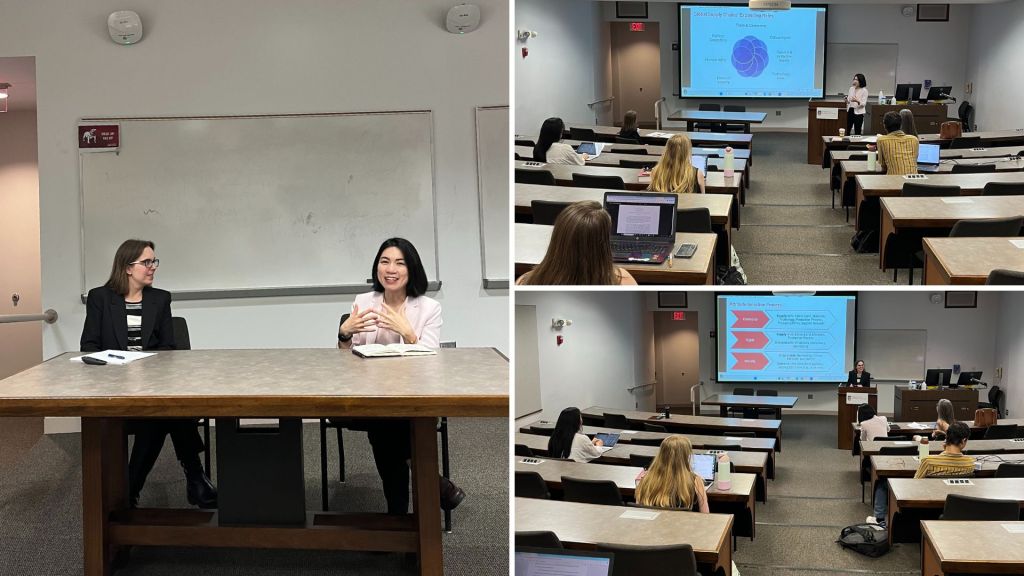
The University of Georgia School of Law’s spring 2025 International Law Colloquium recently hosted Temple Law’s Trang (Mae) Nguyen, who presented her working paper, “Goods’ Nationalities.” Pamela Foohey, Allen Post Professor of Law at Georgia Law, served as Nguyen’s faculty discussant.

Nguyen is an Associate Professor of Law at the Temple University Beasley School of Law and is an Affiliated Scholar at the U.S.-Asia Law Institute at the New York University School of Law. Her research focuses on business law, contracts, transnational law, and international law. Nguyen also previously held research appointments at the University of Hong Kong Faculty of Law, the National University of Singapore Centre for Asian Legal Studies, and the Singapore Management University Yong Pung How School of Law.

Below is an abstract of Nguyen’s working paper:

Products’ nationalities are at the center of today’s fast-changing global order. The Trump administration’s liberal use of tariffs against friends and foes, sanctions against Russian products, the banning of Chinese goods, and efforts to revitalize American manufacturing, to name just a few, all hinge on classifications of where a product is deemed “from.” But in today’s globalized economy, what exactly makes something “American” or “Chinese” or of any other nationality, for that matter?

This Article reexamines how goods acquire their designated nationalities at a time when such designation matters well beyond traditional commerce. It advances two main arguments. First, a product’s nationality is not fixed; rather, it is malleable and can vary depending upon the substantive legal regime under which the good is regulated—once predominantly trade law but now increasingly through a trade-security nexus and a trade-human rights nexus. Second, such malleability occurs through what I call an “attribute selection” process. In effect, each legal regime pivots the nationality analysis on certain “attributes” of a product, swapping and switching them as befit underlying interests and policy goals. The construction of product nationality thus occurs through mapping two separate sets of variables: first, the bundle of attributes of a product, and second, the “prisms” through which laws place significance on these attributes.

This Article makes several contributions. First, descriptively, it charts an updated account on product nationality’s expanded use, particularly in trade law’s nexus with national security and human rights. Second, conceptually, building on this updated descriptive account, it advances a novel framework—the attribute selection process—to unpack the making of product nationality. Third, normatively, it underscores how the need to use product nationality as proxy fits uneasily with the reality of global production, and how efforts to move away from nationality-based rules are likely vulnerable to similar challenges. Ultimately, while the Article makes clear that the concept of nationality is doing heavy lifting across various legal fields, it does not take a strong normative stand, opting instead to explain why taking a strong normative position is premature during fast evolving developments. Finally, the Article offers some practical considerations for policymakers, businesses, and other stakeholders as they consider product-nationality regulations going forward.

This year, Professor Desirée LeClercq is overseeing the colloquium, which is designed to introduce students to features of international economic law through engagement with scholars in the international legal field. To view the full list of International Law Colloquium speakers, visit our website.

This program is made possible through the Kirbo Trust Endowed Faculty Enhancement Fund and the Talmadge Law Faculty Fund.

Michigan Law Professor Julian Arato presents working paper at Georgia Law’s International Law Colloquium

The University of Georgia School of Law’s spring 2025 International Law Colloquium recently welcomed Michigan Law’s Professor of Law Julian Arato, who presented his working paper, “The Institutions of Exceptions.” Timothy Meyer, Professor of International Business Law at Duke University School of Law, served as Arato’s faculty discussant.

Arato currently serves as the Faculty Director of the Center for International and Comparative Law at the University of Michigan School of Law. His research focuses on public international law, international investment law and arbitration, international trade, contracts, corporations, and private law theory. Arato is also a member of the board of editors of the American Journal of International Law.

Below is an abstract of Arato’s working paper:

International economic law binds states’ hands in the interest of liberalizing markets in various ways, including cross border trade in goods and services (trade) and capital (investment). The treaty regimes for both trade and investment do this by disciplining states through legal rules, while preserving a modicum of governmental power over policy. Though not always recognized as such, the preservation of policy space in these regimes typically involves exceptions-style reasoning by adjudicators – formally in the case of most trade and some investment treaties, and informally in the investment treaty regime more generally. This “exceptions paradigm” of justification has worked well in the trade regime, where it has been especially key to securing a workable balance between market disciplines and regulatory policy space in the WTO/GATT context. But it has been less successful at striking a reasonable balance in the investment regime – irrespective of whether the paradigm has been formally codified in an exceptions clause. This Article seeks to explain why, by focusing on the institutions within which this mode of justification is embedded. Certain institutional differences between these regimes help explain the varied success of exceptionalism in trade and investment, in particular: the right of action (public vs private); the degree of judicial centralization (ad hoc arbitration vs court system); and the available remedies (retrospective compensation vs prospective injunctive relief). I argue that it is trade law’s public-oriented institutions that have made the exceptions clause workable – not the other way around. By contrast, investment law’s private-oriented institutions make that system particularly inhospitable to exceptions-style justification.

This year, Professor Desirée LeClercq is overseeing the colloquium, which is designed to introduce students to features of international economic law through engagement with scholars in the international legal field. To view the full list of International Law Colloquium speakers, visit our website.

This program is made possible through the Kirbo Trust Endowed Faculty Enhancement Fund and the Talmadge Law Faculty Fund.

Georgetown Law professor Katrin Kuhlmann presents working paper at International Law Colloquium

The University of Georgia School of Law’s spring 2025 International Law Colloquium welcomed Professor Katrin Kuhlmann, who presented her working paper, “Micro International Law.” Greg Day, Associate Professor in the Terry College of Business at the University of Georgia, served as Kuhlmann’s faculty discussant.

Kuhlmann is the Faculty Director and Co-founder of the Center on Inclusive Trade and Development at Georgetown Law. Her scholarly focus lies in international law, development, inclusive and sustainable international trade law, regional trade agreements, agricultural law and food security, comparative economic law, African trade and development law and corridors, and the interdisciplinary connections between law and development.

Below is an abstract of Kuhlmann’s working paper:

International law has long been viewed as the domain of countries and capitals, not fields or factories, but this overly top-down perspective misses a critical and under-studied part of the picture. Underneath the macro level of standardized legal norms, international law is much more nuanced, with multiple sites of influence, production, design, adoption, and decision-making that scholars have largely neglected but which need to be better understood. Models stemming from legal systems in less powerful states, smaller-scale stakeholder interests, and local solutions are often treated as one-off anecdotes or isolated case studies without broader implications.

Capturing these lessons, cataloging them, and building a methodology around them could be transformational at a time when international law needs a refresh to make it more responsive to a new set of global challenges ranging from inequality to food insecurity to climate change.

This paper presents a conceptual and methodological framework for “micro international law” as a sub-field of international law. Adding a micro dimension to international law would bring it in line with other disciplines that recognize the importance of studying smaller-scale, more granular interventions. It would also make a significant contribution to the international legal field by integrating theoretical and empirical approaches to focus on the impact innovations within domestic legal systems and the interests of individuals have on international law (and the impact of international law on these systems and stakeholders), ultimately providing a framework for designing international law differently to equitably address more specialized needs and positively impact the lives of those international law aims to serve and benefit.

This year, Professor Desirée LeClercq is overseeing the colloquium, which is designed to introduce students to features of international economic law through engagement with scholars in the international legal field. To view the full list of International Law Colloquium speakers, visit our website.

This program is made possible through the Kirbo Trust Endowed Faculty Enhancement Fund and the Talmadge Law Faculty Fund.

Luwam Dirar of Western New England University speaks at Georgia Law’s International Law Colloquium

The University of Georgia School of Law’s spring 2025 International Law Colloquium welcomed Professor Luwam Dirar of Western New England University School of Law as its second speaker last week.

Dirar presented her working paper titled, “Emancipation, Decolonization, and Gender in the Context of African Integration.” Dirar’s research and scholarly focus centers on international human rights law and the intersection of international economics and international relations. Dirar has also served as a consultant to several African governments and international organizations regarding migration and law.

Associate Director of the Dean Rusk International Law Center, Taher Benany, served as Dirar’s faculty discussant. Professor Desirée LeClercq is overseeing the colloquium, which is designed to introduce students to features of international economic law through engagement with scholars in the international legal field.

Below is an abstract of Dirar’s working paper:

The 1960s institutionalization and formalization of Africa’s continental integration was a manifestation of the ontological fragility of the concept of emancipation in the African context. As a concept, continental emancipation excluded concerns of women and formalized the divorce between decolonization and racial domination on the one hand and social emancipatory movements on the other. This divorce was contrary to the expectation of women who sought the end of colonial subjugation as a turning point for women’s emancipation from not only colonial and racial domination but also from social oppression. This article argues that the continental emancipation project betrayed the hopes of women who sought decolonization or the end of white racial domination as central to the end of gendered and gendering social subjugation. This article will have four parts. The first part will be a general introduction and will explore women’s emancipation in the context of regional integration studies. The second part will explore the internal contradictions of the concept of emancipation. The third part will explore the marketization of regional integration in Africa and the debates surrounding gender in trade agreements. The fourth part will be the conclusion and way forward.

To view the full list of International Law Colloquium speakers, visit our website. A summary of the previous week’s talk with Professor Harlan Cohen can be found here.

This program is made possible through the Kirbo Trust Endowed Faculty Enhancement Fund and the Talmadge Law Faculty Fund.