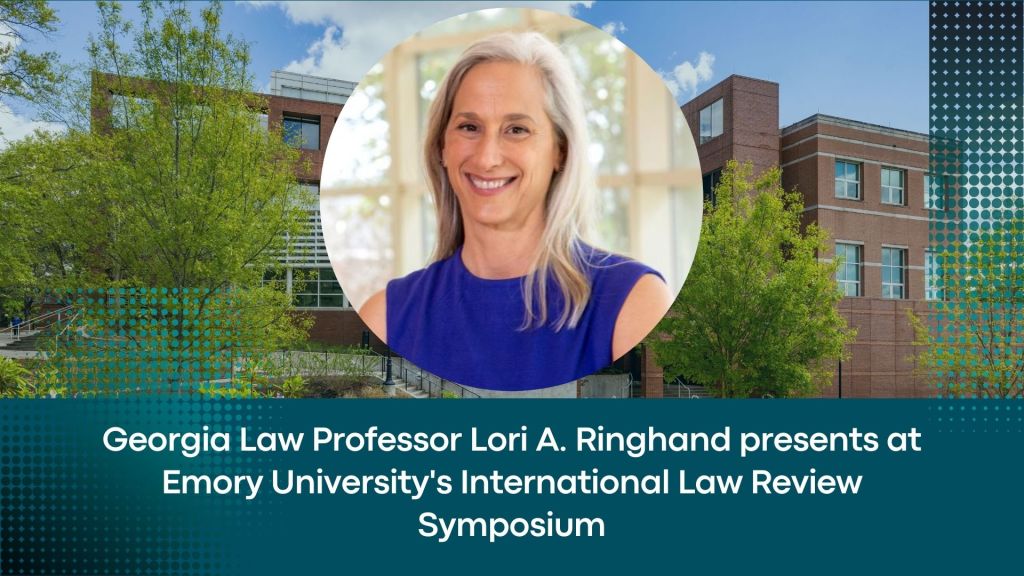
Georgia Law Professor Lori A. Ringhand presents at Emory University’s International Law Review Symposium

Earlier this month, University of Georgia School of Law Professor Lori A. Ringhand presented “First Amendment Restrictions on Non-citizens’ Engagement in Campaign Spending” at the Emory International Law Review symposium “Migration, Law, and Justice: The Evolving Role of International and U.S. Policies.” The event was held at the Emory University School of Law.

This year’s symposium focused on critical issues in immigration law and policy as they relate to international law. They explored the following three topics:

  • The Role of International Law in U.S. Immigration Decisions
  • Human Rights Obligations and the Treatment of Migrants
  • Legal Pathways to Citizenship: Challenges and Opportunities

Ringhand teaches courses on constitutional law and election law. She is a nationally known Supreme Court scholar and the author of two books about the Supreme Court confirmation process: Supreme Court Confirmation Hearings and Constitutional Change (with Paul M. Collins) published by Cambridge University Press; and Supreme Bias: Gender and Race in U.S. Supreme Court Confirmation Hearings, (with Christina L. Boyd and Paul M. Collins), forthcoming Fall 2023 with Stanford University Press. She also is the co-author of Constitutional Law: A Context and Practices Casebook, which is part of a series of casebooks dedicated to incorporating active teaching and learning methods into traditional law school casebooks. Ringhand also publishes extensively on election law related issues, and was awarded a Fulbright Distinguished Chair Award at the University of Aberdeen in Scotland to explore  the different approaches to campaign finance regulation taken by the United States and the United Kingdom.

Georgia Law Professor Jason Cade cited by U.S. Court of Appeals for the Ninth Circuit 

University of Georgia School of Law Associate Dean & Hosch Professor Jason A. Cade’s article “Deporting the Pardoned” was recently cited by the U.S. Court of Appeals for the Ninth Circuit in the case Lopez v. Garland.

Below is an excerpt from the article:

Federal immigration laws make noncitizens deportable on the basis of state criminal convictions. Historically, Congress implemented this scheme in ways that respected the states’ sovereignty over their criminal laws. As more recent federal laws have been interpreted, however, a state’s decision to pardon, expunge, or otherwise set aside a conviction under state law will often have no effect on the federal government’s determination to use that conviction as a basis for deportation. While scholars have shown significant interest in state and local laws regulating immigrants, few have considered the federalism implications of federal rules that ignore a state’s authority to determine the continuing validity of its own convictions. This Article contends that limitations on the preclusive effect of pardons, expungements, appeals, and similar post-conviction processes undermine sovereign interests in maintaining the integrity of the criminal justice system, calibrating justice, fostering rehabilitation, and deciding where to allocate resources. In light of the interests at stake, Congress should be required to clearly express its intent to override pardons and related state post-conviction procedures. A federalism-based clear statement rule for statutory provisions that restrict generally applicable criminal processes would not constrain the federal government’s power to set immigration policy. Congress remains free to make its intent clear in the statute. But the rule would ensure that Congress, rather than an administrative agency, has made the deliberative choice to upset the usual constitutional balance of federal and state power.

Jason A. Cade is Associate Dean for Clinical Programs and Experiential Learning, J. Alton Hosch Professor of Law & Community Health Law Partnership Clinic Director. In addition to overseeing the law school’s 11 in-house clinics and 7 externship programs, Cade teaches immigration law courses and directs the school’s Community Health Law Partnership Clinic (Community HeLP), in which law students undertake an interdisciplinary approach to immigrants’ rights through individual client representation, litigation, and project-based advocacy before administrative agencies and federal courts.

Additional information about the Community HeLP Clinic can be found here.

Georgia Law Professor Cade featured in The Atlanta Journal-Constitution

University of Georgia School of Law Associate Dean & Hosch Professor Jason A. Cade was recently featured in The Atlanta Journal-Constitution regarding the Southern Poverty Law Center’s Southeast Immigrant Freedom Initiative. The article titled “For migrants in Georgia, fighting deportation will become harder. Here’s why.” was written by Lautaro Grinspan and published 6/26/24. 

As stated in the article:

“Detained immigrants in Georgia tend to be held in remote areas, cut off from society, making it really difficult for them to access representation or have contact with family. [The Southern Poverty Law Center’s Southeast Immigrant Freedom Initiative] was essentially the only resource that existed to help them, and they did excellent work,” said Jason Cade, a professor at the University of Georgia School of Law, in a statement.

Jason A. Cade is Associate Dean for Clinical Programs and Experiential Learning, J. Alton Hosch Professor of Law & Community Health Law Partnership Clinic Director. In addition to overseeing the law school’s 11 in-house clinics and 7 externship programs, Cade teaches immigration law courses and directs the school’s Community Health Law Partnership Clinic (Community HeLP), in which law students undertake an interdisciplinary approach to immigrants’ rights through individual client representation, litigation, and project-based advocacy before administrative agencies and federal courts.

Read the full article here. Additional information about the Community HeLP Clinic can be found here.

Georgia Law Professors Cade and Norins present at AALS Conference on Clinical Legal Education

Professors Jason A. Cade and Clare R. Norins presented at the Association of American Law Schools’ 2024 Conference on Clinical Legal Education during May. Below are descriptions of their panel discussions:

Rapid-Response Legal Support for Movements: Seeking Immigration Protections for Organizing Workers

In the lead-up to and aftermath of DHS announcing new immigration protections for worker witnesses and amidst a rising tide of labor organizing across the country, immigrant workers and their organizations have turned to immigration lawyers—and especially law school clinics—as essential support for their campaigns. As law school clinics seek to respond to these requests, faculty and students are building a variety of rapid-response models to meet the movement moment, ranging from organizing-oriented individual representation to mass pro se legal clinics and everything in between. Along the way, legal teams must confront key values and ethics questions in movement lawyering as well as build best practices in this emerging area of legal expertise. These teams were integral to the advocacy push that resulted in the new guidance and are continuing to push for effective implementation that delivers for organizing workers and their organizations.

Presenters will share their varied approaches to key choices in organizing rapid response legal support for preparing deferred action for labor enforcement applications. These approaches will include reflection on the following questions:

  • What legal models have worked well to respond to the growing need for legal support?
  • How do we effectively involve students in building and implementing these legal models?
  • How do we as legal advocates integrate organizing objectives, such as group solidarity and worker leadership, into efforts to provide large-scale legal services?
  • How do we structure organizer, volunteer, and legal team information sharing to build trust and facilitate shared goals in representation and advocacy while also minimizing risk from disclosure of sensitive information?
  • How do we work in coalition to advocate on individual cases and broader policy issues throughout implementation so that these immigration protections deliver for organizing workers and their organizations?

Through guided discussion and breakout exercises, this concurrent session will pose questions about the value, and risk, of engaging in wide-ranging advocacy and litigation in a law school clinic. Ten years after the Ferguson uprising, we have taken many lessons from social movements and how we can challenge and dismantle systems of oppression and injustice. We also continue to ask critical questions about the role that we, as lawyers, play in structural and systemic change. We hope to use this session to surface both the benefits and challenges of this kind of collaborative lawyering and to get audience input on best practices for moving forward.

In addition to Cade, this panel included Katherine Evans, Duke University School of Law; Georgina Olazcon Mozo, University of Washington School of Law; Zaida C. Rivera, Seattle University School of Law; and Mary Yanik, Tulane University Law School.

Wide Ranging Litigation and Advocacy as Resistance and Resilience in a Law School Clinic?

In this concurrent session, presenters, all co-counsel in the Oldaker v. Giles litigation, will explore the challenges and benefits of wide-ranging litigation and advocacy as tools of resistance and resilience in a clinical setting. In Oldaker, the presenters and their co-counsel filed litigation on behalf of fourteen women who suffered medical abuse at the Irwin County Detention Center in Georgia.

In addition to Cade and Norins, this panel included Sabrineh Ardalan, Harvard Law School; and Sarah Sherman-Stokes, Boston University School of Law.  

Jason A. Cade is Associate Dean for Clinical Programs and Experiential Learning, J. Alton Hosch Professor of Law & Community Health Law Partnership Clinic Director. In addition to overseeing the law school’s 11 in-house clinics and 7 externship programs, Cade teaches immigration law courses and directs the school’s Community Health Law Partnership Clinic (Community HeLP), in which law students undertake an interdisciplinary approach to immigrants’ rights through individual client representation, litigation, and project-based advocacy before administrative agencies and federal courts.

Clare R. Norins, who also presented on the panel The Privacy Paradox: Balancing Transparency and Privacy in the Quest for Justice at this conference, is an assistant clinical professor and the inaugural director of the School of Law’s First Amendment Clinic, which represents clients in federal and state court on a range of First Amendment and media law issues. Representative matters include social media blocking by government officials, retaliatory arrest, the right to record, challenges to unconstitutional permit requirements, assertion of the journalist privilege under the Georgia Shield law, and defamation defense.

Georgia Law Professor Cade featured in The Atlanta Journal-Constitution

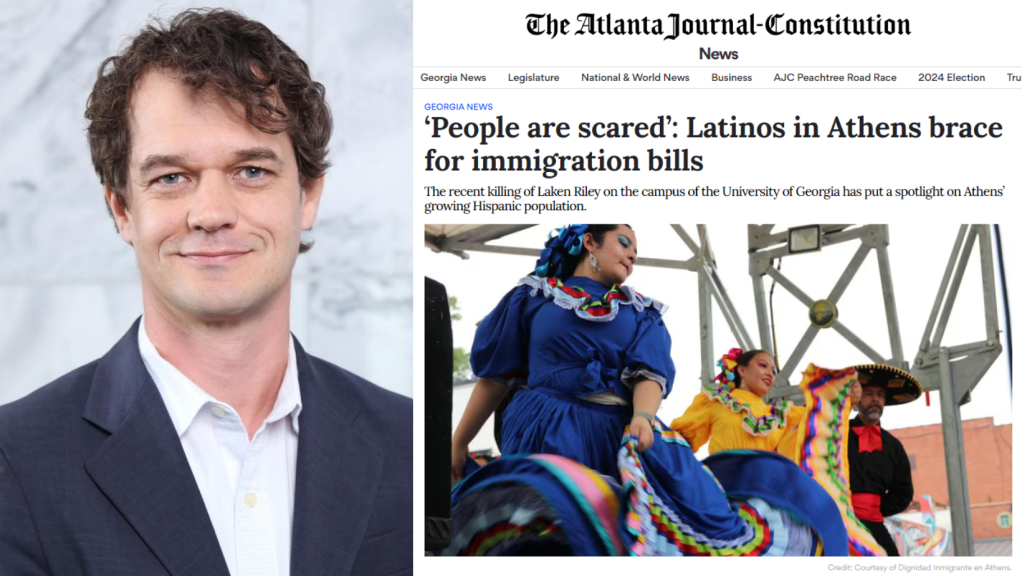
Professor Jason A. Cade was recently featured in The Atlanta Journal-Constitution regarding the University of Georgia School of Law’s Community Health Law Partnership Clinic, (“Community HeLP Clinic”). The article titled “‘People are scared’: Latinos in Athens brace for immigration bills” was written by Lautaro Grinspan and centered around the legislative consequences of the recent loss of Laken Riley on the University of Georgia campus, which put a spotlight on the growth of Athens’ Hispanic population. 

As stated in the article:

“The growth of the community has created significant demand for legal services to help with immigration cases. Those with limited means have only one pro-bono provider to turn to: a legal clinic at the University of Georgia School of Law, run by Professor Jason Cade.”

The Community HeLP Clinic focuses on interdisciplinary advocacy at the intersection of immigration status and health, including humanitarian and family-based immigration benefits, advocacy on behalf of noncitizen workers and detainees, and public education.

In reference to the Clinic within the article, Professor Cade said:

“We have the U.S. citizen children of the families that we serve very much in mind and are trying to do what we can to kind of reduce stress and stigma from their lives.”

Jason A. Cade is Associate Dean for Clinical Programs and Experiential Learning, J. Alton Hosch Professor of Law & Community Health Law Partnership Clinic Director. In addition to overseeing the law school’s 11 in-house clinics and 7 externship programs, Cade teaches immigration law courses and directs the school’s Community Health Law Partnership Clinic (Community HeLP), in which law students undertake an interdisciplinary approach to immigrants’ rights through individual client representation, litigation, and project-based advocacy before administrative agencies and federal courts.

To read the full article, please click here. To learn more about the Clinic, please click here.

Georgia Law Professor Jason Cade presents on immigration at Wisconsin International Law Journal symposium

Professor Jason A. Code, an immigration law expert here at the University of Georgia School of Law, presented in April as part of the Wisconsin International Law Journal 2023 symposium, “Immigration and Access to Legal Resources for Migrants and Refugees,” held at the University of Wisconsin Law School in Madison.

Cade, who is Associate Dean for Clinical Programs and Experiential Learning, J. Alton Hosch Professor of Law, and Director of the Community HeLP Clinic at Georgia Law, gave a presentation entitled “Not Just a Pandemic Problem: Administrative Failures in the Humanitarian Immigration System” in a panel exploring the impact of the Covid-19 pandemic. Other panelists included Evelyn Marcelina Rangel-Media, Temple University Beasley School of Law, Wooksoo Kim, University at Buffalo School of Social Work, and Emily Ryo, University of Southern California Gould School of Law.

In court and in Congress, Georgia Law clinics continue efforts on behalf of immigrant women alleging abuse, retaliation while in ICE detention

University of Georgia School of Law clinics’ faculty and students have continued to press forward– both in court and in Congress – in challenges they have brought on behalf of women clients who are challenging the abuses they endured while in U.S. immigration detention.

As previously posted, Georgia Law’s Community HeLP Clinic and First Amendment Clinic have pursued administrative, judicial, and advocacy paths in support of women who had been in the custody of U.S. Immigration and Customs Enforcement (ICE) at the Irwin Detention Center, a privately run facility in south Georgia. While there, the women were subjected to nonconsensual, gynecological and other medical procedures; those who spoke out were met with retaliatory acts, including attempted or actual removal from the United States.

For more than two years, the Georgia Law clinics have represented some of these women in judicial and administrative proceedings. Associate Dean Jason A. Cade, Director of the Community HeLP Clinic, and Professor Clare R. Norins, Director of the First Amendment Clinic, are among co-counsel in Oldaker v. Giles, a class action complaint pending before Judge W. Louis Sands, U.S. District Court for the Middle District of Georgia. Assisting them have been Staff Attorney Kristen Shepherd, Legal Fellow Lindsey Floyd, and many law students.

The Oldaker litigation took a new turn last Monday, when Judge Sands granted a contested motion and thus added two new named plaintiffs, both of them represented by the Georgia Law clinics.

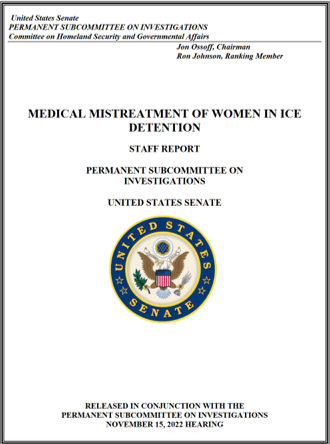
Congressional action occurred earlier last month, when the Senate’s Permanent Subcommittee on Investigations held a hearing on “Medical Mistreatment of Women in Ice Detention,” on November 15 at the Dirksen Senate Office Building in Washington, D.C.

That same day, the subcommittee – led by its Chairman, Sen. Jon Ossoff (D-Georgia), and Ranking Member, Sen. Ron Johnson (R-Wisconsin), simultaneously released a 103-page Staff Report (pictured above) based on its 18-month investigation of the issue. The report recounted many incidents on which the Oldaker suit is based, and further incorporated information provided by six plaintiffs, one of them represented by the Georgia Law clinics. Among other key findings, the report stated that:

  • The women detainees “appear to have been subjected to excessive, invasive, and often unnecessary gynecological procedures” by one of the center’s physicians; and
  • ICE “did not employ a thorough vetting process,” and, before hiring the physician in question, “was not aware of publicly available information regarding medical malpractice suits” and other complaints against him.

Georgia Law Appellate Clinic team briefs, argues, wins Convention Against Torture case before Second Circuit in New York

One week after oral arguments put forward by students in the University of Georgia School of Law Appellate Litigation Clinic, the U.S. Court of Appeals for the Second Circuit today ruled on behalf of a Clinic client, whose immigration case involved the 1984 Convention Against Torture, an international treaty that the United States joined in 1994.

The client, a gay transgender rights advocate from the state of Guerrero, Mexico, and the petitioner in Case No. 20-1693, Santiaguez v. Garland, seeks deferral of removal pursuant to the treaty’s provisions respecting non-refoulement, or non-return. Specifically, the client asks not to be sent back to his home country, where his brother, also gay, recently was killed due to sexual orientation.

Georgia Law 3L Noah Nix (pictured above) argued on behalf of the client last week at the Second Circuit’s New York courthouse. He challenged prior rulings in the case, in which both the Immigration Judge and the Board of Immigration Appeals had agreed that no Mexican public official would likely acquiesce to the Clinic’s client being tortured if he returned. The Board of Immigration Appeals also had found that the Immigration Judge did not violate the client’s due process rights when refusing to allow a country conditions expert to testify at the client’s merits hearing.

Today the Second Circuit panel, composed of Chief Judge Debra Ann Livingston, Judge Barrington D. Parker Jr., and Judge Eunice C. Lee, ruled on behalf of the Clinic’s client. Specifically, reasoning that the agency had not properly considered the client’s evidence, the panel issued an order vacating the agency’s decision and remanding the case for further proceedings.

Assisting in brief-writing in the case were two Georgia Law students who have since graduated, Jared Allen and Olivia Hunter. The team worked under the supervision of Thomas V. Burch, the Clinic’s Director.

Georgia Law’s Community HeLP Clinic assists client in winning bid for asylum

A client of the Community Health Law Partnership Clinic here at the University of Georgia School of Law was recently granted asylum, a status that provides permanent protection to noncitizens fleeing persecution on the basis of their race, religion, nationality, political opinion, or membership in particular social groups. 

The Clinic’s client had fled to the United States alone as a 16-year-old, after facing death threats and physical violence in Guatemala, and had requested asylum at the U.S. border. The Asylum Office of the U.S. Citizenship and Immigration Services initially interviewed the client in 2018. (photo credit) However, a torrent of subsequent administrative decisions upended longstanding asylum policies, leaving his fate in limbo. 

The Community HeLP Clinic reactivated the case early this year. It successfully argued that the Guatemalan government was unable or unwilling to control persecution against the client by private actors. As a result of the asylum grant, the client no longer faces deportation and can focus on rebuilding his life in the United States.

The Clinic’s Staff Attorney, Kristen Shepherd, handled the initial presentation of the case before the Asylum Office. Navroz N. Tharani, who completed his Georgia Law JD in May 2022, wrote the brief, supervised by Shepherd and by Clinic Director Jason Cade, who is Associate Dean for Clinical Programs and Experiential Learning and J. Alton Hosch Associate Professor of Law. Eddy Atallah, a member of the JD Class of 2021, assisted with earlier research.

Immigrants and rights of free speech, free exercise of religion topic of Georgia Law Review symposium March 18

“Immigrants and the First Amendment: Defining the Borders of Noncitizen Free Speech and Free Exercise Claims” is the title of this year’s annual day-long symposium of the Georgia Law Review, to be held Friday, March 18, in hybrid format at the University of Georgia School of Law. Featured will be a keynote by immigrant activist Ravi Ragbir, the plaintiff in a high-profile federal lawsuit alleging retaliation for activism.

Here’s the concept note:

“Immigration law, as well as immigrant activism, are intersecting with the First Amendment in new and surprising ways. This year’s Georgia Law Review Symposium will bring together a diverse set of voices to discuss these exciting new crossovers, providing a forum to explore the nuances of the First Amendment’s scope as applied to immigrants, immigrant advocates, and potential immigrants outside of the country. This is an area of law that is becoming increasingly more topical, and many questions that arise from these areas remain unanswered or ambiguous.”

Details and registration here for the conference, which will take place in-person in the Larry Walker Room on the 4th floor of Georgia Law’s Dean Rusk Hall, and which also welcomes online attendees.

Following opening remarks at 9 a.m., panels will proceed as follows:

9:10-10:35 a.m., “Immigrant Speech and Government Retaliation”

“Despite being entitled to First Amendment rights, immigrants, particularly those without documentation, are highly vulnerable to government suppression of, or retaliation against, their exercise of free speech rights. Recent or ongoing cases in this area include Oldaker v. Giles in the Middle District of Georgia, which concerns first amendment claims brought on behalf of women alleging retaliation for medical abuse at an immigration detention center; and Ragbir v. Homan, which concerns the government’s retaliatory deportation of prominent immigrant rights activists.”

Speaking within that theme on this first panel of the morning will be: Alina Das, Professor of Clinical Law, New York University School of Law; Charles H. Kuck, Managing Partner of Kuck Baxter LLC, an immigration law firm in Atlanta, and an Adjunct Professor at Emory University School of Law; Daniel I. Morales, Associate Professor of Law and George A. Butler Research Professor, University of Houston Law Center; and Clare R. Norins, Clinical Assistant Professor and Director of the First Amendment Clinic at Georgia Law. Moderating will be Jason A. Cade, who is Associate Dean for Clinical Programs, Experiential Learning and J. Alton Hosch Associate Professor of Law, and Community Health Law Partnership Clinic Director at Georgia Law.

10:35 a.m.-12 noon, “Back to the Future: Immigrant Speech Rights Yesterday and Tomorrow”

“From John Lennon to Charlie Chaplin to many less famous immigrants, United States immigration history is riddled with deportation or exclusion decisions based on immigrants’ expression. Looking to the future, it is possible that constitutional free speech rights are best shored up by legislative and administrative solutions.”

Speaking within that theme on this last morning panel will be: Michael Kagan, Joyce Mack Professor of Law and Director of the Immigration Clinic at the William S. Boyd School of Law, University of Nevada-Las Vegas; Jennifer Koh, Associate Professor of Law and Co-Director of the Nootbaar Institute for Law at the Caruso School of Law, Pepperdine University, Malibu, California; Julia Rose Kraut, author of Threat of Dissent: A History of Ideological Exclusion and Deportation in the United States (Harvard University Press 2020); and Gregory P. Magarian, Thomas and Karole Green Professor of Law, Washington University in St. Louis School of Law. Moderating will be Jonathan Peters, Associate Professor of Journalism at the University of Georgia Grady College of Journalism and Mass Communications, who also holds a courtesy appointment on the Georgia Law faculty.

1-2:20 p.m., “The First Amendment’s Limits Abroad After Trump v. Hawaii: Free Exercise, Executive Power, and Justiciability”

“Trump v. Hawaii is the most recent high-profile iteration of immigration actions allegedly taken on the basis of religion. In addition to exploring first amendment issues respecting the religion of potential migrants, this panel will also cover issues relating to the differences in executive power as it pertains to potential immigrants as opposed to immigrants already on U.S. soil, as well as the difficulties associated with immigrants vindicating asserted constitutional rights from abroad.”

Speaking within that theme on this afternoon panel will be: Christopher Lund, Associate Dean for Research and Faculty Development and Professor of Law, Wayne State University Law School, Detroit, Michigan; Zachary Price, Professor of Law, University of California Hastings College of the Law; and Shalini Bhargava Ray, Associate Professor of Law, University of Alabama School of Law. Moderating will be Nathan S. Chapman, Pope F. Brock Associate Professor in Professional Responsibility at Georgia Law.

2:20-3:15 p.m., “Keynote Address” by Ravi Ragbir, followed by a closing reception.