UGA Professor Kalyani Ramnath named 2024 ACLS Fellow

Kalyani Ramnath, Assistant Professor in the Department of History at the Franklin College of Arts & Sciences and Assistant Professor (by courtesy) at the University of Georgia School of Law, is a recipient of an American Council of Learned Societies (ACLS) Fellowship for her project, “Adrift in the Indian Ocean: Abandonment, Law, and the Making of Maritime Sovereignty.”

From Ramnath’s abstract:

“‘Adrift in the Indian Ocean’ explores how and why empires and nation-states looked beyond land-based territorial conquests and claimed maritime spaces. It is a history of sovereignty and placemaking set in the Indian Ocean from the 18th century onwards, one where imperial officials and scientists confronted the differing views of space held by maritime and coastal communities. Legal fictions such as the territorial sea’ or ‘historic waters’ emerged from these encounters, showing how oceanic space patrolled for security was eventually enclosed as property. Exploring key sites looking out to the ocean from south Indian coasts, ‘Adrift’ shows how people and places once abandoned are dredged up during present-day legal disputes over maritime boundaries in the Indian Ocean.

This fellowship follows Dr. Ramnath’s publication of her first book, Boats in a Storm: Law, Migration, and Decolonization in South and Southeast Asia, 1942–1962, with Stanford University Press. To read more about this publication, please click here.

Ramnath received her Ph.D. in history from Princeton University in 2018, and was a Prize Fellow in Economics, History, and Politics at the Center for History and Economics at Harvard University from 2018 – 2021. She also holds a bachelor’s degree in arts and law (B.A., LL.B. (Hons.) (JD equivalent) from the National Law School of India University (NLSIU) and a master’s degree in law (LL.M.) from the Yale Law School.
Georgia Law Professor Amann publishes in AJIL on ICJ advisory opinion on Chagos Archipelago

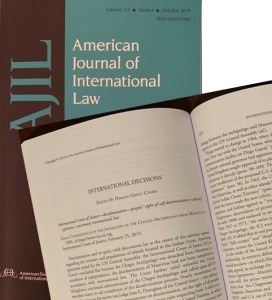
Professor Diane Marie Amann‘s most recent publication appears in the latest print edition of the American Journal of International Law, in the section that analyzes recent judgments. Entitled “International Decisions: Legal Consequences of the Separation of the Chagos Archipelago from Mauritius in 1965,” it may be found at 113 AJIL 784 (2019).

The essay sets forth key aspects of the advisory opinion (available here) that the International Court of Justice issued this past February respecting the Chagos Archipelago, a group of islands located in the Indian Ocean. The archipelago was considered part of Mauritius when both comprised a British colony. But after Mauritius won independence in the mid-1960s, Britain kept the archipelago, ejected its inhabitants, and leased it for a US military base, still there today. The legality and effects of this withholding, or detachment, were at the core of the ICJ proceedings.

Here at the University of Georgia School of Law, Amann holds the Emily & Ernest Woodruff Chair in International Law and serves as Faculty Co-Director of the Dean Rusk International Law Center. (Editor of AJIL’s International Decisions section is our Center’s other Faculty Co-Director, Georgia Law Professor Harlan Grant Cohen.)

Amann’s article, which also forms part of Georgia Law’s Dean Rusk International Law Center Research Paper Series at SSRN, may be accessed at this SSRN link or at the AJIL website. (She surveyed more recent developments related to this issue at her personal blog, in a post yesterday entitled “Chagos islands, at International Court of Justice and on to UK campaign trail.”)

Here’s the AJIL abstract:

“Decolonization and its quite valid discontents lay at the center of the recent International Court of Justice advisory opinion regarding the territory and populations of the Chagos Archipelago, located in the Indian Ocean. Answering questions posed by the UN General Assembly, the concluded that because these islands were detached from Mauritius as a condition of independence, the decolonization of Mauritius had not been completed in accordance with international law. The Court further ruled unlawful the United Kingdom’s continued administration of the Chagos Archipelago and called upon all UN member states to aid completion of the decolonization process. As detailed in this essay, the advisory opinion contained significant pronouncements on decolonization, on the right of all peoples to self-determination, and on the formation of customary rules respecting both.”