Three Georgia Law students to pursue global externships in fall 2025

In the upcoming fall semester, three University of Georgia School of Law students will gain international hands-on learning experience through the Global Externships Overseas (GEO) initiative: Alexis Bartholomew (J.D. ’26), Eleanor Cox (J.D. ’26), and Kara Reed (J.D. ’26).

Two students will work in private law settings: Bartholomew with extern Gleiss Lutz in Stuttgart, Germany, while Cox will extern with Bodenheimer in Berlin, Germany, under the supervision of Dr. Christof Siefarth (LL.M. ’86). Reed has a public interest placement and will extern with the Office of the Privacy Commissioner of Bermuda under the supervision of Alexander White (J.D. ’09). Through their GEOs, students will gain experience in practice areas such as international arbitration and data privacy.

Cox has been selected as the recipient of a grant from the Halle Foundation to support her externship in Germany. Based in Atlanta, The Halle Foundation seeks to promote understanding, knowledge and friendship between the people of Germany and the United States. Cox is the third Georgia Law student to receive this grant to support a semester-long GEO in Germany, following Jack Buckelew (J.D. ’25) and Pace Cassell (J.D. ’26).

Since spring 2021, eight Georgia Law students have participated in semester-long GEOs, an extension of the Center’s existing GEO initiative that is offered jointly between the Center and the law school’s Clinical and Experiential Program. Professor Jessica L. Heywood, Clinical Associate Professor and Washington, D.C., Semester in Practice Director, teaches and directs students externing abroad in partnership with Taher Benany, Associate Director of the Dean Rusk International Law Center, who oversees the GEO initiative. Like Georgia Law’s summer GEOs, semester-long GEOs are legal placements placements around the world that offer all law students the opportunity to gain practical knowledge and experience in an international setting. They are typically supervised in their work by Georgia Law alumni/ae. Students return to Athens with new colleagues and mentors, legal practice skills that set them apart from their peers, and a deeper appreciation of the global legal profession.

***

The Center is currently accepting applications for spring 2026 semester-long GEOs; all 1L and 2L students are eligible to apply. Applications are due September 15. For more information and to access the application, please email Taher Benany: taher.benany@uga.edu

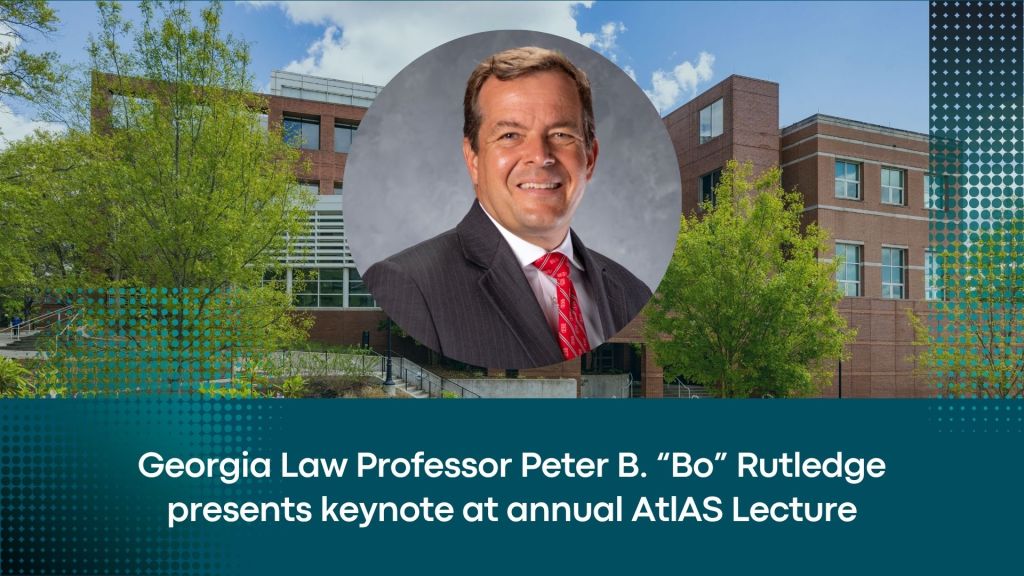
Georgia Law Professor Peter B. “Bo” Rutledge presents keynote at annual AtlAS Lecture

University of Georgia School of Law Professor Peter B. “Bo” Rutledge presented “Perpetual Peace Reconsidered: Arbitration and International Law in the 21st Century” as the keynote speaker at the 10th Annual Atlanta International Arbitration Society Lecture earlier this month. In his lecture, Rutledge considered the use of arbitration and alternative dispute resolution to resolve cross-border conflicts in the 21st century.

Rutledge holds the Talmadge Chair of Law. From 2015 through 2024, he served as dean of the University of Georgia School of Law. He is the author of the book Arbitration and the Constitution and co-author with Gary Born of the book International Civil Litigation in United States Courts. His works have been published by the Yale University Press, the Oxford University Press and the Cambridge University Press, and his articles have appeared in a diverse array of journals such as The University of Chicago Law Review, the Vanderbilt Law Review and the Journal of International Arbitration. He also regularly advises parties on matters of international dispute resolution (litigation and arbitration).

Georgia Law LL.M. students win 12th International Commercial and Investment Arbitration Moot

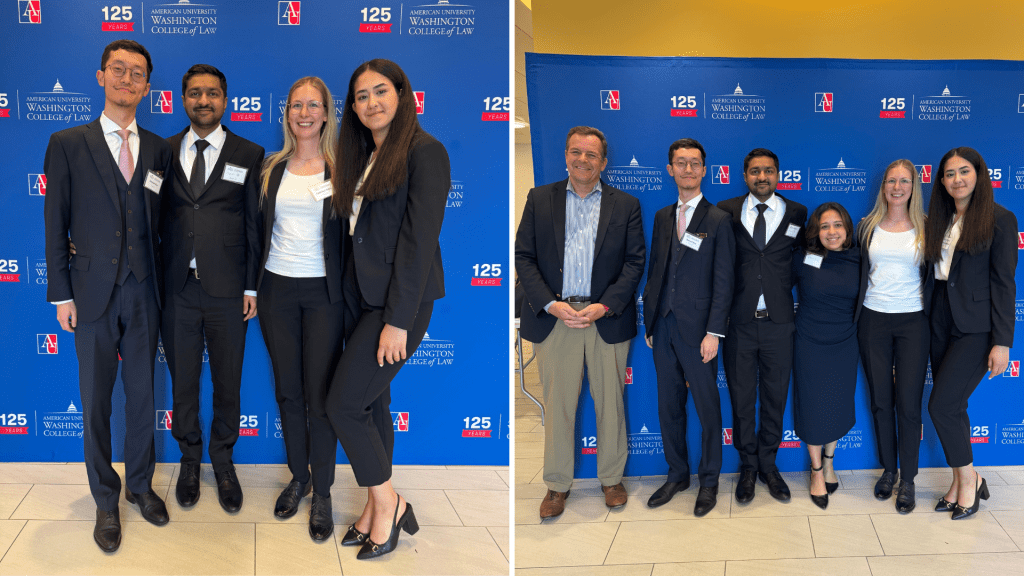
Members of the University of Georgia School of Law LL.M. Class of 2025 won the 12th International Commercial & Investment Arbitration Moot Competition hosted by American University Washington College of Law in Washington, D.C. earlier this month. This event was created specifically for LL.M. students to foster the study of international arbitration for the resolution of international business and investment disputes.

Forming the team at the competition were the four students: Danish Ali, Paria Keramatkhah, Samuel Kuo and Fabienne Taller. The team was coached former Dean & Talmadge Chair Peter B. “Bo” Rutledge and current third-year student Gloria M. Correa (LL.M. ’23). 

Georgia Law students Olha Kaliuzhna (J.D. ‘25) and Vladyslav Rudzinskyi (J.D. ‘25) win AtlAS Pre-Moot Invitational

University of Georgia School of Law students Olha “Olia” Kaliuzhna (J.D. ‘25) and Vladyslav “Vlad” Rudzinskyi (J.D. ‘25) won the Atlanta International Arbitration Society Pre-Moot Invitational, which took place in March. Rudzinskyi was also named the competition’s best advocate.

Law schools primarily from the Southeastern United States competed in this “warm up” tournament for the Willem C. Vis International Commercial Arbitration Moot to be held in Vienna, Austria, during April. 

Notre Dame’s Emilia Justyna Powell presents “Compliance with Decisions of the Permanent Court of Arbitration” at Georgia Law

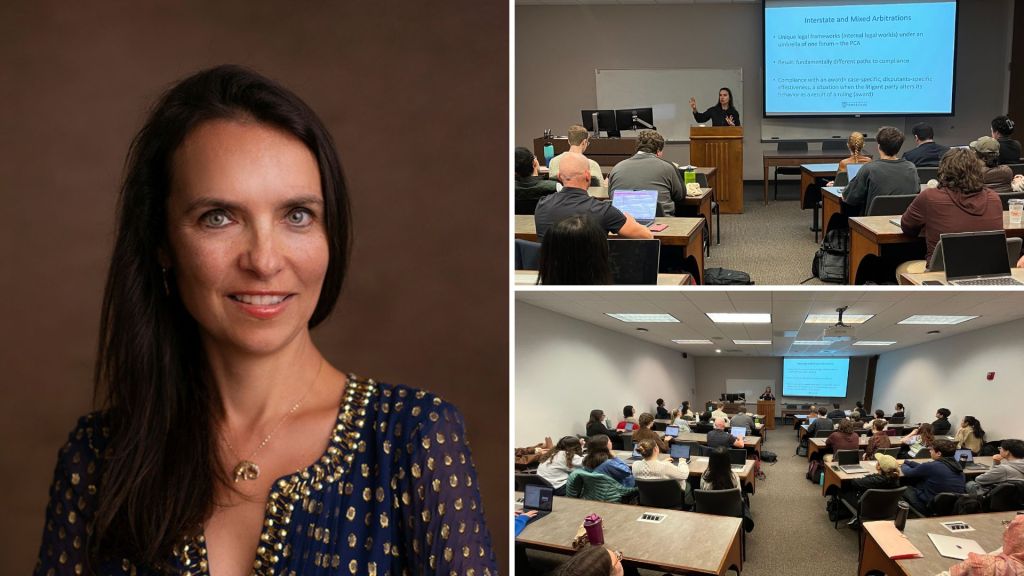
Emilia Justyna Powell, Professor of Political Science and Concurrent Professor of Law at the University of Notre Dame, presented a talk entitled “Compliance with Decisions of the Permanent Court of Arbitration” at the University of Georgia School of Law earlier this week.

Powell presented her findings on the Permanent Court of Arbitration’s award compliance. She presented (qualitatively and quantitively) the underlying reasons for the difference in award compliance in State vs State disputes and Investor vs State Disputes.

Powell has written extensively on international law, international courts, territorial and maritime disputes, international dispute resolution, the Islamic legal tradition, and Islamic constitutionalism. Her prominent publications include a book published in Oxford University Press (2020) entitled Islamic Law and International Law: Peaceful Resolution of Disputes, a Cambridge University Press (2011) book, Domestic Law Goes Global: Legal Traditions and International Courts (with Sara McLaughlin Mitchell). Her new book, The Peaceful Resolution of Territorial and Maritime Disputes (with Krista E. Wiegand) has been published with Oxford University Press in 2023. Currently, professor Powell is working on several research projects devoted to international law, the global order, and constitutional studies: the Permanent Court of Arbitration (with Aníbal Pérez-Liñán), the International Maritime Organization (with Michael J. Atkins, JAG, US Coast Guard), human values in constitutions around the world (with Jarek Nabrzyski and Agnieszka Marczak-Czajka), the evolution of Afghan constitutional order (with Josh Paldino, JAG, US Army), customary law and international law in the world constitutions (with Christina Bambrick and Eric Lease Morgan), and Islamic militant groups’ behavior in the context of humanitarian law (with Jessica Stanton and Tanisha Fazal).

This event was co-sponsored by the Dean Rusk International Law Center and the University of Georgia’s School of Public and International Affairs.

Eva Keïta speaks with Georgia Law students about experience at the International Court of Justice

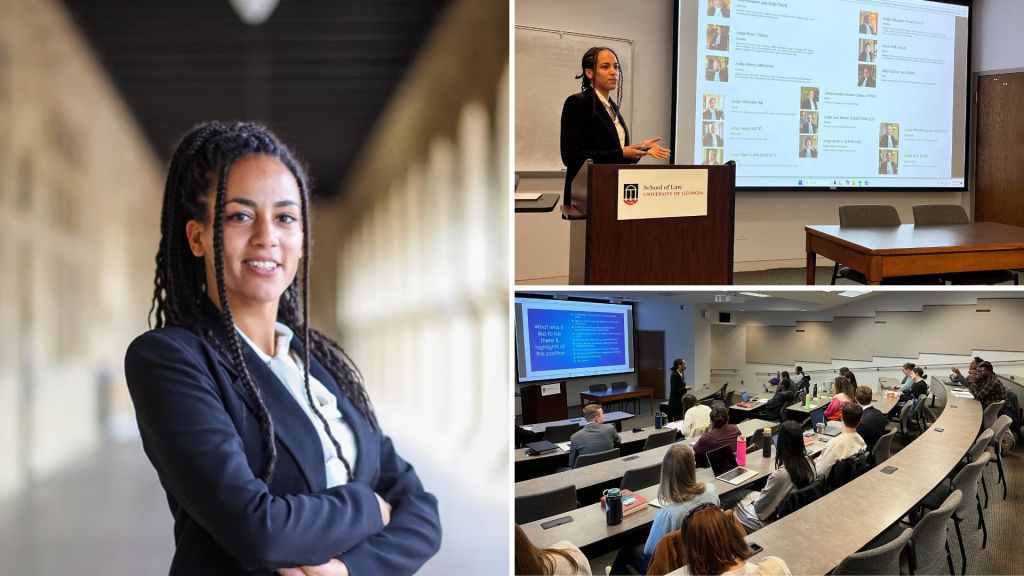
The University of Georgia School of Law welcomed international lawyer Eva Keïta to campus this week to discuss her experience at the International Court of Justice (ICJ) with students in Professor Diane Marie Amann‘s Public International Law course.

Keïta provided students with an overview of the ICJ, where she was an Associate Legal officer and a Judicial Fellow assisting a judge on various public international law matters. She spoke about the makeup of the ICJ, the role of members on each of the Judges’ teams, and how students can make themselves more competitive for open positions. Keïta then took questions from students, detailing her own professional journey as an international dispute settlement lawyer and providing advice for those interested in pursuing international legal careers.

Before her time at the ICJ, Keïta honed her expertise in international arbitration and litigation and handled complex international disputes at two international law firms in Paris. Keïta also has significant experience handling pro bono and international human rights matters. She provided legal representation to an inmate serving a life sentence under California’s Three Strikes Law in post-conviction proceedings, assisted human trafficking victims in compensation proceedings in front of French courts, and volunteered for four months in Togo, providing legal assistance to inmates through a local NGO.

Prior to her legal career, Keïta pursued a bachelor’s and master’s degree in political science, specializing in international relations, from the Sorbonne. In addition, Keïta holds a LL.M. in international economic law, business & policy from Stanford Law School and her first law degree from Sciences Po in Paris.

Georgia Law students attend Atlanta International Arbitration Society annual conference

Last month, a group of eight University of Georgia School of Law students attended the 13th Annual Conference of the Atlanta International Arbitration Society (AtlAS).

Attendees included 3L Jacob Wood and Master of Laws (LL.M.) students Sara Dorbahani, Michael Faleye, Paria Keramatkhah, Neethu James, Fatemeh Khouei, Samuel Kuo, and Zulma Perez. Five of these students (Wood, Dorbahani, Faleye, Keramatkhah, and Khouei) received Louis B. Sohn Professional Development Fellowships to support their attendance of this conference. Awarded by the law school’s Dean Rusk International Law Center, Sohn Fellowships enable students to attend professional development opportunities related to international law.

Conference attendees attended a number of talks and events designed for practitioners and students involved in international arbitration, including the ICC Young Arbitration & ADR Forum, the AtlAS Young Practitioners Group, networking lunches, and panel discussions. Georgia Law Dean Peter B. “Bo” Rutledge led a fireside chat with alumnus and current President of AtlAS, Christof Siefarth (LL.M. ’86).

Reflecting on the variety of panels and speakers in attendance, Keramatkhah said:

My favorite [discussion] was the panel on the “Top 10 Developments in Arbitration” and Dean Rutledge’s speech. This panel covered key trends in international arbitration, such as the rise of the Borneo Arbitration Center, and UNCITRAL procedural amendments. It also highlighted the growing importance of the new IBA Rules of Disclosure and updates to the 1996 English Arbitration Act. Differences between US and European arbitration were discussed, particularly in witness handling, cross-examination, and the judge’s role. I found this panel very interesting as it was very helpful in understanding the current and future challenges of arbitration. As it regards Dean Rutledge’s speech, since I was involved in [the] research of his speech, I appreciated that it provided deep insights into dispute resolution.

In describing the ways in which this experience benefitted him professionally, Wood said:

Attending the AtlAS conference reaffirmed my desire to practice in the field of international arbitration and aided in my pursuit of this goal. I was able to meet and converse with a variety of practitioners and arbitrators from across the globe.

When asked about her favorite moment from the conference, Dorbahani explained:

One of the standout sessions delved into the art of writing for a multicultural audience. As international arbitration becomes more diverse, mastering the nuances of cross-cultural legal advocacy is vital. It emphasizes how language can either clarify or complicate arbitration across borders. Coming from a Civil Law background, I found this especially relevant, as it highlighted the delicate balance needed to communicate effectively in a global legal landscape.

To read prior posts about Georgia Law students using Sohn Fellowships to attend professional development opportunities, please click here and here.

Georgia Law LL.M. student Samuel Kuo admitted as a Fellow to the Chartered Institute of Arbitrators

University of Georgia School of Law Master of Laws (LL.M.) student Samuel Kuo was recently admitted as a Fellow of the Chartered Institute of Arbitrators (FCIArb).

Fellowship is the highest level of membership in the Chartered Institute of Arbitrators (CIArb), and as a Fellow, Kuo is now part of a distinguished group of experienced dispute resolution practitioners and eligible to join the CIArb’s, and other arbitral institutions’, dispute panels of neutrals. CIArb is a global professional organization with over 15,000 members worldwide that represents the interests of alternative dispute resolution practitioners. The headquarters are located in London and the institute was founded in 1915. Its North America Branch has over 400 members and the closest chapter to the University of Georgia geographically is Atlanta.

Kuo, who is from Taiwan and the United Kingdom, received his bachelor of laws degree with upper second class honors from the University of York in the United Kingdom. During his law studies he held a variety of editorial positions and served in leadership positions, including international societies representative, secretary of the University of York International Students’ Association and mock parliament leader. In addition to completing several legal internships, he worked in the marketing department at Gunnercooke LLP in Manchester, England. Kuo serves on the editorial board of the Journal of Legal, Ethical and Regulatory Issues (JLERI) and is a fellow of the Royal Society for the Encouragement of Arts, Manufactures and Commerce. He is a member of the Chartered Institute of Arbitrators (MCIArb) and received a Michael Mustill Scholar of Gray’s Inn and the International Dispute Resolution Centre scholarship to undertake further study in international arbitration. Prior to his LL.M. studies, Mr. Kuo served as a moot arbitrator at the 31st Willem C. Vis International Commercial Arbitration Moot and the 21st Vis East Moot as well as several pre-moots.

The Master of Laws (LL.M.) degree at Georgia Law offers foreign law graduates opportunities to learn about the U.S. legal system, deepen knowledge of an area of specialization, and explore new legal interests. To learn more and to apply, visit our website.

Georgia Law’s Emerging Scholars initiative, including internationalist Mary Yiyue Zhao, enters second year

The University of Georgia School of Law’s Emerging Scholars initiative brings accomplished practitioners to campus to hone their teaching and academic-writing skills during a two-year residency. In 2023, three Emerging Scholars began their residencies: Jill Benton (J.D.’99), Shanée Brown, and Mary Yiyue Zhao. Of the three scholars, Zhao’s scholarship and courses include international areas of focus.

Zhao will instruct in the areas of international intellectual property law and international business transactions. Her scholarship includes: “Morals in Place of Markets: Courts’ Approach to Post-Sale Confusion” forthcoming in the Rutgers Law Review, “Investor-State Dispute Settlement Reform: Reconsidering the Multilateral Investment Court in the Context of Disputes Involving Intellectual Property” in the Columbia Journal of Law & the Arts and “Transparency in International Commercial Arbitration: Adopting a Balanced Approach” in the Virginia Journal of International Law

Before entering academia, Zhao served as an associate for approximately five years at Covington & Burling, where she represented clients in commercial and intellectual property litigation. She was also a visitor at the Max Planck Institute Department of Ethics, Law and Politics during September 2018. 

During her time in law school, she worked at the United Nations Commission on International Trade Law in Austria as a legal intern and at the International Law and Policy Institute in Norway as a research assistant. 

She earned her bachelor’s degree with highest honors from Cornell University in 2014 and both her law and master’s degrees from Stanford University in 2018.

Ninth Annual AtlAS Lecture speaker, Emory Professor Stacie Strong, considers use of artificial intelligence in international arbitration proceedings

A member of the Dean Rusk International Law Center’s staff, Global Practice Preparation Assistant Catrina Martin, attended this year’s ninth annual Atlanta International Arbitration Society (AtlAS) lecture, “Rage Against the Machine: Governing the Use of AI in International Arbitration.” AtlAS is one of the Center’s institutional partners, and Georgia Law alumnus Dr. Christof Siefarth (LL.M., ’88) is the newly-elected president. Below are some of Martin’s reflections of the event.

Earlier this month, the Atlanta International Arbitration Society co-hosted its 9th annual lecture with the Charlotte International Arbitration Society, held at Wyche Law Firm in downtown Greenville, South Carolina. Stacie Strong, Acting Professor of Law at Emory University Law, presented “Rage Against the Machine: Governing the Use of AI in International Arbitration,” to a hybrid crowd of practitioners, students, and academics.

Her lecture discussed the potential copyright concerns in using AI, such as who owns the created data, as well as privacy concerns given that AI generators have the ability to move past firewalls and other security measures. Discussion included a critique of how the increasing use of AI in arbitration, and across the broader legal field, is training students and young lawyers for the profession, and developing the building block skills of research, writing, and cite checking.

Strong advised that in arbitration, both parties agree during preliminary discussions on the use of AI, and that arbitrators proactively raise the issue with their clients.

Martin reflected on the value of this topic for law students in particular:

“[Strong’s] perspective is helpful for students who are interested in best practices in arbitration, and especially those ‘digital natives,’ for whom AI usage feels like a natural extension of technology already ingrained in their legal education, such as LexisNexis case searches. For students who are interested in international arbitration, generative AI use may offer cost and time savings on the front end, but the pitfalls, especially when arbitrating across common- and civil-law countries, outweigh this potential.”

Strong has taught at law schools around the world and has acted as a dual-qualified (England-US) practitioner with major international law firms in the UK and the US. She has also written over 130 books, articles, and other works and has acted as an expert consultant to a variety of governmental, non-governmental and intergovernmental organizations. A full biography can be found on Emory University’s website.