Georgia Law Professor Diane Marie Amann presents on Nuremberg trial at British Institute of International & Comparative Law

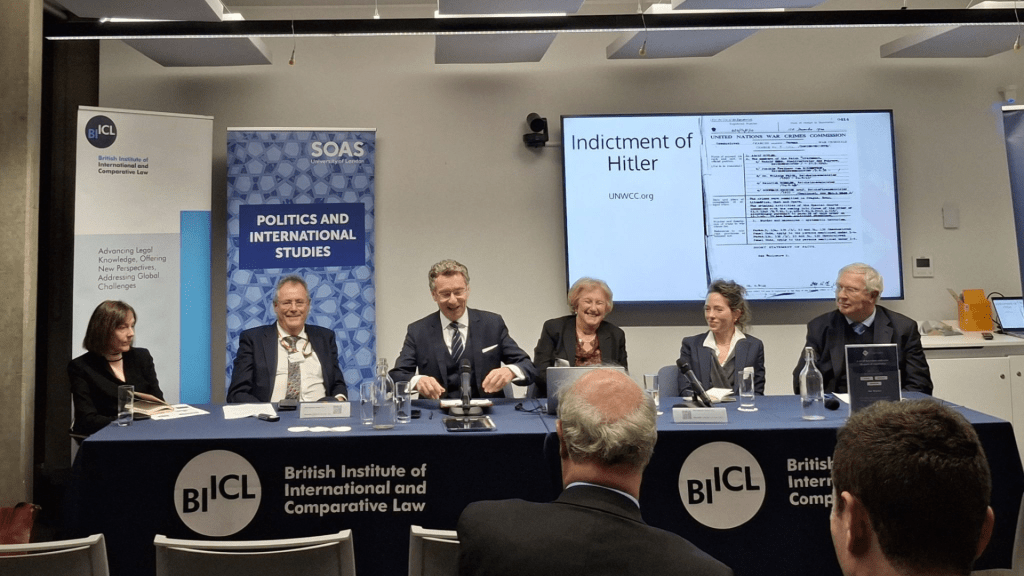
University of Georgia School of Law Professor Diane Marie Amann presented “International Military Tribunal Nuremberg 1945-1946,” an overview of the first post-World War II international criminal trial, at the British Institute of International & Comparative Law in London.

Her talk opened “80 Years On: The Legacy of the Nuremberg Trials for Accountability,” a panel of experts convened to analyze the midtwentieth-century trials project. The panel also looked to contemporary developments in international relations and international criminal justice – not least, to the Nuremberg precedent which permitted international criminal prosecutions of heads of state and other governmental leaders. A full video of the panel can be found here.

Besides Professor Amann (pictured above left), panelists included (l to r): Dan Plesch, Professor of Diplomacy & Strategy at SOAS University of London; Christoph Safferling, Director of the International Nuremberg Principles Academy and Professor of Law at the Friedrich-Alexander-Universität Erlangen-Nürnberg; as moderator, International Criminal Court Judge Joanna Korner CMG KC; Kirsty Sutherland, international barrister at 9BR Chambers, London; and Sir Howard Morrison KCMG CBE KC, former Judge on the International Criminal Court. (LinkedIn photo credit)

Cosponsoring the panel along with BIICL were the Robert H. Jackson Center and the International Nuremberg Principles Academy.

Amann is Regents’ Professor of International Law, Emily & Ernest Woodruff Chair in International Law, and a Faculty Co-Director of our Dean Rusk International Law Center here at Georgia Law. During her current research-intensive semester, she is an Affiliate Academic at University College London Faculty of Laws. She has published several essays on the Nuremberg era and is writing a book on lawyers and other women professionals at that first trial.

Georgia Law Professor Diane Marie Amann publishes “Nuremberg Women” chapter in Oxford Handbook on Women and International Law

“Absented at the Creation: Nuremberg Women and International Criminal Justice,” a chapter by University of Georgia School of Law Professor Diane Marie Amann, has just been published in a new Oxford University Press essay collection.

Amann is Regents’ Professor of International Law, Emily & Ernest Woodruff Chair in International Law, and a Faculty Co-Director of our Dean Rusk International Law Center here at Georgia Law. During her current research-intensive semester, she is an Affiliate Academic at University College London Faculty of Laws.

Her chapter appears in The Oxford Handbook on Women and International Law, co-edited by Professors J. Jarpa Dawuni (Howard University), Nienke Grossman (University of Baltimore), Jaya Ramji-Nogales (Temple University), and Hélène Ruiz Fabri (Université Paris 1 Panthéon-Sorbonne). The thirty-five-chapter volume spans many topics – topics that its four dozen authors explore through a variety of methods, including substantive legal analysis, legal history, and global critical race feminism.

Amann’s chapter draws from research that she had presented online as part of “In/ex-clusiveness of the Legal Construction of Justice,” a panel of the 17th Annual Conference of the European Society of International Law, held in 2022 at Utrecht University in The Netherlands.

Here’s the abstract for Amann’s chapter:

Women seldom surface in conventional accounts of the many war crimes trials that took place after World War II. Yet as this chapter shows, hundreds of women lawyers and other professionals were present, thus helping to lay the foundations of an international criminal justice project that continues to this day. Combining methodologies of narrative with theories sounding in global legal history and feminist scholarship and discussing what it reveals as dances of absence-presence, visible-invisible, and inclusion-exclusion, this chapter first examines how and why women were absented and then surfaces their contributions. It concludes with a look at contemporary international legal practice.