
In this post Professor Diane Marie Amann, the Emily & Ernest Woodruff Chair in International Law and Faculty Co-Director of our Dean Rusk International Law Center here at the University of Georgia School of Law, discusses her most recent publication.
 Among the more captivating women who worked at the 1st Nuremberg trial – women whose stories I’m now researching – was Dame Laura Knight. Already celebrated as the 1st woman in over 150 years to win election to Britain’s Royal Academy of Arts, Knight, then 68, arrived in January 1946, about a third of the way before the year-long proceedings before the International Military Tribunal. Soon after her departure 4 months later she unveiled a 5-foot by 6-foot oil painting, “The Nuremberg Trial,” at a London exhibition.
That work forms the centerpiece of “What We See When We See Law … Through the Eyes of Dame Laura Knight,” my contribution Monday to an ongoing Opinio Juris symposium on Justice as Message: Expressivist Foundations of International Criminal Justice, a new Oxford University Press book by Carsten Stahn, an international criminal law professor at Leiden Law School and Queen’s University Belfast.
My post began by discussing Stahn’s 2020 book in light of my own 2002 article about expressivist theories and international criminal law. The focus was Nuremberg: not only is it much-discussed in Stahn’s book, but the book’s cover features her 1946 painting, pictured above. Those facts launched my post’s cameo about Knight-as-messenger, available here.
Contributors of other posts in the book series include Marina Aksenova, Mark A. Drumbl, Angela Mudukuti, Darryl Robinson, Priya Urs, and Stahn himself.
(Cross-posted from Diane Marie Amann)

 In this post Professor
  In this post Professor
  University of Georgia Law Professor
  The work of an internationally known civil rights and criminal defense lawyer is the subject of a new Stanford University Press biography by Professor
  The group started the day at the International Court of Justice (ICJ) for an audience with
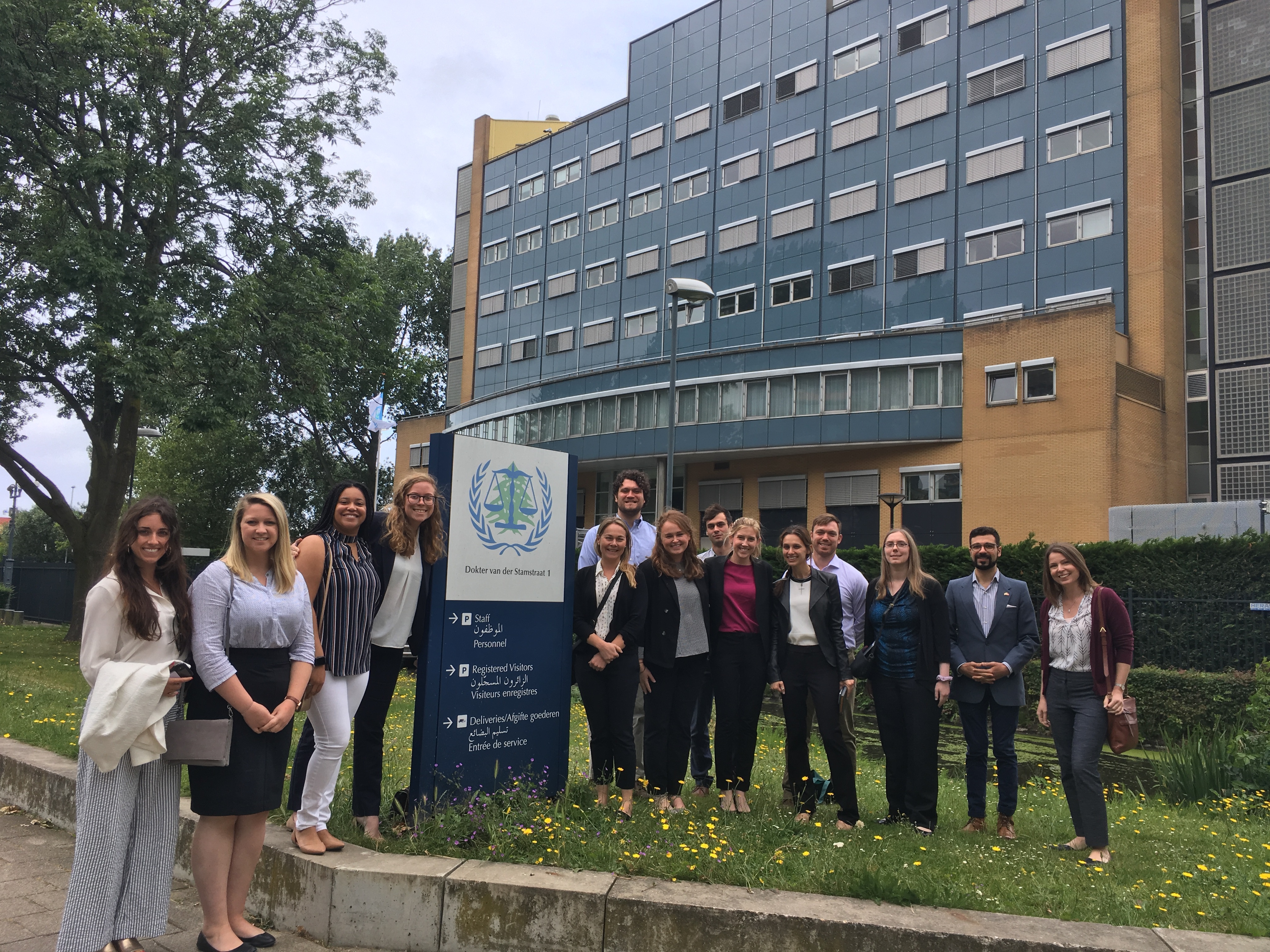
  In the afternoon, the group visited the International Criminal Court (ICC), located on the dunes near The Hague’s North Sea coast. Student first had a meeting with Prosecutor
  The second audience at the ICC was with the
  Students also had the opportunity to view the

 “Victors’ Justice and the New Turn to Transnational Process” is the title of a paper that Professor
 exchange of notes