Georgia Law professor Christopher Bruner presents working paper at International Law Colloquium

The University of Georgia School of Law’s spring 2025 International Law Colloquium welcomed Professor Christopher Bruner, who presented his working paper, “Sustainable Corporate Governance and Prospects for a US Value Chain Due Diligence Law.” Joshua Barkan, Associate Professor in the Department of Geography at the University of Georgia, served as Bruner’s faculty discussant.

Bruner is the Stembler Family Distinguished Professor in Business Law at the University of Georgia School of Law and serves as a faculty co-director of the Dean Rusk International Law Center. Bruner’s scholarship centers around corporate law, corporate governance, comparative law and sustainability.

Below is an abstract of Bruner’s working paper:

Laws requiring multinational companies to undertake due diligence to detect, prevent, and mitigate human rights and environmental abuses in their value chains have proliferated across Europe, and the European Union has adopted a directive to harmonise such national laws. This chapter assesses the prospects for enactment of such a value chain due diligence law in the United States.

Although such laws are often conceptualised as an extension of corporate law, they can just as readily be conceptualised as an extension of trade law – and the latter approach offers real potential to sidestep anti-ESG and anti-sustainability sentiment among the US political right. Packaged as a trade initiative, the prospects for bipartisanship improve because the political left and right can each embrace the effort by reference to policy preferences resonating with their respective bases. To the progressive left, such laws raise labour and environmental standards globally, while to the conservative right, such laws protect domestic industry from unfair foreign competition.

The chapter first examines corporate politics in the United States, discussing how fundamental corporate governance debates revolve around thorny ideological issues that strongly polarise the political left and right, diminishing the prospects for a value chain due diligence law conceptualised as an extension of corporate law. It then examines trade politics in the United States, discussing how framing by reference to trade improves the prospects for a US value chain due diligence law by sidestepping such ideological issues and giving both the political left and right plausible ways to view such a law as a victory for their respective bases. The chapter concludes with discussion of trade-offs raised by these differing modes of legal strategy and institutionalisation, observing that the corporate law approach offers broader reach with weaker enforcement while the trade law approach offers narrower reach with stronger enforcement.

This year, Professor Desirée LeClercq is overseeing the colloquium, which is designed to introduce students to features of international economic law through engagement with scholars in the international legal field. To view the full list of International Law Colloquium speakers, visit our website.

This program is made possible through the Kirbo Trust Endowed Faculty Enhancement Fund and the Talmadge Law Faculty Fund.

Luwam Dirar of Western New England University speaks at Georgia Law’s International Law Colloquium

The University of Georgia School of Law’s spring 2025 International Law Colloquium welcomed Professor Luwam Dirar of Western New England University School of Law as its second speaker last week.

Dirar presented her working paper titled, “Emancipation, Decolonization, and Gender in the Context of African Integration.” Dirar’s research and scholarly focus centers on international human rights law and the intersection of international economics and international relations. Dirar has also served as a consultant to several African governments and international organizations regarding migration and law.

Associate Director of the Dean Rusk International Law Center, Taher Benany, served as Dirar’s faculty discussant. Professor Desirée LeClercq is overseeing the colloquium, which is designed to introduce students to features of international economic law through engagement with scholars in the international legal field.

Below is an abstract of Dirar’s working paper:

The 1960s institutionalization and formalization of Africa’s continental integration was a manifestation of the ontological fragility of the concept of emancipation in the African context. As a concept, continental emancipation excluded concerns of women and formalized the divorce between decolonization and racial domination on the one hand and social emancipatory movements on the other. This divorce was contrary to the expectation of women who sought the end of colonial subjugation as a turning point for women’s emancipation from not only colonial and racial domination but also from social oppression. This article argues that the continental emancipation project betrayed the hopes of women who sought decolonization or the end of white racial domination as central to the end of gendered and gendering social subjugation. This article will have four parts. The first part will be a general introduction and will explore women’s emancipation in the context of regional integration studies. The second part will explore the internal contradictions of the concept of emancipation. The third part will explore the marketization of regional integration in Africa and the debates surrounding gender in trade agreements. The fourth part will be the conclusion and way forward.

To view the full list of International Law Colloquium speakers, visit our website. A summary of the previous week’s talk with Professor Harlan Cohen can be found here.

This program is made possible through the Kirbo Trust Endowed Faculty Enhancement Fund and the Talmadge Law Faculty Fund.

Georgia Law’s International Law Colloquium hosts Harlan Cohen, Fordham Law, as first speaker

The University of Georgia School of Law’s spring 2025 International Law Colloquium began last week with Professor Harlan Cohen of Fordham University School of Law. For more than a decade, the International Law Colloquium Series has brought leading scholars to Georgia Law, where they have presented works in progress and invited discussion and comments from students as well as faculty discussants.

This year, Professor Desirée LeClercq is overseeing the colloquium, which is designed to introduce students to features of international economic law through engagement with scholars in the international legal field. The course broadly defines “international economic law,” to include traditional approaches (trade and investment agreements) as well as non-traditional, emerging approaches (examining the effects of international economic law on marginalized communities and considering re-distributional policies).

Cohen presented his working paper titled, “The International Order, International Law, and the Definition of Security.” Cohen, who previously served as the Gabriel M. Wilner/UGA Foundation Professor in International Law at the University of Georgia School of Law and Faculty co-Director of the Dean Rusk International Law Center, specializes in international trade, international law, international legal theory, global governance, and U.S. foreign relations law.

Dean Usha Rodrigues opened the colloquium (recording of opening remarks available here). Professor Diane Marie Amann served as Cohen’s faculty discussant. 

Below is an abstract of Cohen’s working paper:

As economic security has seemingly moved to the center of American and European foreign policy, both the United States and the European Union have broadened their interpretation of international law rules governing security, coercion, and intervention.  These broadened interpretations have supported a bevy of new sanctions, trade restrictions, investment controls, and industrial policies that have turned the global economy into an increasingly weaponized space.  But these interpretations are not exactly new, echoing developing state interpretations of international law that developed states had long ago seemingly rejected.  How are these once moribund interpretations of security, force, and coercion being brought back to life?

This essay argues that these interpretative shifts highlight the role of the international order as an interpretative mechanism within international law.  Borrowing from the work of Robert Cover, it explains the ways that the international order acts as a jurispathic agent within the system, judging which interpretations live on and which are cast aside.  As global power shifts, the international order shifts with it, potentially reopening interpretative fights over international law.  Today’s fights over the meaning of security, force, and coercion thus reflect both the realities of a changing order and the battle to shape the one to come.

To view the full list of International Law Colloquium speakers, visit our website.

This program is made possible through the Kirbo Trust Endowed Faculty Enhancement Fund and the Talmadge Law Faculty Fund.
Georgia Law 2L Aubrey “Ellie” Wilson-Wade attends ASIL Abroad meeting in Switzerland

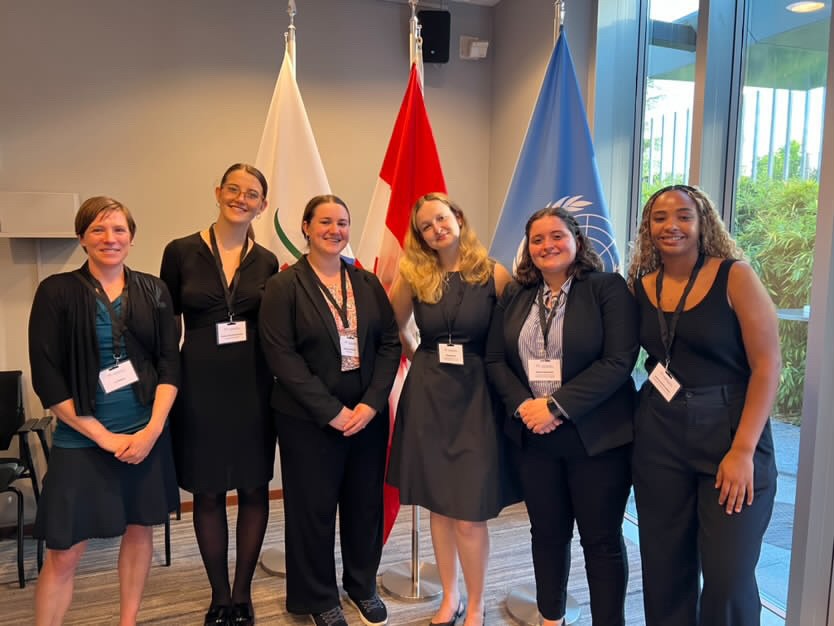
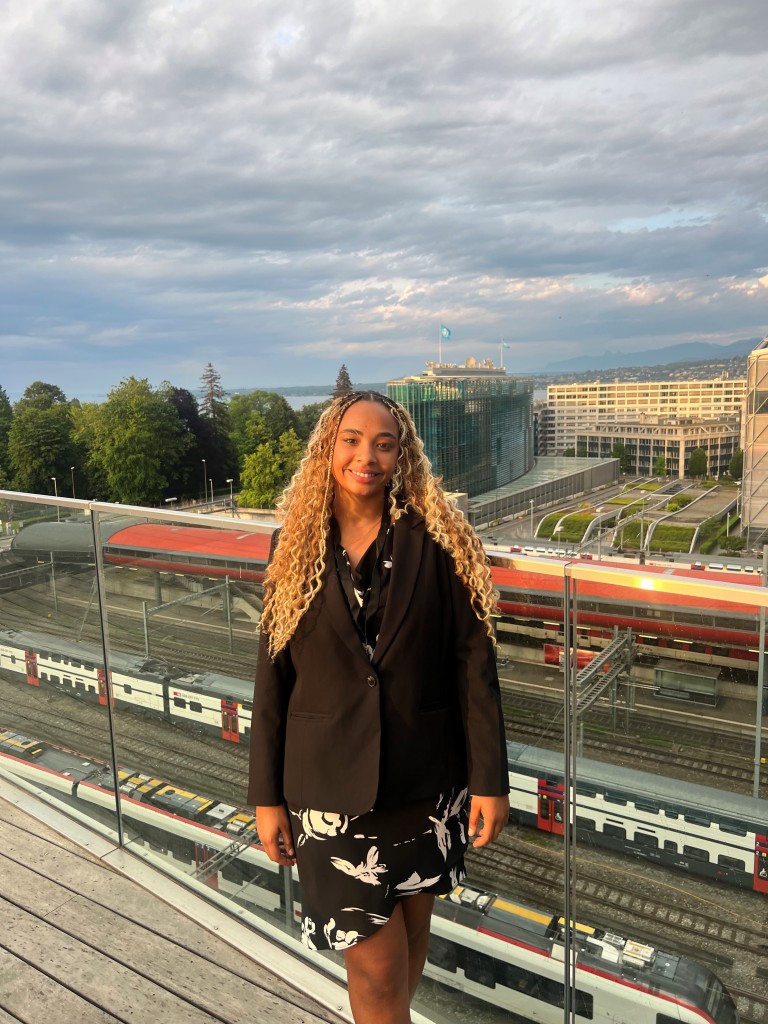
University of Georgia School of Law student, rising 2L Aubrey “Ellie” Wilson-Wade, recently attended the American Society of International Law (ASIL)’s 2024 ASIL Abroad meeting on June 5-6 at the University of Geneva in Geneva, Switzerland. The two-day conference consisted of dual parallel tracks on Human Rights, International Humanitarian Law, International Criminal Law (Track 1) and International Dispute Resolution & International Economic Law (Track 2). Georges Abi-Saab (honorary professor at The Geneva Graduate Institute) delivered a keynote speech, with Laurence Boisson de Chazournes (University of Geneva) as discussant. Below, Wilson-Wade reflects on her experience as an attendee of the conference. Georgia Law is an academic partner of ASIL.

I am so grateful to have had the opportunity to attend the 2024 ASIL Abroad Conference in Geneva, Switzerland. I was able to attend sessions in both track 1 and track 2, as I have an interest in both tracks’ topics. The most memorable sessions that I attended included “Enforcement of Arbitral Awards Rendered Against States” and “Compensation in International Law.” Additionally, I was able to see a mock arbitration related to growing tensions between investment treaties and environmental protection. These panels taught about investment and trade disputes in international law.

My favorite session was titled “Gender, Sexualized Violence, and Conflict: Incorporating the Women, Peace, and Security Agenda into Global Atrocity Prevention Efforts.” The panelists, including Priya Gopalan, Vanessa Murphy, and Dalila Seoane, were able to share their firsthand knowledge and experience working on issues related to gender-based violence.

Overall, the conference was a once-in-a-lifetime learning experience and every panel had an array of diverse perspectives and ideas. Not only was the substantive portion of the conference great, but I also met so many legal professionals and students during my time in Geneva. In just two days, I was able to connect with students attending law school throughout the United States, as well as from schools in England, Brazil, and Geneva. I was also able to network with legal professionals from all over the world.

As a first-year law student, it was a unique opportunity to learn about intricacies of international law outside of the typical classroom setting from professionals in the field. Additionally, it was a great way to make connections with international lawyers and law students. I would highly recommend any student who wishes to globalize their legal perspective and education to attend this conference.

Georgia Law Professor Bruner presents on national identity and economic development at Princeton University “Post-Colonial Era” symposium

“National Identity and Economic Development in Market-Dominant Small Jurisdictions” is the title of the workshop paper that Christopher Bruner, the Stembler Family Distinguished Professor in Business Law here at the University of Georgia School of Law, presented last Friday at Princeton University.

Bruner’s talk was part of a symposium on “Law, Identity, and Economic Development in the Post-Colonial Era: The Case of the Northern Atlantic and Larger Caribbean Regions,” hosted by the Princeton School of Public and International Affairs. The university’s Liechtenstein Institute on Self-Determination co-sponsored the event.

“Law of Global Economic Statecraft,” October 24 Georgia Journal of International and Comparative Law conference, to feature book keynote discussion with Nicholas Mulder

This year’s annual conference of the Georgia Journal of International and Comparative Law will consider a highly topical question: “The Law of Global Economic Statecraft.” Featured will be a keynote discussion by Cornell University historian Nicholas Mulder, author of The Economic Weapon: The Rise of Sanctions as a Tool of Modern War (Yale University Press 2022), as well as panels including more than a dozen experts from around the world.

The daylong conference will take place on Monday, October 24, in the Larry Walker Room of Dean Rusk Hall at the University of Georgia School of Law.

Sponsoring along with GJICL, a 50-year-old student-edited journal, is the law school’s Dean Rusk International Law Center. GJICL Executive Conference Editor, 3L Claire Kimbrell, and Senior Conference Editor, Sarah Grace McCord, worked closely with Catrina Martin, the Center’s Global Practice Preparation Assistant, and with GJICL’s Faculty Advisor, Professor Harlan Grant Cohen, who is Gabriel M. Wilner/UGA Foundation Professor in International Law and one of the Center’s Faculty Co-Directors.

The University of Georgia Willson Center for Humanities & Arts is a cosponsor of the keynote event. Additional conference cosponsors include these University of Georgia units: Georgia Law students’ International Law Society; the Center for International Trade & Security, School of Public & International Affairs; the Department of History, Franklin College of Arts & Sciences; and the Department of Economics, Terry College of Business.

Registration for all aspects of the conference (to be livestreamed for online registrants) here.

Here’s the concept note:

“The global economy has been weaponized.  It’s not clear when it happened, or whether it’s even something new, but watching the response to Russia’s invasion of Ukraine has made it impossible to ignore.  With breathtaking speed, a full phalanx of sophisticated economic tools was mobilized against Russia that threatened to sever it from the global economy.  For its, part, Russia demonstrated the continued force of its own economic weapons – its control over substantial supplies of oil and gas.  But the speed with which these tools were amassed was in fact testament to years of experiments and practice.  Economic tools that had been developed to isolate “rogue states,” to fight terrorist networks, and to punish human rights abusers had begun to show how the carrot of the global market could quickly become a lever of influence and a forceful stick.  But these tools gained new prominence as they were refined and redeployed for use in the intensifying economic and geopolitical rivalry between China, the United States, and Europe.  

“Is international law prepared for this reality?  Until recently, tools of economic pressure have been left largely to the margins of the discipline, treated at best as the preferred alternative to more regulated fields of military activities, at worst as exceptional tools that could largely be ignored – even in the face of critiques from the Global South and regarding human rights.  While every international law textbook has chapters on the regulation of military activity and economic cooperation, few have standalone sections on sanctions.  International economic law regimes meanwhile struggle to adapt to the realities of ‘geoeconomics’ and ‘weaponized interdependence,’ in which, structures designed to encourage economic cooperation are repurposed as tools of competition and rivalry.

“A reconsideration is long overdue.  This symposium surveys the current state of economic statecraft – the tools in use, their purposes, and their targets.  It explores how they are or should be regulated.  But most importantly, it seeks to put today’s economic statecraft in historical, political, and legal context asking critical questions about the international order they reflect and the international order they might require.”

The day’s events are as follows:

9-9:10 am Welcome

  • Melissa J. “MJ” Durkee, Associate Dean for International Programs, Director of the Dean Rusk International Law Center, and Allen Post Professor, University of Georgia School of Law

9:10-10:30 am How We Got Here

Speaking on this 1st panel:

  • Zohra Ahmed, Assistant Professor of Law, University of Georgia School of Law
  • Mona Ali, Associate Professor of Economics, State University of New York-New Paltz
  • Henrique Choer Moraes, Minister-Counsellor, Embassy of Brazil in New Zealand
  • Nicholas Mulder, Assistant Professor and Milstein Faculty Fellow, Cornell University Department of History

10:45 am-12:05 pm Where We Are

Lauren Brown, Associate, Squire Patton Boggs, Washington, D.C., will moderate this 2d panel. Speaking will be:

  • Sarah Bauerle Danzman, Director, Tobias Center for Innovation in International Development, and Associate Professor, International Studies, Indiana University-Bloomington
  • Maryam Jamshidi, Associate Professor of Law University of Florida Levin College of Law
  • Tom Ruys, Professor, Faculty of Law and Criminology, Department of European, Public, and International Law, Ghent University, Belgium
  • Jan Zahradil, Member, European Parliament

1:05-2:25 pm Where We’re Headed

Speakers on this 3d panel:

  • Elena Chachko, Lecturer on Law, Harvard Law School
  • J. Benton Heath, Assistant Professor of Law, Temple University Beasley School of Law
  • Henry Farrell, SNF Agora Institute Professor of International Affairs at SAIS, Johns Hopkins University
  • Mona Paulsen, Assistant Professor of Law, London School of Economics Law School, England

2:40-3:55 pm Keynote Book Discussion on “The Economic Weapon: The Rise of Sanctions as a Tool of Modern War”

3:55 pm Thank You

  • Courtney Robinson, Editor-in-Chief, Georgia Journal of International and Comparative Law

Georgia Law Professor Cohen discusses developments in international trade law as part of plenary opening ASIL interest group conference at Texas A&M Law

Harlan Grant Cohen, who is Gabriel M. Wilner/UGA Foundation Professor in International Law and Faculty Co-Director of the Dean Rusk International Law Center here at the University of Georgia School of Law, took part in last Thursday’s opening plenary of the Biennial Conference of the American Society of International Law International Economic Law Interest Group.

On the opening plenary panel entitled “Sustainable Development and the Multiple Aims of Trade Law,” Cohen (above, 2d from left) primarily discussed the new competition to define international trade’s purpose, as well as the increasing enmeshments of trade and national security.

Organizer of the plenary was Nicolas Lamp, Queen’s University, Ontario (above, with Cohen to his left). Other panelists included (l to r): Ernesto Fernández Monge, Pew Charitable Trusts; Olabisi Akinkugbe, Schulich School of Law, Dalhousie University; Kathleen Claussen, University of Miami School of Law; Tony VanDuzer, University of Ottawa Faculty of Law; and Maria Panezi, University of New Brunswick School of Law. (photo credit)

The overall theme of the conference, which took place September 22 to 24 at Texas A&M University School of Law in Fort Worth, Texas, was “Energy, Sustainability, and International Economic Law.”

Georgia Law Associate Dean MJ Durkee, our Center’s Director, gives online webinar to law students in Bangladesh

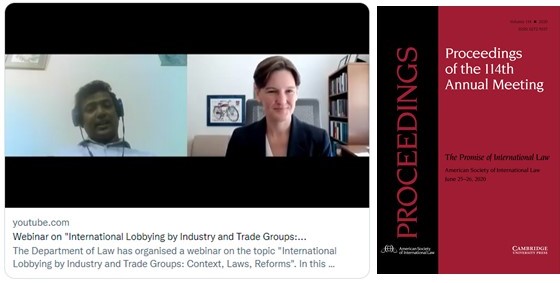
Melissa J. “MJ” Durkee, who is Associate Dean for International Programs, Director of the Dean Rusk International Law Center, and Allen Post Professor here at Georgia Law, gave an online presentation on Friday, entitled “International Lobbying by Industry and Trade Groups: Context, Laws, Reforms,” to students at the Department of Law of North South University in Dhaka, Bangladesh.

She delivered the webinar by invitation of North South Law Professor Md. Rizwanul Islam, whose own scholarship includes examinations of the operation of international economic law in South Asia.

In her presentation, Durkee observed that COP26, the 2-week international climate change conference just concluded in Glasgow, Scotland, spotlighted difficulties in designing rules and processes that welcome nongovernmental organizations and business groups into global governance. She explored the adequacy vel non of conceptualizations of this challenge, and further considered possible designs for reform.

The webinar built on “Welcoming Participation, Avoiding Capture: A Five-Point Framework,” remarks that Durkee published in the Proceedings of the American Society of International Law Annual Meeting of 2020, available here.

Video of last Friday’s webinar may be found here.