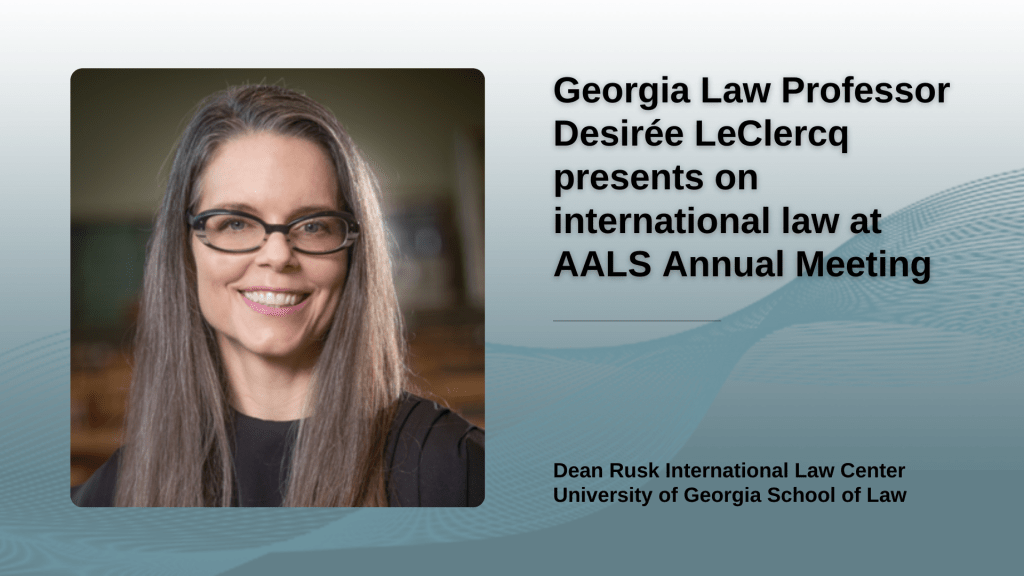
Georgia Law Professor Desirée LeClercq and former U.S. diplomat Christina Hardaway discuss careers in public international law and diplomacy

University of Georgia School of Law Professor Desirée LeClercq and former U.S. diplomat Christina Hardaway discussed their career trajectories and experiences working internationally in a recent law school panel discussion, “Working in Public International Law and Diplomacy.”

After introducing themselves and outlining their academic and professional paths, LeClercq and Hardaway took questions from the audience. They talked about the importance of soft skills in diplomatic work, how to develop your expertise in domestic affairs to make yourself more marketable overseas, the challenges of living abroad, and detailed both the rewards and complexities of committing to a career in public service.

Hardaway is a former diplomat (Foreign Service Officer) for the U.S. Department of State with a 14-year career spanning Latin America, Europe, and Africa.  She most recently completed a diplomatic assignment at the U.S. Consulate General in Nuevo Laredo, Mexico, where she advanced U.S. economic, security, and commercial priorities on the U.S.-Mexico border. Prior to that, Hardaway served as Deputy Chief of the Political-Economic Section at the U.S. Embassy in Cameroon leading the mission’s economic and commercial portfolio. Her previous assignments include gender and entrepreneurship officer in the Bureau of African Affairs, energy and environment officer at the U.S. Embassy in The Hague, consular officer at the U.S. Consulate General in Monterrey, Mexico, and a detail at the U.S. African Development Foundation.

LeClercq joined the University of Georgia School of Law in 2024 as an assistant professor. She teaches Contracts, International Trade and Workers Rights, International Labor Law, International Law and U.S. Labor Law, and Public International Law. She also serves as a faculty co-director of the Dean Rusk International Law Center and as the faculty adviser for the Georgia Journal of International and Comparative Law. From 2016 to 2020, she served as a director of labor affairs in the Office of the U.S. Trade Representative (USTR). Before joining USTR, LeClercq worked for nearly a decade as a legal officer at the International Labor Organization in Geneva, Switzerland, and served as staff counsel for the chairman of the National Labor Relations Board.

This event was part of the Dean Rusk International Law Center’s ongoing Consular Series, which presents students, staff, and faculty with global perspectives on international trade, cooperation, development, and policy.

Georgia Law Professor Desirée LeClercq publishes in Cornell International Law Journal 

University of Georgia School of Law Professor Desirée LeClercq recently published an article, “Gender-Based Violence at Sea,” in the Cornell International Law Journal. The article stems from LeClercq’s previous contribution to Cornell’s Transnational Labor Law Conference as a conference co-organizer.

LeClercq’s article highlights the pervasive gender-based violence and harassment that female seafarers endure at sea. Furthermore, LeClercq argues the International Labour Organization (ILO) has failed to properly protect workers despite the protections intended by the Maritime Labour Convention, 2006.

Below is an abstract from the article:

“This Symposium contribution assesses the ability of international law to evolve to offer essential protections for workers in an increasingly globalized world. It focuses on protections for women seafarers, specifically around gender-based violence and harassment on board vessels. Even though it is the world’s oldest transnational sector, seafaring remains overwhelmingly male-dominated. Consequently, international law was not initially conceived with women seafarers in mind. Now that women have broken into the maritime profession, they count on international law to evolve in kind. Notwithstanding, they continue to face sexist, if not violent, workplaces, and report high incidents of gender-based violence and harassment at sea.

The international organization responsible for adopting and supervising protections for workers, the International Labour Organization (ILO), has long prioritized the special needs of seafarers. Its Maritime Labor Convention, 2006, promised to ensure holistic protections for all women and men at sea and to quickly adapt with evolving sectoral challenges. A close look at the prevalence of gender-based violence and harassment at sea shows, however, that the ILO’s bureaucratic pathologies and interinstitutional processes preclude it from accomplishing that mission. The ILO’s failure to quickly respond to mounting evidence of that violence and harassment has broad implications for international law, which must absorb and respond to transnational work’s dynamic and fluctuating demands to remain useful and relevant.”

LeClercq joined the University of Georgia School of Law in 2024 as an assistant professor. She teaches International Trade and Workers Rights, International Labor Law, International Law and U.S. Labor Law. This semester, LeClercq is overseeing the International Law Colloquium, a for-credit course designed to introduce students to international economic law through engagement with scholars in the international legal field. She also serves as a faculty co-director of the Dean Rusk International Law Center and as the faculty adviser for the Georgia Journal of International and Comparative Law.

Georgia Law Professor Desirée LeClercq featured in ACF Report by Johns Hopkins University

University of Georgia School of Law Professor Desirée LeClercq contributed to the annual report published by Johns Hopkins University’s Institute for America, China, and the Future of Global Affairs (ACF) entitled “Getting China Right at Home.” LeClercq authored the article “A Pragmatic Approach to U.S.-China Labor Tensions,” which centers on the importance of the International Labor Organization in improving worker’s rights in China.

Below is an excerpt from the article:

“Tensions with the People’s Republic of China (PRC) concerning its treatment of workers have featured prominently in U.S. trade and diplomatic policies. The new administration must draw lessons from the failure of policies employed to date to entice the PRC to align its labor policies with international legal standards, not least because residual noncompliance in China has impacted domestic interests in the United States. Instead, the International Labor Organization (ILO), as a neutral intermediary, could better engender incremental changes in the treatment of workers.”

LeClercq joined the University of Georgia School of Law in 2024 as an assistant professor. She teaches International Trade and Workers Rights, International Labor Law, International Law and U.S. Labor Law. She also serves as a faculty co-director of the Dean Rusk International Law Center and as the faculty adviser for the Georgia Journal of International and Comparative Law.

Georgia Law Professor Desirée LeClercq featured in Inside US Trade article 

University of Georgia School of Law Professor Desirée LeClercq was recently featured in Inside US Trade regarding the U.S.-Mexico-Canada Agreement’s Rapid Response Mechanism (RRM) and how it may be used by the upcoming Trump administration.

The December 5 article entitled “Under Trump, hope — and recommendations — for the stronger use of RRM” was written by Margaret Spiegelman. It references a report LeClercq co-authored with Mexican researchers on the views of workers in the Mexican auto sector on their labor rights under the USMCA’s RRM, as well as her November 10 post for the International Economic Law and Policy Blog entitled “Whither the Worker-Centered Trade Policy?”

From the article:

University of Georgia School of Law Assistant Professor Desirée LeClercq…says a recent study she conducted with El Colegio de Sonora professor Alex Covarrubias-V and Cirila Quintero Ramirez, a research professor at El Colegio de Frontera Norte, Unidad Matamoros, suggests that the mechanism has disproportionately served a relatively narrow group of workers with ties to major U.S. unions and non-governmental organizations, without raising labor standards overall.

LeClercq, who was USTR’s director of labor affairs during President Trump’s first term, said she believes a second Trump administration, less beholden to such groups, might be incentivized to use the tool more broadly to try to improve labor standards that give Mexico an unfair competitive edge.

LeClercq joined the University of Georgia School of Law in 2024 as an assistant professor. She teaches International Trade and Workers Rights, International Labor Law, International Law and U.S. Labor Law, as well as the International Law Colloquium. She also serves as a faculty co-director of the Dean Rusk International Law Center and as the faculty adviser for the Georgia Journal of International and Comparative Law.