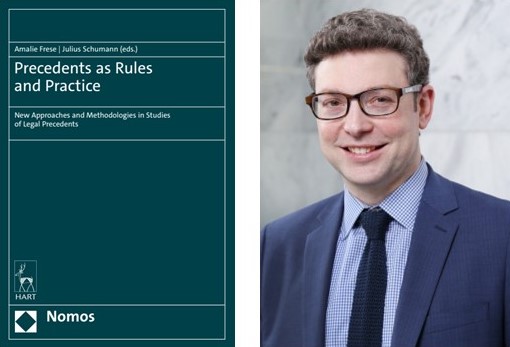
Harlan Cohen, who is Gabriel M. Wilner/UGA Foundation Professor in International Law and Faculty Co-Director of the Dean Rusk International Law Center here at the University of Georgia School of Law, has contributed a chapter entitled “Culture Clash: The Sociology of WTO Precedent” to a just-published essay collection.
Here’s the SSRN abstract for Professor Cohen’s chapter:
Thanks to the United States, the WTO Appellate Body can no longer hear appeals. Having blocked all appointments to the body, the United States has left its bench empty, with no members to fulfill its role. Among the United States’ justifications: The Appellate Body’s adoption of an apparent doctrine of precedent.
This chapter takes a deeper look at the fight over precedent at the WTO, both as a case study in the emergence and operation of precedent within international law and as a microcosm of the cultural conflicts playing out within the WTO. The chapter develops an account of precedent as a product of three overlapping, inter-dependent, and mutually constructed logics: (1) the jurisprudential, (2) the rational, and (3) the sociological. It then uses these three logics to retell the story of precedent at the WTO – the emerging patterns of argumentative practice, the Appellate Body’s adoption of a doctrinal test, and the escalating U.S. opposition to the “cogent reasons” standard that body applied. Seeing the fight over precedent as a function of all three logics reveals the real cultural fights for control of the WTO community of practice. Seeing that community of practice coalesce around and split over unwritten practices of precedent reveals how international law develops as much as a function of culture, training, and practice as of rules and power.
Our Center’s Director, Associate Dean Melissa J. “MJ” Durkee, has contributed an essay in the newest symposium issue, which she edited, of American Journal of International Law Unbound.
Entitled “Introduction to the Symposium on Frédéric Mégret, “Are There ‘Inherently Sovereign Functions’ in International Law?”, the essay appears at 115 American Journal of International Law Unbound 299 (2021) and is available online at the Cambridge University Press site. It opens a symposium exploring an article just published in the American Journal of International Law by McGill University Law Professor Frédéric Mégret. Also contributing to the symposium are Cambridge Law Professor Eyal Benvenisti, Collège de France Professor Samantha Besson, Columbia Political Science Professor Jean L. Cohen, Nottingham Law Professor Nigel D. White, and California-Berkeley Political Science Professor Daniel Lee.
In addition to leading the Dean Rusk International Law Center, Durkee is Associate Dean for International Programs and the Allen Post Professor here at the University of Georgia School of Law. She is on the Board of Editors of the American Journal of International Law and is the supervising editor of AJIL Unbound. Both are publications of the American Society of International Law, for which Durkee serves as an Executive Council member and Vice Chair of the International Legal Theory Interest Group.
The 1972 United Nations Conference on the Human Environment produced the “Stockholm Declaration,” an environmental manifesto that forcefully declared a human right to environmental health and birthed the field of modern international environmental law. In celebration of its 50th anniversary volume, the Georgia Journal of International and Comparative Law is convening a symposium to reflect on the first 50 years of international environmental law and the lessons this history may hold for the future.
The symposium will include a keynote address by Dinah L. Shelton, Manatt/Ahn Professor of International Law Emeritus at George Washington University School of Law whose distinguished service in areas of human rights and environmental law includes President of the Inter-American Commission on Human Rights. Also featured will be scholars and practitioners from around the world, taking part in panel discussions and breakout sessions: on the rights-based approach to environmental protection; on anti-racism, decolonization, and environmental protection; and on the future of international environmental law. As indicated in the schedule below, the panels reflect themes in Principle 1 of the 1972 Stockholm Declaration, which states in full:
“Man has the fundamental right to freedom, equality and adequate conditions of life, in an environment of a quality that permits a life of dignity and well-being, and he bears a solemn responsibility to protect and improve the environment for present and future generations. In this respect, policies promoting or perpetuating apartheid, racial segregation, discrimination, colonial and other forms of oppression and foreign domination stand condemned and must be eliminated.”
The conference will take place on Zoom, though students and a limited number of registrants may attend in person. Details and registration here. The full schedule follows:
Welcome and Introduction by Georgia Law’s Peter B. “Bo” Rutledge, Dean, MJ Durkee, Associate Dean for International Programs, Director of the Dean Rusk International Law Center, and Allen Post Professor, 9 a.m.
Panel 1: The Rights-Based Approach to Environmental Protection, 9:10 a.m. (followed by breakout session at 10:25 a.m.)
Recalling Principle 1’s statement that humankind “has the fundamental right to freedom, equality and adequate conditions of life, in an environment of a quality that permits a life of dignity and well-being,” the following panelists will explore how and in what contexts the Stockholm Declaration’s rights-based approach to environmental protection is useful, as well as limitations of this approach:
Nnimmo Bassey, Director, Health of Mother Earth Foundation
Tyler Giannini, Clinical Professor and Co-Director of the Harvard Human Rights Program and the International Human Rights Clinic at Harvard Law
Kate Mackintosh, Executive Director, Promise Institute for Human Rights, UCLA Law
Katie O’Bryan, Lecturer, Monash University, Australia
Moderating will be Diane Marie Amann, Regents’ Professor of International Law, Emily & Ernest Woodruff Chair in International Law and Faculty Co-Director of the Dean Rusk International Law Center at Georgia Law
Panel 2: Anti-Racism, Decolonization, and Environmental Protection, 10:50 a.m. (followed by breakout session at 12:05 p.m.)
Recalling Principle 1’s statement that “policies promoting or perpetuating apartheid, racial segregation, discrimination, colonial and other forms of oppression and foreign domination stand condemned and must be eliminated,” the following panelists will explore how international environmental law addresses, or fails to address, environmental racism:
Robin Bronen, Executive Director of the Alaska Institute for Justice
Sarah Riley Case, Boulton Junior Fellow at McGill University Faculty of Law in Canada
Usha Natarajan, Edward W. Said Fellow at Columbia University
Moderating will be Harlan G. Cohen, Gabriel M. Wilner/UGA Foundation Professor in International Law and Faculty Co-Director of the Dean Rusk International Law Center at Georgia Law
Panel 3: International Environmental Law’s Future, 1 p.m. (followed by breakout session at 2:15 p.m.)
Recalling Principle 1’s statement that humankind “bears a solemn responsibility to protect and improve the environment for present and future generations,” the following panelists will explore what are the successes and failures of the last 50 years of environmental law, as well as the key international environmental law challenges for the next 50 years:
Rebecca M. Bratspies, Professor and Director of the Center for Urban Environmental Reform at CUNY Law
Jutta Brunnée, Dean, University Professor, and James Marshall Tory Dean’s Chair at the University of Toronto Faculty of Law in Canada
Lakshman D. Guruswamy, Nicholas Doman Professor of International Environmental Law at Colorado Law
Cymie Payne, Associate Professor in the Department of Human Ecology and the School of Law, Rutgers University
Moderating will be MJ Durkee, Associate Dean for International Programs, Director of the Dean Rusk International Law Center, and Allen Post Professor at Georgia Law
Introduction of keynote by Adam D. Orford, Assistant Professor at Georgia Law, followed by keynote address, entitled “Stockholm Plus 50: Glass Half Full, Half Empty, or Shattered?” and delivered by Dinah L. Shelton, Manatt/Ahn Professor of International Law Emeritus at George Washington University School of Law, 2:40 p.m.
Closing remarks by Kimberlee Styple, Editor-in-Chief of the Georgia Journal of International and Comparative Law, 3:15 p.m.
Besides ASIL, many units of the University of Georgia are cosponsoring this event. They include the International Law Society, Environmental Law Association, Georgia Initiative for Climate & Society, Warnell School of Forestry & Natural Resources, School of Public & International Affairs, Center for International Trade & Security, Global Health Institute of the College of Public Health, School of Social Work, and College of Environment & Design.
Registration and details on the program and accommodations here.
The world’s leading international economic law publication has awarded its top scholarship honor to Harlan G. Cohen, Gabriel M. Wilner/UGA Foundation Professor in International Law and Faculty Co-Director of the Dean Rusk International Law Center here at the University of Georgia School of Law.
As stated on the website of this Oxford University Press journal, the prize is named after its founding editor, John Howard Jackson (1932-2015), who, in the course of his career teaching law at Georgetown, Michigan, and Berkeley, kept “a keen eye on new developments and novel systemic interactions in the field beyond the four corners” of the General Agreement on Tariffs and Trade/World Trade Organization. With an aim to “underlining the importance of construing international economic law in this broader, ever changing perspective,” the Jackson Prize “is awarded annually to the article or other contribution in the JIEL that most significantly breaks new ground and adds new insights to the study and understanding of international economic law, especially in fields beyond a self-contained analysis of WTO law.”
Published in December 2020, Cohen’s “Nations and Markets” appears in volume 23, issue 4, of the peer-reviewed journal, at pages 793-815, and is available online here. Here’s the abstract:
Economics and security seem increasingly intertwined. Citing national security, states subject foreign investments to new scrutiny, even unwinding mergers. The provision of 5G has become a diplomatic battleground—Huawei at its center. Meanwhile, states invoke national security to excuse trade wars. The USA invoked the General Agreement on Tariffs and Trade national security exception to impose steel and aluminum tariffs, threatening more on automotive parts. Russia invoked that provision to justify its blockade of Ukraine, as did Saudi Arabia and the United Arab Emirates to excuse theirs of Qatar. And with the spread of COVID-19, states are invoking national security to scrutinize supply lines. Multiplying daily, such stories have led some observers to dub the era one of geoeconomics. Nonetheless, these developments remain difficult to judge, and the relationship between economics and national security remains confused and slippery. The essay seeks clarity in the deeper logic of these labels, revealing a fundamental choice between the logics of markets and the logics of state. Whether invoked to ‘secure’ borders, privacy, health, the environment, or jobs, ‘national security’ is a claim about the proper location of policymaking. Appeals to economics, with their emphasis on global welfare and global person-to-person relationships, are such claims as well. Resolving disputes, this essay argues, requires recognizing these root choices.
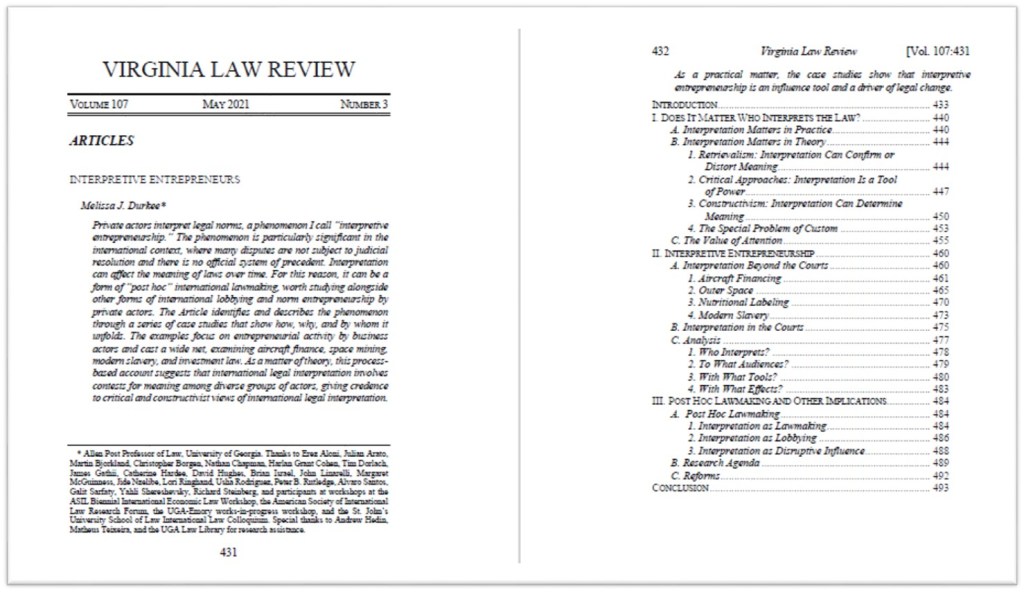
Melissa J. “MJ” Durkee, Associate Dean for International Programs and Director of the Dean Rusk International Law Center here at the University of Georgia School of Law, has published “Interpretive Entrepreneurs” in 107 Virginia Law Review 431 (2021).
Here’s the abstract of this latest publication by Durkee, who also holds the title of Allen Post Professor of Law:
Private actors interpret legal norms, a phenomenon I call “interpretive entrepreneurship.” The phenomenon is particularly significant in the international context, where many disputes are not subject to judicial resolution, and there is no official system of precedent. Interpretation can affect the meaning of laws over time. For this reason, it can be a form of “post hoc” international lawmaking, worth studying alongside other forms of international lobbying and norm entrepreneurship by private actors. The Article identifies and describes the phenomenon through a series of case studies that show how, why, and by whom it unfolds. The examples focus on entrepreneurial activity by business actors and cast a wide net, examining aircraft finance, space mining, modern slavery, and investment law. As a matter of theory, this process-based account suggests that international legal interpretation involves contests for meaning among diverse groups of actors, giving credence to critical and constructivist views of international legal interpretation. As a practical matter, the case studies show that interpretive entrepreneurship is an influence tool and a driver of legal change.
In assuming leadership of the Dean Rusk International Law Center, Durkee succeeds Professor Lori A. Ringhand, who has served as the Center’s Interim Director for the past year and a half. The law school’s most recent Associate Dean for International Programs was Professor Diane Marie Amann, who served in that post from 2015-2017 and who since then has been a Faculty Co-Director of the Center along with Professor Harlan G. Cohen.
Named after former U.S. Secretary of State and Georgia Law Professor Dean Rusk, our Center has served since 1977 as the international law and policy nucleus for education, scholarship, and other collaborations among faculty and students, the law school community, and diverse local and global partners. As Director, Durkee will lead a Center staff that includes Laura Tate Kagel and Mandy Dixon, respectively the Associate Director and the Assistant for International Professional Education, and Sarah Quinn and Catrina Martin, respectively the Associate Director and the Assistant for Global Practice Preparation.
Durkee (prior posts, SSRN page) also holds the title at Georgia Law of Allen Post Professor, as well as a courtesy appointment in the university’s Terry College of Business. A highly regarded scholar, she teaches, writes, and presents on international law and corporate governance, with focus on international economic and environmental law, global governance, democratic participation, public-private partnerships, and legal theory. Her most recent article, “Interpretive Entrepreneurs,” has just been published at 107 Virginia Law Review 431 (2021).
Before joining the Georgia Law faculty in 2018, Durkee was a professor at the University of Washington School of Law. A graduate of Yale Law School, she practiced international litigation and arbitration at Cleary Gottlieb Steen & Hamilton in New York and was law clerk to Judge Kim McLane Wardlaw, U.S. Court of Appeals for the Ninth Circuit, and Judge Sidney H. Stein, U.S. District Court for the Southern District of New York.
Durkee’s presentation, “Interpretive Entrepreneurs: Business, Interpretive Lobbying, and International Legal Change,” drew from her paper available here.
Her talk formed part of a panel on “Global Legal Pluralism: Perspectives on International, Transnational, and Multilevel Governance.” Chaired by George Washington Law Professor Paul Schiff Berman, the panel also included Law Professors Elies van Sliedregt of the University of Leeds, England, Frédéric Mégret of McGill University, Montreal, Canada, and Erin Ryan of Florida State University, Tallahassee.
Professor Amann spoke on “Nuremberg Women as Shapers of International Criminal Justice,” as part of a panel entitled “Hidden Figures in International Courts and Tribunals.” She joined Howard University Professor J. Jarpa Dawuni, Director of the Institute for African Women in Law, and University of Baltimore Law Professor Nienke Grossman, Co-Director of the Center for International and Comparative Law. One of the seminar series’ organizers, Nina Pineau, moderated, while her co-organizer, Rita Guerreiro Texeira, gave opening remarks. Both are doctoral researchers at the Belgium-based Leuven Centre, with which our own Center partnered, pre-pandemic, on our Global Governance Summer School.
Scheduled to run throughout the 2021 spring and fall terms, the Women in International Law seminar commemorates 100 years since the first arrival of women law students at KU Leuven, one of the premier institutions of higher education in Europe. Details on and registration for subsequent sessions, at which experts who work in in Amsterdam, Istanbul, Lisbon, London, Geneva, The Hague, and Rome, on issues including international organizations, international fair trials, and law of the sea, here.
► Superb members of the law faculty, including: Dean Peter B. “Bo” Rutledge, an international arbitration expert; our Center’s Interim Director, Lori A. Ringhand, a scholar of comparative constitutional law and elections law; the Center’s Faculty Co-Directors, Professors Diane Marie Amann, an expert in security governance fields including the laws of war and international criminal justice, and Harlan G. Cohen, an expert in global governance and foreign relations law; Professors Melissa J. “MJ” Durkee, whose expertise includes international business law and international environmental law, Christopher M. Bruner, a comparative corporate governance scholar, Thomas E. Kadri, whose expertise includes cybercrime and global data privacy, Jason A. Cade, an immigration expert, Jonathan Peters, a journalism and law professor expert in international media and free speech, Anne Burnett, foreign and international law librarian, Elizabeth Weeks and Fazal Khan, health law specialists, Kent Barnett, Sonja West, and Elizabeth Chamblee Burch, who have presented overseas on administrative law, media law, and civil procedure, respectively, Walter Hellerstein, a world-renowned tax specialist, Nathan S. Chapman, a scholar of due process and extraterritoriality, Michael L. Wells, a European Union scholar, and Andrea Dennis, whose book “Rap on Trial” has garnered international media attention.
► Talented students pursuing JD, MSL, and LLM degrees, including: the staffers and editors of the Georgia Journal of International and Comparative Law who produce one of the country’s oldest student journals, and who led our January 2021 conference, “The Future of Global Healthcare Governance”; the advocates on our Willem C. Vis International Commercial Arbitration Moot and Philip C. Jessup International Law Moot Court teams; students in our Appellate Litigation Clinic who argue asylum cases before U.S. Courts of Appeals; participants in our full-semester NATO Externship and in our Global Externships; and the student leaders of our International Law Society.
► Academics, practitioners, and policymakers, from all over the world, who have contributed to our events – conferences, workshops, and lectures, as well as our International Law Colloquium and Consular Series.
► Graduates who excel as partners in international commercial law firms, as heads of nongovernmental organizations and international organizations, as in-house counsel at leading multinational enterprises, and as diplomats and public servants – and who give back through mentoring and other support.
With thanks to all, we look forward to continue strengthening our initiatives in international, comparative, transnational, and foreign relations law – not least, in the preparation of Georgia Law students to practice in our 21st C. globalized legal profession.







 exchange of notes