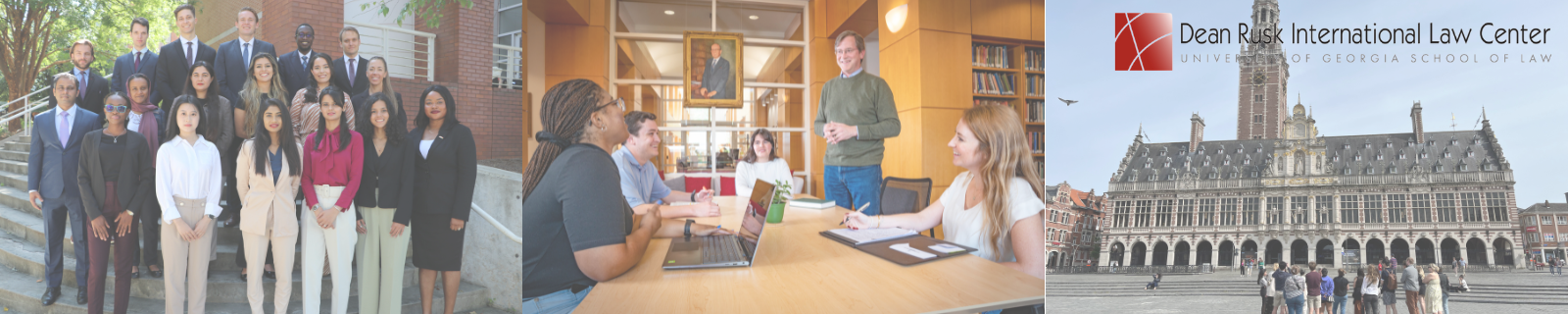
 This summer, twenty law students will earn practice experience through our Global Externship initiative. Most will be GEOs, or Global Externs Overseas, while a couple are GEAs, or Global Externs At-Home. Some will complement this experience with participation in our Global Governance Summer School in Belgium and the Netherlands.
Administered by our Dean Rusk International Law Center, University of Georgia School of Law, the decades-old Global Externship enables Georgia Law students to gain practice experience via placements at law firms, in-house legal departments, government agencies, and nongovernmental organizations around the world. Thanks to generous donations, virtually all Global Externs receive financial support from law school funds; a few receive funds from their placement. (Posts about last year’s Global Externs here and here.)
This year’s class of rising 2Ls and 3Ls will work in Africa, North America, Asia, Europe, and the Middle East. The class includes twelve students in business-law placements, in practice areas including intellectual property, finance, environment, and trade:
► Taryn Arbeiter, U.S. Court of International Trade, New York, New York
► Casey Callahan – Buse Heberer Fromm, Frankfurt, Germany
► James Cox – PSA Legal, New Delhi, India
► Nicholas Duffey – GÖRG, Cologne, Germany
► Brian Griffin – PwC, Milan, Italy
► Karen Hays – Fererro, Luxembourg
► Matt Isihara – MV Kini, New Delhi, India
► George Ligon – PwC, Milan, Italy
► Nils Okeson – Maples Teesdale, London, England
► Matt Poletti – Araoz & Rueda, Madrid, Spain
► Nicholas Steinheimer – PSA Legal, New Delhi, India
► Ezra Thompson – Al Tamimi & Co., Dubai, United Arab Emirates
The remaining eight students will be in public interest law placements, working on issues such as international criminal law, international child law, and international human rights:
► Jeremy Akin – Research Assistant for Professor William A. Schabas, Middlesex University, London, England
► Lauren Brown – War Child, Amsterdam, The Netherlands
► Jennifer Cotton – Global Coalition to Protect Education from Attack / Human Rights Watch, New York, New York
► Wade Herring – Open Society Justice Initiative, The Hague, The Netherlands
► Zack Lindsey – Women in Law and Development in Africa, Accra, Ghana
► Lyddy O’Brien – No Peace Without Justice, Brussels, Belgium
► Azurae Orie – Global Coalition to Protect Education from Attack / Human Rights Watch, remote research from Athens, Georgia
►Rebecca Wackym – Legal Unit of the Hebron Rehabilitation Committee, Israel
Join us in congratulating them on their success and wishing them a great summer!
 A leading Georgia Law
  exchange of notes