This symposium invited Catholic, Protestant, and Orthodox scholars to present and discuss papers debating and discussing the role of natural rights in their theological and legal traditions. The papers will be published in the American Journal of Jurisprudence (Oxford University Press).
Chapman currently serves as the law school’s associate dean for faculty development and holds the Cleveland Distinguished Chair of Law. He writes and teaches about constitutional law, especially constitutional rights, and law and religion. Most recently, he is the author, with Michael W. McConnell, of Agreeing to Disagree: How the Establishment Clause Promotes Religious Pluralism and Protects Freedom of Conscience (OUP, 2023).
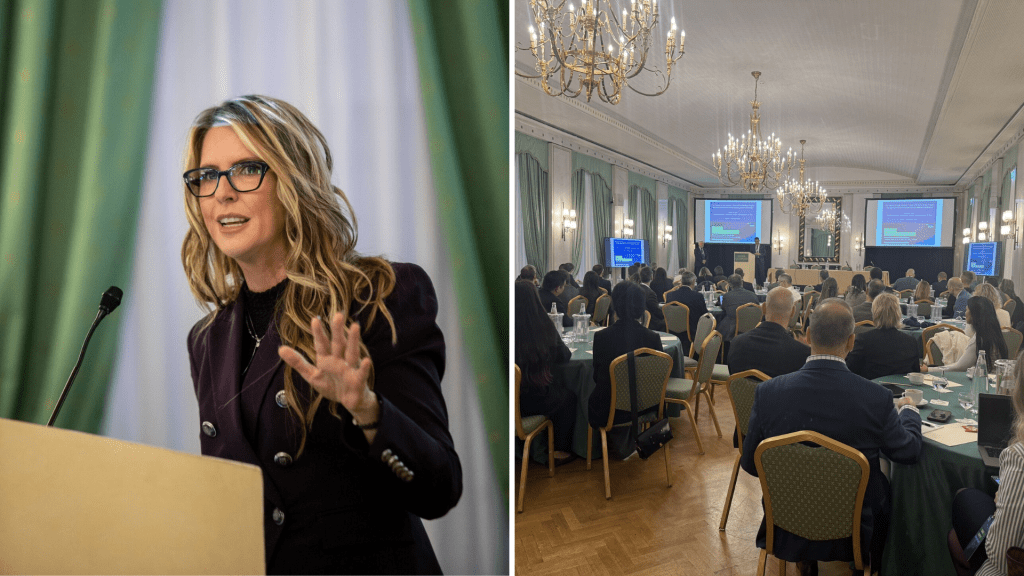
University of Georgia School of Law Professor Victoria J. Haneman recently spoke at the RSM Global Legal Conference in Rome, Italy. Her presentation was titled “The Relationship Between Universities and Lawyers” and it explored how law firms can maximize their relationships with local universities in today’s shifting landscape of AI disruption and hyper-politicization.
Haneman joined the University of Georgia School of Law in the fall of 2025 as the holder of the Verner F. Chaffin Chair in Fiduciary Law. Haneman comes to UGA from Creighton University, where she was a member of the law school’s faculty for seven years. In 2023, she was appointed the associate dean for research and innovation. She also held the Frank J. Kellegher Professorship of Trusts & Estates and served as the interim director of the health law program for the 2023-24 academic year. Haneman has a particular interest in tax policy, death care services, industry disruption, emerging markets, and women and the law.
University of Georgia School of Law Professor Christopher Bruner presented “Value Chain Due Diligence and Populist Politics” at the University of Turin in Italy earlier this month. The seminar was co-hosted by the Department of Law and the Department of Economics and Statistics, with Roberto Caranta, Professor, Department of Law, and David Monciardini, Assistant Professor, Department of Economics and Statistics, serving as discussants. The audience included faculty and Ph.D. students.
Bruner is the Stembler Family Distinguished Professor in Business Law at the University of Georgia School of Law and serves as a faculty co-director of the Dean Rusk International Law Center.
University of Georgia School of Law Professor Christopher Bruner presented the keynote address for a symposium titled “Sustainability is (Still) Possible! Governing Market Actors for a Safe and Just Space” at the University of Turin (Italy) in September. Bruner’s keynote was titled “Corporate Sustainability and Anti-ESG Backlash” and the symposium was co-sponsored by Turin’s Department of Law and Department of Economics and Statistics.
Bruner is the Stembler Family Distinguished Professor in Business Law at the University of Georgia School of Law and serves as a faculty co-director of the Dean Rusk International Law Center.
Thomas E. Kadri, Assistant Professor of Law at the University of Georgia School of Law, recently spent several weeks as a fellow at the European University Institute (EUI) in Florence, Italy. His experience abroad was made possible by a Sarah H. Moss Fellowship, which “provide[s] funds for travel and related expenses for tenure-track faculty of the University of Georgia (Athens) pursuing advanced scholarship, research, and study in institutions of higher learning abroad and in the United States.” Kadri also received financial support from the Dean Rusk International Law Center as a Rusk Scholar-in-Residence, which promotes international opportunities for Georgia Law faculty that advance the mission of the Center.
In his guest post below, Kadri reflects on his time abroad, which he calls “a tremendous professional and personal experience that enriched [his] scholarly research, broadened [his] comparative understanding of legal education and academic culture, and helped [him] build meaningful relationships with scholars from across Europe and beyond.”
One of the most formative aspects of my fellowship was my participation in a seminar series titled Thinking Infrastructurally, organized by Professor Thomas Streinz. This series, which brought together researchers working across disciplines, focused on how legal scholars might better engage with insights from infrastructure studies. The seminar explored fundamental conceptual questions—how infrastructures differ from platforms, systems, or networks; how infrastructures are regulated and how they might themselves serve as regulatory tools; and how legal scholars can incorporate infrastructural thinking into normative, doctrinal, and empirical work.
Each of the three sessions I attended provided new perspectives and provocations that will shape my future research. The first session emphasized methodology, asking how legal academics might attend to “relations, processes, and imaginations” across technical, organizational, and social dimensions. The second session turned to digital infrastructures, grappling with questions such as: What is gained by viewing platforms as infrastructures—or infrastructures as platforms? What kinds of regulatory possibilities emerge when code is conceptualized as an architectural or infrastructural force? These questions dovetail with my own interests in digital platforms and online speech governance. The final session featured doctoral students presenting posters based on their projects, offering a chance to reflect on visual, material, and speculative methods for representing infrastructures and their effects.
These sessions were intellectually generative and expanded my scholarly toolkit in unexpected ways. I have long studied the regulation of online platforms, but the seminar invited me to reframe these inquiries through an infrastructural lens. This framing has already begun to shape my current writing on the regulation of deepfakes and may form the basis of future scholarly collaborations.
Workshop Participation and Interdisciplinary Dialogue
In addition to the seminar series, I participated in a workshop titled Entangled Concerns, Uncertain Futures: Law and Politics in the Making of Infrastructures, which brought together scholars and artists to discuss the construction and contestation of infrastructures. This experience was inspiring for my own work on deepfake harms and regulatory responses, helping me situate these concerns within the broader question of how legal systems should respond to emerging technologies whose boundaries and risks are often unstable. The workshop featured excellent presentations, including a memorable artifact-based presentation by the Indonesian artist Elia Nurvista, whose piece Long Hanging Fruits: Myth and Matter on Palm Oil Complex invited participants to think materially and historically about infrastructures of extraction and trade.
These discussions reaffirmed the value of interdisciplinarity in legal scholarship and encouraged me to think more creatively about the empirical and theoretical frames I use in my own research. They also exposed me to new voices and methods, enhancing my appreciation of the ways law is entangled with political economy, cultural meaning, and technological development.
Contributing to the Scholarly Community: Mentorship and Outreach
While at the EUI, I was also pleased to contribute to the intellectual life of the doctoral program by organizing and hosting a workshop titled How to Publish in U.S. Law Reviews. This session was aimed at EUI’s graduate students and demystified the odd publication process that defines American legal scholarship. The workshop served not only as a chance to offer mentorship but also to reflect on the institutional and cultural differences between U.S. and European approaches to legal scholarship. It deepened my appreciation for the rich diversity of scholarly styles across jurisdictions and highlighted the structural barriers that non-U.S. scholars often face when trying to enter the American legal academy. I left the session with a renewed commitment to making space for more international voices in U.S. legal publications and a network of aspiring scholars whose work I hope to support going forward.
Advancing Research and Building Collaborations
The EUI fellowship provided the intellectual space and community support that allowed me to make significant progress on my writing. While in residence, I began working on a forthcoming article coauthored with University of Georgia School of Law Professor Sonja West titled Deepfake Torts: Emerging Tort Frameworks in U.S. Deepfake Regulation. The piece, which will appear later this year in the peer-reviewed Journal of Tort Law, explores how various tort doctrines are being adapted to address the novel harms posed by synthetic media. Although the article is grounded in U.S. law, many of the insights I developed during my time at EUI—particularly those drawn from discussions about infrastructure and transnational platform governance—shaped how I framed the legal challenges at stake.
I also held multiple one-on-one meetings with Professor Thomas Streinz, a fellow legal scholar based at EUI who shares my interest in platform regulation, data governance, and comparative digital policy. These conversations were productive and inspiring. In addition, I had the pleasure of meeting repeatedly with Adi Mansour, a Palestinian LL.M. student whose work on censorship and surveillance by state and corporate actors in Palestine and Israel offered sobering insights into how infrastructure—both digital and political—can become a tool of domination and control.
Broader Benefits and Institutional Impact
Beyond these specific accomplishments, the fellowship helped me develop a more global perspective on legal education, research, and academic culture. Engaging with European scholars—many of whom approach legal questions from sociolegal or historical perspectives less common in the United States—challenged some of my assumptions and introduced me to new bodies of literature. I gained a clearer sense of how European doctoral training operates, how interdisciplinary work is structured, and how faculty balance research with mentorship in different institutional settings. These insights will inform my own mentorship of students and contribute to ongoing conversations within my home institution about graduate training and international engagement.
The fellowship also strengthened institutional ties between my university and EUI. I encouraged several doctoral students to consider applying for visiting opportunities in the United States and hope to maintain long-term scholarly relationships with several of the colleagues I met. In this way, the benefits of the fellowship extend beyond my own development and offer pathways for future collaboration and exchange.
***
For more information about the Rusk Scholar-in-Residence initiative, please email Sarah Quinn, Director, Dean Rusk International Law Center: squinn@uga.edu
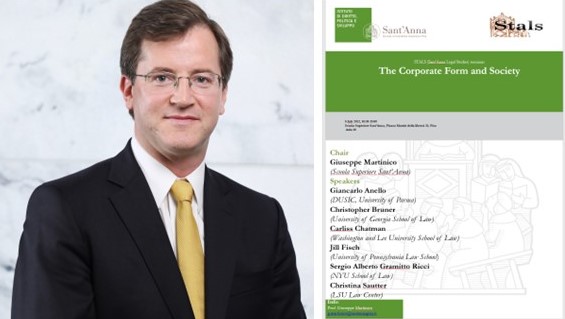
Christopher M. Bruner, the Stembler Family Distinguished Professor in Business Law here at the University of Georgia School of Law, presented Friday at “The Corporate Form and Society,” a seminar at the Sant’Anna School of Advanced Studies in Pisa, Italy.
Also speaking at the panel, which was chaired by Sant’Anna Professor Giuseppe Martinico, were legal scholars from the University of Parma in Italy and Washington and Lee University, University of Pennsylvania, New York University, and Louisiana State University in the United States.
Christopher M. Bruner, the Stembler Family Distinguished Professor in Business Law here at the University of Georgia School of Law, delivered a 3-hour seminar online yesterday to students in the PhD Programmes in Legal Sciences and Law and Innovation at the University of Macerata in Italy.
The seminar’s title, “The Corporation as Technology: Re-Calibrating Corporate Governance for a Sustainable Future,” is also the provisional title of Bruner’s forthcoming Oxford University Press book.
Bruner was introduced by Alessio Bartolacelli, who holds the Jean Monnet Business Law Chair in the European Union and Sustainable Economy at Macerata.
Pleased today to welcome a contribution from Kent Barnett(near right), J. Alton Hosch Associate Professor of Law here at the University of Georgia School of Law. He reprises his recent Yale Journal on Regulation blog post; it summarizes the forthcoming article,Chevron Abroad, which he co-authored with Georgia Law 3L Lindsey Vinson (above right). An expert on administrative law and related areas—at times using comparative approaches—Professor Barnett’s previous Exchange of Notes contribution is here.
The Kids Will Be Alright—How comparative study can inform U.S. judicial review of agency statutory interpretation
Chevron deference—the U.S. doctrine that calls for courts to defer to reasonable agency statutory interpretations—is under siege. A majority of current U.S. Supreme Court Justices have, at one time or another, expressed concern over its domain, operation, or very existence. Two state courts in the U.S. have overruled their state-law equivalents. Some welcome Chevron’s demise as an antidote to an ever-encroaching administrative state that chafes at statutory limits to authority. Others view Chevron’s internment as nothing but a judicial power grab in the face of ideological hostility to an effective administrative state. For my part, my past research co-authored with Dr. Christy Boyd and Professor Chris Walker suggests that—whatever its downsides—Chevron deference has the benefit of muting ideological judicial behavior. This muting can further national uniformity in lower court decisions concerning agency statutory interpretation.
But is the angst surrounding Chevron worth it? Do we really need to worry that administrative agencies will eventually consume all our liberty if Chevron continues or that the American bureaucracy will become an ineffective wasteland if Chevron ends? Moreover, even those not taken to hyperbolic worry have argued, to varying degrees, that Chevron deference is inevitable—whatever its drawbacks.
To evaluate whether Chevron or something like it exists or is absent in other stable democracies, my co-author, Lindsey Vinson, and I considered judicial review of agency statutory interpretation in five other countries in Chevron Abroad, our forthcoming article in the Notre Dame Law Review. Although we would have liked to see how countries with a presidential system like that of the United States behave, that system is rare, especially among mature legal systems. Instead, we looked at 5 parliamentary systems. These included countries with separation of powers guaranteed in written constitutions, with civil-law legal systems, and with federal systems. Among the countries studied were Germany, Italy, the United Kingdom, Canada, and Australia.
Based on our study, we cannot say that Chevron or something like it is inevitable. Only one of the countries that we studied had a doctrine similar, if not more expansive than, Chevron. One has rejected deference altogether, and one has rejected Chevron specifically in dicta. The others, at best, had some small space for deferring to agency interpretations. This variation among these major legal systems also suggests that the existence or absence of something like Chevron does not mean the end of either democracy or an effective bureaucracy. After all, citizens in both Canada—with a strong form of deference—and Germany—without one—have strong confidence in their governments. Of course, we cannot say that any of these systems are operating optimally, but we can say that Chevron existence or absence alone does not appear as significant as the U.S. administrative law cognoscenti often suggests.
In brief, here’s the variation that we found in our study:
Germany. Influenced by its conscious concern over the relationship between judicial abdication and its Nazi past, Germany has its own 2-step deference doctrine that has a much more limited domain than Chevron. Deference in Germany is significantly limited to certain technical, scientific, or economic matters that the legislature has delegated to the agency.
Italy. Italy has had tumultuous doctrinal shifts in the past few decades. As it stands, it has rejected judicial deference altogether when reviewing agency statutory interpretations. But it sends contradictory signals occasionally.
United Kingdom. For decades, the UK has rejected judicial deference to agency statutory interpretation, after having a doctrine similar to Chevron. Although it defers in some instances for “special” matters decided by entities that U.S. law would characterize as agencies, its limited deference arises under its law on charities.
Canada. Canadian judicial review comes the closest to Chevron, with a highly functional, contextual inquiry into whether deference is appropriate for statutory provisions that can support more than one reasonable interpretation. Canada has applied deference even to questions that implicated constitutional or common-law matters.
Australia. Finally, Australia’s High Court expressly rejected Chevron in dicta. Nonetheless, Australia continues to have a very limited, rarely applied doctrine somewhat similar to Chevron when statutes expressly give agencies exclusive jurisdiction and limit judicial review.
Our study also provides insight on how U.S. courts—whether or not they prefer Chevron—could go about improving Chevron in a way that is more consistent with its theoretical grounding.
For instance, Chevron, like other countries’ deference doctrines, is grounded primarily on notions of legislative delegation and expertise. Chevron relies primarily upon ambiguity in a statute that the agency administers to signal legislative delegation. But the presence of statutory ambiguity somewhere in a statute is not the most direct way of assessing either actual delegation or agency expertise on the matter at issue. Germany focus on expertise. German courts permit deference only in limited circumstances—for certain scientific, economic, or technical matters—as a way of ensuring that deference adheres only to matters in which the agency has likely epistemological advantage over courts. Australia has its limited Hickman deference doctrine that requires that the legislature signal its intent with two statutory clauses that it wants agencies (or inferior courts) to have interpretive primacy over the matter at issue. By doing so, Hickman requires a more direct, although not express, signal of legislative delegation than Chevron. These approaches in other countries suggest how Chevron could better ground itself on its theoretical foundations.
We hope that our article will lead more American scholars to consider how other countries approach administrative law matters. Doing so not only provides examples of possible improvements to the American administrative state, but it also helps lower the temperature of academics and judges who worry over the current or future state of Chevron deference.
In the weeks ahead, 13 rising 2L and 3L students at the University of Georgia School of Law will depart for Global Externship Overseas (GEO) and Global Externship At Home (GEA) placements all around the world. Administered by the Dean Rusk International Law Center, the GEO and GEA initiatives place Georgia Law students in externships lasting between four and twelve weeks, and offer students the opportunity to gain practical work experience in a variety of legal settings worldwide.
This summer, GEO students will undertake placements in law firms, in-house legal departments, nongovernmental organizations, and intergovernmental organizations across Europe, Asia, and the Pacific. Practice areas include: dispute resolution, corporate law, international trade law, intellectual property law, international human rights law, refugee law, cultural heritage law, and international environmental law.
This year’s GEO class includes the following students, who will complete placements in private law settings:
Additionally, the following students will work in public interest law placements:
Zoe Ferguson (2L) – War Child, Amsterdam, Netherlands
Drew Hedin (2L) – Secretariat of the Pacific Regional Environment Programme, Apia, Samoa
Hanna Karimipour (2L) – No Peace Without Justice, Brussels, Belgium
Matt Isihara (3L) – Boat People SOS, Bangkok, Thailand
Devon Pawloski (2L) – Documentation Centre of Cambodia, Phnom Penh, Cambodia
Frances Plunkett (2L) – Open Society Justice Initiative, The Hague, Netherlands
Last, but certainly not least, two students will undertake GEA placements in Washington, D.C.:
Casey Callahan (3L) — International Trade Administration, U.S. Department of Commerce
Caroline Harvey (2L) – The Antiquities Coalition
Finally, during the first ten days of July, eight Georgia Law students will gather in Leuven, Belgium for the Global Governance Summer School, which the Center again co-presents with the Leuven Centre for Global Governance Studies. Students will spend several days in classroom sessions at Leuven, and then spend two days in Brussels: one to attend a high-level policymaking event, and the other on professional development visits at a law firm, a nongovernmental organization, and an intergovernmental organization. The group will then proceed to The Hague, Netherlands, for several days of briefings at international courts and tribunals and other cultural excursions.
Join us in wishing these students an unforgettable summer, and stay tuned for travel updates in the coming months!
This summer, twenty law students will earn practice experience through our Global Externship initiative. Most will be GEOs, or Global Externs Overseas, while a couple are GEAs, or Global Externs At-Home. Some will complement this experience with participation in our Global Governance Summer School in Belgium and the Netherlands.
Administered by our Dean Rusk International Law Center, University of Georgia School of Law, the decades-old Global Externship enables Georgia Law students to gain practice experience via placements at law firms, in-house legal departments, government agencies, and nongovernmental organizations around the world. Thanks to generous donations, virtually all Global Externs receive financial support from law school funds; a few receive funds from their placement. (Posts about last year’s Global Externs here and here.)
This year’s class of rising 2Ls and 3Ls will work in Africa, North America, Asia, Europe, and the Middle East. The class includes twelve students in business-law placements, in practice areas including intellectual property, finance, environment, and trade:
► Taryn Arbeiter, U.S. Court of International Trade, New York, New York
► Casey Callahan – Buse Heberer Fromm, Frankfurt, Germany
► James Cox – PSA Legal, New Delhi, India
► Nicholas Duffey – GÖRG, Cologne, Germany
► Brian Griffin – PwC, Milan, Italy
► Karen Hays – Fererro, Luxembourg
► Matt Isihara – MV Kini, New Delhi, India
► George Ligon – PwC, Milan, Italy
► Nils Okeson – Maples Teesdale, London, England
► Matt Poletti – Araoz & Rueda, Madrid, Spain
► Nicholas Steinheimer – PSA Legal, New Delhi, India
► Ezra Thompson – Al Tamimi & Co., Dubai, United Arab Emirates
The remaining eight students will be in public interest law placements, working on issues such as international criminal law, international child law, and international human rights:
► Jeremy Akin – Research Assistant for Professor William A. Schabas, Middlesex University, London, England
► Lauren Brown – War Child, Amsterdam, The Netherlands
► Jennifer Cotton – Global Coalition to Protect Education from Attack / Human Rights Watch, New York, New York
► Wade Herring – Open Society Justice Initiative, The Hague, The Netherlands
► Zack Lindsey – Women in Law and Development in Africa, Accra, Ghana
► Lyddy O’Brien – No Peace Without Justice, Brussels, Belgium
► Azurae Orie – Global Coalition to Protect Education from Attack / Human Rights Watch, remote research from Athens, Georgia
►Rebecca Wackym – Legal Unit of the Hebron Rehabilitation Committee, Israel
Join us in congratulating them on their success and wishing them a great summer!




 Pleased today to welcome a contribution from
  In the weeks ahead, 13 rising 2L and 3L students at the University of Georgia School of Law will depart for
  This summer, twenty law students will earn practice experience through our
  exchange of notes