Georgia Law Professor Kannan Rajarathinam (LL.M. ’88) interviewed by Hindustan Times

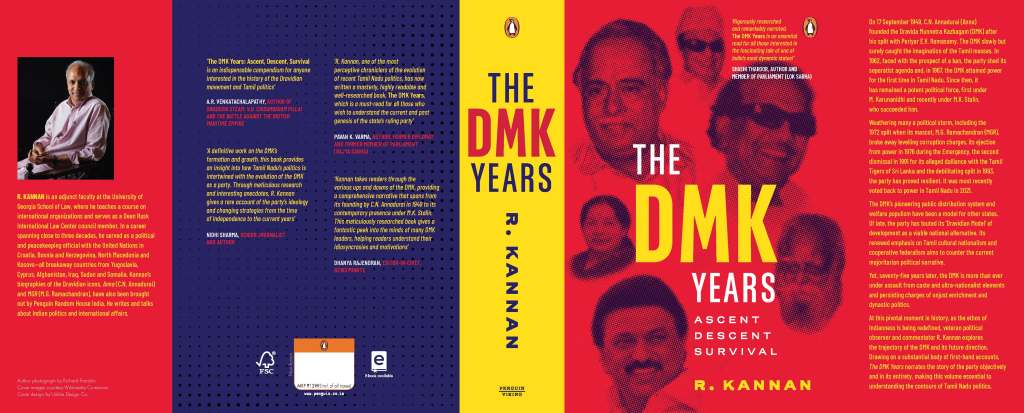
University of Georgia School of Law alumnus and adjunct professor Kannan Rajarathinam (LL.M. ’88) was interviewed in Hindustan Times about his new book, The DMK Years: Ascent, Descent, Survival (India Viking, 2024). The book will be available for purchase on November 15, 2024 in the United States.

The article titled “Unclear if the DMK is still the party of the modest or is for the modest” was written by Divya Chandrababu and was published on September 20.

Below is the introduction to the interview:

Political commentator and author R. Kannan recently launched his book, ‘The DMK Years: Ascent, Descent, Survival’ which is [an] account of the DMK’s journey, from its foundation in 1949 by CN Annadurai to its present-day prominence under Tamil Nadu Chief Minister MK Stalin. In an interview with Hindustan Times, the author speaks on the DMK’s 75th founding day and the Hindu assertion of the BJP that has forced the DMK to hold a conference for Murugan, the Hindu deity. Chief Minister Stalin’s son Udhayanidhi’s real test is a post-Stalin-phase, he says, adding that DMK’s strength is in its [organizational] base and a divided opposition, but if actor Vijay were to join forces with AIADMK or others, the ruling party might be in trouble for the 2026 assembly polls. 

The University of Georgia School of Law’s Dean Rusk International Law Center is hosting a book talk on Tuesday, November 19th for Rajarathinam. The conversation will be co-facilitated by Professor Laura Phillips-Sawyer of Georgia Law and Dr. Laura Zimmermann of the School of Public and International Affairs. This event is part of International Education Week, a joint initiative of the U.S. Department of State and the U.S. Department of Education, an effort to promote programs that prepare Americans for a global environment and celebrate the benefits of international education.

Kannan Rajarathinam is an adjunct professor at the University of Georgia School of Law teaching a course on International Organizations. Between 1993 and 2022, he served the United Nations in various capacities, including senior political affairs officer, head of office, senior planning and coordination officer, chief civil affairs officer, and legal officer from Afghanistan to Bosnia and Herzegovina. Before joining the UN, he briefly taught at the University of Madras in India as a guest faculty member and junior professor and practiced law. Presently, he serves on the Dean Rusk International Law Center Advisory Council.
Georgia Law Professor Kannan Rajarathinam (LL.M. ’88) publishes book

University of Georgia School of Law alumnus and adjunct professor Kannan Rajarathinam (LL.M. ’88) recently published a book, The DMK Years: Ascent, Descent, Survival (India Viking, 2024). The ‘DMK Years’ tells the story of how India’s democracy has accommodated the cultural nationalist aspirations of the Tamils. It also tells the seventy-five-year story of the DMK and the state of Tamil Nadu, once separatist but now India’s second-most prosperous state.      

Below is a full description of the book:

India has twenty states and eight union (federal territories). In April 2023, it became the world’s most populated country. It has 22 official languages, numerous ethnicities and people of all faiths.  

Uniting a country as vast and diverse as India is a herculean task. However, India’s democracy, which was adopted after the 1947 Partition, has shown remarkable resilience. The country’s quasi-federal constitution was designed with unity in mind, recognizing and valuing the diverse population as a key component of its unity.

Yet, India’s unity has not been without its challenges. The restive border states of Kashmir and Punjab are well known. However, there have been other less well-known challenges to the Indian Union. One such was from Tamil Nadu, the southernmost state where the sub-nationalist Dravida Munnetra Kazhagam (DMK) or Dravidian Progressive Federation espoused separation since its founding in 1949.

As the DMK grew into a significant political force, the Indian Centre brought forward the Sixteenth Amendment to the Constitution in 1962, banning any secessionist advocacy—even by peaceful means. The DMK dropped its demand and, in five years, became the ruling party in the state of Tamil Nadu. Since then, it has alternated in power there with its breakaway party, the All India Anna DMK, and has been part of the federal coalition for eighteen years.

The ‘DMK Years’ tells the story of how India’s democracy has accommodated the cultural nationalist aspirations of the Tamils. It also tells the seventy-five-year story of the DMK and the state of Tamil Nadu, once separatist but now India’s second-most prosperous state.      

Kannan Rajarathinam is an adjunct professor at the University of Georgia School of Law teaching a course on International Organizations. Between 1993 and 2022, he served the United Nations in various capacities, including senior political affairs officer, head of office, senior planning and coordination officer, chief civil affairs officer, and legal officer from Afghanistan to Bosnia and Herzegovina. Before joining the UN, he briefly taught at the University of Madras in India as a guest faculty member and junior professor and practised law. Presently, he serves on the Dean Rusk International Law Center Advisory Council.

Kannan Rajarathinam (LL.M., ’88) speaks about the future of the United Nations at UGA Law

University of Georgia School of Law alumnus Dr. Kannan Rajarathinam (LL.M., ’88) spoke to students last week about the future of the United Nations in a multipolar world in a lecture entitled, “The UN at a Crossroads.”

Rajarathinam used his decades of experience working at the UN to frame his central question of what lies ahead for the international organization. Founded in 1945, the UN’s main focus over the past 80 years has remained the same: to provide all nations with the opportunity to work together to find shared solutions to shared challenges. From supporting refugees to providing food and vaccines globally, the UN has many ongoing campaigns that realize this vision.

One area where he felt the UN had been particularly successful is in building awareness of and consensus around the global challenge of climate change. He noted that the UN has led over twenty conferences on climate change, and, as a direct result of their commitment to this topic, climate security is a top concern for many western nations. Although there is still much work to be done, Rajarathinam stated that shared solutions, like a fund being developed to aid the Global South in managing the disproportionately-felt effects of climate change and technology-sharing to establish renewable energy systems worldwide, are more likely to find consensus due to the inclusive design of the UN.

There are many challenges to the UN’s role in the new multipolar landscape, including the emergence of regionally-focused forums like BRICS and the G20, international development initiatives like China’s Belt and Road Initiative, and ongoing conflicts like Russia’s invasion of Ukraine and the Israel-Hamas war. Rajarathinam believes that the ability of the UN to offer all 193 Member States from India to Nauru an equal vote is its main strength in withstanding this contemporary power shift. He concluded his talk by observing that, now that we are entering into a multipolar global landscape, no one country has the ability to control history anymore – and that, as a result, the world will be more colorful.

After his afternoon lecture, Rajarathinam met with current LL.M. students to discuss his career in the UN. Students shared their backgrounds and professional aspirations and were able to get advice from Rajarathinam and his wife, Usha.

Rajarathinam recently retired after nearly three decades of UN peace keeping and political work in the former Yugoslavia, Cyprus, Afghanistan, Iraq, Sudan and Somalia. Prior to the UN, he briefly practiced and taught law in India. A commentator of international and political affairs in India, he is the author of two political biographies of Indian leaders and his next work, on the political history of his state of Tamil Nadu in India is due next summer.