The panel focused on concerns about the second Trump administration’s impact on the international legal order, including U.S. engagement with international bodies and the potential effects on areas such as international criminal law and human rights law.
LeClercq also moderated the panel “Teaching Human Rights: From Specialized Courses to Doctrinal Integration”, which explored innovative approaches to teaching human rights, including strategies for standalone courses and ways to integrate human rights perspectives into first-year doctrinal courses and other core parts of the law school curriculum.
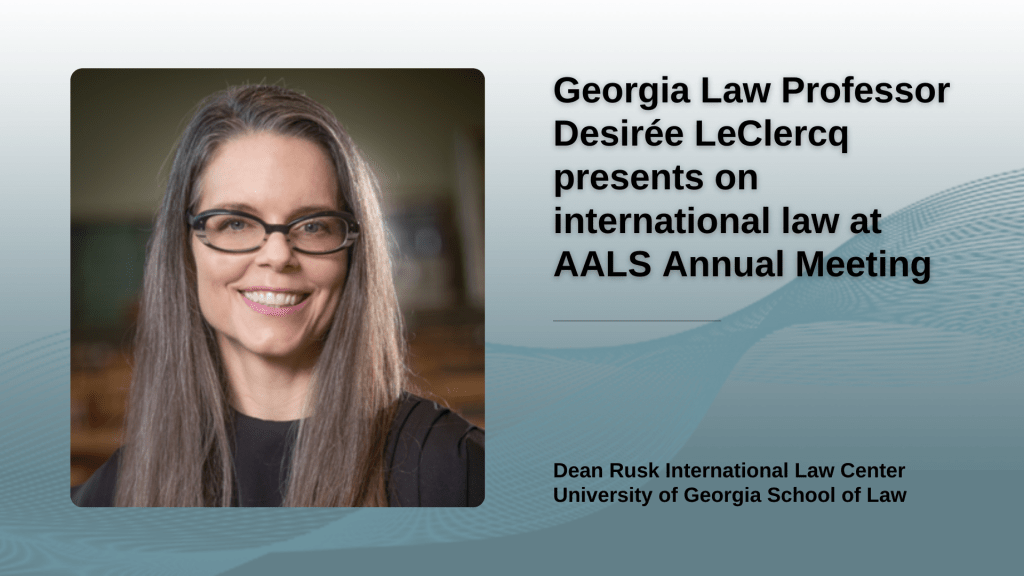
LeClercq joined the University of Georgia School of Law in 2024 as an assistant professor. She teaches Contracts, International Trade and Workers Rights, International Labor Law, U.S. Labor Law, and Public International Law. She also serves as a faculty co-director of the Dean Rusk International Law Center and as the faculty adviser for the Georgia Journal of International and Comparative Law and the Labor and Employment Student Association.
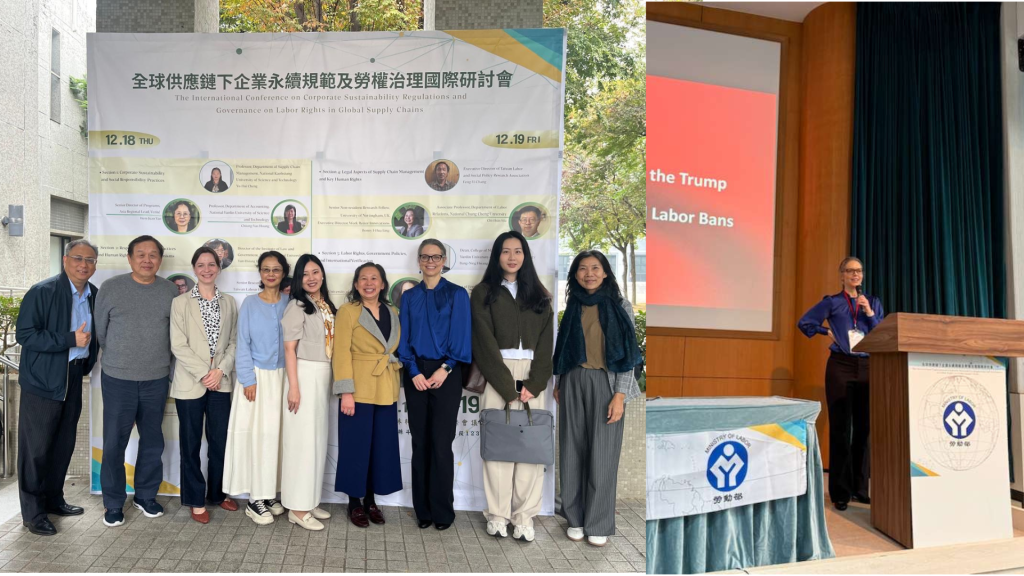
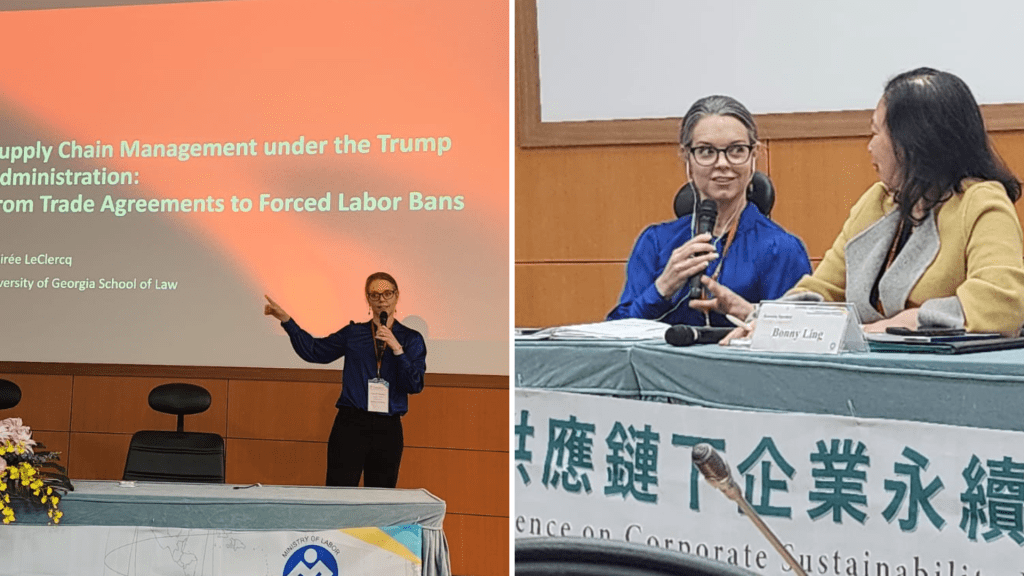
University of Georgia School of Law Professor Desirée LeClercq delivered a keynote address at the International Conference on Corporate Sustainability Regulations and Governance on Labor Rights in Global Supply Chains, held in Douliu, Taiwan, on 19 December 2025.
Her keynote, “Supply Chain Management under the Trump Administration: from Trade Agreements to Forced Labor Bans,” examined how shifting U.S. trade policy and enforcement tools shape corporate supply chain strategy, with a focus on labor rights compliance and emerging forced labor restrictions. A short video from her time in Taiwan was shared in an Instagram reel.
LeClercq joined the University of Georgia School of Law in 2024 as an assistant professor. She teaches Contracts, International Trade and Workers Rights, International Labor Law, U.S. Labor Law, and Public International Law. She also serves as a faculty co-director of the Dean Rusk International Law Center and as the faculty adviser for the Georgia Journal of International and Comparative Law and the Labor and Employment Student Association.
University of Georgia School of Law Professor Desirée LeClercq recently delivered a presentation for the Foreign, Commonwealth & Development Office’s Trade & Economic Diplomacy Faculty entitled “Growing Employment Through Trade: The Role of Fair Labour Standards.”
LeClercq discussed the evolution of international labor standards, noting how rules once designed to protect workers and improve living conditions are now used by countries such as the United States to enforce rights abroad and reshape global supply chains. Drawing on her experience as director of labour affairs at the Office of the U.S. Trade Representative and as a legal officer at the International Labour Organization, she illustrated this trend through examples from the United States-Mexico-Canada Agreement (USMCA).
LeClercq joined the University of Georgia School of Law in 2024 as an assistant professor. She teaches Contracts, International Trade and Workers Rights, International Labor Law, International Law and U.S. Labor Law, and Public International Law. She also serves as a faculty co-director of the Dean Rusk International Law Center and as the faculty adviser for the Georgia Journal of International and Comparative Law.
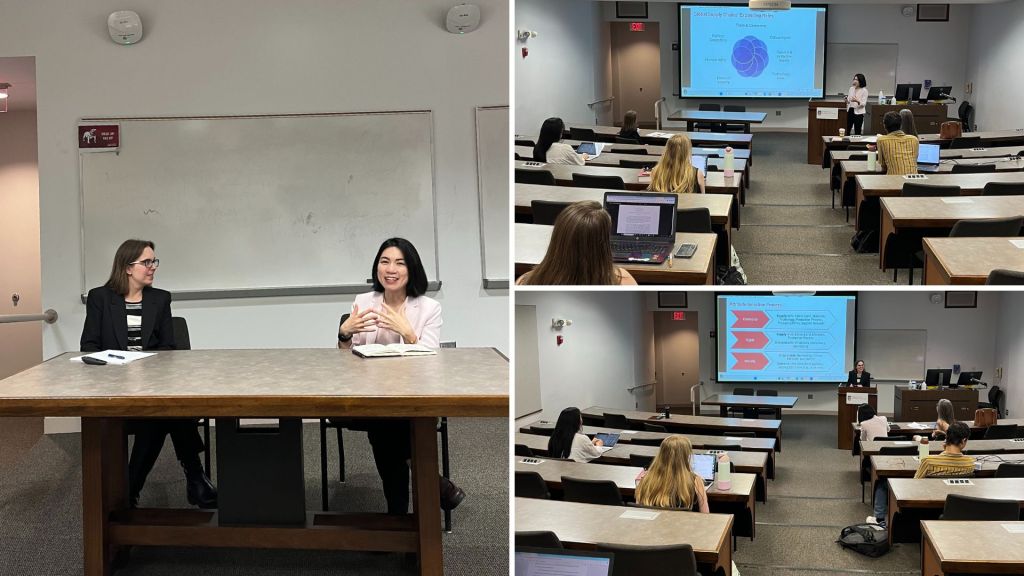
University of Georgia School of Law Professor Desirée LeClercq and former U.S. diplomat Christina Hardaway discussed their career trajectories and experiences working internationally in a recent law school panel discussion, “Working in Public International Law and Diplomacy.”
After introducing themselves and outlining their academic and professional paths, LeClercq and Hardaway took questions from the audience. They talked about the importance of soft skills in diplomatic work, how to develop your expertise in domestic affairs to make yourself more marketable overseas, the challenges of living abroad, and detailed both the rewards and complexities of committing to a career in public service.
Hardaway is a former diplomat (Foreign Service Officer) for the U.S. Department of State with a 14-year career spanning Latin America, Europe, and Africa. She most recently completed a diplomatic assignment at the U.S. Consulate General in Nuevo Laredo, Mexico, where she advanced U.S. economic, security, and commercial priorities on the U.S.-Mexico border. Prior to that, Hardaway served as Deputy Chief of the Political-Economic Section at the U.S. Embassy in Cameroon leading the mission’s economic and commercial portfolio. Her previous assignments include gender and entrepreneurship officer in the Bureau of African Affairs, energy and environment officer at the U.S. Embassy in The Hague, consular officer at the U.S. Consulate General in Monterrey, Mexico, and a detail at the U.S. African Development Foundation.
LeClercq joined the University of Georgia School of Law in 2024 as an assistant professor. She teaches Contracts, International Trade and Workers Rights, International Labor Law, International Law and U.S. Labor Law, and Public International Law. She also serves as a faculty co-director of the Dean Rusk International Law Center and as the faculty adviser for the Georgia Journal of International and Comparative Law. From 2016 to 2020, she served as a director of labor affairs in the Office of the U.S. Trade Representative (USTR). Before joining USTR, LeClercq worked for nearly a decade as a legal officer at the International Labor Organization in Geneva, Switzerland, and served as staff counsel for the chairman of the National Labor Relations Board.
This event was part of the Dean Rusk International Law Center’s ongoing Consular Series, which presents students, staff, and faculty with global perspectives on international trade, cooperation, development, and policy.
University of Georgia School of Law Professor Desirée LeClercq recently organized and funded (through a grant won at Cornell University) a transnational conference of U.S., Mexican, and Canadian labor unions and leaders at Flacso Mexico in Mexico City. Patricia Campos-Medina (WI-ILR Cornell University), Alex Covarrubias (El Colegio de Sonora), and Cirila Quintero (El Colegio de la Frontera Norte) served as conference co-organizers.
This one-day transnational labor conference solicited the views of labor unions, non-governmental organizations (NGOs), organizers, and workers on the United States-Mexico-Canada Agreement (USMCA)’s Rapid Response Mechanism (RRM) in light of current geopolitical dynamics. Participants identified current challenges in filing petitions under the RRM, aligned strategic approaches to the 2026 re-negotiation of the USMCA, and discussed ways to work together notwithstanding current tensions in politics and trade. The conference was structured to first discuss the RRM on a technical level before broadening to account for political tensions and joint transnational strategies. It concluded with ways participants could remain organized and collaborate in the future.
LeClercq joined the University of Georgia School of Law in 2024 as an assistant professor. She teaches International Trade and Workers Rights, International Labor Law, International Law and U.S. Labor Law. She also serves as a faculty co-director of the Dean Rusk International Law Center and as the faculty adviser for the Georgia Journal of International and Comparative Law.
Convened by the Remaking Trade Project (RTP) and co-hosted by the Centre for Trade and Economic Integration (CTEI), this workshop brought together a diverse range of researchers, economists, legal experts and policy advocates to explore the creation of a dedicated research stream as part of the RTP. Their stated goal is “…to continue strengthening the intellectual foundations of the trade-sustainability agenda, while also responding to a rapidly changing trade landscape in ways that are agile, inclusive, and impactful.”
Over twenty-five colleagues joined the day of interactive roundtables, from over 20 global institutions and/or countries, drawing from participants of the RTP’s work to date.
LeClercq received financial support to attend this workshop from the Dean Rusk International Law Center as a Rusk Scholar-in-Residence, an initiative promoting international opportunities for Georgia Law faculty that advance the mission of the Center.
LeClercq joined the University of Georgia School of Law in 2024 as an assistant professor. She teaches International Trade and Workers Rights, International Labor Law, International Law and U.S. Labor Law. She also serves as a faculty co-director of the Dean Rusk International Law Center and as the faculty adviser for the Georgia Journal of International and Comparative Law.
University of Georgia School of Law Professor Desirée LeClercq served as a panelist in the virtual discussion “Inequalities and Violence at Sea.” This panel, moderated by Furaha Joy Sekai Saungweme and Costanza Hermanin, was part of a webinar series hosted by the Gender Justice and Harassment Working Group of UC Berkeley Law’s Center on Comparative Equality & Anti-Discrimination Law. The series was launched in recognition of the International Day for Women in Maritime, an annual observance on May 18 that highlights the contributions of women across the maritime industry.
LeClercq discussed her recent article, “Gender-Based Violence and Harassment at Sea”, which examines the Maritime Labour Convention (2006). She was joined by panelist Tim Springett, Policy Director of the United Kingdom Chamber of Shipping, as they explored the gendered dimensions of labor, safety, and inclusion in the maritime sector.
LeClercq joined the University of Georgia School of Law in 2024 as an assistant professor. She teaches International Trade and Workers Rights, International Labor Law, International Law and U.S. Labor Law. This semester, LeClercq is overseeing the International Law Colloquium, a for-credit course designed to introduce students to international economic law through engagement with scholars in the international legal field. She also serves as a faculty co-director of the Dean Rusk International Law Center and as the faculty adviser for the Georgia Journal of International and Comparative Law.
The University of Georgia School of Law’s spring 2025 International Law Colloquium recently hosted Temple Law’s Trang (Mae) Nguyen, who presented her working paper, “Goods’ Nationalities.” Pamela Foohey, Allen Post Professor of Law at Georgia Law, served as Nguyen’s faculty discussant.
Nguyen is an Associate Professor of Law at the Temple University Beasley School of Law and is an Affiliated Scholar at the U.S.-Asia Law Institute at the New York University School of Law. Her research focuses on business law, contracts, transnational law, and international law. Nguyen also previously held research appointments at the University of Hong Kong Faculty of Law, the National University of Singapore Centre for Asian Legal Studies, and the Singapore Management University Yong Pung How School of Law.
Below is an abstract of Nguyen’s working paper:
Products’ nationalities are at the center of today’s fast-changing global order. The Trump administration’s liberal use of tariffs against friends and foes, sanctions against Russian products, the banning of Chinese goods, and efforts to revitalize American manufacturing, to name just a few, all hinge on classifications of where a product is deemed “from.” But in today’s globalized economy, what exactly makes something “American” or “Chinese” or of any other nationality, for that matter?
This Article reexamines how goods acquire their designated nationalities at a time when such designation matters well beyond traditional commerce. It advances two main arguments. First, a product’s nationality is not fixed; rather, it is malleable and can vary depending upon the substantive legal regime under which the good is regulated—once predominantly trade law but now increasingly through a trade-security nexus and a trade-human rights nexus. Second, such malleability occurs through what I call an “attribute selection” process. In effect, each legal regime pivots the nationality analysis on certain “attributes” of a product, swapping and switching them as befit underlying interests and policy goals. The construction of product nationality thus occurs through mapping two separate sets of variables: first, the bundle of attributes of a product, and second, the “prisms” through which laws place significance on these attributes.
This Article makes several contributions. First, descriptively, it charts an updated account on product nationality’s expanded use, particularly in trade law’s nexus with national security and human rights. Second, conceptually, building on this updated descriptive account, it advances a novel framework—the attribute selection process—to unpack the making of product nationality. Third, normatively, it underscores how the need to use product nationality as proxy fits uneasily with the reality of global production, and how efforts to move away from nationality-based rules are likely vulnerable to similar challenges. Ultimately, while the Article makes clear that the concept of nationality is doing heavy lifting across various legal fields, it does not take a strong normative stand, opting instead to explain why taking a strong normative position is premature during fast evolving developments. Finally, the Article offers some practical considerations for policymakers, businesses, and other stakeholders as they consider product-nationality regulations going forward.
This year, Professor Desirée LeClercq is overseeing the colloquium, which is designed to introduce students to features of international economic law through engagement with scholars in the international legal field. To view the full list of International Law Colloquium speakers, visit our website.
This program is made possible through the Kirbo Trust Endowed Faculty Enhancement Fund and the Talmadge Law Faculty Fund.
LeClercq’s article highlights the pervasive gender-based violence and harassment that female seafarers endure at sea. Furthermore, LeClercq argues the International Labour Organization (ILO) has failed to properly protect workers despite the protections intended by the Maritime Labour Convention, 2006.
Below is an abstract from the article:
“This Symposium contribution assesses the ability of international law to evolve to offer essential protections for workers in an increasingly globalized world. It focuses on protections for women seafarers, specifically around gender-based violence and harassment on board vessels. Even though it is the world’s oldest transnational sector, seafaring remains overwhelmingly male-dominated. Consequently, international law was not initially conceived with women seafarers in mind. Now that women have broken into the maritime profession, they count on international law to evolve in kind. Notwithstanding, they continue to face sexist, if not violent, workplaces, and report high incidents of gender-based violence and harassment at sea.
The international organization responsible for adopting and supervising protections for workers, the International Labour Organization (ILO), has long prioritized the special needs of seafarers. Its Maritime Labor Convention, 2006, promised to ensure holistic protections for all women and men at sea and to quickly adapt with evolving sectoral challenges. A close look at the prevalence of gender-based violence and harassment at sea shows, however, that the ILO’s bureaucratic pathologies and interinstitutional processes preclude it from accomplishing that mission. The ILO’s failure to quickly respond to mounting evidence of that violence and harassment has broad implications for international law, which must absorb and respond to transnational work’s dynamic and fluctuating demands to remain useful and relevant.”
LeClercq joined the University of Georgia School of Law in 2024 as an assistant professor. She teaches International Trade and Workers Rights, International Labor Law, International Law and U.S. Labor Law. This semester, LeClercq is overseeing the International Law Colloquium, a for-credit course designed to introduce students to international economic law through engagement with scholars in the international legal field. She also serves as a faculty co-director of the Dean Rusk International Law Center and as the faculty adviser for the Georgia Journal of International and Comparative Law.
University of Georgia School of Law Professor Desirée LeClercq contributed to the annual report published by Johns Hopkins University’s Institute for America, China, and the Future of Global Affairs (ACF) entitled “Getting China Right at Home.” LeClercq authored the article “A Pragmatic Approach to U.S.-China Labor Tensions,” which centers on the importance of the International Labor Organization in improving worker’s rights in China.
Below is an excerpt from the article:
“Tensions with the People’s Republic of China (PRC) concerning its treatment of workers have featured prominently in U.S. trade and diplomatic policies. The new administration must draw lessons from the failure of policies employed to date to entice the PRC to align its labor policies with international legal standards, not least because residual noncompliance in China has impacted domestic interests in the United States. Instead, the International Labor Organization (ILO), as a neutral intermediary, could better engender incremental changes in the treatment of workers.”
LeClercq joined the University of Georgia School of Law in 2024 as an assistant professor. She teaches International Trade and Workers Rights, International Labor Law, International Law and U.S. Labor Law. She also serves as a faculty co-director of the Dean Rusk International Law Center and as the faculty adviser for the Georgia Journal of International and Comparative Law.





 exchange of notes