LeClercq joined the University of Georgia School of Law in 2024 as an assistant professor. She teaches Contracts, International Trade and Workers Rights, International Labor Law, U.S. Labor Law, and Public International Law. She also serves as a faculty co-director of the Dean Rusk International Law Center and as the faculty adviser for the Georgia Journal of International and Comparative Law and the Labor and Employment Student Association.
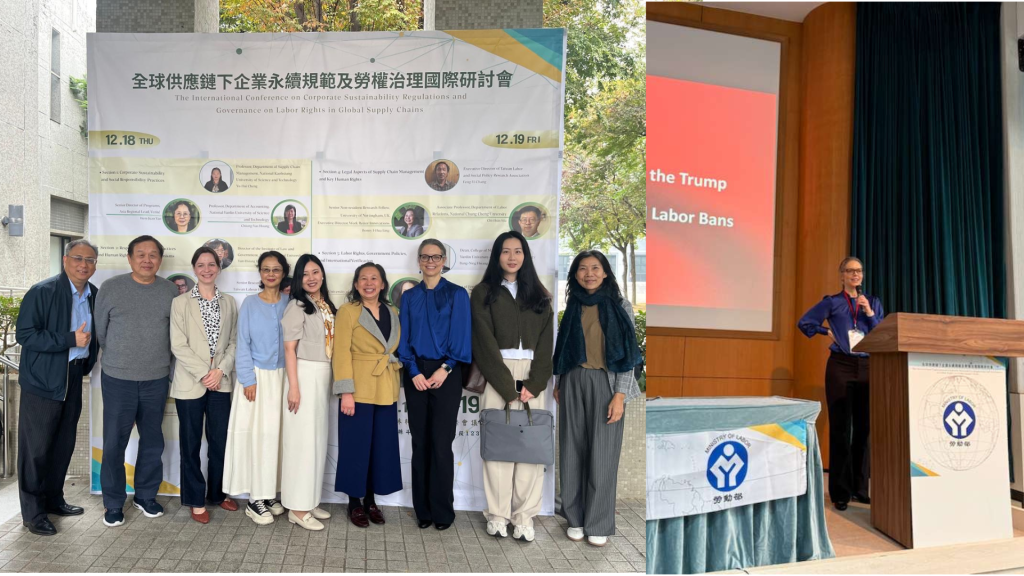
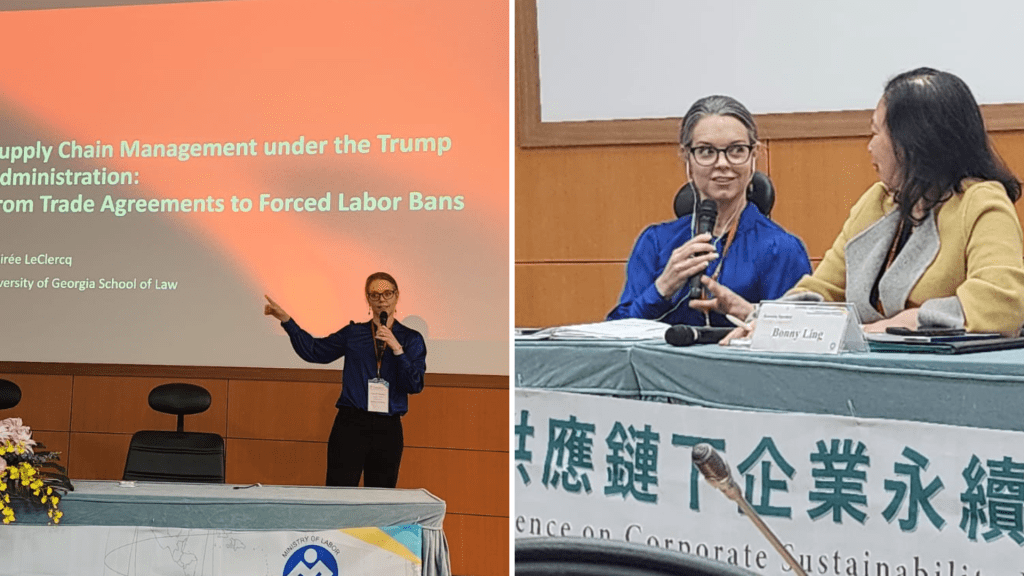
University of Georgia School of Law Professor Desirée LeClercq delivered a keynote address at the International Conference on Corporate Sustainability Regulations and Governance on Labor Rights in Global Supply Chains, held in Douliu, Taiwan, on 19 December 2025.
Her keynote, “Supply Chain Management under the Trump Administration: from Trade Agreements to Forced Labor Bans,” examined how shifting U.S. trade policy and enforcement tools shape corporate supply chain strategy, with a focus on labor rights compliance and emerging forced labor restrictions. A short video from her time in Taiwan was shared in an Instagram reel.
LeClercq joined the University of Georgia School of Law in 2024 as an assistant professor. She teaches Contracts, International Trade and Workers Rights, International Labor Law, U.S. Labor Law, and Public International Law. She also serves as a faculty co-director of the Dean Rusk International Law Center and as the faculty adviser for the Georgia Journal of International and Comparative Law and the Labor and Employment Student Association.
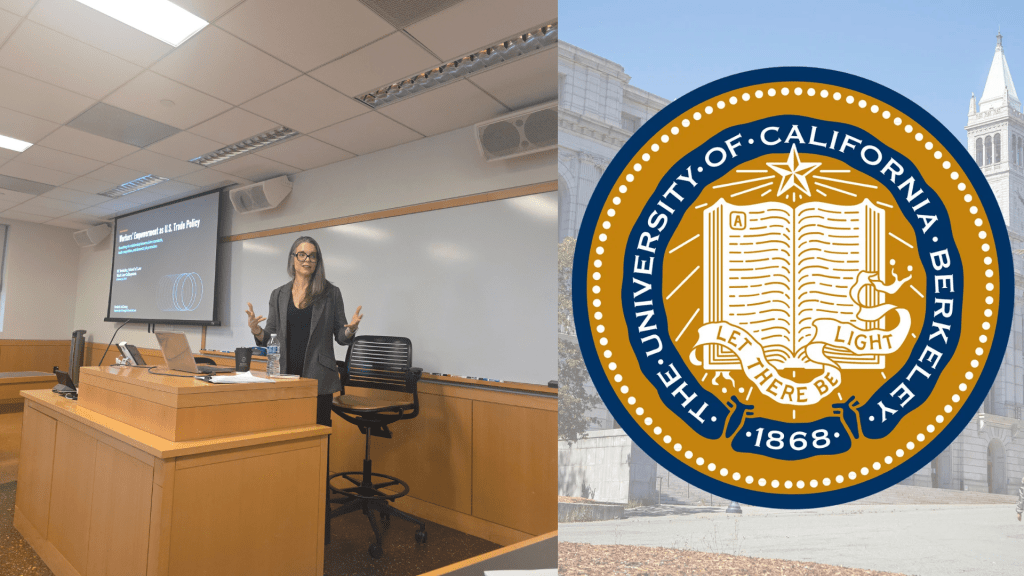
University of Georgia School of Law Professor Desirée LeClercq recently delivered a presentation for the Foreign, Commonwealth & Development Office’s Trade & Economic Diplomacy Faculty entitled “Growing Employment Through Trade: The Role of Fair Labour Standards.”
LeClercq discussed the evolution of international labor standards, noting how rules once designed to protect workers and improve living conditions are now used by countries such as the United States to enforce rights abroad and reshape global supply chains. Drawing on her experience as director of labour affairs at the Office of the U.S. Trade Representative and as a legal officer at the International Labour Organization, she illustrated this trend through examples from the United States-Mexico-Canada Agreement (USMCA).
LeClercq joined the University of Georgia School of Law in 2024 as an assistant professor. She teaches Contracts, International Trade and Workers Rights, International Labor Law, International Law and U.S. Labor Law, and Public International Law. She also serves as a faculty co-director of the Dean Rusk International Law Center and as the faculty adviser for the Georgia Journal of International and Comparative Law.
Convened by the Remaking Trade Project (RTP) and co-hosted by the Centre for Trade and Economic Integration (CTEI), this workshop brought together a diverse range of researchers, economists, legal experts and policy advocates to explore the creation of a dedicated research stream as part of the RTP. Their stated goal is “…to continue strengthening the intellectual foundations of the trade-sustainability agenda, while also responding to a rapidly changing trade landscape in ways that are agile, inclusive, and impactful.”
Over twenty-five colleagues joined the day of interactive roundtables, from over 20 global institutions and/or countries, drawing from participants of the RTP’s work to date.
LeClercq received financial support to attend this workshop from the Dean Rusk International Law Center as a Rusk Scholar-in-Residence, an initiative promoting international opportunities for Georgia Law faculty that advance the mission of the Center.
LeClercq joined the University of Georgia School of Law in 2024 as an assistant professor. She teaches International Trade and Workers Rights, International Labor Law, International Law and U.S. Labor Law. She also serves as a faculty co-director of the Dean Rusk International Law Center and as the faculty adviser for the Georgia Journal of International and Comparative Law.
LeClercq’s article reviews two books that examine trade and labor rights, the development of the United States-Mexico-Canada Agreement (USMCA) and the Rapid Response Mechanism.
Below is an excerpt from the article:
Over the past decade, trade lawyers and legal researchers have had to take a crash course in international labor law and the so-called ‘sustainable development’ framework. Trade bans across the Atlantic punish governments and corporations for engaging in forced labor. The European Union (EU) recently revised its trade agenda to ensure that commitments to trade agreements with sustainable development provisions are enforceable through sanctions. The United States adopted a ‘worker-centered’ trade policy foregrounding international labor law, the International Labor Organization (ILO), and conceptions of workplace democracy, choice, and voice. The trade and labor linkage, long the source of dispute, is apparently with us to stay, with its attendant implications for trade, political relationships, and international economic law. Namely, who establishes the rules? Governments? International organizations? Civil society? And who decides whether and how those rules are violated?
LeClercq joined the University of Georgia School of Law in 2024 as an assistant professor. She teaches International Trade and Workers Rights, International Labor Law, International Law and U.S. Labor Law. She also serves as a faculty co-director of the Dean Rusk International Law Center and as the faculty adviser for the Georgia Journal of International and Comparative Law.



 exchange of notes