Eduardo Conghos (LL.M., ’98), speaks about Argentinian environmental law at UGA Law

Director of GreenCo SA and National University of the South professor Eduardo Conghos (LL.M., ’98) spoke to students at the University of Georgia School of Law last week about environmental law in Argentina and the effects of “constitutional greening” in Latin America. The conversation was moderated by Adam D. Orford, Assistant Professor of Law.

Conghos provided students with historic context for environmental legal developments in Latin America, tracing the global period of “constitutional greening” that stretched from the 1970s through the 90s. Over these two decades, 14 of the 20 countries in Latin America encoded environmental considerations and protections into law. Some common characteristics included protection of natural resources, wildlife, and protected natural areas; a right to the environment; and a right to public participation in environmental processes. Despite these strong constitutional protections for the environment, Conghos noted that the lack of statutory laws created tension between judicial rulings in favor of environmental protection and consistent implementation and oversight of environmental regulations. He used the 2007 Argentinian Supreme Court decision, Mendoza, Beatriz Silvia et al. v. National Government et al. about damages (damages derived from the environmental pollution of the Matanza Riachuelo River) and the rulings that followed it to illustrate this conflict. Students asked Conghos about the reality of the private sector being able to adapt to new environmental regulations and whether arbitration would be the appropriate way to address some of these issues.

Conghos is an environmental lawyer, consultant, and professor based in Buenos Aires, Argentina. He is currently the Director of GreenCo S.A., an environmental consulting business that provides services to both public and private institutions. Conghos is also professor at the National University of the South in Buenos Aires, where he has worked in several faculty positions since 1999. His specialties include environmental legislation and environmental training, skills that he has honed over several decades of experience in both the public and private sectors in Argentina. Dr. Conghos received his LL.M. from the University of Georgia School of Law in 1998, as well as postgraduate degrees from the University of Salamanca, the National University of the South, the University of San Andres, and Buenos Aires University.

UGA Law students attend American Branch of the International Law Association’s International Law Weekend through Louis B. Sohn Professional Development Fellowships

Top row, from left to right: Aashka Vyas, Bohdan Krivuts, N’guessan Clément Kouame, Savelii Elizarov Bottom row, from left to right: Anna Carolina Mares, Eman Abdella Ali, Shivani Ravi Prakash, Victoria Agbakwuru, and Sarah Quinn

Each fall, the American Branch of the International Law Association hosts its annual International Law Weekend (ILW) conference in New York City. This event features over 30 panels, and many of the world’s leading international lawyers and diplomats participate. Audiences recently have included more than a thousand practitioners, academics, U.N. diplomats, business leaders, federal and state government officials, NGO leaders, journalists, students, and interested citizens. 

This year, the University of Georgia School of Law was a sponsor of the event, and eight students attended through the support of Louis B. Sohn Professional Development Scholarships awarded by the Dean Rusk International Law Center. This builds on a tradition of supporting students seeking professional development opportunities (Prior posts here, here, and here). Recipients of the scholarships this year included:

Krivuts was selected by ABILA to serve as one of six Student Ambassadors for the event.

ILW keynote speakers included Ambassador Sheikha Alya Ahmed Saif Al Thani, Permanent Representative of the State of Qatar to the United Nations, and Judge Gatti Santana, President, International Residual Mechanism for Criminal Tribunals. The students enjoyed hearing a range of perspectives on the current international law scheme and how its shortcomings and challenges may be met. For example, one of the panels that Vyas attended was “Investment Law and Energy in times of Armed Conflict.” She appreciated the legal framing of the recent events in Ukraine, and noted that these discussions illuminate the “…considerable gaps…in the current legal regime” and how they could potentially be addressed by “…adopting new measures to maintain cross-border investments during armed conflict.” Kouame, meanwhile, enjoyed the panel entitled “Trade, Labor Rights and Forced Labor.” He said that the panelists provided insight concerning the enforcement of labor and human rights provisions of the USMCA directly related to a research project he is conducting under Professor Christopher M. Bruner.

In addition to the ILW programming, students met with LL.M. alumni working in New York. These included Julie Guo (LL.M., ’09), who hosted students in her firm’s New York City office; along with Parham Zahedi (LL.M., ’18) and Tatyana Popovkina (LL.M., ’23), who met with students before the conference on Saturday. In both meetings, students were able to learn about the experiences of Guo, Zahedi, and Popvkina at UGA Law, how they prepared for the New York bar exam, and their advice for conducting domestic job searches. Students appreciated their insights; Mares, for example, commented that her conversations with alumni reminded her of the strength of the UGA Law community. “Alumni spoke about their gratitude for time spent at UGA and mentioned wanting to do as much as possible to help UGA grads entering the legal field,” she reflected. “Though New York is a competitive market to enter, with hard work and support from fellow UGA grads, it appears to be in reach as a dynamic place to establish a legal career.”

Each of the eight UGA Law students who attended the ABILA ILW agreed that being able to attend this type of professional conference is valuable as they learn about the field of international law and consider their professional futures. Ravi Prakash noted the event’s “transformative impact” on her professional aspirations. “This experience introduced me to a network of highly accomplished individuals in the realm of international law, many of whom are prolific writers, professors, ambassadors and successful attorneys in the field,” she commented. “Interacting with these experts not only expanded my knowledge but also provided valuable insights and connections that will be invaluable in my journey. On a personal level, it instilled in me a deeper passion for international law and a sense of belonging within this community of experts. This event has undoubtedly set me on a path to a more promising and fulfilling future in international law.”

Alexander Campbell King Law Library hosts annual gathering for international students

Last Friday, international students at UGA Law gathered for an annual reception hosted by the Alexander Campbell King Law Library. International students in the J.D. program, Master of Laws (LL.M.) students, and exchange students from O.P. Jindal Global University Law School (JGLS) were invited to this social gathering to meet with each other and Law Library staff. This year, several LL.M. alumni/ae were in attendance, in addition to staff from the Dean Rusk International Law Center, the Center’s two Visiting Research Scholars, members of the Center’s Faculty Committee, and law faculty who teach classes for LL.M. students.

This event began in 2018 when Access Services Manager Marie Mize and Access Services Associate Szilvia Somodi proposed that the Law Library host a reception for the LL.M. students in order to introduce them to the law library staff and to talk about the library’s services. They and Foreign & International Law Librarian Anne Burnett planned the reception, which was first held September 11, 2018.

Over the years, this event has evolved in response to both students’ needs external circumstances. The event date was adjusted to accommodate the acculturative stress patterns of international students, who, Law Library staff learned, tend to experience homesickness around this time of the year. During the 2020-21 academic year, the Law Library held two virtual receptions in the fall and spring semesters to build community despite not being able to gather in person. In lieu of catered refreshments, Somodi and Mize assembled goodie bags that were made available for pickup in the Law Library for the week surrounding the virtual events.

Beginning in 2022, the Law Library expanded the event to include all international students in the J.D. program and Visiting Research Scholars. This year, the first two exchange students from UGA Law’s partnership with JGLS joined, in addition to several LL.M. alumni/ae. Somodi and Mize continue to be crucial to the planning and execution of the event, with the broader support of the library’s Student Engagement Team.

This event shines a spotlight on the relationship between the Law Library and UGA Law’s community of international students, emphasizing that they are welcome and encouraged to use the library’s facilities and services— and that the Law Library staff is glad they are here.

From classmates to colleagues: LL.M. alumna Rawdha Hidri (LL.M. ’23) and 2L Carolina Mares reflect on summer work experience together

Through the Global Externships Overseas (GEO) initiative administered by the Dean Rusk International Law Center, 2L Carolina Mares spent her summer working in international arbitration at the Houerbi Law Firm in Tunis, Tunisia. In this placement, Ms. Mares worked under the supervision of Rawdha Hidri, a Fulbright recipient who completed her Master of Laws (LL.M.) at UGA Law in May 2023.

While it is not uncommon for our J.D. students to work under our LL.M. alumni/ae in GEO placements, this is the first experience in recent memory when they had the opportunity to meet on-campus and learn together as classmates prior to their experience abroad. Below, Mares and Hidri describe their experiences participating in the GEO from the perspectives of student and supervisor, respectively. Responses have been edited for length and clarity.   

* * * *

Carolina Mares, 2L

What initially interested you about the Global Externships Overseas (GEO) initiative?

With the desire to practice international law in my career moving forward, I knew that the GEO initiative was an incredible opportunity designed to encourage me to explore one potential avenue for my future. I was torn between pursuing summer work in public international law or looking for a firm that would give me some experience in international arbitration. However, when I heard about the possibility of focusing exclusively on international arbitration at Houerbi Law Firm, my mind was set.

What was your GEO experience like?

This summer, I worked at Houerbi Law Firm in Tunis, the capital of Tunisia. The firm specializes in commercial international arbitration and operates between Tunis and Paris with a focus on disputes in Europe, the Middle East, and Africa. My work consisted of reading case dockets, synthesizing parties’ positions, analyzing factual and legal exhibits, drafting an answer to a request for document production, and writing appropriate parts of an award. What I enjoyed most was the novelty of each case I got to work on. The parties in the disputes ranged from state to private parties in the UAE, Italy, Jordan, Iran, Malaysia, Tunisia, Turkey, and Morocco. I also had the chance to learn about all sorts of industries, including oil and gas, gold and fine jewelry manufacturing, and government procurement.

In addition to Rawdha, Mr. Houerbi was a phenomenal mentor to me during my time in Tunisia. With sixteen years of experience as the Arbitration and ADR Director of the ICC for the Mediterranean, the Middle East, and Africa, his positive and direct feedback played an important role in shaping my work and experience at the firm. He often invited me to sit in on team meetings that did not pertain to my particular cases so that I could gain exposure to as many disputes as possible, and he encouraged me to observe all of the virtual hearings that took place this summer.

How do you envision your GEO contributing to your academic and professional goals?

Taking part in the GEO has already impacted my professional trajectory. First, I now know that I enjoy the work involved in international arbitration, and I can picture myself pursuing a career in this practice area. Second, I’m convinced that my participation in a GEO is the reason I landed a 2L summer job fairly quickly, as it was the hot topic in all of my interviews. But more importantly, the GEO gave me a chance to take a deep dive into a niche area of law that is difficult to get into as a novice, especially in the Atlanta area. In addition to delving into international arbitration, the GEO program allowed me to develop my confidence navigating across cultures all while improving my French skills in a captivating work environment.

What was the best part of participating in a GEO?

The highlight of my GEO experience was making deep connections with my colleagues and experiencing day-to-day life in an incredibly rich culture that was brand new to me. Besides taking on the role of mentor, Rawdha was also my cultural guide. She introduced me to the coastal neighborhoods of Tunis, invited me to join her family and friends on the weekend for a shopping expedition in the Medina, pointed out the flocks of flamingos flying by in V-formation as we lounged on the beach, and took me sightseeing in Hammamet where we attended an amateur Opera concert at the Dar Sebastian villa overlooking the Mediterranean. In short, the best part of doing a GEO was getting a feel for the flow of life in Tunis and growing in my cultural competency, all of which I owe in big part to Rawdha’s support as my mentor and host.

* * * *

Rawdha Hidri (LL.M., ’23)

What interested you in serving as a placement supervisor for a GEO?

My time at UGA Law was so formative, I was eager to reciprocate and provide inquisitive American J.D. students with an experience as enriching as the one that I had in Athens. I strongly believe that immersing oneself in new experiences and can be influential on both personal and professional levels. Throughout my journey at UGA Law, I embraced the role of an informal cultural ambassador for my country Tunisia. The GEO initiative emerged as an ideal opportunity for both providing American J.D. students with professional experiences in a distinct legal framework and within a specific geopolitical context and with rich cultural immersion in my home country.

How did hosting a UGA Law student contribute to your firm’s work?

Carolina’s ability to methodically structure and articulate her thoughts has been a valuable addition to our team dynamics. Her innate attention to detail was evident from the outset, as she engaged diligently with the tasks assigned to her. Encouraging her to delve further and uncover nuances within cases became a rewarding challenge, showcasing her dedication to thorough exploration.

How did you approach integrating a UGA Law student into the local community and culture?

In the spirit of fostering a sense of belonging, I took it upon myself to introduce Carolina to the richness of Tunisian culture, ensuring she tried traditional Tunisian cuisine and experienced the crystal-clear waters of the Mediterranean. The entire team enthusiastically engaged in this process, sharing suggestions of places to visit, offering language lessons, and collectively enjoying lunches together outside the office on a weekly basis. This collaborative approach not only enhanced Carolina’s integration but also fostered a supportive and inclusive environment, benefitting both her and the entire team.

What did you enjoy about serving as a supervisor for a GEO?

Serving as a supervisor for a GEO was incredibly rewarding on a personal level. It expanded upon my own Fulbright journey that I started at UGA Law, allowing me to share my perspective and insights with someone eager to learn. The most fulfilling aspect was knowing that the student I hosted would carry their experiences in Tunisia with them, and that perspective would continue to guide them in their professional pursuits. This connection ensures a lasting impact, creating a sense of continuity and mutual understanding that extended beyond the program itself.

* * * *

Global Externships Overseas (GEOs) are four-to-twelve week summer placements in diverse areas of legal practice around the world. Students return to Athens with new colleagues and mentors, legal practice skills, and a deeper appreciation of the global legal profession. Over the last fifteen years, more than 200 UGA Law students have completed a GEO. Students secure placements tailored to their career goals with the aid of the Dean Rusk International Law Center.

For more information about GEOs, visit our website.
Welcoming the newest class of Master of Laws (LL.M.) students to UGA Law

With the Fall 2023 semester in full swing, we at the Dean Rusk International Law Center are proud to welcome another class of talented lawyers, now studying for our University of Georgia School of Law Master of Laws (LL.M.) degree.

The group of 18 hails from 14 different countries in Africa, Asia, Europe, and the Americas, including Nigeria, Ethiopia, India, Germany, Argentina, Romania, Brazil, Russia, Côte d’Ivoire, Ukraine, Ghana, China, Bangladesh, and Afghanistan. Among them are lawyers and other professionals specializing in a wide range of fields including corporate law, alternative commercial dispute resolution, immigration law, bankruptcy law, family law, corporate sports law, international trade, business law, cybersecurity and digital fraud, refugee and asylum law, technology law, tax law, and criminal law.

They are pictured above, standing on the steps of Dean Rusk Hall. From the left to right – top row: Daniel Danca, Bohdan Krivuts, Savelii Elizarov, Cornelius Bulanov, N’guessan Clément Kouame, Jonas Römer; middle row: Md Mushfiqur Rahman, Eman Abdella Ali, Quraisha Sherzad, Raissa dos Santos Bastos Rolim, Gracia Varinia Rojas Mina Bogliotti, Agostina Calamari; bottom row: Victoria Agbakwuru, Xinyi Nie, Shivani Ravi Prakash, Naina Bishnoi, Amanda Pinto, and Lydia Lartey.

This Class of 2024 joins a tradition that began at the University of Georgia School of Law in the early 1970s, when a Belgian lawyer became the first foreign-trained practitioner to earn a UGA Law LL.M. degree. In the ensuing four decades, the law school and its Dean Rusk International Law Center have produced nearly 600 LL.M. graduates, with ties to nearly 100 countries and every continent in the world.

Side by side with J.D. candidates, LL.M.s follow a flexible curriculum tailored to their own career goals – goals that may include preparation to sit for a U.S. bar examination, or pursuit of a concentration affording advancement in their home country’s legal profession or academic institutions.

The application for the LL.M. Class of 2025 is now open; for information or to apply for LL.M. studies, see here.

Georgia Law Dean Rutledge and student Rudzinskyi comment on appeals decision affecting international arbitration

A decision in which the U.S. Court of Appeals for the Eleventh Circuit overturned its precedent regarding international arbitration awards, and thus ruled in line with other federal appellate courts, is the subject of a new commentary by  Peter B. “Bo” Rutledge (above left) and student Vladyslav Rudzinskyi, a member of the Master of Laws (LL.M.) Class of 2023.

Their article, entitled “Eleventh Circuit Switches Stance on Grounds for the Vacatur of Non-Domestic Awards,” appeared on May 11 in the Daily Report.

The article discusses Corporacion AIC, SA v. Hidroelectrica Santa Rita S.A., an en banc April 13, 2023, decision in which the Eleventh Circuit set aside panel precedents to hold that vacatur proceedings related to non-domestic awards are governed by chapter 1 the Federal Arbitration Act. Noting that the new decision corresponds with others in the Second, Third, Sixth, and Tenth Circuits, Rutledge and Rudzinskyi concluded noted:

“Previously, arbitration practitioners in the Eleventh Circuit (especially hubs like Atlanta and Miami) could tout its distinctive vacatur standards as a reason to site disputes there.

“Those standards had aligned the Eleventh Circuit with international jurisdictions following the UNCITRAL Model Arbitration Law (whose vacatur standards track those under the New York Convention). Corporacion strips the Eleventh Circuit of that potential comparative advantage as an arbitral forum.”

They further warned that “[t]he new standard risks diluting the enforceability of international awards.”

International law at University of Georgia, administered by Dean Rusk International Law Center, earns #15 U.S. News ranking

Delighted to report that the just-released U.S. News rankings place our international law curriculum here at the University of Georgia School of Law at No. 15 in the United States.

This excellence rating caps a decade in which our international law initiatives have ranked in the top 20 or so among US law schools. In this year’s rankings, our international law curriculum tied with UCLA Law for the No. 15 spot. (The University of Georgia School of Law, as a whole, earned a No. 20 ranking this year, as it posted here.)

Our international law achievement is due in no small part to the enthusiastic support and hard work of everyone affiliated with Georgia Law’s four-decades-old-old Dean Rusk International Law Center. As chronicled at this Exchange of Notes blog and our Center website, these include:

► Superb members of the law faculty, including: Dean Peter B. “Bo” Rutledge, an international arbitration expert; our Center’s Director, Melissa J. “MJ” Durkee, whose expertise includes international business law, international environmental law, and space law; the Center’s Faculty Co-Directors, Professors Diane Marie Amann, an expert in peace-and-security fields including the laws of war, child rights, and international criminal justice, and Harlan G. Cohen, an expert in global governance, trade, and foreign relations law. Among those supporting their efforts are many other Georgia Law faculty and courtesy faculty members, including: Professors Zohra Ahmed, whose interests include law and political economy; Christopher M. Bruner, a comparative corporate governance scholar; Thomas Burch, who leads the Appellate Clinic that has won clients relief under the Convention Against Torture; Anne Burnett, foreign and international law research librarian; Jason Cade and Clare Norins, who recently led a clinical team in securing federal redress for immigration detainees; Nathan S. Chapman, a scholar of due process and extraterritoriality; Jessica L. Heywood, Director of the Washington, D.C. Semester in Practice; Thomas E. Kadri, whose expertise includes cybercrime and global data privacy; Fazal Khan and Elizabeth Weeks, health law specialists; Jonathan Peters, a journalism and law professor expert in international media and free speech; Laura Phillips-Sawyer; Kalyani Ramnath, a global legal historian who focuses on South Asia; Lori A. Ringhand, a scholar of comparative constitutional law and elections law; Tim Samples, whose scholarship includes global digital platforms agreements; Kent BarnettSonja West, and Elizabeth Chamblee Burch, who have presented overseas on administrative law, media law, and civil procedure, respectively; Walter Hellerstein, a world-renowned tax specialist; Michael L. Wells, a European Union scholar; and Anna Howard White, who led our champion Jessup International Moot Court Team.

► Talented students pursuing JDMSL, and LLM degrees, as well as Graduate Certificates in International Law. They include: our Center’s many Student Ambassadors; the staffers and editors of the Georgia Journal of International and Comparative Law who produce one of the country’s oldest student journals, and who led our October 2022 conference, “The Law of Global Economic Statecraft”; the advocates on the Philip C. Jessup International Law Moot Court, the LL.M.s’ International Commercial & Investment Arbitration Moot Competition, and the Willem C. Vis International Commercial Arbitration Moot; student clinicians in our Appellate Litigation Clinic who have argued asylum cases before U.S. Courts of Appeals, as well as those in our Community HeLP Clinic, Jane W. Wilson Family Justice Clinic, and First Amendment Clinic who have litigated claims for detainees and other immigration clients; participants in our Global Externships as well as our full-semester NATO Externship and other D.C. Semester in Practice placements; and the student leaders of our International Law Society.

► Superb Center staff like Laura Tate KagelSarah QuinnMandy Dixon, and Catrina Martin.

► Visiting Scholars and Researchers, including, most recently, Professor Brianne McGonigle Leyh and Maisie Hopkins from the Netherlands’ Utrecht University, Daesun Kim, a comparative administrative law researcher; and Professor Natalia Pires de Vasconcelos, Insper São Paulo, Brazil.

► Academics, practitioners, and policymakers, from all over the world, who have contributed to our events – conferences, workshops, and lectures, including our ongoing Consular Series and International Law Colloquium, as well as this past semester’s Space Law Speaker Series, part of a minicourse that culminated in a daylong problem-solving exercise.

► Graduates who excel as partners in international commercial law firms, as heads of nongovernmental organizations and international organizations, as in-house counsel at leading multinational enterprises, and as diplomats and public servants – and who give back through participation in our Dean Rusk International Law Center Council, through mentoring, and through other support.

► Our valued partnerships, with Georgia Law student organizations; with leading higher education institutions such as the Leuven Centre for Global Governance Studies in Belgium, our partner in our Global Governance Summer School,  as well as O.P. Jindal University in India and Bar Ilan University in Israel, with which we have student and faculty exchanges; with organizations like the American Branch of the International Law Association, the American Society of International Law, and the European Society of International Law, in which our faculty have held leadership roles, as well as Global Atlanta, the World Affairs Council of Atlanta, the Atlanta International Arbitration Society; and with university units like the School of Public & International Affairs, the Terry College of Business, the Grady School of Journalism, the African Studies Institute, and the Willson Center for Humanities & Arts.

With thanks to all, we look forward to continue strengthening our initiatives in international, comparative, transnational, and foreign relations law – not least, in the preparation of Georgia Law students to practice in our 21st C. globalized legal profession.

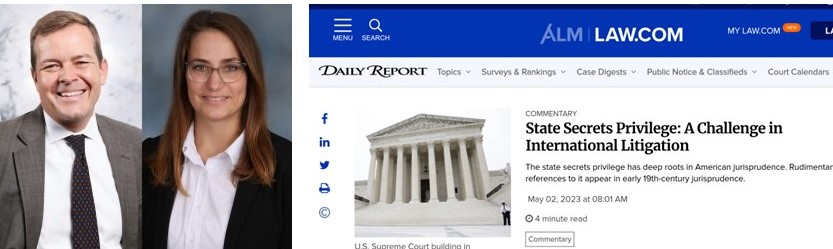
Georgia Law Dean Bo Rutledge and student Alexandra Lampe publish commentary on federal appellate ruling involving state secrets privilege

The implications of a recent federal appellate ruling related to international civil litigation is the subject of a commentary published last week by the dean and a student researcher here at the University of Georgia School of Law.

Coauthoring the Daily Report article, entitled “State Secrets Privilege: A Challenge in International Litigation,” were international business law expert Peter B. “Bo” Rutledge, Dean and Herman E. Talmadge Chair of Law at Georgia  Law, along with Alexandra Lampe, a member of Georgia Law’s Master of Laws (LL.M.) Class of 2023.

The article discusses Sakab Saudi Holding Co. v. Aljabri, 58 F.4th 585 (1st Cir. 2023), in which the Boston-based U.S. Court of Appeals affirmed a dismissal of a suit arising out of an asset seizure, lest further litigation risk disclosure of state secrets. After describing the ruling in the context of other case law, Rutledge and Lampe concluded:

“Parties in international commercial disputes with any kind of national security implication approaching U.S. courts, thus, should be aware to not expect too much from such proceedings. … [T]he broad application and interpretation of the state secrets privilege in the U.S. can complicate the resolution of international disputes.”

Georgia Law professors, alumna, students take part in annual meeting of American Society of International Law

Many members of the University of Georgia School of Law community – professors, alumna, and students – took part in last week’s 117th Annual Meeting of the American Society of International Law, the theme of which was “The Reach and Limits of International Law to Solve Today’s Challenges.”

The annual meeting took place Wednesday-Saturday at several venues in Washington, D.C.

Representatives of Georgia Law, an ASIL Academic Partner, included three scholars affiliated with the law school’s Dean Rusk International Law Center:

The Center’s Director, Melissa J. “MJ” Durkee, who is also Associate Dean for International Programs and Allen Post Professor, moderated a panel entitled “How Does International Law Change? Theories and Concepts of Legal Change.” (photo top row left) It was sponsored by ASIL’s International Legal Theory Interest Group, for which Durkee serves as Chair. Panelists were: Benedict Kingsbury, New York University; Nico Krisch, Graduate Institute of International and Development Studies in Geneva; and Sivan Shlomo Agon, Bar-Ilan University.

Durkee additionally serves on the ASIL Executive Council and the Board of Editors of the American Journal of International Law, and took part in the meetings of both those groups.

Diane Marie Amann, Regents’ Professor of International Law, Emily & Ernest Woodruff Chair in International Law, and one of our Center’s Faculty Co-Directors (above second from left), took part in a late-breaking panel, “ICC Arrest Warrant Against Putin: Impunity in Check?” (photo above left) Amann, an international child law expert and former Special Adviser to the International Criminal Court Prosecutor on Children in & affected by Armed Conflict, spoke on the significance of the fact that crimes against children form the basis of the international arrest warrant issued March 17 against the President and the Children’s Rights Commissioner of Russia. Additional panel participants were: Javier Eskauriatza, University of Nottingham; Marko Milanovic, University of Reading; Saira Mohamed, University of California-Berkeley; and moderator Katherine Gallagher, Center for Constitutional Rights. Panel video here.

Amann also attended the ASIL Executive Council meeting, completing her term as an ASIL Counsellor.

Harlan G. Cohen, Gabriel M. Wilner/UGA Foundation Professor in International Law and Faculty Co-Director of the Dean Rusk International Law Center, took the ASIL General Assembly stage: in his capacity as Chair of the 2023 Book Awards Committee, he co-presented those honors to numerous authors. (photo top row right, from left to right: ASIL President Greg Shaffer, honoree Damilola Olawuyi, ASIL Executive Director Michael Cooper, and Cohen; video 27:09)

Like Durkee, Cohen is a member of the AJIL Board of Editors and took part in the journal’s meeting. The annual meeting completed his service as Chair of ASIL’s International Legal Theory Interest Group.

A distinguished Georgia Law graduate also was featured:

Tess Davis (JD 2009), who is the Executive Director of the D.C.-based Antiquities Coalition and Dean Rusk International Law Center Council member, served as moderator for a session at the Smithsonian National Museum of Asian Art. (photo above right) Entitled “Protecting Cultural Heritage in Conflict Zones: Multi-Disciplinary Approaches,” the discussion also included: Patty Gerstenblith, DePaul University; Brooke Cuven, Cerberus Capital Management; Richard Kurin, Smithsonian Institution; and Zaydoon Zaid, American Foundation for Cultural Research.

Rounding out the contingent were four Georgia Law students, who received Louis B. Sohn Professional Development grants to serve as volunteers at the meeting: 2L Hao Chen “Bobby” Dong, 3L Collin Douglas, LLM candidate Alexandra Lampe, and 1L Mahi Patel.

Georgia Law LL.M. students win top honors at 10th International Commercial and Investment Arbitration Moot

Members of the University of Georgia School of Law LL.M. Class of 2023 won top honors at last weekend’s 10th International Commercial & Investment Arbitration Moot Competition.

Forming the champion team at the competition were the three students pictured above, from left: Tatiana Popovkina, Alexandra F. Lampe, and John A. Omotunde, The competition’s best oralist, meanwhile, was Olha Kaliuzhna, pictured above right; Lampe was the third runner-up. Kaliuzhna, along with Oleksandra Iordanova and Vladyslav Rudzinskyi, formed the second Georgia Law team, which also competed in advance rounds.

Coaching the teams were another LL.M. student, Gloria María Correa, as well as Georgia Law’s Dean, Peter B. “Bo” Rutledge, whose specialty is international arbitration.

The competition took place at American University Washington College of Law in Washington, D.C. (prior post)

Georgia Law’s Master of Laws (LL.M.) curriculum offers U.S. legal education to lawyers trained overseas. The participants and coach in the D.C. competition, for instance, were trained in Germany, Nigeria, Panama, Ukraine, and Uzbekistan.

For more information about the curriculum, which is administered by the law school’s Dean Rusk International Law Center, is available here.