
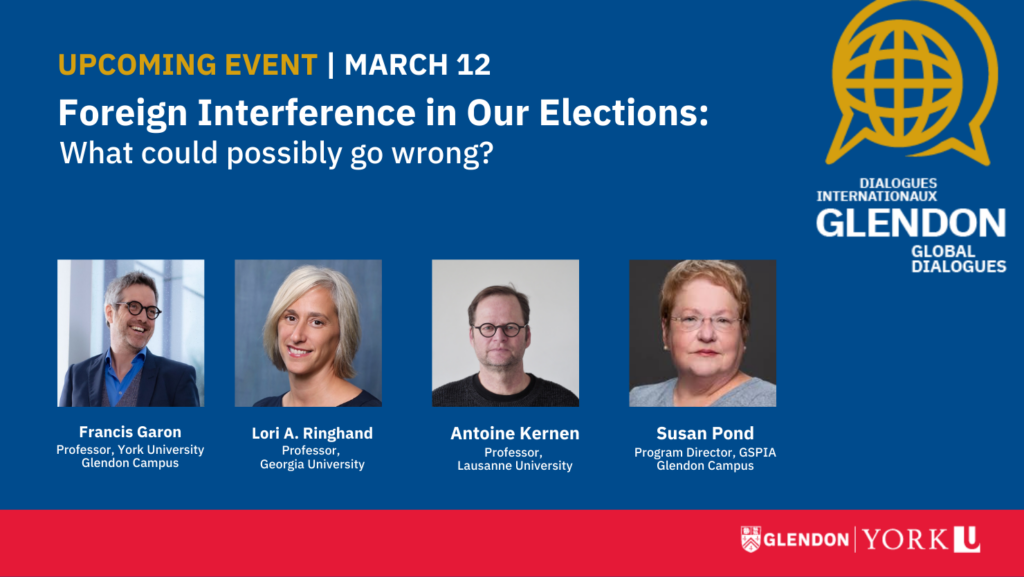
University of Georgia School of Law Professor Lori A. Ringhand presented at the Glendon Global Dialogue series titled “Foreign Interference in Our Elections: What Could Possibly Go Wrong?” last month. The event was hosted by York University’s Glendon School of Public and International Affairs in Toronto, Canada.
In addition to Ringhand, panelists included Francis Garon, Associate Professor of Political Science, Program Director of The Glendon School of Public and International Affairs; Antoine Kernen, Professor, Lausanne University; and Susan Pond, Director Glendon School of Public and International Affairs, York University.
This year’s Global Dialogue series aims to bring together renowned scholars and practitioners in political science, law, and international affairs to explore:
- How foreign actors manipulate public opinion through disinformation and digital influence
- The legal and policy frameworks protecting electoral integrity
- The role of media, governments, and civil society in countering these threats
Ringhand teaches courses on constitutional law and election law. She has been a member of the University of Georgia School of Law faculty since 2008 and was named a Hosch Professor in 2012 and awarded a Josiah Meigs Distinguished Professorship, UGA’s highest teaching honor, in 2021. She is a nationally known Supreme Court scholar and the author of two books about the Supreme Court confirmation process: Supreme Court Confirmation Hearings and Constitutional Change (with Paul M. Collins) published by Cambridge University Press; and Supreme Bias: Gender and Race in U.S. Supreme Court Confirmation Hearings (with Christina L. Boyd and Paul M. Collins), published by Stanford University Press. She also is the co-author of Constitutional Law: A Context and Practices Casebook, which is part of a series of casebooks dedicated to incorporating active teaching and learning methods into traditional law school casebooks. Ringhand also publishes extensively on election law related issues, and was awarded a Fulbright Distinguished Chair Award at the University of Aberdeen in Scotland to explore the different approaches to campaign finance regulation taken by the United States and the United Kingdom.
 exchange of notes