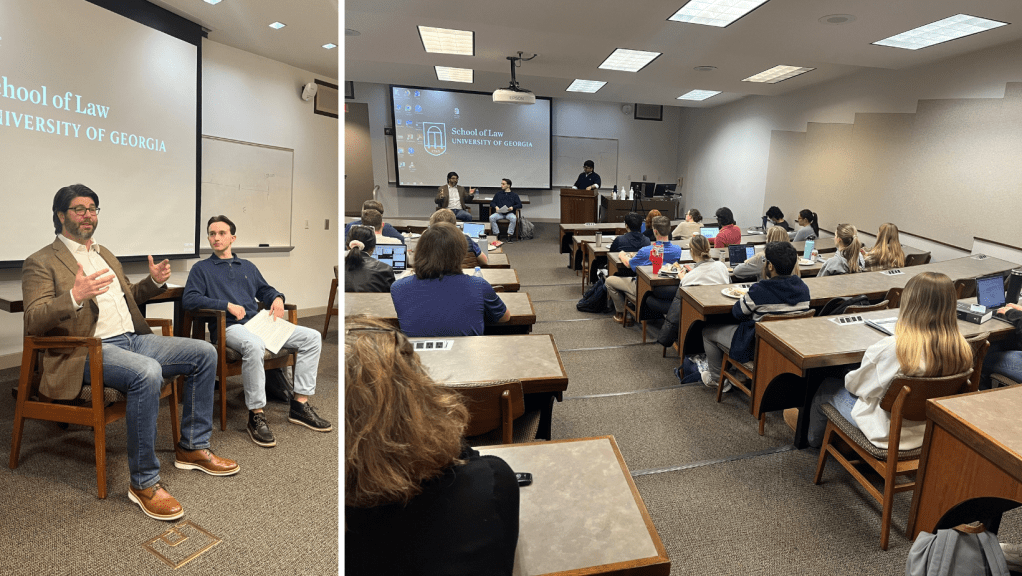
In conversation with Georgia Law student Isaac Clement (J.D. ’27), Mullins discussed her career trajectory in national security. She provided law students with an overview of her educational background as well as her work in the Army, on Capitol Hill, with the U.S. Department of Defense, and in academia. She answered questions from law students about military and national security law, the intersections of law and policy, considerations for political and apolitical work, the importance of international education and language learning, and general advice for students interested in national security careers.
This talk was co-sponsored by the International Law Society, Armed Forces Association, Middle Eastern Law Students Association, and Law Democrats.
Mullins is the Director of Public Options and Governance at the Vanderbilt Policy Accelerator, where she researches and writes on defense acquisition and civil service reform. She is also an Assistant Adjunct Professor at Georgetown University’s Center for Security Studies.
Previously, Mullins served as Senior Advisor to the Deputy Secretary of Defense and as Senior Advisor for National Security to the Chair of the U.S. Export-Import Bank. Earlier in her career, she worked in the U.S. Senate on defense and foreign policy issues, including as national security advisor to Georgia Senator Raphael Warnock, and served as an intelligence officer in the U.S. Army, deploying to Afghanistan in 2013.
Mullins holds a BSFS from Georgetown University’s School of Foreign Service, an MPA from Princeton University’s School of Public and International Affairs, and a JD from Georgetown University Law Center. She has been a Council on Foreign Relations Term Member and is a member of the Truman National Security Project.
University of Georgia School of Law 2L Madison Graham recently completed an externship in Norfolk, Virginia, in the legal department of HQ SACT, a leading unit of the North Atlantic Treaty Organization. This externship forms part of Georgia Law’s D.C. Semester in Practice initiative, in partnership with NATO Allied Command Transformation. Graham arrived at Georgia Law after working as a Staff Assistant and Legislative Correspondent in the U.S. Senate. As an undergraduate at the University of Tennessee, Knoxville, Graham interned for the USDA in Washington, D.C. Her law school experiences have included service as an Editorial Board Member of the Georgia Journal of International & Comparative Law, a summer internship at Brussels-based law firm Van Bael & Bellis through the Global Externships Overseas initiative, and President of the International Law Society. Below, Graham reflects on her experiences as an extern with NATO HQ SACT this semester.
I first heard about the opportunity to intern with NATO through the University of Georgia School of Law and the Dean Rusk International Law Center nearly three years ago. At the time, I was only beginning to think about law school and where I might apply. Eventually, however, opportunities like this one are the reason I came to Georgia Law. Getting to spend the spring semester in the Office of the Legal Advisor at NATO’s Headquarters Supreme Allied Command Transformation (HQ SACT) was nothing short of a dream come true.
Fortunately, the mere fact of doing the externship is not where the dream ended. Not only was I working in the midst of an international organization, I was also physically working on a section of the biggest naval base in the world. Because of these two features, I received uniquely multifaceted exposure to both the complexities of working in an international organization, as well as the realities of working in a military environment. As a law student interested in pursuing a career in the national security realm of federal public service, this exposure could not have been more valuable.
The substance of the work was also incredibly rewarding. The Office of the Legal Advisor performs an wide variety of legal roles to support HQ SACT’s mission, and I was fortunate to experience parts of each.
First, the office provides legal assistance to the international military staff of HQ SACT. This is usually in the form of helping them obtain local driver licenses, helping their spouses obtain work permits, assisting with traffic tickets, ensuring their visas are up to date, and preparing powers of attorney for outgoing military personnel. Personally, I found this facet of my work to be an incredibly eye-opening and important reminder of how hard it is to legally transition to life in America. But even further, this work involved communicating with NATO staff from each of the 32+ NATO member countries. This was a test of my ability to communicate clearly, anticipate needs and expectations based on certain peoples’ backgrounds, and generally remind myself of how much peoples’ own cultural perceptions affect their approach to life. As an undergraduate anthropology major, I thought I was prepared for this, but could not have expected how much this work experience even further tested and honed these skills for me.
Second, the Office of the Legal Advisor supports HQ SACT through a variety of more general counsel duties. This might include anything from advising on intellectual property rights, contracting, employment law, operational law, and international law. However, the office prides itself on supporting the endeavors of other sections of HQ SACT – ensuring that their plans and processes are within legal possibility. Because of this, the work of the office is largely dependent on the needs and processes of other offices. In my case, this meant I got to help with contracting guidance for contracting officers in the procurement branch, as well as helping to draft another HQ SACT-wide directive for the permissible use of funding for staff morale and welfare activities. This was a great way to hone the knowledge and skills from previous semesters’ contracting and drafting classes, while also having to adapt to the unique requirements NATO has for such documents.
The highlight of my time, however, may have been the multiple educational and coursework opportunities I was able to participate in. These ranged from online, subject-specific courses – on topics like counterterrorism and gender perspectives in armed conflict – to a week-long Strategic Writing Course, to sitting in on meetings with representatives from the International Committee on the Red Cross. Lastly, the Office of the Legal Advisor hosted a week-long Legal Gathering, with legal advisors from several NATO commands around the world invited to talk about each other’s ongoing work and areas in need of assistance. This as a great opportunity to meet other European lawyers with their own unique backgrounds, as well as learn more about NATO’s structure and the roles of each command. Most importantly, however, my supervisors were incredibly supportive of my participation in all these learning opportunities. It is well-understood that just being in the room, taking in as much information as you can, is so valuable to a young student.
Lastly, I was lucky enough to work with incredible colleagues in HQ SACT during my externship. For example, interns from all over Europe, working in other offices at HQ SACT, welcomed me with open arms and have become close friends. I would, however, like to specifically thank my supervisors and colleagues in the Office of the Legal Advisor: Monte DeBoer, Theresa Donahue, Renata Vaisviliene, Cyrille Pison, Kathy Hansen-Nord, Mette Hartov, Agathe Tregarot, and Galateia Gialitaki. Their kindness, patience, and overall support made an already incredible experience even more special. From bi-weekly staff meetings to monthly staff lunches, to staff birthday celebrations, I felt welcomed as a full member of the team from my first day to my last.
I could not be more thankful for my time at NATO HQ SACT, and was reminded of that each time I was asked: “so how do you get to be here?” Over the course of the semester, I must have watched at least a dozen people marvel at the fact that Georgia Law has this externship opportunity available to students. Its uniqueness cannot be understated; I firmly believe it is an something every student at Georgia Law – regardless of your current interests may be – should at least take a moment to appreciate, if not consider doing themselves.
Johnson discussed how being in law school during 9/11 galvanized his interest in national security law. After graduation, he moved to DC and was able to gain experience in a wide variety of national security and cybersecurity leadership roles. His work in these national security and intelligence communities, in the regulatory arena, and in the Executive Branch now inform his advocacy to improve the efficiency of government-industry collaboration. Johnson stated that we are at an inflection point: incredible breakthroughs in technology and connectivity have the potential to solve the grand challenges of our time, but, as large holders of data, they can pose dangers to our freedoms.
Johnson was most recently the senior adviser for cybersecurity and technology at the U.S. Department of Commerce, where he coordinated the department’s cybersecurity initiatives and support for the Commission on Enhancing National Cybersecurity. He was also the department’s representative for National Security Council staff deliberations on cybersecurity, encryption, and other policy issues at the intersection of technology and security. Previously, Johnson was appointed by the Federal Communications Commission (FCC) chairman as the FCC’s first chief counsel for cybersecurity. In that position, he helped develop the FCC’s cybersecurity mission, focusing on creating new legal mechanisms for government collaboration with private sector stakeholders to improve the security and reliability of communications infrastructure. He was also the primary drafter of the charter for the Cybersecurity Forum for Independent and Executive Branch Regulators, a coordinating body of regulatory agencies presently chaired by the FCC. Prior to his time at the FCC, Johnson was Senator John D. Rockefeller IV’s designated counsel on the Senate Intelligence Committee and counsel for defense, foreign policy, and international trade. In those roles, he was a leading staffer on bipartisan Senate cybersecurity initiatives and the primary staff drafter of the legislation that codified the National Institute of Standards and Technology’s collaborative process to work with industry to develop and update the Cybersecurity Framework.
Before his government service, Johnson worked for a major Washington-based law firm, where he practiced in the areas of international trade, defense, and security. Earlier, he served as a U.S. Army officer in Germany, Korea, and the Balkans. He is a graduate of the University of Georgia School of Law, where he was editor-in-chief of the Georgia Journal of International and Comparative Law, and he received a master of science degree in international relations from the London School of Economics and Political Science. He received his bachelor’s degree from Harvard University, where he graduated cum laude, cross-enrolled at the Massachusetts Institute of Technology for service as executive officer of its Army ROTC Paul Revere Battalion.
University of Georgia School of Law alumna Ellen Clarke (J.D., ’14), security counsel at Google, recently spoke to students about her career in data protection law at the Dean Rusk International Law Center’s Louis B. Sohn Library.
Students from Georgia Law’s International Law Society and Privacy, Security, and Technology Law Society attended the talk. Clarke began by discussing her professional background and explaining how her experience prosecuting white collar crime at the U.S. Department of Justice provided her with the skills and experiences to successfully transition into her current role at Google. As security counsel, Clarke advises on global data security and law enforcement issues. Students asked Clarke about her opinions on Artificial Intelligence, her decision to become a licensed solicitor in England and Wales, and about the realities of her day-to-day work at Google.
Before joining Google, Clarke prosecuted competition crimes as a trial attorney in the Washington Criminal I Section of the Antitrust Division of the U.S. Department of Justice. She joined the DOJ through the Attorney General’s Honors Program. Clarke previously served as a law clerk to Judge Richard W. Story of the U.S. District Court for the Northern District of Georgia. She received an Advanced Diploma in Data Protection Law from the Honorable Society of King’s Inns, a J.D. degree magna cum laude from the University of Georgia School of Law, and a B.S. in Foreign Service from Georgetown University. She is licensed as an attorney in Georgia and Washington, D.C., as registered in-house counsel in California, and as a solicitor in England and Wales. Clarke is currently an Adjunct Professor of Law at Georgia Law, where she teaches a mini-course entitled Cybercrime.
James Martin Center for Nonproliferation Studies (CNS) Research Fellow Nomsa Ndongwe spoke to students about careers in international law and contemporary security challenges Wednesday here at the University of Georgia School of Law.
Joined by UGA alumna and CNS Research Associate Tricia White, Ndongwe discussed her own career trajectory and current work in nonproliferation at CNS. Both Ndongwe and White identified several skills aspiring international lawyers can work towards in law school, including learning languages and developing subject matter expertise. Ndongwe championed the importance of professional networking, building relationships with peers, and making use of the resources available to students at UGA Law, like the Career Development Office and the Dean Rusk International Law Center. She also answered student questions about the Russian war in Ukraine, space law, maritime law, and global nuclear security challenges.
Ndongwe is a Co-founder of the WCAPS West Coast Chapter, and an N-Square Innovators Network Fellow 2020 – 2021. As of January 2022, she co-leads the CNS Young Women in Nonproliferation Initiative, is a School of International Futures Mentor 2023, and served as a Girl Security mentor. She is also a part of the P5 –Young Professionals Network (YPN) 2022-2023 cohort. She has a Master of Arts in Nonproliferation, Terrorism Studies, and Financial Crime Management from the Middlebury Institute of International Studies. She obtained her first degree, an LLB Single (Hons) degree at Brunel University, and her Postgraduate Diploma in Legal Practice (LPC) from the University of Law in Guildford, UK.
Previously, she served as diplomat for the Zimbabwe Permanent Mission to the United Nations Office at Geneva, focusing mainly on the Disarmament portfolio and International Telecommunication Union (ITU). Nomsa is a featured non-proliferation panelist/moderator for the Ploughshares Foundation, Harvard Belfer Center, Trinity College DC, United Nations Office for Disarmament Affairs (UNODA) New York, Naval Postgraduate School, United Nations Institute for Disarmament Research (UNIDIR), N Square Innovators Network and Royal United Services Institute (RUSI).
This event was cosponsored by the International Law Society and the UGA Law Career Development Office.




 exchange of notes