Comparative constitutional law scholar Lori Ringhand is Center’s Interim Director; outgoing Director Kathleen Doty takes up post in Seattle

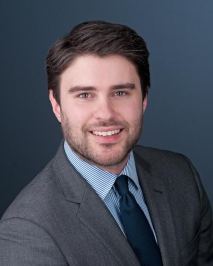
We’re delighted to announce that Lori A. Ringhand (near left), J. Alton Hosch Professor of Law, is the new Interim Director of the Dean Rusk International Law Center here at the University of Georgia School of Law. She succeeds Professor Kathleen A. Doty (left), who has just taken up a position as an Analyst in the Global Security, Technology, and Policy Group of the National Security Directorate at the Pacific Northwest National Laboratory in Seattle.

Ringhand (prior posts) returned to Athens earlier this academic year from Scotland, having been a Spring 2019 US-UK Fulbright Distinguished Chair at the University of Aberdeen. While overseas, she delivered “‘What Law?’ Political Spending on the Internet in the US and the UK,” a Gresham College Fulbright Lecture, at the Museum of London. An article that Ringhand researched and wrote during her Fulbright visit, entitled “First Amendment (Un)Exceptionalism: A Comparative Taxonomy of Campaign Finance Reform Proposals in the US and UK,” is forthcoming in the Ohio State Law Journal.

A well-known scholar of US as well as comparative constitutional law and election law, Ringhand’s publications include two co-authored books, Supreme Court Confirmation Hearings and Constitutional Change (Cambridge University Press, 2013) and Constitutional Law: A Context and Practices Casebook (Carolina Academic Press, 2d ed. 2017). After graduating from the University of Wisconsin Law School, she earned her Bachelor of Civil Law degree and was Professor of Law at the University of Kentucky College of Law and a Visiting Scholar at the Oxford Institute of European and Comparative Law. Her decorated career at Georgia Law includes service as Associate Dean for Academic Affairs and as a Provost’s Women Leadership Fellow, as well as the receipt of multiple teaching awards.

As Interim Director of the Dean Rusk International Law Center she will lead the staffers who support the Global Practice Preparation and International Professional Education portfolios – Mandy Dixon, Laura Kagel, Catrina Martin, and Sarah Quinn – along with numerous Student Ambassadors. Georgia Law Professors Harlan Cohen and Diane Marie Amann will continue to serve in advisory capacities as Faculty Co-Directors.

Professor Ringhand’s immediate predecessor, Professor Doty (prior posts), will pursue her career, as an international lawyer specializing in global security governance, at the national laboratory, an affiliate of the U.S. Department of Energy. Just prior to joining the Center as an associate director in 2015, she was Assistant Counsel for Arms Control & International Law at the Office of the General Counsel, U.S. Department of the Navy, Strategic Systems Programs. Doty has also served as attorney-editor at the American Society of International Law and inaugural Fellow of the California International Law Center at the University of California-Davis School of Law, from which she earned her J.D. degree.

Doty’s many Dean Rusk International Law Center initiatives included: teaching the International Advocacy Seminar; leading the Georgia Law-Leuven Centre Global Governance Summer School; launching the Consular Lecture Series; and managing the Center’s interdepartmental grant project relating to the United States’ North Korea sanctions regime. With deep thanks for her service, we wish her well in her new venture.
Georgia Law’s International Law Colloquium returns for Spring 2020

The International Law Colloquium, a time-honored tradition here at the University of Georgia School of Law, returns this spring semester with another great lineup of global legal experts.

This 3-credit course consists of presentations of substantial works-in-progress on a variety of international law topics by prominent scholars from other law schools. In keeping with a tradition established when the series began in 2006, students will write reaction papers on the scholars’ manuscripts, and then discuss the papers with the authors in class. Leading the class will be Harlan G. Cohen, Gabriel M. Wilner/UGA Foundation Professor in International Law and Faculty Co-Director of the Dean Rusk International Law Center. Other Georgia Law and university faculty will join in the dialogues.

Further supporting the colloquium are staff at our Center; in particular, the Center’s Global Practice Preparation team, which includes Sarah Quinn and Catrina Martin. The colloquium further benefits from generous support from the Kirbo Trust Endowed Faculty Enhancement Fund and the Talmadge Law Faculty Fund.

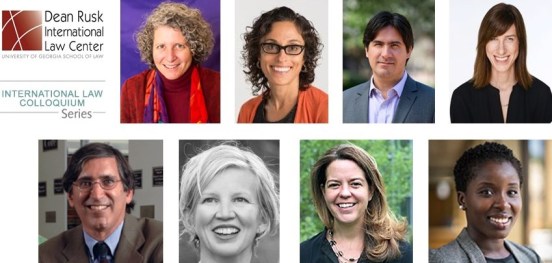
Presenting at the Spring 2020 Colloquium (pictured above, clockwise from top left):

► January 17: Karen Alter, Lady Board of Managers of the Colombian Exposition Professor of Political Science & Law, Northwestern University, on International Economic Governance and Dispute Resolution: A Contractual v. Rule-of-Law Approach? 

► January 24: Monica Hakimi, James V. Campbell Professor of Law, University of Michigan Law School, on Making Sense of Customary International Law 

► February 7: Jorge Contesse, Associate Professor of Law, Rutgers Law, on The Rule of Advice in International Human Rights Law

► February 21: Karen Knop, Professor, University of Toronto Faculty of Law, on Greenham Common Women’s Peace Camp and Foreign Relations Law From the Ground Up 

► February 28: Dan Bodansky, Foundation Professor of Law, Sandra Day O’Connor College of Law, Arizona State University, on Is the Concept of War Really Obsolete? 

► March 20: Fleur Johns, Professor, Faculty of Law, University of New South Wales, and current member of the Institute for Advanced Study at Princeton University, on #Help: The Digital Transformation of Humanitarianism and the Governance of Populations 

► March 27: Rachel Brewster, Jeffrey and Bettysue Hughes Professor of Law, Duke Law, on Corporate Families

► April 17: Matiangai Sirleaf, Assistant Professor of Law, University of Pittsburgh Law School, on Racial Valuation of Diseases

Georgia Law Professor Cohen takes part in AALS roundtable on law, international economic security


Harlan G. Cohen, Gabriel M. Wilner/UGA Foundation Professor in International Law and Faculty Co-Director of Dean Rusk International Law Center, participated in a roundtable on “Changing Concepts of International Economic Security & the Law” at the Annual Meeting of the Association of American Law Schools.

Organized by Kathleen Claussen (University of Miami School of Law), other participants in the AALS roundtable included: Anupam Chander (Georgetown University Law Center), Jennifer Daskal (American University, Washington College of Law), Kristen Eichensehr (University of California, Los Angeles School of Law), J. Benton Heath (New York University School of Law), Jide O. Nzelibe (Northwestern University Pritzker School of Law), Aaron D. Simowitz (Willamette University College of Law), Anna Spain Bradley (University of Colorado Law School), and Edward T. Swaine (The George Washington University Law School). (credit for photos)

Participants convened to discuss emergent global tensions between economics and national security and how the relevant legal regimes – trade, investment, development, finance, and national security – might respond. Among the topics of discussion were two papers by Professor Cohen:

one that discusses domestic national security delegations to the Executive Branch in the United States; and

another, “Nations and Markets,” that attempts to diagnose the causes of current global conflicts over jobs, data, climate change, and beyond (prior post).

UGA Professor Jonathan Peters Participates in Expert Workshop on the ICCPR at Cambridge

JP headshot (1).jpgJonathan Peters, a media law professor with appointments in the School of Law and the Grady College of Journalism and Mass Communication, was among 34 scholars, policy leaders, and United Nations officials who participated in an expert workshop last week at the University of Cambridge on the right to peaceful assembly.

2019-12-04_11-36-49_243The workshop’s purpose was to support the U.N. Human Rights Committee by informing its drafting of General Comment No. 37 on Article 21 of the International Covenant on Civil and Political Rights. Article 21 guarantees the right of peaceful assembly, and the General Comment will provide an authoritative interpretation of that right as well as substantive guidance to ensure its practical enjoyment.

One significant open question is whether General Comment No. 37 will recognize the Internet as a space where assemblies occur—on social media platforms and through other information and communication technologies. Participants exchanged ideas about whether and how Article 21 could be interpreted to protect virtual assemblies.

Peters, whose research explores digital media and the law, discussed the state action doctrine in U.S. law and how it distinguishes public and private action, along with the history and evolution of the public forum doctrine and its application to physical and virtual spaces.

Other workshop participants came from the U.N. Human Rights Committee, the Office of the U.N. High Commissioner for Human Rights, the Organization for Security and Co-operation in Europe, the Office for Democratic Institutions and Human Rights, the European Center for Not-for-Profit Law, the International Center for Not-for-Profit Law, Amnesty International, Article 19, and numerous universities.

Georgia Law Professor Harlan Cohen presents at Hebrew University on “Metaphors and International Law”

Harlan G. Cohen, Gabriel M. Wilner/UGA Foundation Professor in International Law and Faculty Co-Director of the Dean Rusk International Law Center at the University of Georgia School of Law, presented earlier this month at “International Law’s Invisible Frames – Social Cognition and Knowledge Production in International Legal Processes,” a 2-day conference at the Hebrew University of Jerusalem Faculty of Law in Israel.

Cohen’s presented “Metaphors and International Law” on a panel, chaired by  Moshe Hirsch, which also included a talk by Dr. Shiri Krebs of Australia’s Deakin University Law School. The discussant was Hebrew University Law Professor Tomer Broude.

Georgia Law Professor Walter Hellerstein gives lecture in Vienna on tax law in global digital economy


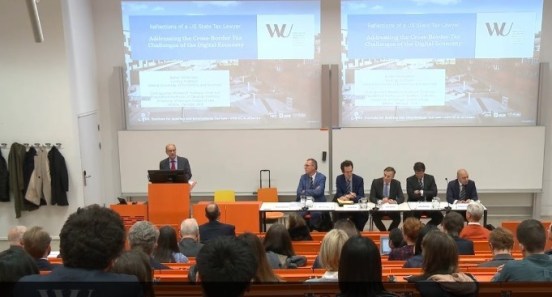
Walter Hellerstein, Distinguished Research Professor & Shackelford Distinguished Professor in Taxation Law Emeritus here at the University of Georgia School of Law, recently delivered a lecture at the Institute for Austrian and International Tax Law, Vienna University of Economics and Business.

As a visiting professor at the institute, Hellerstein spoke on “Addressing the Direct and Indirect Tax Challenges of the Digital Economy: Reflections of a US State Tax Lawyer on Recent International and Subnational Developments.” Video of his lecture is here.

New Cambridge corporate law, governance, and sustainability handbook coedited by Georgia Law Professor Christopher Bruner

Cambridge University Press has just published a handbook co-edited by Professor Christopher Bruner, the Stembler Family Distinguished Professor in Business Law here at the University of Georgia School of Law.

Entitled The Cambridge Handbook of Corporate Law, Corporate Governance and Sustainability, the 700-plus-page book consists of 50 chapters, by 60 contributors from around the world.

Bruner and his co-editor, Professor Beate Sjåfjell of the University of Oslo in Norway, wrote the introduction and conclusion, which establish the conceptual framing for the project, and each also contributed substantive chapters. Bruner’s is chapter 36, “Leaders or Laggards? Corporate Sustainability In Hong Kong And Singapore.”

The book received some strong endorsements, including from senior officials in the European Commission; the Executive Director of the Aspen Institute’s Business & Society Program; a world-leading climate scientist; and prominent law and business scholars from around the world. It features forewords by Mervyn King, an emeritus professor and judge in South Africa who is a global leader in sustainability-oriented reporting, and Vanderbilt Law Professor Margaret Blair, an economist and co-author of one of the more prominent theories of corporate governance.

The Handbook is available here.

Georgia Law Professor Brown authors biography of internationally known rights lawyer, Ramsey Clark

The work of an internationally known civil rights and criminal defense lawyer is the subject of a new Stanford University Press biography by Professor Lonnie T. Brown Jr., who holds the A. Gus Cleveland Distinguished Chair of Legal Ethics and Professionalism and is a Josiah Meigs Distinguished Teaching Professor here at the University of Georgia School of Law.

Defending the Public’s Enemy: The Life and Times of Ramsey Clark examines the life of a man – due to celebrate his 92d birthday later this month – who followed his 2 years of service as Attorney General, the United States’ top law enforcement officer, with decades as the legal representative of a range of individuals and groups at odds with US policies. His foreign clients included the Palestine Liberation Organization, Qaddafi’s Libya, an accused Rwandan génocidaire, Serbian President Slobodan Milošević – and as detailed in Chapter 11, Saddam Hussein, president of Iraq for nearly a quarter-century before he was deposed, captured, convicted by a tribunal, and executed.

Professor Brown’s book details these cases and others, and explores – in chapters enriched by interviews with Clark and his colleagues – what has motivated Clark to pursue this career path.

Georgia Law Dean Bo Rutledge, students Katherine Larsen and Miles Porter publish on Cuba sanctions

Recent change in US policy toward Cuba is the subject of a new commentary by the dean and 2 student researchers here at the University of Georgia School of Law.

Coauthoring the Daily Report article, entitled “Lawyers Should Keep Their Eyes on Cuba Sanctions Cases,” were international business law expert Peter B. “Bo” Rutledge, Dean and Herman E. Talmadge Chair of Law at Georgia  Law, along with 3L Katherine M. Larsen and 2L Miles S. Porter.

The article examines the potentially “broad implications for entities that conduct business in or with Cuba” that may follow from the announcement earlier this year that a portion of the mid-1990s “Helms-Burton Act would no longer be suspended, thereby allowing U.S. nationals to file lawsuits against any individual or entity that ‘traffics in property expropriated by the Cuban government.”

The full commentary is here.

Georgia Law Professor Amann publishes in AJIL on ICJ advisory opinion on Chagos Archipelago

Professor Diane Marie Amann‘s most recent publication appears in the latest print edition of the American Journal of International Law, in the section that analyzes recent judgments. Entitled “International Decisions: Legal Consequences of the Separation of the Chagos Archipelago from Mauritius in 1965,” it may be found at 113 AJIL 784 (2019).

The essay sets forth key aspects of the advisory opinion (available here) that the International Court of Justice issued this past February respecting the Chagos Archipelago, a group of islands located in the Indian Ocean. The archipelago was considered part of Mauritius when both comprised a British colony. But after Mauritius won independence in the mid-1960s, Britain kept the archipelago, ejected its inhabitants, and leased it for a US military base, still there today. The legality and effects of this withholding, or detachment, were at the core of the ICJ proceedings.

Here at the University of Georgia School of Law, Amann holds the Emily & Ernest Woodruff Chair in International Law and serves as Faculty Co-Director of the Dean Rusk International Law Center. (Editor of AJIL’s International Decisions section is our Center’s other Faculty Co-Director, Georgia Law Professor Harlan Grant Cohen.)

Amann’s article, which also forms part of Georgia Law’s Dean Rusk International Law Center Research Paper Series at SSRN, may be accessed at this SSRN link or at the AJIL website. (She surveyed more recent developments related to this issue at her personal blog, in a post yesterday entitled “Chagos islands, at International Court of Justice and on to UK campaign trail.”)

Here’s the AJIL abstract:

“Decolonization and its quite valid discontents lay at the center of the recent International Court of Justice advisory opinion regarding the territory and populations of the Chagos Archipelago, located in the Indian Ocean. Answering questions posed by the UN General Assembly, the concluded that because these islands were detached from Mauritius as a condition of independence, the decolonization of Mauritius had not been completed in accordance with international law. The Court further ruled unlawful the United Kingdom’s continued administration of the Chagos Archipelago and called upon all UN member states to aid completion of the decolonization process. As detailed in this essay, the advisory opinion contained significant pronouncements on decolonization, on the right of all peoples to self-determination, and on the formation of customary rules respecting both.”