Last month, the University of Georgia School of Law hosted its fourth annual International Law Hackathon, led by Professor Natalia Pires De Vasconcelos.
The International Law Hackathon is one-credit mini-course on a selected topic in international law that concludes with an intensive, day-long collaborative exercise. The theme of this year’s hackathon was the international human rights of incarcerated people, with particular emphasis on their right to health and the prohibition of cruel, inhuman, or degrading treatment under international law.
Working in five interdisciplinary teams of four, students spent the morning developing creative and persuasive solutions to a complex scenario involving the death of an incarcerated woman following delays in emergency medical care in a U.S. prison. Teams were tasked with designing legal and advocacy strategies to seek accountability, obtain reparations, and promote broader structural reforms, drawing on both international human rights treaties and norms (such as the Mandela Rules, the Bangkok Rules, and the ICCPR) as well as U.S. Eighth Amendment doctrine.
In the afternoon, teams presented their proposals to a distinguished panel of four judges with expertise spanning international law, prison studies, criminal law, and legal theory:
- Taher S. Benany, Associate Director, Dean Rusk International Law Center, Georgia Law
- Roberta Olivato Canheo, Postdoctoral researcher, FGV Law São Paulo
- Thomas E. Kadri, Associate Professor of Law, Georgia Law
- Christian Turner, Associate Professor of Law, Georgia Law
Judges evaluated presentations based on the teams’ ability to mobilize legal frameworks, engage human rights principles, and propose innovative and transformative solutions that make international human rights language relevant to incarcerated people’s rights cases in the United States. The presentations were of exceptionally high quality, and the judges noted the depth, creativity, and rigor across all teams. In fact, selecting first and second place proved challenging: when asked individually, each judge identified different top teams, and all five teams were recognized as top choices by at least one judge.
After thoughtful deliberation, the judges selected the top two teams:
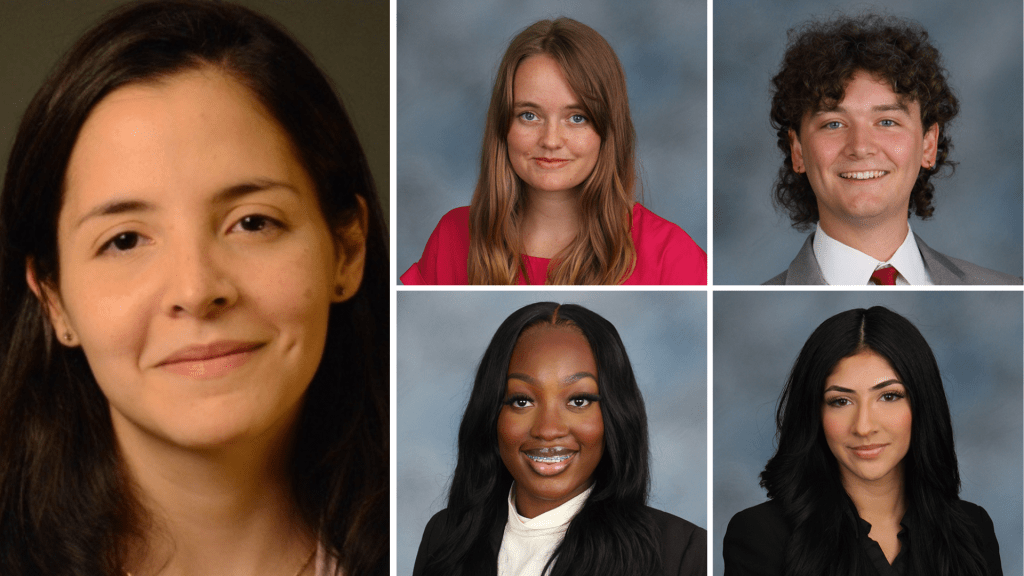
First Place – Team Lions and Tigers
- Kellianne Elliott (J.D. ’26)
- Camara King (J.D. ’26)
- Mason Favro (J.D. ’26)
- Jovanna Aceves (J.D. ’26)
Second Place – Team Pegasus
- Adoris Gibbs (J.D. ’26)
- Daniel Missroon (J.D. ’27)
- Carsen Christy (J.D. ’26)
- Alexis Ortiz (J.D. ’27)
The hackathon showcased students’ ability to think across disciplines, engage critically with legal tools, and address urgent questions surrounding health, accountability, and the rights of incarcerated populations. The creativity and rigor demonstrated by all participants made this year’s event a great success.

 The workshop’s purpose was to support the U.N. Human Rights Committee by
  exchange of notes