Drawing links between initiatives to increase protection of children during armed conflict & similar violence


“‘Protecting Children’: A Welcome Addition to Efforts to Redress Wartime Harms,” an essay I published yesterday at Just Security, underscores connections among a number of recent initiatives related to children and armed conflict.

The essay welcomes Protecting Children in Armed Conflict (Hart Publishing 2018), the 600-page report of the 2017 Inquiry on Protecting Children in Armed Conflict spearheaded by Gordon Brown, former British Prime Minister and current UN Special Envoy for Global Education. (I served on the Inquiry’s Advisory Panel.)

Leading a team of researchers was Shaheed Fatima QC, a barrister at London’s Blackstone Chambers, who spoke on this work at the International Law Weekend panel last month. (prior post here) My Just Security essay offers a detailed description and favorable critique of this research, noting the work’s connections with what the UN Security Council terms the “Six Grave Violations against Children in Armed Conflict.”

The essay further draws links between this work and the 2016 International Criminal Court Office of the Prosecutor Policy on Children, which I had the honor of helping to prepare in my ongoing service as ICC Prosecutor Fatou Bensouda’s Special Adviser on Children in & affected by Armed Conflict. (prior post here) The essay points to “the complementary potential of these and other initiatives,” and concludes:

Together, they may advance two essential goals: first, to articulate norms prohibiting wartime harms against children; and second, to secure redress for any such harms that occur.

My Just Security essay is here. It is part of a miniforum which began with a post last week jointly authored by Fatima and Brown, available here. The Just Security series will continue with forthcoming posts by Sarah Knuckey (Columbia Law), Alex Moorehead (Columbia Law), and Alex Whiting (Harvard Law).

(Cross-posted from Diane Marie Amann)

Georgia Law Professor Kent Barnett compares administrative law approaches at conference in Poland


Pleased today to welcome a contribution from Kent Barnett, J. Alton Hosch Associate Professor of Law here at the University of Georgia School of Law. Professor Barnett concentrates his teaching and scholarship in the areas of contracts law, consumer law, and administrative law—including comparative approaches. He contributes the post below on his recent collaboration with European counterparts on the panel above, at a conference in Poland.

In what may come as a surprise for many American administrative law scholars, the world extends beyond Washington, D.C.

These scholars rarely consider comparative approaches to administrative law or debates in other legal systems. Perhaps they can be forgiven because of the ever-increasing complexity of domestic administrative law. But as conservative and liberal political and judicial factions contest an increasing number of longstanding tenants of domestic administrative law, comparative inquires may prove more useful and timely than ever.

I confirmed this intuition recently, when I accepted an invitation to participate in a conference concerning “Judicial Deference in Competition Law,” sponsored by the Centre for Antitrust and Regulatory Studies at the University of Warsaw this month. Taking part in a panel that considered general aspects of deference law, I discussed my research into the theoretical and doctrinal foundations of how American courts defer to administrative agencies’ determinations. My co-panelists—Drs. Mira Scholten and Rob Widdershoven, both professors at the Netherlands’ University of Utrecht—discussed deference in European Union courts or theoretical models for understanding deference in most legal systems.

Most of the legal models (whether of the EU, national European courts, or U.S. courts) follow similar paths when approaching how and whether to defer to agencies. In many instances, the terminology differs or the boundaries for similar doctrines may vary slightly. But in the main, these disparate legal systems have largely reached consensus on certain matters: deference to factual findings for technical matters and deference to discretionary decisions.

But my interactions with scholars in Poland confirmed that the European model has some striking differences from the American system—differences that inform two current debates:

► One difference, as numerous panelists mentioned during the conference, is that European models distinguish between civil and “criminal” punishments. “Criminal” matters are significant agency actions, such as large fines, which require significantly more judicial oversight. American law, in contrast, does not meaningfully distinguish between insignificant and significant agency actions against regulated parties. Perhaps doing so, however, would assuage growing concerns over U.S. regulatory agencies’ ability to fine regulated parties or deprive them of necessary business licenses, especially when regulated firms demonstrate good faith attempts at regulatory compliance.

► A second difference is that European courts do not defer to agencies’ interpretations of law. American courts, on the other hand, defer under the well-known Chevron doctrine to agencies’ reasonable interpretations of ambiguous statutory provisions. The European experience suggests that whatever Chevron’s constitutional or statutory demerits, deference to agency legal interpretations is not inevitable. Instead, it is a chosen policy or jurisprudential choice whose benefits or demerits support or cut against it.

In short, the conference represents but the beginning of comparative conversations that U.S. administrative scholars can and should have to inform debates about domestic administrative law.

Accountability for harms to children during armed conflict discussed at Center-sponsored ILW panel

NEW YORK – Ways to redress offenses against children during armed conflict formed the core of the panel that our University of Georgia School of Law Dean Rusk International Law Center sponsored last Friday at International Law Weekend, an annual three-day conference presented by the American Branch of the International Law Association and the International Law Students Association. I was honored to take part.

► Opening our panel was Shaheed Fatima QC (top right), a barrister at Blackstone Chambers in London, who led a panel of researchers for the Inquiry on Protecting Children in Conflict, an initiative chaired by Gordon Brown, former United Kingdom Prime Minister and current UN Special Envoy for Global Education.

As Fatima explained, the Inquiry focused on harms that the UN Security Council has identified as “six grave violations” against children in conflict; specifically, killing and maiming; recruitment or use as soldiers; sexual violence; abduction; attacks against schools or hospitals; and denial of humanitarian access. With regard to each, the Inquiry identified legal frameworks in international criminal law, international humanitarian law, and international human rights law. It proposed a new means for redress: promulgation of a “single instrument” that would permit individual communications, for an expressed set of violations, to the Committee on the Rights of the Child, the treaty body that monitors compliance with the Convention on the Rights of the Child and its three optional protocols. These findings and recommendations have just been published as Protecting Children in Armed Conflict (Hart 2018).

► Next, Mara Redlich Revkin (2d from left), a Ph.D. Candidate in Political Science at Yale University and Lead Researcher on Iraq and Syria for the United Nations University Project on Children and Extreme Violence.

She drew from her fieldwork to provide a thick description of children’s experiences in regions controlled by the Islamic State, an armed group devoted to state-building – “rebel governance,” as Revkin termed it. Because the IS sees children as its future, she said, it makes population growth a priority, and exercises its control over schools and other “sites for the weaponization of children.” Children who manage to free themselves from the group encounter new problems on account of states’ responses, responses that Revkin has found often to be at odds with public opinion. These range from the  harsh punishment of every child once associated with IS, without considering the extent of that association, to the rejection of IS-issued birth certificates, thus rendering a child stateless.

► Then came yours truly, Diane Marie Amann (left), Emily & Ernest Woodruff Chair in International Law here at the University of Georgia School of Law and our Center’s Faculty Co-Director. I served as a member of the Inquiry’s Advisory Board.

Discussing my service as the Special Adviser to the Prosecutor of the International Criminal Court on Children in and affected by Armed Conflict, I focused on the preparation and contents of the 2016 ICC OTP Policy on Children, available here in Arabic, English, French, Spanish, and Swahili. The Policy pinpoints the crimes against and affecting children that may be punished pursuant to the Rome Statute of the International Criminal Court, and it further delineates a “child-sensitive approach” to OTP work at all stages, including investigation, charging, prosecution, and witness protection.

► Summing up the conversation was Harold Hongju Koh (2d from right), Sterling Professor of International Law at Yale Law School and former Legal Adviser to the U.S. Department of State, who served as a consultant to the Inquiry.

Together, he said, the presentations comprised “5 I’s: Inquiry, Iraq and Syria, the ICC, and” – evoking the theme of the conference – “international law and why it matters.” Koh lauded the Inquiry’s report as “agenda-setting,” and its proposal for a means to civil redress as a “panda’s thumb” response that bears serious consideration. Koh envisaged that in some future administration the United States – the only country in the world not to have ratified the Convention on the Rights of the Child – might come to ratify the proposed new  protocol, as it has the optional protocols relating to children in armed conflict and the sale of children.

The panel thus trained attention on the harms children experience amid conflict and called for redoubled efforts to secure accountability and compensation for such harms.

(Cross-posted from Diane Marie Amann)

Georgia Law’s international law librarian, Anne Burnett, takes part in global conference in Malaysia

Pleased today to welcome a contribution from Anne Burnett, who has served since 1996 as the foreign and international law librarian at the University of Georgia School of Law Alexander Campbell King Law Library. She earned her B.A. degree from the University of Nevada, her J.D. cum laude from Georgia Law, and her MLIS from the University of Texas in Austin. Burnett teaches International Legal Research, among other courses, at Georgia Law, and is active in global societies, as indicated in the post below.

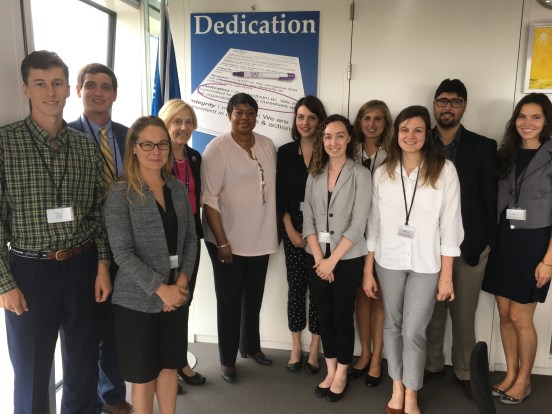
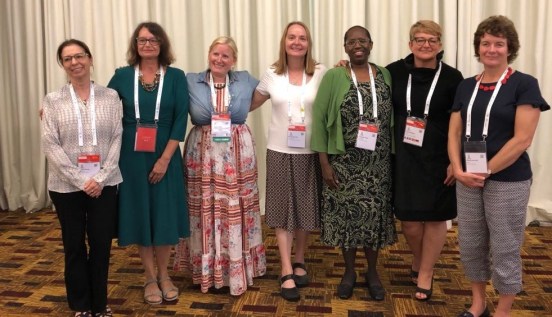
Over 3,500 librarians and information professionals gathered in Kuala Lumpur, Malaysia, this past August 24-30 for the World Library and Information Congress (WLIC), the annual conference of the International Federation of Library Associations and Institutions (IFLA). As Secretary of the Standing Committee for the IFLA Law Libraries Section (I’m at center in the Standing Committee photo at top), I participated in a week of meetings, educational programs, leadership workshops and strategic planning.

I became involved in the IFLA Law Libraries Section because of its work supporting the rule of law by promoting access to information and access to justice globally. Our section’s business meetings this year concentrated on planning upcoming workshops for law librarians in Senegal and the country of Georgia (the latter in conjunction with the Georgian-Norwegian Rule of Law Association). The section has conducted similar workshops in Croatia, Côte d’Ivoire and Uganda. These workshops spotlight open access to legal materials and also provide a nucleus for law librarian networks in the targeted regions. The section also discussed means of promoting the principles set forth in the IFLA Statement on Government Provision of Public Legal Information in the Digital Age, drafted by Section members and adopted by IFLA’s Governing Board, to encourage governments to ensure access to information, identified as a right in Article 19 of the Universal Declaration of Human Rights and in the UN’s 2030 Agenda for Sustainable Development.

One of my greatest pleasures in serving as an officer of the Standing Committee is my collaboration with law and government librarians from all corners of the world who share a common goal of providing and preserving access to government and legal information. Our Section Standing Committee meetings this year included members and observers from Africa, Southeast Asia, Australia, China, Canada, Australia and Europe.

The Section also sponsored two educational programs during the Kuala Lumpur conference:

  • In a program titled The Role of Government and Law Libraries in Times of Crisis and Turmoil, three speakers, including Law Librarian of Congress Jane Sanchez, provided examples of different roles played by government and law libraries in responding to crises and with access to justice initiatives and social advocacy projects.
  • A second program, titled Legal Capability: Law as a Life Skill, discussed programs in Canada and in the United States that seek to improve “legal capability” in the general population.

Additional programs of interest addressed global copyright issues, the impact of AI on information science, and providing services to indigenous populations.

The conference schedule allowed for some sightseeing opportunities. Kuala Lumpur (KL), the capital and largest city of Malaysia, boasts record-setting skyscrapers housing national and international corporations, high-end fashion stores, insane traffic and delicious street food (right). The large convention center, where we met, is in the shadows of the twin towers (top right) of Malay’s Petroleum Company, Petronas, which are the emblematic symbol of the city. But KL’s architecture also reflects Portuguese, Dutch and British colonialism. The population is similarly diverse, with predominately Muslim Malaysians joined by significant Indian and Chinese populations. I was fortunate to take a trip to the outskirts of KL to see the Hindu temple at the Batu Caves (above left), an international pilgrimage site with imposing statues, natural limestone caves, and very friendly and bold resident Macaque monkeys!

During a day trip to the coastal town of Melaka (or Malacca), situated between KL and Singapore, I was struck by the stark contrast between the raucous Joncker Steet Night Market and the sobering architectural reminders of colonialism. The A Famosa Portuguese fort, built in the early 16th Century by forced indigenous labor, later fell under Dutch, then British control.  Modern independent Malaysia, however, embraces its position as an upper middle—income economy, and the Malaysians I met were excited about the energy and growth there.

For a report from the overall WLIC conference, including details of the Law Libraries Section’s business meetings, see the October issue of the FCIL SIS newsletter and the FCIS SIS blog post on the Law Libraries’ Section’s educational programs.
Scholarly achievements, thriving initiatives featured in newsletter of Dean Rusk International Law Center

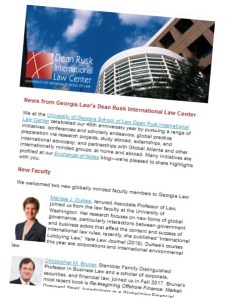
For a recap of the year’s global law-and-practice accomplishments here at the University of Georgia School of Law, have a look at the just-published annual newsletter of the Dean Rusk International Law Center. Features include:

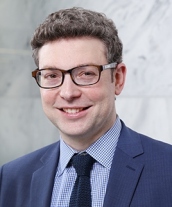
► Welcome to new professors, Melissa J. Durkee and Christopher Bruner, as well as scholarly achievements of our many other globally minded faculty and staff, including Diane Marie Amann, Jason Cade, Nathan S. Chapman, Harlan G. Cohen, Kathleen A. Doty, Matthew I. Hall, Walter Hellerstein, Laura Tate Kagel, Jonathan Peters, Lori Ringhand, Peter B. “Bo” Rutledge, Christian Turner, and Carol Watson.

Events past and future, including day-long conferences cosponsored with the Georgia Journal of International & Comparative Law, public lectures and our Consular Series of lunch talks with Atlanta-based diplomats, and cosponsorship of panels at regional and national international law meetings.

► Initiatives aimed at preparing our J.D. and LL.M. students for global legal practice, including our Global Externships and our Global Governance Summer School, plus support for students’ organizations and international advocacy teams.

The full newsletter is here.


In international law journal, Library Director Carol A. Watson publishes article on “fake news”

Critical reading is the core topic of the article that Carol A. Watson, Director of the Alexander Campbell King Law Library here at the University of Georgia School of Law, has just published in a Cambridge University Press law journal.

Watson’s article, “Information Literacy in a Fake/False News World: An Overview of the Characteristics of Fake News and its Historical Development,” 46 International Journal of Legal Information 93 (2018), stems from her panel presentation at the 2017 Annual Course of the International Association of Law Libraries.

Here’s an extract:

“Prior to designing strategies and information literacy programs to combat the dissemination and proliferation of fake/false news, it is instructive for legal information professionals to understand the characteristics of fake news and the context of its historical development.”

The full article is available here.

Georgia Law Professor Harlan Cohen Fall 2018 Senior Fellow at NYU Law Institute for International Law & Justice

cohen2017New York University School of Law is hosting University of Georgia School of Law professor Harlan Grant Cohen (right) during the Fall 2018 semester. He serves as a Senior Fellow at the Institute for International Law and Justice (IILJ).

A member of our Georgia Law faculty since 2007, Cohen (right) publishes and teaches in a range of international law areas, including trade, foreign affairs, global governance, and human rights. He is the inaugural holder of the Gabriel M. Wilner/UGA Foundation Professorship in International Law and Faculty Co-Director of the Dean Rusk International Law Center.

logos combinedWhile at IILJ, Cohen will work on projects reconsidering the normative narratives underpinning the global trading system and exploring and mapping international law’s various communities of practice. He will also be involved in Institute programs on History and Theory of International Law, Global Governance, and Infrastructure as Regulation (InfraReg).

The IILJ organizes research projects with academic and policy institutions, and conducts academic and practical training initiatives.

Center to sponsor “Inquiry on Protecting Children in Conflict” panel at annual International Law Weekend, October 19 in New York City

In support of International Law Weekend, a three-day conference of the American Branch of the International Law Association, the University of Georgia School of Law Dean Rusk International Law Center will sponsor a panel entitled “The Inquiry on Protecting Children in Conflict,” set for 3 p.m. Friday, October 19, in Room 2-02B, Fordham Law School, 150 West 62d Street, New York City.

To be discussed are findings and recommendations of the 2018 report of the Inquiry on Protecting Children in Conflict, an initiative chaired by Gordon Brown, former United Kingdom Prime Minister and current UN Special Envoy for Global Education. The Inquiry reviewed the adequacy and effectiveness of the child-protection frameworks set out in international criminal law, international humanitarian law, and international human rights law, and also proposed reforms aimed at enhancing accountability and deterring future atrocities. The report has just been in book form as Protecting Children in Armed Conflict (Hart 2018).

Panelists include:

  • Shaheed Fatima QC, Barrister, Blackstone Chambers, London (pictured above at right), who led the legal panel that compiled the Inquiry’s report.
  • Professor Harold Hongju Koh, Sterling Professor of International Law at Yale Law School (second from right), who served as a consultant to the Inquiry.
  • Mara Redlich Revkin, Ph.D. Candidate in Political Science at Yale University and Lead Researcher on Iraq and Syria for the United Nations University Project on Children and Extreme Violence (pictured at left).
  • Professor Diane Marie Amann, Emily & Ernest Woodruff Chair in International Law at the University of Georgia School of Law and our Center’s Faculty Co-Director (second from left). Amann, who serves as Special Adviser to the Prosecutor of the International Criminal Court on Children in and affected by Armed Conflict, is a member of the Inquiry’s Advisory Panel.

Another principal cosponsor of International Law Weekend, which constitutes the 97th annual meeting of the American Branch of the International Law Association, is the worldwide International Law Students Association, with which Georgia Law students’ International Law Society is affiliated.

Full program, other details, and registration here.

Georgia Law Professor Harlan Cohen presents at European Society of International Law annual meeting in the UK

cohen2017Medium-logo_esil

Harlan Grant Cohen, the Gabriel M. Wilner/UGA Foundation Professor in International Law and Faculty Co-Director of the Dean Rusk International Law Center here at the University of Georgia School of Law, recently presented at the annual meeting of the European Society of International Law in Manchester, United Kingdom.

Cohen presented his paper, entitled “What is International Trade Law For?” as part of the International Economic Law Interest Group Roundtable, “The Multilateral Trading System in Trouble.”

Known by its acronym ESIL, the goals of the European Society of International Law “are to contribute to the rule of law in international relations and to promote the study of public international law.”

Global Governance Summer School: Hague briefings begin with International Criminal Court

THE HAGUE – Our 2018 Global Governance Summer School has moved to this Dutch capital for several days of briefings at international organizations devoted to securing accountability and reparations for violations of international law. Today centered on the International Criminal Court, a permanent organization that began operating at The Hague in 2002. Its founding charter, the Rome Statute of the ICC, was adopted 20 years ago this month.

Our Georgia Law students, who spent last week at the Leuven Centre for Global Governance Studies, first visited Leiden Law School‘s Hague campus, where two international lawyers – Niamh Hayes and Leiden Law Professor Joe Powderly – talked with them about a range of issues (left). These included the development of international criminal law, practical and academic career opportunities for young lawyers interested in the area, and the advantages gained by working in The Hague on the “inside” of international criminal law issues.

The rest of the day was spent at the ICC’s Permanent Premises, located on the dunes near The Hague’s North Sea coast. Highlights of the visit included:

► A meeting with Prosecutor Fatou Bensouda (top), for whom our summer school’s co-director, Georgia Law Professor Diane Marie Amann, serves as Special Adviser on Children in & affected by Armed Conflict. Bensouda described her own path to practicing international criminal law. While acknowledging the barriers to achieving justice, she expressed the urgency of continuing the effort, on behalf of global society as well as the victims of international crimes.

► An audience with Judge Geoffrey A. Henderson (left) of Trinidad and Tobago, who was elected to the ICC in 2013 and serves in the Trial Division. Henderson emphasized the challenges of judging in a context that brings together the civil and common law systems, and offered encouragement that engaged students can change the world.

► A presentation on the work of lawyers in the court’s Registry from Elizabeth Little, Special Assistant to the Registrar, Special Assistant to the Registrar, and an overview of the court’s work from ensuring the right to family life of the accused to assisting the indigent select defense counsel.

Together, these presentations made for an informative and inspiring day in court.