Professor Bruner publishes chapter on “How Small Jurisdictions Compete in International Financial Services”

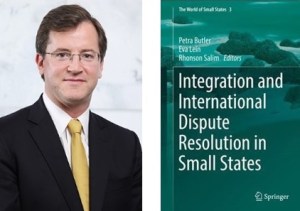
Christopher M. Bruner, J. Alton Hosch Professor of Law here at the University of Georgia School of Law, has just published “How Small Jurisdictions Compete in International Financial Services.”

This chapter appears in Integration and International Dispute Resolution in Small States, a 2018 Springer volume edited by Petra Butler (Victoria University of Wellington, New Zealand), Eva Lein (University of Lausanne, Switzerland), and Salim Rhonson (Open University).

Bruner’s contribution is a revised version of his keynote address at a conference on “International Financial Services and Small States,” held in London in 2017.

Professors Hall and Turner present in Netherlands, at Association for Law, Property and Society annual meeting


Professors Matthew I. Hall and Christian Turner, both members of the University of Georgia School of Law faculty, recently presented at the annual meeting of the annual conference of the Association for Law, Property & Society, held this year at the University of Maastricht in the Netherlands.

Hall (pictured top left) and Turner delivered their presentation, entitled “The Judicial Agenda and Angry Neighbors,” as part of a 5-paper panel on “Designing Optimal Rules, Markets, and Registries in Property Law.”

Known by its acronym ALPS, the Association for Law, Property & Society “brings together scholars from different disciplines to discuss their work and to foster dialogue among those working in property law, policy, planning, social scientific field studies, modeling, and theory.”

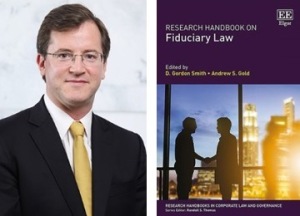
Professor Bruner compares UK, US business practices in new “Research Handbook on Fiduciary Law”

Christopher M. Bruner, J. Alton Hosch Professor of Law here at the University of Georgia School of Law, has just published “Opting Out of Fiduciary Duties and Liabilities in U.S. and U.K. Business Entities.” It appears as a chapter in a 2018 Edward Elgar volume, entitled Research Handbook on Fiduciary Law, and edited by D. Gordon Smith, Dean and Glen L. Farr Professor of Law at Brigham Young University’s J. Reuben Clark Law School,  and Andrew S. Gold, Professor of Law at DePaul University College of Law.

Here’s the SSRN abstract for Bruner’s contribution:

This chapter explores the extent of contractual freedom to opt out of fiduciary duties and liabilities in U.S. and U.K. business entities, including the U.S. corporation, general partnership, limited partnership, limited liability partnership, and limited liability company, and the U.K. limited company, general partnership, limited partnership, and limited liability partnership.

Discernible commonalities emerge from this comparative analysis. Notably, corporate law readily permits reducing liability exposure for breaches of duty in each jurisdiction, yet provides only quite limited capacity to carve back at the substance of the duties themselves. Meanwhile, unincorporated entities in each jurisdiction offer substantially greater latitude to limit the duties themselves, in some cases resulting in purely contractual business relationships.

Yet substantial differences are also apparent. U.S. corporate law permits greater insulation from liability exposure, and U.S. unincorporated entities generally provide clearer and more extensive latitude to eliminate default duties of loyalty and care outright (particularly in Delaware). One cannot comprehensively declare that U.S. law universally deviates further from the “fiduciary” governance paradigm, however, because the U.K. limited liability partnership has gone further by providing an entity form in which no such general default duties apply at all.

The analysis raises some complex comparative questions, and the chapter closes with brief reflections on why such trends, commonalities, and divergences may have arisen.

Professor Amann publishes “Bemba and Beyond,” on accountability and command responsibility, at EJIL: Talk!

One week after the International Criminal Court Appeals Chamber acquitted a Congolese politician-warlord whom a Trial Chamber unanimously had convicted of rape, pillage, and other crimes, practitioners and scholars continue to debate the decision’s significance. Indeed, the case, Prosecutor v. Bemba, has been invoked in both the papers so far presented at the 2-day ICC Scholars Forum now under way at Leiden Law School’s Hague campus.

My own initial thoughts – concerned not about the decision’s fact-based details but rather to its refashioning of the legal doctrine of command responsibility – have been published at EJIL: Talk!, the blog of the European Journal of International Law. My post, entitled “In Bemba and Beyond,” discusses command responsibility as “a time-honored doctrine with roots in military justice and international humanitarian law.” Placing this appeals judgment in the context of other decisions, the post warns:

“Together, such rulings suggest a turn away from the goal of assigning responsibility at high levels, and toward a jurisprudence which acknowledges (with regret) the commission of crimes, yet holds no cognizable legal person responsible.”

Full post here.

(Cross-posted from Diane Marie Amann)

Georgia Law Professor Harlan Cohen presents “Multilateralism’s Life Cycle” in visit at University College London

Harlan Grant Cohen, the Gabriel M. Wilner/UGA Foundation Professor in International Law and Faculty Co-Director of the Dean Rusk International Law Center here at the University of Georgia School of Law, spent the last two weeks as a visitor of University College London (UCL) Faculty of Laws newly renovated building, Bentham House.

As part of Cohen’s visit, UCL’s Global Governance Institute invited him to give a public keynote lecture on “Multilateralism’s Life Cycle.” As previously posted, that is the topic of his forthcoming article for the American Journal of International Law.

Cohen is a member of AJIL’s Board of Editors, and serves as Editor of the journal’s International Decisions section.

Georgia Law Professor Amann presents “A New History of the Nuremberg Trials” at Oxford University’s Bonavero Institute of Human Rights

We’re pleased today to cross-post this report from Professor Diane Marie Amann, Emily & Ernest Woodruff Chair in International Law and Faculty Co-Director here at the Dean Rusk International Law Center, University of Georgia School of Law, who undertook research-intensive semester this spring:

OXFORD – A capstone of my Hilary-Trinity Term visit here took place yesterday, when I presented “A New History of the Nuremberg Trials: Figuring Women and Others into the Narrative” to law students and faculty who gathered at the Bonavero Institute of Human Rights, located at Oxford University’s Mansfield College. The Oxford Transitional Justice Research network cosponsored.

Professor Kate O’Regan, director of the institute and a former judge on the Constitutional Court of South Africa, opened my Research Visitor Seminar. Then came my  presentation of my research on the roles women played at Nuremberg – not only the Trial of the Major War Criminals before the International Military Tribunal, but also the 12 subsequent American trials before what are known as the Nuremberg Military Tribunals. Next, Dapo Akande, Professor of Public International Law at Oxford’s Blavatnik School of Government, offered discussant’s remarks before opening the floor for a stimulating round of Q&A.

I’m grateful to all at the Institute for this event and the hospitality I’ve enjoyed during my stay at a Bonavero Research Visitor and Mansfield College Visiting Fellow. Grateful, too, for the opportunities I’ve had to present this work elsewhere in Europe, at the Irish Centre for Human Rights at the National University of Ireland Galway, University of Stockholm, University of Göttingen, and Max Planck Institute Luxembourg.

Georgia Law Professor Chapman presents “Due Process of War” at Oxford University Faculty of Law

OXFORD – University of Georgia School of Law Professor Nathan S. Chapman recently visited Oxford University to deliver a paper entitled “Due Process of War.” He spoke at Oxford’s Trinity College, on the invitation of the Programme for the Foundations of Law and Constitutional Government, a project within the auspices of the Oxford Faculty of Law.

In his presentation, Chapman set forth an historical account of how thinkers in America’s founding era understood the interplay of war and due process. He then linked these understandings to much more recent events, such as the United States’ 2011 targeted killing by drone strike of an American citizen, Anwar al-Awlaki.

The paper follows from Chapman’s other works in this area, including “Due Process Abroad,” published in 2017 in the Northwestern University Law Review.

Student editors create online platform for 48-year-old Georgia Journal of International and Comparative Law

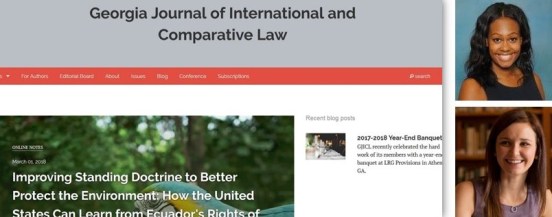
It’s our pleasure today to publish this post by Victoria Aynne Barker, pictured above at bottom right, who will receive her J.D. degree tomorrow as part of the University of Georgia School of Law commencement. Victoria’s distinguished law student career includes service as the 2017-18 Editor-in-Chief of the 48-year-old Georgia Journal of International and Comparative Law. In the post below, Victoria announces GJICL’s newest initiative:

The Georgia Journal of International and Comparative Law is pleased to announce the release of its new online platform, pictured above. All issues from the past 5 years are viewable on this website, as well as 3 online-only student notes from this year.

The new website will serve as the online face of the Journal, publishing pieces also available in the Journal’s print version and providing information about the Journal’s yearly conference.

Jamie McDowell, the Executive Online Editor, spearheaded this project. Like me a member of the Georgia Law J.D. Class of 2018, Jamie is pictured above at top right.

We look forward to seeing how the 2018-19 Online Editors, Kyle Paladino and Jacob McClendon, further develop the Journal’s online presence in the future.

GJICL’s new website can be viewed here.

Jane Addams and Belva Ann Lockwood, et al., the newest members of ASIL

A warm welcoming of new members highlighted the recent annual meeting of the American Society of International Law.

Those welcomed included two luminaries – a Nobel Peace Prizewinner and a U.S. Presidential candidate – plus untold others, as reflected in this resolution, adopted by ASIL’s General Assembly:

RESOLVED,

That the American Society of International Law, wishing to provide recognition and posthumous redress to women who were excluded from membership in the Society during its early years, hereby confers membership on JANE ADDAMS, BELVA ANN LOCKWOOD, and any other women whose applications for membership were denied from 1906-1921.

FURTHER RESOLVED,

That the Society should undertake additional research to determine which members of other groups also were excluded from membership over the course of the Society’s history, and merit similar redress.

ASIL President Lucinda A. Low (left) introduced the resolutions, one of her last acts before handing the presidency to Professor Sean D. Murphy. Low, a partner at Steptoe & Johnson LLP, acted in response to a member inquiry – an inquiry prompted, as Low told ASIL members, by “International Law and the Future of Peace,” the speech I gave upon receiving the 2013 Prominent Woman in International Law award of ASIL’s Women in International Law Interest Group. As I indicated in that speech, original credit is owed to yet another ASIL President: Professor Alona Evans (below left), the 1st woman elected to lead the Society, in 1980, her tenure cut short by her death at age 63 that same year.

Six years earlier, Evans and Carol Per Lee Plumb had published “Women and the American Society of International Law” in the American Journal of International Law. They reported that ASIL, founded in 1906, had refused women’s applications for membership until 1921, the year after the U.S. Constitution was amended to give women the right to vote. Applicants before that time included:

► Lockwood (1830-1917) (top, middle), an attorney-activist who gained admittance to the District of Columbia bar in 1873 thanks to the intervention of U.S. President Ulysses Grant. Thereafter, she became the 1st woman to appear on an official ballot as a candidate for U.S. President, and also the 1st to argue a case before the U.S. Supreme Court.

► Addams (1860-1935) (top, right), the Chicago settlement house leader whose achievements including chairing the 1915 International Congress of Women at The Hague and serving and the 1st President of the Women’s International League for Peace and Freedom. She would earn the Peace Prize in 1931.

According to Evans’ co-authored article, when Addams sought ASIL membership, she was sent a letter in which she was “invited, instead, to subscribe to the Journal ‘for the same amount as the annual dues ….’” That letter constitutes one of the few remaining records of such applications; it is for this reason that the 2018 Resolution refers to all women, known and unknown, who were denied membership.

Similarly lacking is evidence of how members of other groups fared in ASIL. (The sole African-American person elected ASIL President, C. Clyde Ferguson Jr., served just before Evans.) The Society has further resolved to seek this information and grant redress.

As for Evans, President Low indicated that the Society is considering how best to honor her legacy. These resolutions surely constitute a superb 1st step.

(Cross-posted from Diane Marie Amann)
Associate Dean Lori Ringhand wins Fulbright Distinguished Chair at University of Aberdeen in Scotland

Delighted to announce that Lori A. Ringhand, Associate Dean for Academic Affairs and J. Alton Hosch Professor of Law here at the the University of Georgia School of Law, has been awarded a Fulbright Distinguished Chair for Spring 2019, when she will be in residence at the University of Aberdeen, Scotland. While overseas, she also will present a Fulbright Gresham College Lecture.

A scholar whose expertise includes comparative constitutional law, Ringhand earned a B.C.L. in European and Comparative Law from Oxford University in England, and a J.D. from the University of Wisconsin Law School. She plans to spend the semester researching U.S. and British approaches to campaign finance regulation.