Visiting Scholar Piotr Uhma Delivers Lecture on International Law and Democracy

IMG_2095Last week, Georgia law faculty, students, and friends from other departments were treated to a lecture by Dr. Piotr Uhma, Visiting Research Scholar at the Dean Rusk International Law Center. Uhma presented his new paper, completed while in residence at the Center, What democracy is the value of international law? In it, he focuses on the linkages between democracy and international law, explores the shape of democracy in the context of a changing international order, and the issue of non-liberal democracy. In particular, he discussed Poland’s recent political changes and what they mean for democracy and the rule of law.

Uhma serves as a lecturer in international law and postdoctoral researcher at the Andrzej Frycz Modrzewski Kraków University, located in Kraków, Poland. He formerly held multiple posts with the Organization for Security and Co-operation in Europe, and worked as Director of the Legal and Corporate Communications Office of the Polish Electric Power Grid company, PSE Operator S.A. He has been visiting at the Center during the spring 2018 semester.

Professor Bruner’s book wins praise from two law journal reviewers

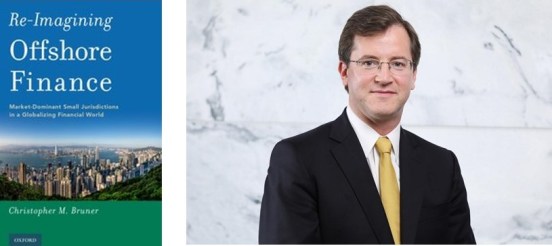
Winning accolades in two law journal book reviews is Re-Imagining Offshore Finance: Market-Dominant Small Jurisdictions in a Globalizing Financial World , a 2016 Oxford University Press volume by Christopher M. Bruner, J. Alton Hosch Professor of Law here at the University of Georgia School of Law:

► In a 19-page analysis entitled “Tax Havens as Producers of Corporate Law” and published in the Michigan Law Review, author William J. Moon, Acting Assistant Professor at New York University School of Law, describes Bruner’s book as

“a significant contribution to the literature that should become required reading for both consumers and producers of knowledge concerning the regulation of global financial transactions.”

► Beginning at page 312 of the “Book Annotations” section of a recent issue of the NYU Journal of International Law and Politics is a review by student Zachary S. Freeman. He describes Bruner’s work as “compelling,” and credits it for explaining

“a fundamental question of international finance: how are small jurisdictions able to compete with global powers?”

Center’s Laura Tate Kagel presents on integrating migrants in Germany

CES KagelOur Center’s Associate Director for International Professional Education, Dr. Laura Tate Kagel, presented her paper, “Integration Measures and Conceptual Limits: The Example of Germany,” at the recent 25th annual International Conference of Europeanists in Chicago.

Kagel’s timely paper examines the integration of migrants in Germany following the massive influx of refugees to the country.  She analyzes the legal and policy measures adopted in Germany to address the issue, provides an overview of the historical evolution of attitudes toward immigration in the German context, and discusses the tensions embodied in the current concept of migrant integration in light of the rise of populist politics.

The conference was sponsored by the Council for European Studies, which supports multidisciplinary research on Europe through a wide range of programs and initiatives.

Center to co-host launch of OUP book on trade by Director Emeritus Johnson

We at the Dean Rusk International Law Center are delighted to co-host the launch of The Wealth of a Nation: A History of Trade Politics in America (Oxford University Press 2018), by our Director Emeritus, C. Donald Johnson.

The event will take place 4-5 p.m. in Room 285 of the University of Georgia Richard B. Russell Library for Political Research and Studies, with which our Center is co-sponsoring.

In his presentation, Johnson, who served as our Center’s Director from 2004 to 2015, will examine the history of trade politics as a means to explore the question whether the United States is better served by a free trade agenda or protectionist measures.

It’s a subject on which Johnson has particular expertise: he served from 1998 to 2000 as Ambassador in the Office of the United States Trade Representative, and then specialized in international trade law as a partner at the Washington law firm Patton Boggs. Additionally, while serving from 1993 to 1995 as a U.S. Representative on behalf of Georgia’s 10th District, Johnson focused on national security and international economic policy, including legislation implementing North Atlantic Free Trade Agreement and the World Trade Organization.

Last September, Johnson joined other experts in a panel entitled “Setting the Negotiation Agenda,” part of a daylong Georgia Journal of International & Comparative Law symposium on “The Next Generation of International Trade Agreements.”

Johnson served as an Articles Editor for that journal while a student at the University of Georgia School of Law, from which he earned his J.D. in 1973. Thereafter, he studied at the London School of Economics and Political Science, earning an LL.M. degree in International Economic Law and International Relations.

Georgia Law students, Center take part in ASIL annual meeting in Washington

Many of us the University of Georgia School of Law Dean Rusk International Law Center took part last week in a whirlwind of activities at the American Society of International Law Annual Meeting in Washington, D.C.

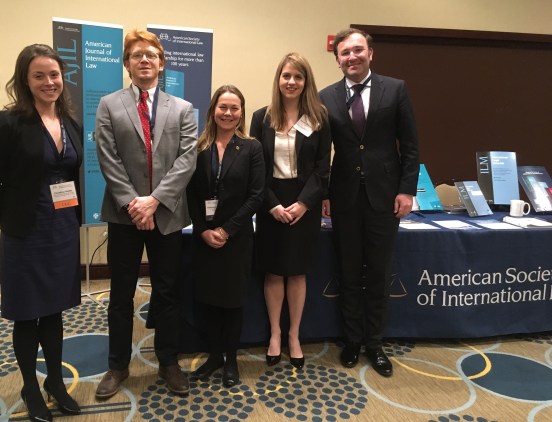
Supported by Louis B. Sohn Profession Development Fellowships awarded by our Center, Georgia Law students again volunteered at the meeting (prior posts here and here). Standing at either side of Center Director Kathleen A. Doty in the photo above, this year’s Sohn Fellows were Wade Herring and Hanna Karimipour. Flanking them, in turn, are Christine Keller, our Center’s Associate Director for Global Practice Preparation, and Dr. Piotr Uhma, our Visiting Scholar from the Andrzej Frycz Modrzewski Kraków University, Poland. Also in D.C. were Georgia Law student Chanel Chauvet, who has just completed a term as Student President of the worldwide International Law Students Association, and Laura Tate Kagel, our Center’s Associate Director for International Professional Education.

Among those speaking at the Annual Meeting were Doty, who moderated a panel on the crisis in Yemen, and Professor Harlan Cohen, our Center’s Faculty Co-Director, who participated in a launch of his new coedited book. Their presentations were among the scores of Annual Meeting panels and speeches, by judges, scholars, and practitioners of international law from around the world.

Pride of place: Georgia Law’s international law curriculum and initiatives rank No. 15 in US News

Delighted to share the news that the just-released 2019 US News rankings place our international law curriculum here at the University of Georgia School of Law at No. 15 in the United States.

We’re situated just below UCLA and Stanford, just above Northwestern and the University of Texas, and 3 slots higher than last year. By our count, this marks the 4th time in recent years we’ve been among the top 20 or so US law schools for international law.

The achievement is due in no small part to the enthusiastic support and hard work of everyone affiliated with Georgia Law’s 40-year-old Dean Rusk International Law Center. To name a few:

► Stellar members of the law faculty, including: Dean Peter B. “Bo” Rutledge, an international arbitration expert; Associate Dean Lori A. Ringhand, a scholar of comparative constitutional law; our Center’s Faculty Co-Directors, Professors Diane Marie Amann, currently at the University of Oxford, as a Research Visitor at the Bonavero Institute of Human Rights and Visiting Fellow at Mansfield College, and Professor Harlan G. Cohen, an expert in global governance and foreign relations law; Professors Christopher M. Bruner, a comparative corporate governance scholar, Jason A. Cade, an immigration expert, Sonja West and Elizabeth Chamblee Burch, who have presented on media law and civil procedure, respectively, in Budapest and Tel Aviv, Walter Hellerstein, a world-renowned tax specialist, Nathan S. Chapman, a scholar of due process and extraterritoriality, and Michael L. Wells, a European Union scholar; and our Center’s Director, Kathleen A. Doty, an arms control specialist;

► Talented students pursuing JD, MSL, and LLM degrees, including: the dozen or so who work with us as Dean Rusk International Law Center Student Ambassadors; the staffers and editors of the Georgia Journal of International and Comparative Law who produce one of the country’s oldest student journals, and who led our Fall 2017 conference on international trade; the advocates on our Willem C. Vis International Commercial Arbitration Moot and Philip C. Jessup International Law Moot Court teams; participants in our Global Externships and our Global Governance Summer School; the leaders of our International Law Society and, this year, of the worldwide International Law Students Association; and the students who take part each week in our Legal Spanish Study Group;

► Superb Center staff like Laura Tate Kagel, Christine Keller, Britney Hardweare, and Mandy Dixon;

► Visiting scholars like Professor Yanying Zhang of Shandong University, China, and Dr. Piotr Uhma of Andrzej Frycz Modrzewski Kraków University, Poland;

► Academics, practitioners, and policymakers, from all over the world, who have contributed to our events – conferences and lectures, as well as our International Law Colloquium Series;

Graduates who excel as partners in international commercial law firms, as directors of public law entities like the United Nations World Food Programme, as in-house counsel at leading multinational enterprises, and as diplomats and public servants – and who give back through mentoring and other support;

► Our valued partnerships, with Georgia Law student organizations; with institutions like the Leuven Centre for Global Governance at Belgium’s University of Leuven; with organizations like the International Committee of the Red Cross, the American Society of International Law, the American Branch of the International Law Association, IntLawGrrls blog, Global Atlanta, the World Affairs Council of Atlanta, the Atlanta International Arbitration Society, and the Planethood Foundation; with professional groups including the Georgia Asian and Pacific American Bar Association and the Vietnamese American Bar Association; with university units like the School of Public & International Affairs, the Department of Comparative Literature, the African Studies Institute, the Institute for Native American Studies, the Latin American & Caribbean Studies Institute, and the Willson Center for Humanities & Arts.

With thanks to all, we look forward to continue strengthening our initiatives in international, comparative, transnational, and foreign relations law – not least, in the preparation of Georgia Law students to practice in our 21st C. globalized legal profession.
Georgia Law Professor Bruner, Cambridge corporate governance book co-editor, presents at Oslo conference

Professor Christopher M. Bruner took part last week in a Norway conference leading to a new Cambridge University Press book he is co-editing.

Bruner, who is J. Alton Hosch Professor of Law at the University of Georgia School of Law and member of our Dean Rusk International Law Center Council, together with his co-editor, University of Oslo Law Professor Beate Sjåfjell, introduced, moderated, and concluded the symposium for the Cambridge Handbook of Corporate Law, Corporate Governance and Sustainability (forthcoming 2019).

Bruner also presented a draft chapter, on Hong Kong and Singapore.

The symposium, which brought together scholars from around the world who were invited to contribute to the Handbook following a competitive call for papers, was held at the University of Oslo Faculty of Law March 12-14.

Professor Cohen’s AJIL essay on “Multilateralism’s Life-Cycle” at SSRN

Harlan Grant Cohen, the Gabriel M. Wilner/UGA Foundation Professor in International Law and Faculty Co-Director of our Dean Rusk International Law Center at the University of Georgia School of Law, has posted a chapter entitled “Multilateralism’s Life-Cycle,” which will appear in a forthcoming issue of volume 112 of the American Journal of International Law.

The manuscript, which forms part of our Dean Rusk International Law Center Research Paper Series at SSRN, may be downloaded at this SSRN link.

Here’s the abstract for this essay by Professor Cohen, an expert in global governance and member of the AJIL Board of Editors:

Does multilateralism have a life-cycle? Perhaps paradoxically, this essay suggests that current pressures on multilateralism and multilateral institutions, including threatened withdrawals by the United Kingdom from the European Union, the United States from the Paris climate change agreement, South Africa, Burundi, and Gambia from the International Criminal Court, and others, may be natural symptoms of those institutions’ relative success. Successful multilateralism and multilateral institutions, this essay argues, has four intertwined effects, which together, make continued multilateralism more difficult: (1) the wider dispersion of wealth or power among members, (2) the decreasing value for members of issue linkages, (3) changing assessment of multilateral institutions’ value in the face of increased effectiveness, and (4) members’ increased focus on relative or positional gains over absolute ones. Exploring how each of these manifests in the world today, this essay suggests that current stresses on multilateralism may best be understood as the natural growing pains of an increasingly mature set of institutions. The open question going forward is what form the next stage of development will take. Will strategies of multilateralism continue or will they be replaced by smaller clubs and more local approaches?

On Holocaust Remembrance Day, thanks to archives preserving histories of post-WWII war crimes trials: Amann


LOS ANGELES – On this International Holocaust Remembrance Day, I am honored to be spending this month at the USC Shoah Foundation, reviewing testimonies of persons who did their part to set right one of history’s terrible wrongs.

Seventy-three years ago today, Soviet troops liberated Auschwitz-Birkenau, the infamous Nazi concentration camp located about 45 miles west of Kraków, Poland. Liberations of other camps by other Allied forces soon followed; among them, the U.S. liberation of Buchenwald on April 11, 1945, and the British liberation of Bergen-Belsen 4 days later.

Sixty years later, a 2005 U.N. General Assembly resolution set this date aside for commemoration of World War II atrocities; to quote the resolution, of

“… the Holocaust, which resulted in the murder of one third of the Jewish people, along with countless members of other minorities …”

The resolution further:

  • honored “the courage and dedication shown by the soldiers who liberated the concentration camps”;
  • rejected “any denial of the Holocaust as an historical event”;
  • envisaged the Holocaust as “a warning to all people of the dangers of hatred, bigotry, racism and prejudice”;
  • denounced “all manifestations of religious intolerance, incitement, harassment or violence against persons or communities based on ethnic origin or religious belief, wherever they occur”; and
  • encouraged initiatives designed to “inculcate future generations with the lessons of the Holocaust in order to help to prevent future acts of genocide.”

Among the many such initiatives are memorial centers and foundations throughout the world – 2 of which have helped me in my own research into the roles that women played during postwar international criminal trials at Nuremberg.

In December, the Holocaust Memorial and Tolerance Center of Nassau County, located in Glen Cove, New York, opened its archives to me. Special thanks to Helen  Turner, archivist and Director of Youth Education, for her assistance.

This month, as the inaugural Breslauer, Rutman and Anderson Research Fellow, I am in residence at the University of Southern California, examining documents in USC Shoah Foundation’s Visual History Archive. It has been a fruitful and moving scholarly experience, and I look forward to sharing my research at a public lecture on campus at 4 p.m. this Tuesday, Jan. 30 (as I was honored to do last week at UCLA Law’s Promise Institute for Human Rights; video here). Special thanks to all at the foundation’s Center for Advanced Research – Wolf Gruner, Martha Stroud, Badema Pitic, Isabella Evalynn Lloyd-Damnjanovic, and Marika Stanford-Moore – and to the donors who endowed the research fellowship. (Fellowship info here.)

As reflected in the 2005 General Assembly resolution, the work of such institutions helps to entrench – and to prevent backsliding from – states’ promises to ensure and respect human rights and dignity norms, set out in instruments like the 1945 Charter of the United Nations, the 1948 Convention on the Prevention and Punishment of Genocide, the 1948 Universal Declaration of Human Rights, and the 1966 International Covenant on Civil and Political Rights. To this list I would add the many documents establishing international criminal fora to prosecute persons charge with violating such norms – from  the Nuremberg-era tribunals through to today’s International Criminal Court.

(Cross-posted from Diane Marie Amann; image credit)

Professor Bruner presents on corporate law and corporate governance at international conference in England

“Contextual Corporate Governance: Tailoring Board Independence Rules by Industry” is the title of the presentation that our Christopher Bruner, J. Alton Hosch Professor of Law at the University of Georgia School of Law, delivered Monday at the annual International Corporate Governance and Law Forum, held this year in England.

Hosted by the Centre for Business Law and Practice at the University of Leeds School of Law and cosponsored by Deakin Law School of Australia and the Alexander von Humboldt Foundation, the 2-day event brought together law and business scholars from around the world to discuss corporate board composition and process.

Bruner, a member of our Dean Rusk International Law Center Council, was among the 20 or so scholars who presented, from Australia, China, England, France, Japan, Norway, and the United States. Here’s the description of his paper:

Over recent decades, several commercially prominent jurisdictions have increasingly required that listed company boards, and certain committees, consist primarily of ‘independent’ (i.e. non-executive) directors. In the United States, for example, the Sarbanes-Oxley Act and the Dodd-Frank Act respectively require that a listed company’s audit and compensation committees be entirely independent. NYSE and NASDAQ rules go further, requiring that a majority of the whole board be independent. Such requirements reflect the prevailing view that independent directors protect minority shareholder interests through greater objectivity and practical capacity to monitor and resist domineering CEOs. That such benefits outweigh the costs – notably, limited information (relative to executive directors) – is assumed.

Recent empirical work, however, increasingly casts doubt on this assumption – at least in certain contexts. While empirical studies initially found little evidence that director independence rules impact corporate performance at all, more recent studies focusing on the cost of acquiring company-specific information suggest that the impacts of such rules are far from uniform. Indeed, mounting evidence suggests that such rules may improve performance where company-specific information can be acquired at low cost, yet harm performance where the cost of information acquisition is high. These findings – commending sensitivity to industry context – dovetail with a parallel body of post-crisis studies associating board independence (and other shareholder-centric governance structures) with potentially undesirable risk-taking incentives in certain industries – notably, finance.

These perspectives offer much-needed nuance to our thinking about corporate governance reform, strongly suggesting that one-size-fits-all rules mandating uniform board structures across the universe of listed companies may widely miss the mark in important contexts. This paper will discuss the history of such reforms, canvass relevant legal and financial literatures, and explore regulatory strategies for more targeted reforms on an industry-by-industry basis.