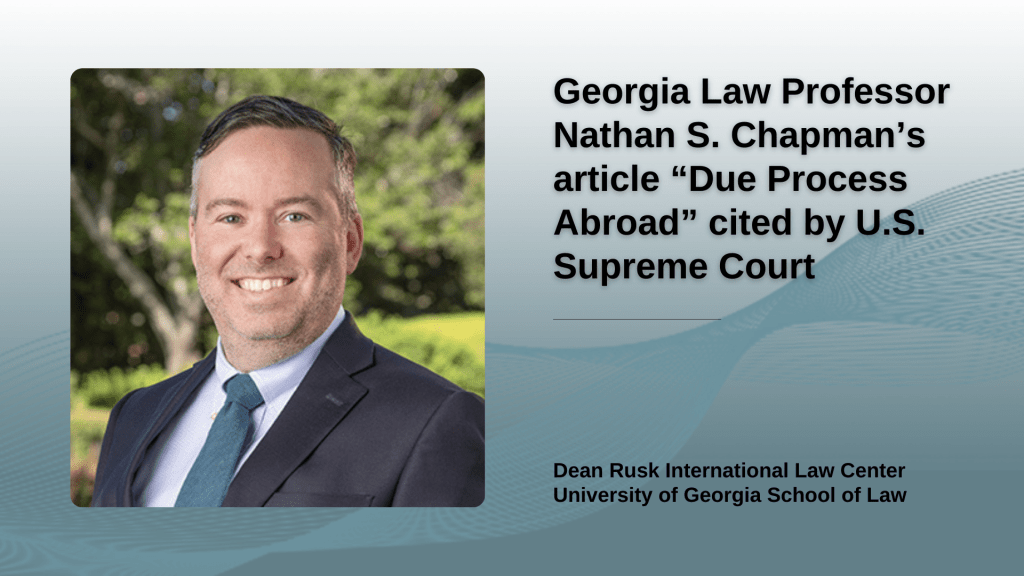
University of Georgia School of Law Professor Nathan S. Chapman’s articles “Due Process Abroad” (112 Northwestern University Law Review 377 (2017)) and “Due Process as Separation of Powers” (121 Yale Law Journal 1672 (2012) (with M.W. McConnell)) were cited by the U.S. Supreme Court in Fuid v. Palestine Liberation Organization.
Below is the abstract from “Due Process Abroad”:
Defining the scope of the Constitution’s application outside U.S. territory is more important than ever. In February, the Supreme Court heard oral argument about whether the Constitution applies when a U.S. officer shoots a Mexican teenager across the border. At the same time, federal courts across the country scrambled to evaluate the constitutionality of an Executive Order that, among other things, deprived immigrants of their right to reenter the United States. Yet the extraterritorial reach of the Due Process Clause—the broadest constitutional limit on the government’s authority to deprive persons of “life, liberty, or property”—remains obscure.
Up to now, scholars have uniformly concluded that the founding generation did not understand due process to apply abroad, at least not to aliens. This Article challenges that consensus. Based on the historical background, constitutional structure, and the early practice of federal law enforcement on the high seas, this Article argues that the founding generation understood due process to apply to any exercise of federal law enforcement, criminal or civil, against any person anywhere in the world. Outside the context of war, no one believed that a federal officer could deprive a suspect of life, liberty, or property without due process of law— even if the capture occurred abroad or the suspect was a noncitizen.
This history supports generally extending due process to federal criminal and civil law enforcement, regardless of the suspect’s location or citizenship. This principle has immediate implications for cross-border shootings, officially sponsored kidnappings and detentions abroad, the suspension of immigration benefits, and the acquisition of foreign evidence for criminal defendants.
Chapman currently serves as the law school’s associate dean for faculty development and holds the Cleveland Distinguished Chair of Law. He writes and teaches about constitutional law, especially constitutional rights, and law and religion. Most recently, he is the author, with Michael W. McConnell, of Agreeing to Disagree: How the Establishment Clause Promotes Religious Pluralism and Protects Freedom of Conscience (OUP, 2023).
 exchange of notes