UK Consul General Andrew Staunton addresses Brexit at Georgia Law

IMG_7503.2

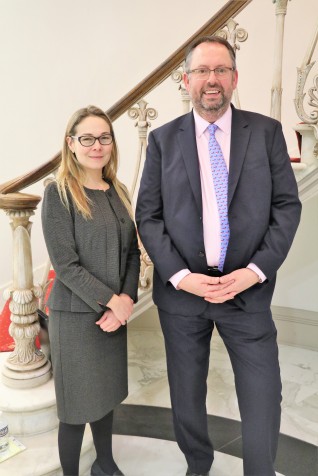
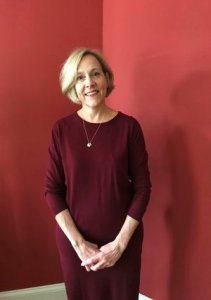
Andrew Staunton, Consul General of the United Kingdom pictured with Kathleen A. Doty, Director of Dean Rusk International Law Center

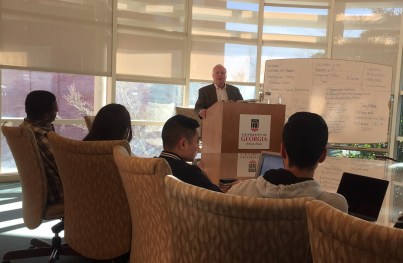
Last week, the Consul General of the United Kingdom Andrew Staunton delivered a lecture at the University of Georgia School of Law, “Leaving the EU: Impact on U.K.-U.S. Relations.” The event was the most recent installment of the Dean Rusk International Law Center’s ongoing Consular Series. The Consular Series presents students, staff, and faculty with global perspectives on international trade, cooperation, development, and policy.

In his lecture, Consul General Staunton described the political and economic context surrounding the British exit from the European Union and outlined the primary areas currently under negotiation. Describing the situation as “trying to take a raw egg out of a baked cake,” the Consul General nevertheless stressed that the United Kingdom will continue to work collaboratively with Europe and the United States to address international concerns. He emphasized that the United Kingdom will remain a strategic trading partner with the United States, and particularly with the Southeast.

Consul General Staunton has been a part of the United Kingdom’s diplomatic service since 1987. Prior to his current post as the Consul General in Atlanta, he served as Deputy Head of Mission and Economic Counsellor at the British Embassy in Athens, Greece. He was also Deputy Head of Mission at the British Embassy in Dublin, Ireland. Prior to these postings, Consul General Staunton served overseas in China, France, Romania, and Canada.

Watch the full lecture, including an introduction by Professor Diane Marie Amann, below:

Georgia Law Professor Cade and attorney Mary Honeychurch (JD18) coauthor immigration essay

The U visa – a visa set aside for nonimmigrant victims of certain crimes who have endured mental or physical abuse and are willing to assist law enforcement – is the subject of a new essay co-authored by scholars here at the University of Georgia School of Law.

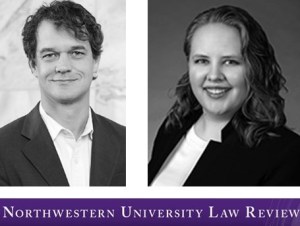
The essay, “Restoring the Statutory Safety-Valve for Immigrant Crime Victims: Premium Processing for Interim U Visa Benefits,” appears at 113 Northwestern University Law Review Online 120 (2019). It was written by Georgia Law Professor Jason A. Cade, whose teaching and scholarship focus on immigration law, and one of his former students, Mary Honeychurch (JD’18), who is now an immigration attorney at Seyfarth Shaw LLP in Atlanta.

Here’s the abstract:

“This Essay focuses on the U visa, a critical government program that has thus far failed to live up to its significant potential. Congress enacted the U visa to aid undocumented victims of serious crime and incentivize them to assist law enforcement without fear of deportation. The reality, however, is that noncitizens eligible for U status still languish in limbo for many years while remaining vulnerable to deportation and workplace exploitation. This is in large part due to the fact that United States Citizenship and Immigration Services (USCIS) has never devoted sufficient resources to processing these cases. As a result, the potential benefits of the U visa remain underrealized and communities are left less safe. In an era of sustained focus on enforcement and increased instability within immigrant communities, the situation becomes ever more urgent. This Essay introduces and defends a simple administrative innovation that would dramatically improve the process: a premium processing route for interim approvals and employment authorization. Although our proposal cannot resolve all the underlying problems, it is pragmatic, easily implemented, and superior to the status quo.”

The full essay is available here.

Georgia Law’s 2019 Jessup International Law Moot team competes in New Orleans

72ED1EF0-BD4F-4F26-8A48-B3EC8ED506D1

The 2019 Georgia Law Jessup Team, from left: Hanna Karimipour, Sam Hatcher, Lyddy O’Brien, and Drew Hedin

Members of our University of Georgia School of Law team are competing this week in the New Orleans regional rounds of the Philip C. Jessup International Law Moot Court Competition. They’re part of a 60-year-old tradition, in which law students enact the presentation of arguments before the International Court of Justice, the Hague-based judicial organ of the United Nations.

Jessup2019_HiRes_PDF_300dpiIn New Orleans and in cities across the globe, teams from more than 680 law schools, representing 100 countries and jurisdictions, are arguing this year’s Jessup dispute, Case Concerning the Kayleff Yak (State of Aurok v. Republic of Rakkab).

We at Georgia Law’s Dean Rusk International Law Center have enjoyed working with this talented team of students throughout this academic year, and we wish them the best of luck in this year’s contest.

Experts to gather March 8 for journal conference, “International Criminal Court and the Community of Nations”

This International Women’s Day, Friday, March 8, 2019, experts will gather here in Athens for a conference entitled “The International Criminal Court and the Community of Nations.”  Featured will be panels on the ICC’s relation to various constituent communities, as well as a video message from the ICC Prosecutor, Fatou Bensouda.

Principal sponsors of this University of Georgia School of Law conference are the Georgia Journal of International & Comparative Law and the Dean Rusk International Law Center, which I am honored to serve as a Faculty Co-Director. I’m pleased to serve as faculty adviser for this conference, given my ongoing role as Special Adviser to Prosecutor Bensouda on Children in & affected by Armed Conflict, and also to be joined at this conference by her Special Adviser on Crimes Against Humanity, Leila Nadya Sadat.

The conference concept note begins with a quote from the Preamble of the 1998 Rome Statute of the International Criminal Court, whose Hague headquarters of which are depicted above. In it, states parties “[r]esolved to guarantee lasting respect for and the enforcement of international justice.” The concept note continues:

“Across the globe, resurgent nationalisms place stress on institutions designed to promote human and collective security through international cooperation. Critiques – even, at times, outright denunciations – compel such institutions to re-examine, in a process that poses challenges yet also portends opportunities for renewal. The dynamic surely affects the International Criminal Court. In the last several months alone, states as varied as Burundi, the Philippines, and the United States have levied harsh criticism against this twenty-year-old justice institution, established in recognition that “children, women and men have been victims of unimaginable atrocities” that “threaten the peace, security and well-being of the world.” In the same time frame, the ICC Prosecutor welcomed a multistate referral of alleged crimes in Venezuela and launched a preliminary examination into alleged forced deportation in Myanmar, and the Court as a whole continued complementary efforts to strengthen national and regional prevention and accountability. It did so within legal, geopolitical, and budgetary constraints imposed by a trio of stakeholder communities.

“Experts from academia and the practice will cast a critical eye on ‘The International Criminal Court and the Community of Nations’; that is, on the place of the ICC vis-à-vis communities of states parties, nonparty states, and nonstate stakeholders, as well as inherited communities. Presentations will be published in the Georgia Journal of International and Comparative Law.”

Here’s the schedule:

8:45-9:00 Welcome

Dean Peter B. “Bo” Rutledge University of Georgia School of Law

9:00-10:30  Community of States Parties

Diane Desierto University of Notre Dame Keogh School of Global Affairs ǀ The Philippines and the International Criminal Court: Withdrawal from the Rome Statute and the War on Drugs

Mark Kersten Wayamo Foundation, University of Toronto Munk School of Global Affairs ǀ On the Road to Compromise? African States and the International Criminal Court

Naomi Roht-Arriaza University of California Hastings College of the Law ǀ The Role of the Court in Latin America

Leila Nadya Sadat Washington University School of Law ǀ States Parties and the Shifting Sands of the Court’s Jurisprudence

David Tolbert Duke University Sanford School of Policy ǀ A Look Back, Learning from the Experiences of the Ad Hoc Tribunals: What Lessons for the ICC?

Moderator ǀ Kathleen A. Doty University of Georgia School of Law

11:00-12:30  Community of Nonstate Stakeholders

Tess Davis Antiquities Coalition ǀ Cultural Heritage as an International Criminal Court Stakeholder

Christopher Engels Commission for International Justice & Accountability ǀ Private Investigations, Public Partnerships—Supporting International Criminal Prosecutions through Nongovernmental Organizations

Megan A. Fairlie Florida International University School of Law ǀ The International Criminal Court and the Community of Nonstate Stakeholders: Defense Issues

Valerie Oosterveld University of Western Ontario Faculty of Law ǀ Victims of Sexual and Gender-Based Violence as Stakeholders in the International Criminal Court: An Assessment

Peter Robinson Defense Counsel before International Criminal Court ǀ How the Defense Can Support the ICC

Moderator ǀ Melissa J. Durkee University of Georgia School of Law 

1:45-2:00  Video Remarks

Fatou Bensouda International Criminal Court Prosecutor

2:00-2:35  Inherited Communities

Diane Marie Amann University of Georgia School of Law ǀ What Would Maître Chalufour Say Today?

Mark A. Drumbl Washington & Lee University School of Law ǀ What Would Justice Pal Say Today?

2:45-3:45  Community of Nonparty States

Chimène Keitner University of California Hastings College of the Law ǀ International Institutions and the “Ideology of Patriotism”

Jane E. Stromseth Georgetown University Law Center ǀ The United States and the ICC: Why John Bolton’s Attack on the ICC Is Not in U.S. Interests

Saira Mohamed University of California Berkeley School of Law ǀ States Parties, Non-States Parties, and the Idea of International Community

Moderator ǀ Harlan G. Cohen University of Georgia School of Law

3:50-4:00  Closing Remarks

Morgan Renee Thomas Editor-in-Chief, Georgia Journal of International and Comparative Law

Registration, for CLE credit, and other details here. Additional cosponsors include the International Law Society, Georgia Law’s chapter of the the International Law Students Association, along with SPIA, the University of Georgia School of Public & International Affairs.
UK Consul General Andrew Staunton to speak on Brexit at Georgia Law

The Dean Rusk International Law Center at the University of Georgia School of Law will welcome Consul General Andrew Staunton to campus on Tuesday, February 12, 2019. He will give a lecture, “Leaving the EU: Impact on UK-US Relations.”

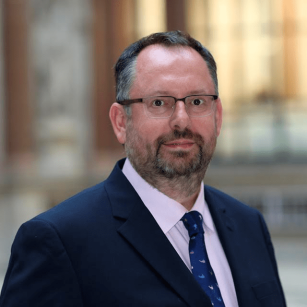
Andrew Staunton Pic

Staunton is the United Kingdom’s Consul General in Atlanta. He took up the position in June 2018, after serving for four years as the Deputy Head of Mission and Economic Counselor at the British Embassy in Athens, Greece. He also served as Deputy Head of Mission at the British Embassy in Dublin from 2009 to 2013. His time in Greece and Ireland coincided with critical points in each countries respective economies.

A career diplomat since 1987, Staunton has also held posts in China, France, Romania and Canada.

This event is presented as part of the Dean Rusk International Law Center’s Consular Series, which brings to campus perspectives on international trade, development, policy, and cooperation during the 2018-2019 academic year. The Consular Series is co-sponsored by the International Law Society, Georgia Law’s chapter of the International Law Students Association.

This installment of the Series coincides with the Center’s long-standing tradition of celebrating the birthday of another career diplomat – former Secretary of State and our Center’s namesake, Dean Rusk. In honor of Dean Rusk’s 110th birthday, lunch and celebratory cupcakes will be served.

Details here.

Learn about Georgia Law LL.M. degree at Atlanta info session Tuesday, Feb. 5

llm ad_Persons who have completed legal studies overseas are invited to learn about earning a University of Georgia School of Law Master of Laws (LL.M.) degree at a free information session this month at Atlantic Station in Atlanta.
The session will take place at 6:30 p.m. on Tuesday, February 5, 2019, and hosted at the offices of Arnall Golden Gregory LLP, 171 17th Street NW, Atlanta, GA 30363 (click here for directions).

The LL.M. is a one-year, full-time degree designed for lawyers who trained in countries outside the United States and wish to study at the University of Georgia School of Law, a 160-year-old institution that is consistently ranked among the country’s top law schools.

Georgia Law LL.M. candidates study alongside J.D. candidates. Each LL.M. student pursues a flexible curriculum tailored to his or her career goals, including preparation to be eligible to sit for the Georgia or other U.S. bar examination. Details about this decades-old initiative may be found at our website and in posts at this blog of the Dean Rusk International Law Center, the law school unit that administers the LL.M. degree.

Among those speaking at the information session will be our Center’s Associate Director for International Professional Education, Dr. Laura Kagel, as well as graduates of the LL.M. degree, who will talk about the student experience at the University of Georgia School of Law.

Other topics to be discussed at the information session include:

  • benefits of obtaining an LL.M.
  • putting together a strong application
  • costs and financial aid
  • career options for LL.M. graduates
  • steps toward preparing to take a U.S. bar examination

Interested persons are invited to register at no cost. Light refreshments will be served.

We look forward to seeing you and answering your questions there!

Alumnus Kevin Conboy lectures on marketing and sales in legal profession

img_5791_crpLast week, Kevin Conboy (JD 1979), delivered a lecture at the University of Georgia School of Law, “Where do Clients Come From? Marketing and Sales in the Practice of Law.” The event, designed for students seeking to build an international practice, was followed by a reception.

In his lecture, Conboy emphasized the importance of business development for lawyers. He covered preparation for a career after law school, and provided an overview of good lifelong marketing habits. In particular, he offered practical advice about networking skills, which students had the opportunity to practice at the reception after the event. Conboy’s talk at the Law School was based on his 2016 article, Inventory Less Sales Equals Scrap: Legal Education’s Largest Lacuna, published in the Transactions: Tennessee Journal of Business Law.  

Conboy is a retired partner at Paul Hastings and at Powell Goldstein LLP. His practice included cash-flow lending, asset-based lending, the financing of leveraged buyouts, and representation of banks and other financial institutions lending to cable television, radio, cellular and other technology and communications media. He is also the former President of the Irish Chamber of Atlanta, and served as a Visiting Associate Professor at the University of Tennessee College of Law. He served as a law clerk for the Honorable Marvin H. Shoob, U.S. District Court Judge for the Northern District of Georgia. Conboy is a graduate of LeMoyne College and the University of Georgia School of Law. 


Georgia Law Professor Diane Marie Amann profiled by ATLAS women

img_2013cropProfessor Diane Marie Amann, holder of the Emily & Ernest Woodruff Chair in International Law here at the University of Georgia School of Law and our Center’s Faculty Co-Director, was profiled at ATLAS yesterday, in a post written by the organization’s co-founder, barrister Sareta Ashraph.

ATLAS, which stands for “Acting Together: Law, Advice, Support,” is a community of female-identifying lawyers, activists, and jurists with expertise in public international law. Founded in 2012, the organization aims to create a space where women in the field can reach out to each other for information, career advice, and mentoring. ATLAS builds upon and is complementary to the ethos of IntlLawGrrls, a blog Amann founded in 2007. Her charter coeditors, as she notes, were Beth Van Schaack, Jaya Ramji-Nogales, and our Center’s Director, Kathleen A. Doty. Amann joins 8 other women so far featured by ATLAS.atlas+empowered+women+empower+women

In her profile, Amann reflects on her career path and its high points, including teaching, working with inspirational people such as Mireille Delmas-Marty, clerking for U.S. Supreme Court Justice John Paul Stevens, and serving as Special Adviser on children’s issues to Fatou Bensouda, Prosecutor of the International Criminal Court. Amann also comments on diversity of the profession, noting:

“Many (or perhaps, only some) in the profession have become more aware and more vocal on the need for diversity when it comes to gender, race, ethnicity, and sexual orientation. That has not yet translated into a level of progress that is both right and required. At the same time, there have been far fewer conversations, and less awareness, of the lack of diversity within our profession when it comes to class. There seem to be few international lawyers who come from a working-class background, who are in their family’s first college-going generation.”

Amann goes on to offer advice to young women hoping to work in international law: follow your heart; move towards the positive; never stop learning; build a network of friends and mentors; build skills; and find time to do the things that make you happy.

Read the full profile here.

Brexit and international trade expert, Dr. Hanspeter Tschaeni, to speak at Georgia Law

The Dean Rusk International Law Center at the University of Georgia School of Law is pleased to host Dr. Hanspeter Tschaeni for Coffee and Conversation: International Trade and Economic Law this afternoon.

Hanspeter Tschaeni

Dr. Tschaeni is Chief Trade Adviser at Trade Advisers, a consulting firm engaged in activities relating to the British exit from the European Union. He also serves on several World Trade Organization dispute settlement panels.

Previously, Dr. Tschaeni served for more than thirty years in the Swiss Federal Administration, where he was Head of Section on International Economic Law and Deputy Head of Division on Foreign Economic Services, with the rank of ambassador. In that capacity, he participated as legal counsel and headed delegations in negotiations with the European Union and in free-trade agreement negotiations with numerous countries around the globe.

Co-sponsors of the event include Georgia Law’s Business Law Society and the International Law Society.

Details here.

International arbitrators and mediators to speak at Georgia Law

We at the University of Georgia School of Law Dean Rusk International Law Center welcome international practitioners and scholars to campus today for an International Arbitration and Mediation Roundtable.

Panelists include: Dr. Christof Siefarth, Partner at the Cologne, Germany-based law firm GÖRG; Dr. Klaus Peter Berger, Professor of Law at the University of Cologne; and Dr. Beate Berger, Cologne-based attorney and mediator. They will discuss contemporary issues in international arbitration and mediation, as well as career paths and opportunities for interested students.

MediationRoundtable

From left, Christof Siefarth, Klaus Peter Berger, and Beate Berger

Co-sponsoring the event with the Dean Rusk International Law Center is the Alternative Dispute Resolution Society and the International Law Society.

Details here.