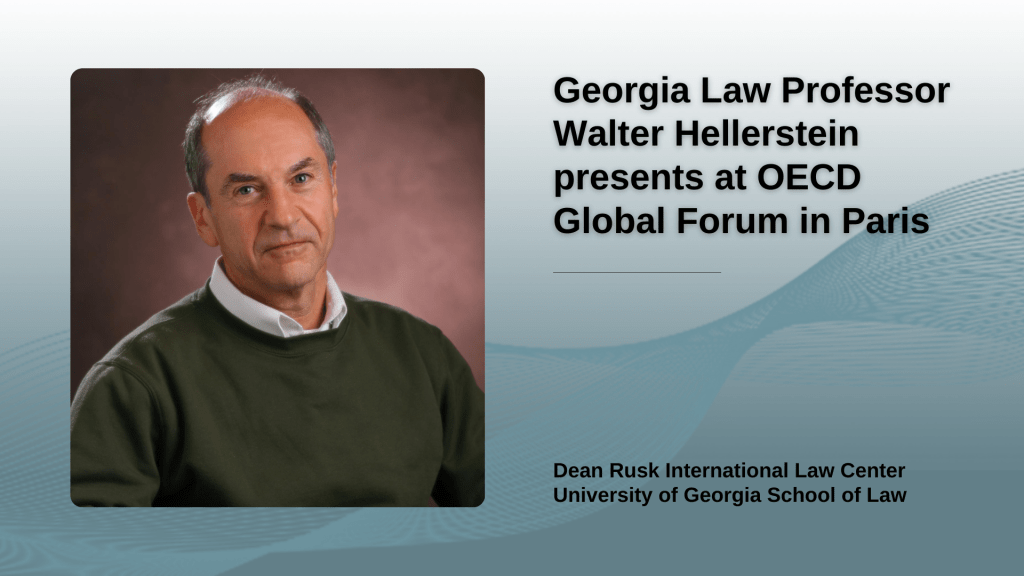
University of Georgia School of Law Professor Emeritus Walter Hellerstein presented at the Sixth Meeting of the OECDGlobal Forum on VAT in Paris, France in January. The Global Forum gathered government officials, international organizations, and business stakeholders to share approaches to building effective VAT systems.
Hellerstein is the Distinguished Research Professor & Francis Shackelford Distinguished Professor in Taxation Law Emeritus. He is a recipient of the National Tax Association’s Daniel M. Holland Medal for outstanding lifetime contributions to the study and practice of public finance, is widely regarded as the nation’s leading academician on state and local taxation. He has authored numerous books, textbooks, and law review articles, and has practiced extensively in the field. Hellerstein is currently a Visiting Professor at the Vienna University of Economics and Business, and he remains actively involved in his scholarship, consulting, and, in particular, his work as an academic advisor to the OECD.
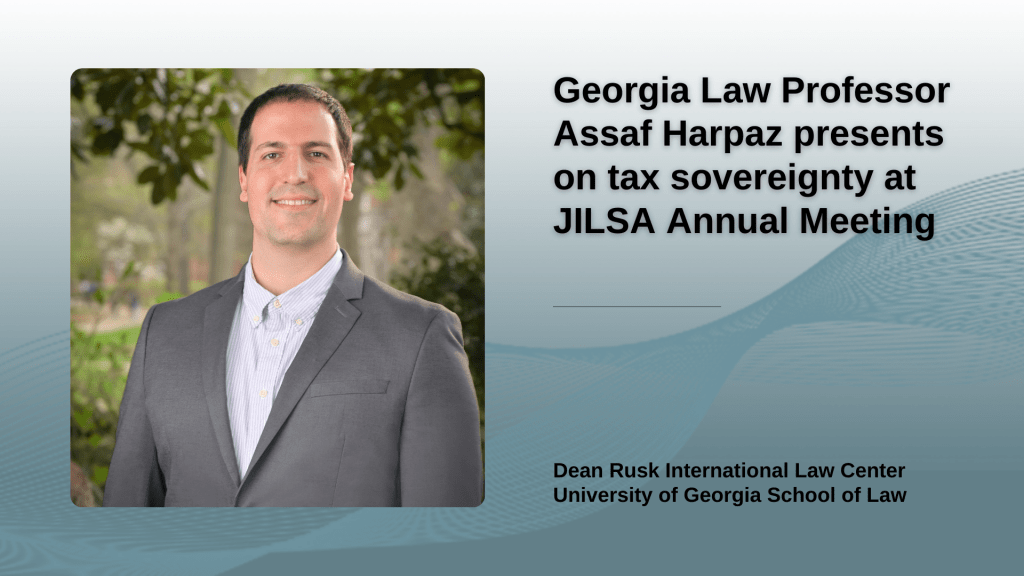
Tax sovereignty is gaining significant attention in international tax policy. The concept traditionally refers to a government’s authority to design and enforce its own tax laws, without infringement. Policymakers are increasingly invoking the principle to broaden their country’s assertions of taxing rights (e.g., on offshore profits) and to withdraw from international agreements that they deem unfavorable. While tax sovereignty has been widely debated in legal scholarship, its parameters are not clearly established. These tensions have emerged in recent negotiations on issues like the global minimum tax and the legitimacy of tax havens, highlighting the need to better conceptualize the principle. This Article explores the origins of the tax sovereignty principle and its proliferation in the current international tax discourse. It develops a doctrinal account of tax sovereignty that illuminates the obligations and limitations embedded within the concept. The Article argues that tax sovereignty operates as a legally bounded doctrine rather than an unrestricted claim of fiscal autonomy, especially if a sovereign’s policies create negative externalities to others.
In addition to presenting his own work, Harpaz served as a commentator for the presentation “Is Rule of Law Decline Rewarded in Trade? Lessons from the European Union” by Janka Deli of Stanford Law School and was a panelist for a discussion titled “Preparing for a Career in Academia.”
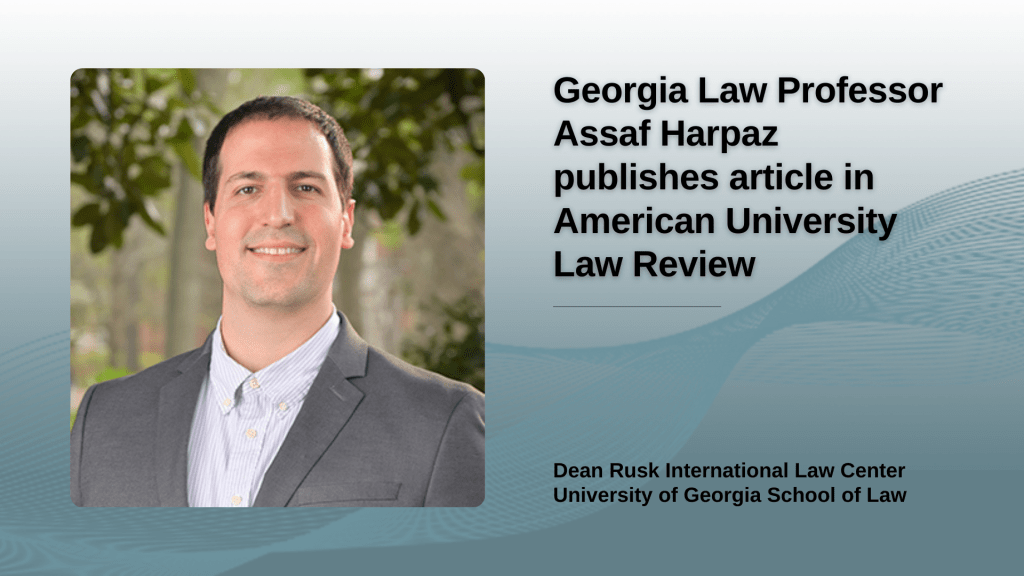
Harpaz joined the University of Georgia School of Law as an assistant professor in summer 2024 and teaches classes in federal income tax and business taxation. Harpaz’s scholarly focus lies in international taxation, with an emphasis on the intersection of taxation and digitalization. He explores the tax challenges of the digital economy and the ways to adapt 20th-century tax laws to modern business practices.
University of Georgia School of Law Professor Assaf Harpaz published “Global Tax Wars in the Digital Era” in the American University Law Review (Vol. 75, 2025). The article explores the global conflict over tax governance, particularly the tensions between OECD-led Global North countries and the UN-backed Global South. It argues for a shift toward source-based taxation that would allow countries to tax online businesses that have a “significant economic presence” without a physical one.
The article’s abstract can be found below:
The digital economy fundamentally disrupts international tax principles that rely on physical presence. When a business earns income abroad, the country of residence (where the taxpayer resides) and the country of source (where income is generated) both have legitimate, competing claims to tax that income. The international tax system tends to favor residence-based taxation. The source country has the right to tax business profits only if the enterprise carries on a permanent establishment within its borders, which typically requires physical presence. The permanent establishment standard becomes flawed in a digital economy where profit shifting practices are abundant and businesses no longer need a physical presence in the location of their online consumer markets.
An upcoming United Nations Framework Convention on International Tax Cooperation recognizes these challenges and is overwhelmingly supported by Global South economies. However, the Global North has historically dominated the international tax regime through the Organization for Economic Co-operation and Development (OECD), informally known as the “World Tax Organization.” A U.N. framework convention creates potential conflict in international tax policymaking and would need to bridge the underlying North-South divide.
This Article explores the “tax wars” surrounding the leadership for global tax governance, contrasting the taxing powers and interests of the OECD-led Global North with those of the U.N.-backed Global South. It argues for a shift toward source-based taxation by revisiting the permanent establishment standard. To achieve this, the Article promotes a significant economic presence doctrine that would expand the permanent establishment criteria to include online businesses. This proposal addresses longstanding inequities and is increasingly warranted in a digital economy that does not depend on physical presence.
Harpaz joined the University of Georgia School of Law as an assistant professor in summer 2024 and teaches classes in federal income tax and business taxation. Harpaz’s scholarly focus lies in international taxation, with an emphasis on the intersection of taxation and digitalization. He explores the tax challenges of the digital economy and the ways to adapt 20th-century tax laws to modern business practices.
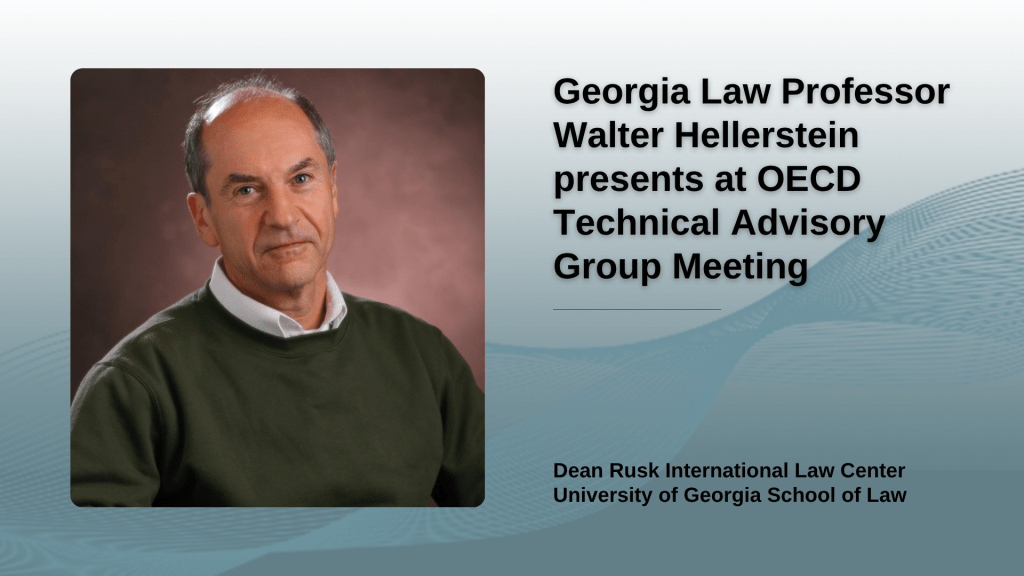
University of Georgia School of Law Professor Emeritus Walter Hellerstein presented at the Organisation for Economic Cooperation and Development Technical Advisory Group to Working Party No. 9 on Consumption Taxes meeting in October in Paris, France.
The Working Party No. 9 on Consumption Taxes is a forum for the discussion of consumption tax policy and administration, working with both Members and non-Members of the OECD to develop appropriate and effective taxation outcomes.
Hellerstein is the Distinguished Research Professor & Francis Shackelford Distinguished Professor in Taxation Law Emeritus. He is a recipient of the National Tax Association’s Daniel M. Holland Medal for outstanding lifetime contributions to the study and practice of public finance, is widely regarded as the nation’s leading academician on state and local taxation. He has authored numerous books, textbooks, and law review articles, and has practiced extensively in the field. Hellerstein is currently a Visiting Professor at the Vienna University of Economics and Business, and he remains actively involved in his scholarship, consulting, and, in particular, his work as an academic advisor to the OECD.
The digital economy fundamentally disrupts international tax principles that rely on physical presence. When a business earns income abroad, the country of residence (where the taxpayer resides) and the country of source (where income is generated) both have legitimate, competing claims to tax that income. The international tax system tends to favor residence-based taxation. The source country has the right to tax business profits only if the enterprise carries on a permanent establishment within its borders, which typically requires physical presence. The permanent establishment standard becomes flawed in a digital economy where profit shifting practices are abundant and businesses no longer need a physical presence in the location of their online consumer markets.
An upcoming United Nations (U.N.) Framework Convention on International Tax Cooperation recognizes these challenges and is overwhelmingly supported by Global South economies. However, the Global North has historically dominated the international tax regime through the Organization for Economic Co-operation and Development (OECD), informally known as the “World Tax Organization.” A U.N. framework convention creates potential conflict in international tax policymaking and would need to bridge the underlying North-South divide.
This Article explores the “tax wars” surrounding the leadership for global tax governance, contrasting the taxing powers and interests of the OECD-led Global North with those of the U.N.-backed Global South. It argues for a shift toward source-based taxation by revisiting the permanent establishment standard. To achieve this, the Article promotes a significant economic presence doctrine that would expand the permanent establishment criteria to include online businesses. This proposal addresses longstanding inequities and is increasingly warranted in a digital economy that does not depend on physical presence.
Harpaz joined the University of Georgia School of Law as an assistant professor in summer 2024 and teaches classes in federal income tax and business taxation. Harpaz’s scholarly focus lies in international taxation, with an emphasis on the intersection of taxation and digitalization. He explores the tax challenges of the digital economy and the ways to adapt 20th-century tax laws to modern business practices.
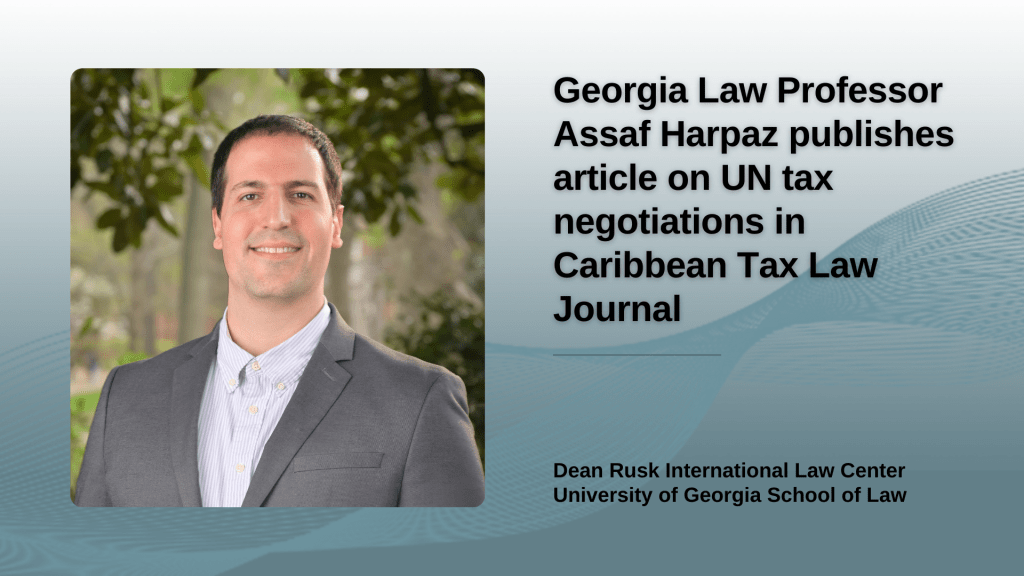
The drafting process for a United Nations Framework Convention on International Tax Cooperation, along with two early protocols, is now underway. A UN framework convention represents a Global South effort to shift international tax policymaking from the OECD to the UN. For developing countries, the UN has long been viewed as a more inclusive space for tax policy negotiations, producing more favorable but historically less influential standards compared to the OECD.
Support for the UN framework convention, including its terms of reference, has been sharply divided across traditional Global North-South lines. The backlash following the OECD’s recent two-pillar reform triggered the UN initiative, as Global South countries quickly turned to the UN to begin a new chapter in cross-border taxation. Nonetheless, the UN framework convention faces an uphill battle as the Global North and South fundamentally diverge on questions of choice of forum, tax principles, and the desired scope of the convention. The U.S.’s recent withdrawal from the UN negotiation process casts further doubt on the institution’s capacity to achieve universality and compete with the OECD for the informal title of “World Tax Organization.
This article examines the ongoing UN tax negotiations, focusing on the Global North-South tensions and the historical context of the UN forum shift. It argues that the North-South divide remains a barrier to garnering institutional legitimacy, potentially undermining the framework convention’s viability.
Harpaz joined the University of Georgia School of Law as an assistant professor in summer 2024 and teaches classes in federal income tax and business taxation. Harpaz’s scholarly focus lies in international taxation, with an emphasis on the intersection of taxation and digitalization. He explores the tax challenges of the digital economy and the ways to adapt 20th-century tax laws to modern business practices.
University of Georgia School of Law Professor Victoria J. Haneman presented “The Politics of Impermanence” as part of the Perspectives on the Development and Enactment of Tax Policy Conference at the Centre for Tax Law at the University of Cambridge in the United Kingdom this summer.
Haneman joined the University of Georgia School of Law in the fall of 2025 as the holder of the Verner F. Chaffin Chair in Fiduciary Law. Haneman comes to UGA from Creighton University, where she was a member of the law school’s faculty for seven years. In 2023, she was appointed the associate dean for research and innovation. She also held the Frank J. Kellegher Professorship of Trusts & Estates and served as the interim director of the health law program for the 2023-24 academic year. Haneman has a particular interest in tax policy, death care services, industry disruption, emerging markets, and women and the law.
University of Georgia School of Law Professor Assaf Harpaz presented his paper, Artificial Intelligence and Taxpayer Entity, at the 2025 Law and Society Association Annual Meeting in May. This presentation was part of the Global Taxation and Policy panel. Harpaz also chaired the conference’s panel on Local Governments and Tax Benefits.
Below is an abstract of the paper:
Artificial intelligence (AI) is changing the world and presents numerous challenges to legal and regulatory frameworks. The evolving, complex yet still ambiguous concept demands rethinking longstanding doctrines at risk of obsoleteness. These tensions are highlighted in federal income taxation, which generally compartmentalizes taxpayers into individuals and business entities. Technological developments such as generative AI upend these conceptions given their capacity to create value and operate autonomously, interacting with the economy in ways that combine human and non-human attributes.
Under current U.S. law, even the most advanced AI models are not directly subject to the income tax regime, as they are neither individuals nor separate business entities. AI is poised to dramatically reshape the tax base by altering both the sources of income (from humans to robots) and the type of income (from labor to capital) that is subject to tax.
This article examines the intersections and frictions between AI models and federal income tax policy. It focuses on questions of taxpayer entity and ownership that arise from the widespread use of AI. The article argues that the unique and non-binary characteristics of AI challenge the principles of personhood, income, and asset character, at the foundation of the income tax system. The extent of disruption will depend on the degree to which AI displaces human labor and achieves sentience.
Harpaz joined the University of Georgia School of Law as an assistant professor in summer 2024 and teaches classes in federal income tax and business taxation. Harpaz’s scholarly focus lies in international taxation, with an emphasis on the intersection of taxation and digitalization. He explores the tax challenges of the digital economy and the ways to adapt 20th-century tax laws to modern business practices.
The digital economy fundamentally disrupts traditional international tax principles that rely on physical presence. When a business earns income abroad, the country of residence (where the taxpayer resides) and the country of source (where income is generated) both have legitimate, competing claims to tax that income. The international tax system favors residence-based taxation. The source country has the right to tax business profits only if the enterprise carries on a permanent establishment within its borders, which typically requires a physical presence. The permanent establishment standard becomes flawed in a digital economy where profit shifting practices are abundant and businesses no longer need a physical presence in the location of their online consumer markets.
An upcoming United Nations (UN) Framework Convention on International Tax Cooperation recognizes these challenges and is overwhelmingly supported by Global South economies. However, the Global North has historically dominated the international tax regime through the Organization for Economic Co-operation and Development (OECD), informally known as the “World Tax Organization.” A UN framework convention creates potential conflict in international tax policymaking and would need to bridge the underlying North-South divide.
This article explores the “tax wars” surrounding the leadership for global tax governance, contrasting the taxing powers and interests of the OECD-led Global North with those of the UN-backed Global South. It argues for a shift toward source-based taxation by revisiting the permanent establishment standard. To achieve this, the article introduces a significant economic presence doctrine that would expand the permanent establishment criteria to include online businesses. This proposal addresses longstanding inequities and is increasingly warranted in a digital economy that does not depend on physical presence.
Harpaz joined the University of Georgia School of Law as an assistant professor in summer 2024 and teaches classes in federal income tax and business taxation. Harpaz’s scholarly focus lies in international taxation, with an emphasis on the intersection of taxation and digitalization. He explores the tax challenges of the digital economy and the ways to adapt 20th-century tax laws to modern business practices.
Distinguished Research Professor & Shackelford Distinguished Professor in Taxation Law Emeritus Walter Hellerstein presented as part of a panel on taxable persons and related issues in VAT law at the Court of Justice of the European Union Conference held at the Vienna University of Economics and Business in Austria during January.
A description of the conference can be found below:
This conference will focus on the recent case law of the Court of Justice in the area of indirect taxation. The judgment rendered from September 2018 onwards and important previous judgments will be analyzed by panels consisting of leading academics, judges, government representatives and business representatives.
Hellerstein joined the University of Georgia School of Law faculty in 1978 and was named the Francis Shackelford Distinguished Professor in Taxation Law during 1999 and a UGA Distinguished Research Professor in 2011. He taught in the areas of state and local taxation, international taxation and federal income taxation until he retired from teaching at the School of Law in 2015. He is currently a Visiting Professor at the Vienna University of Economics and Business, and he remains actively involved in his scholarship, consulting and, in particular, his work as an academic advisor to the Organisation for Economic Cooperation and Development (OECD).





 exchange of notes