The Washington International Trade Association (WITA) hosted two panels last month to discuss changing attitudes toward trade in the 250 years since the Boston Tea Party. Taking part in the panel was University of Georgia School of Law alumnus and Director Emeritus of the law school’s Dean Rusk International Law Center, Ambassador C. Donald Johnson.
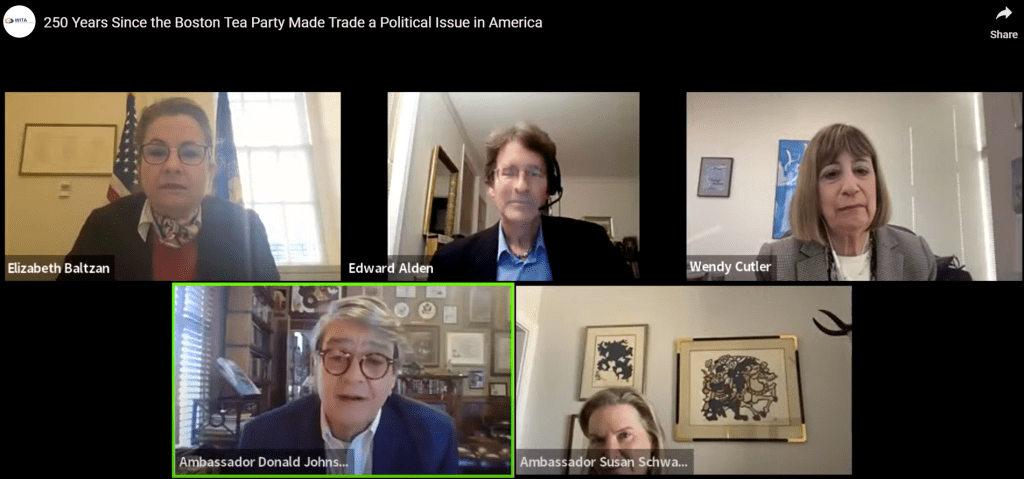
The two panels addressed the evolution of trade policy, trade’s present and future, and the role of the United States as a leader in global trade. The first panel (recording here), moderated by Edward Alden, Ross Dist Visiting Professor at Western Washington University and Bernard L. Schwartz senior fellow at the Council on Foreign Relations (CFR), featured the following speakers:
- Elizabeth Baltzan, Senior Advisor, Office of the United States Trade Representative
- Wendy Cutler, Vice President, Asia Society Policy Institute (ASPI), and Managing Director of the Washington, D.C. office; former Acting Deputy United States Trade Representative
- Ambassador Donald Johnson, Director Emeritus, Dean Rusk Center for International Law and Policy, University of Georgia; former Chief Textile Negotiator, Office of the United States Trade Representative
- Ambassador Susan Schwab, Strategic Advisor, Mayer Brown; former U.S. Trade Representative
Johnson’s comments contextualized the attitude towards trade during the era of the Boston Tea Party. He discusses the historical conflict between trade and labor, with roots in the Jefferson and Hamilton political philosophies, and moves through the industrialization of the 19th century.
Johnson’s book The Wealth of a Nation: a History of Trade Politics in America (Oxford University Press 2018) presents a history of trade politics from the 1790s through the Trump administration. He received the 2019 Certificate of Merit for High Technical Craftsmanship and Utility to Lawyers and Scholars (Honorable Mention) at the 113th American Society of International Law Annual Meeting, detailed in our previous post here.
Johnson served from 1998 to 2000 as Ambassador in the Office of the United States Trade Representative, and then specialized in international trade law as a partner at the Washington law firm Patton Boggs. Additionally, while serving from 1993 to 1995 as a U.S. Representative on behalf of Georgia’s 10th District, Johnson focused on national security and international economic policy, including legislation implementing North Atlantic Free Trade Agreement and the World Trade Organization. Johnson served as an Articles Editor for that journal while a student at the University of Georgia School of Law, from which he earned his J.D. in 1973. Thereafter, he studied at the London School of Economics and Political Science, earning an LL.M. degree in International Economic Law and International Relations.
 exchange of notes