
Mine Turhan, former Center Visiting Researcher, publishes new book based on research conducted at Georgia Law

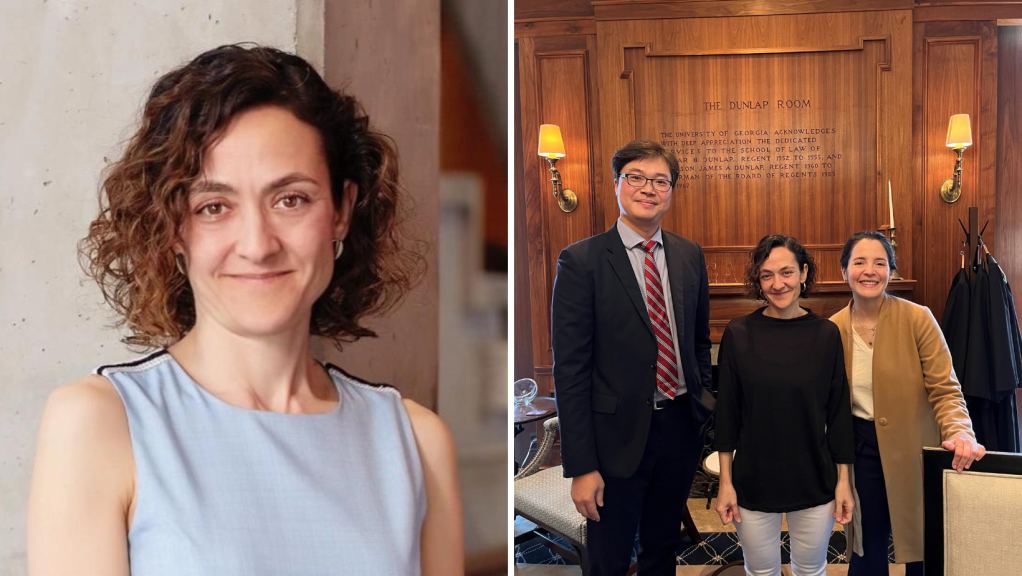
Mine Turhan, who was a Visiting Researcher at the University of Georgia School of Law’s Dean Rusk International Law Center during the 2023-2024 academic year, recently published a book, The Right to Be Heard in Administrative Procedure. Her book, written in Turkish, draws upon the research Turhan conducted during her time as a Visiting Researcher at the Center.

Turhan is an assistant professor of administrative law in the Faculty of Law at the Izmir University of Economics in Türkiye. While at Georgia Law, Turhan was sponsored by Professor David E. Shipley. Her project focused on procedural due process rights, in particular the right to be heard before administrative agencies, and it analyzed how individual rights are protected by different procedures in the U.S. and EU against arbitrary actions on the part of administrative agencies. Turhan’s research was supported by a fellowship from the Scientific and Technological Research Council of Türkiye (TÜBİTAK) within the scope of the International Postdoctoral Research Fellowship Program.

Regarding how her experience as a Visiting Researcher at Georgia Law contributed to her book, Turhan reflected:

The United States possesses a highly developed system of administrative procedure and adjudication. My experience as an observer in administrative hearings at the Georgia Office of State Administrative Hearings and in the Immigration Court in Atlanta provided an invaluable opportunity to examine the functioning of the administrative hearing process within American administrative law firsthand. This experience significantly strengthened the empirical foundation of my research by allowing me to gain direct insight into the practical implementation of administrative procedure in the United States.

Below is the introduction of the book, translated into English by Turhan:

The right to be heard is one of the most fundamental principles of administrative procedure. This right allows individuals whose legal status may be adversely affected by an administrative act to express themselves before the decision is taken. Limiting this right to judicial proceedings is not sufficient to protect individuals against the administration. In accordance with the principle of the rule of law, individuals must also be protected before an administrative act is taken. The right to be heard provides individuals with the opportunity to actively participate in the administrative decision-making process, thereby serving as an important procedural safeguard that prevents the administration from making unlawful decisions. In this respect, the right to be heard is directly linked to several principles at the core of administrative procedure law, such as good administration, participation, transparency, accountability, and legal certainty. This book examines the right to be heard in administrative procedure both within the framework of Turkish administrative procedure law and from a comparative law perspective. The main objective of the book is to offer recommendations for ensuring the effective regulation and implementation of the right to be heard in Türkiye, taking into account examples from other countries, particularly the United States. To this end, the right to be heard in administrative procedure law has been analyzed in all its aspects.
Center’s Visiting Researcher Mine Turhan reflects on her year at Georgia Law

The Dean Rusk International Law Center Visiting Researcher for 2023-2024, Mine Turhan, Assistant Professor of Administrative Law in the Faculty of Law at the Izmir University of Economics in Türkiye, recently concluded her research year at the University of Georgia School of Law under the supervision of  Georgia Athletic Association Professor in Law David E. Shipley. Below are some of Turhan’s reflections on her research findings regarding administrative procedure and procedural fairness at Georgia Law.

I was a visiting researcher at the University of Georgia School of Law and the Dean Rusk International Law Center for my post-doc research during 2023-2024 academic year.

My research was related to administrative procedure and procedural fairness. The concept of administrative procedure serves a dual purpose within a legal framework. Primarily, it defines and establishes the limits of the authority of administrative agencies by outlining the structured steps and processes they must follow. Simultaneously, administrative procedure prevents arbitrary actions of agencies by ensuring accurate decisions by the proper application of the law to the facts. This dual function promotes transparency, fairness, and accountability in the functions of administrative agencies.

My research focused on the right to be heard in administrative procedure, and administrative hearings during the process of individual measures which would adversely affect the person concerned. I looked specifically at American and European procedural rights in adjudicative proceedings, in particular the right to be heard before administrative agencies. I tried to answer how procedural rights were protected by different administrative procedures in the U.S. and European countries against arbitrary actions of administrative agencies. I also tried to understand the administrative hearing procedures and components of hearings in common law and civil law systems.

Administrative procedure acts have a significant role in protecting the procedural rights. Therefore, I focused on the administrative procedure acts of different countries to find an answer. The U.S. Administrative Procedure Act, dated 1946, was helpful for my research. I have analyzed the court precedents regarding the right to be heard and I also have observed administrative hearings in U.S. to better understand administrative hearing procedures in U.S.

Throughout my time at the Dean Rusk International Law Center, I have been impressed by the dedication of the faculty, scholars, and staff to fostering a dynamic learning environment. The guidance and mentorship I received from Professor David Shipley has been instrumental in shaping my research. His expertise and encouragement have inspired me to push the boundaries of my intellectual curiosity and pursue excellence in my studies. The resources available at the School of Law, including the extensive library collections and research databases, have greatly enriched my research endeavors.

As I reflect on my time at the Dean Rusk International Law Center, I am filled with appreciation for the enriching experiences and lasting connections forged during my research. The skills and insights gained through my research studies will undoubtedly serve me well in my future endeavors, both academically and professionally.

I extend my heartfelt thanks to everyone at the Dean Rusk International Law Center and the University of Georgia School of Law for their support and encouragement. I am proud to have been a part of such an vibrant academic community and look forward to carrying forward the relationships formed as I embark on the next chapter of my journey.

Visiting Researcher Turhan participates in spring Faculty Colloquium Series

University of Georgia School of Law Visiting Researcher Mine Turhan took part in the Spring 2024 Faculty Colloquium Series last month. Her presentation, “Right to be Heard in Administrative Procedure,” was the third of six talks this semester.

Turhan’s project at Georgia Law focuses on procedural due process rights, in particular the right to be heard before administrative agencies. Her talk began by describing the fundamentals of this right, followed by her findings about this right in comparative law, specifically focusing on the U.S. and EU countries. The final third of Turhan’s presentation looked at the right to be heard in Turkish law.

In addition to Turhan, this semester’s colloquium series includes Anne Tucker, Alyse Bertenthal, Alex Klass, Rachel Barkow, and Libby Adler. The series provides a forum for provocative and innovative legal scholarship and gives our law faculty the opportunity to collaborate on current legal research, exchange ideas and foster relationships with other institutions. It is made possible through the Kirbo Trust Endowed Faculty Enhancement Fund and the Talmadge Law Faculty Fund.

Turhan’s research is supported by a fellowship from the Scientific and Technological Research Council of Türkiye (TÜBİTAK) within the scope of the International Postdoctoral Research Fellowship Program. She is sponsored as a Visiting Research Scholar by Georgia Law Professor David E. Shipley, the Georgia Athletic Association Professor in Law. Her visit continues our Center’s long tradition of hosting scholars and researchers whose work touches on issues of international, comparative, or transnational law. Details and an online application to become a visiting scholar here.

Welcoming Mine Turhan, Visiting Scholar at UGA Law’s Dean Rusk International Law Center

We at the University of Georgia School of Law Dean Rusk International Law Center are pleased to welcome a new Visiting Research Scholar: Mine Turhan, Assistant Professor of Administrative Law in the Faculty of Law at the Izmir University of Economics in Türkiye. She holds an LL.M. degree and a Ph.D. in Public Law from Dokuz Eylül University in Izmir, Türkiye.

Professor Turhan plans to conduct research on comparative administrative procedure between the United States and the European Union during her stay at the Dean Rusk International Law Center. Her project will focus on procedural due process rights, in particular the right to be heard before administrative agencies, and it will analyze how individual rights are protected by different procedures in the U.S. and the European Union against arbitrary actions on the part of administrative agencies.

Professor Turhan is sponsored as a Visiting Research Scholar by UGA Law Professor David E. Shipley, the Georgia Athletic Association Professor in Law. Professor Shipley teaches administrative law and civil procedure.

Turhan’s research is supported by a fellowship from the Scientific and Technological Research Council of Türkiye (TÜBİTAK) within the scope of the International Postdoctoral Research Fellowship Program. Her visit continues our Center’s long tradition of hosting scholars and researchers whose work touches on issues of international, comparative, or transnational law. Details and an online application to become a visiting scholar here.

University of Georgia Professor Peters, of Grady College and School of Law, presents on digital freedom of assembly in EU-funded project supporting civil society in West Balkans and Turkey

Pleased today to welcome a contribution from our colleague Jonathan Peters, an associate professor who has faculty appointments in the Grady College of Journalism and Mass Communication and the School of Law at the University of Georgia. Dr. Peters teaches and researches in the area of media law and policy, and his post here discusses his participation November 4 in an online panel about freedom of peaceful assembly.

I had the opportunity last week to be part of an event hosted by Technical Assistance to Civil Society Organisations in the Western Balkans and Turkey (TACSO), which is a project funded by the European Union (EU) that provides support to civil society organizations (CSOs) in the region to help them contribute to public debate and democratic processes.

The two-day event, organized in cooperation with the European Center for Not-for-Profit Law (ECNL), gathered dozens of CSOs and public institutions for panels about emerging issues and trends affecting civil-society work and for exchanges about best practices in monitoring and advocacy.

I spoke on the panel “Freedom of Assembly in a Digital Age: Monitoring Online Assemblies,” along with my colleagues Francesca Fanucci, senior legal advisor at ECNL, and Florin Gisca, legal expert at Promo-LEX. Francesca covered digitally-mediated assemblies in general, and Florin explained efforts in Moldova to monitor such assemblies, while I discussed my work for ECNL to develop a related monitoring tool for use in the region and beyond.

Traditionally, the definition of peaceful assembly included physical gatherings of individuals to protest, commemorate, exchange views, and so on. But our increasingly digital world has opened up new ways to organize assemblies and new spaces in which to hold them. Digitally-mediated assembly is the umbrella term for all types of assemblies with a digital component, of which there are basically three:

  1. Digitally-enabled assemblies: These occur in a physical space but are facilitated by digital communication technologies.
  2. Digitally-based assemblies: These are sometimes called online assemblies, and they occur entirely in a virtual space, typically on a social media platform.
  3. Hybrid assemblies: These have elements of digitally-based and digitally-enabled assemblies.

For example, people have gathered online during the pandemic to express common sentiments and to protest everything from public health mandates to abortion restrictions. This has happened all over the world and in particular in Europe: in Hungary, Moldova, and Poland. Where physical protests have been suspended or unsafe to organize, they have frequently moved online.

With that in mind, on last week’s panel I discussed my ongoing work to develop a monitoring tool to allow CSOs to collect data about digitally-mediated assemblies to provide understanding of how they take place and the extent to which they are enabled, facilitated, and protected by government and private actors—as well as any special opportunities and challenges that such assemblies present.

  • Among the opportunities: Digitally-mediated assemblies can be easier to organize, they can reduce physical dangers to participants, and they can simplify administrative procedures for organizers.
  • Among the challenges: Digitally-mediated assemblies can be disrupted by platform content moderation, they can be weakened by the digital divide, and they can be undermined by the viral spread of misinformation and disinformation.

This is just a selection of the issues that I hope monitors will be able to explore, and I’m eager to continue working with ECNL and others to support the CSOs that will do the actual monitoring.