Georgia Law Professor Desirée LeClercq leads experiential learning opportunity for students in Atlanta

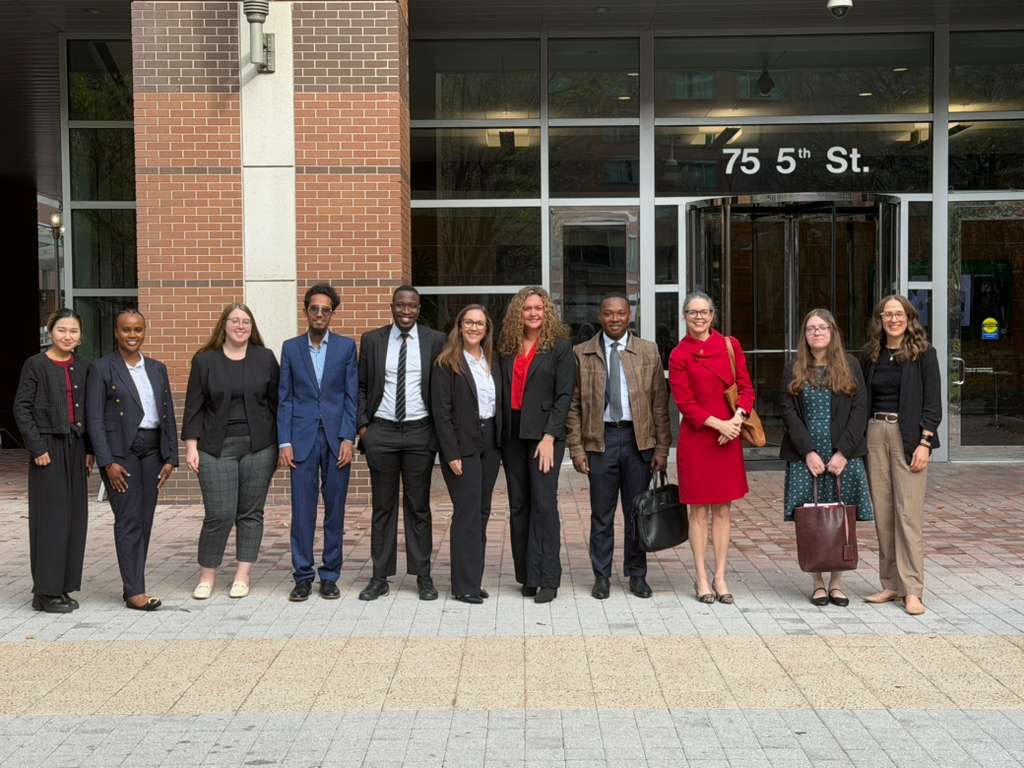
In November, University of Georgia School of Law Professor Desirée LeClercq traveled to Atlanta with a group of students as the culmination of their semester-long exploration of international trade.

15 students, including J.D., LL.M., and Graduate Certificate in International Law students, spent the semester examining potential trade and investment opportunities between the State of Georgia and the United Kingdom from an interdisciplinary perspective. They researched and wrote a paper examining key export and import sectors in Georgia and the United Kingdom, and then prepared a hypothetical Memorandum of Understanding (MoU) between the two. The students spent the day in Atlanta presenting to, and fielding technical questions from, three different audiences: representatives from the state of Georgia, transactional and international lawyers from Eversheds Sutherland, and foreign diplomats from the U.K. consulate.

Georgia Department of Economic Development

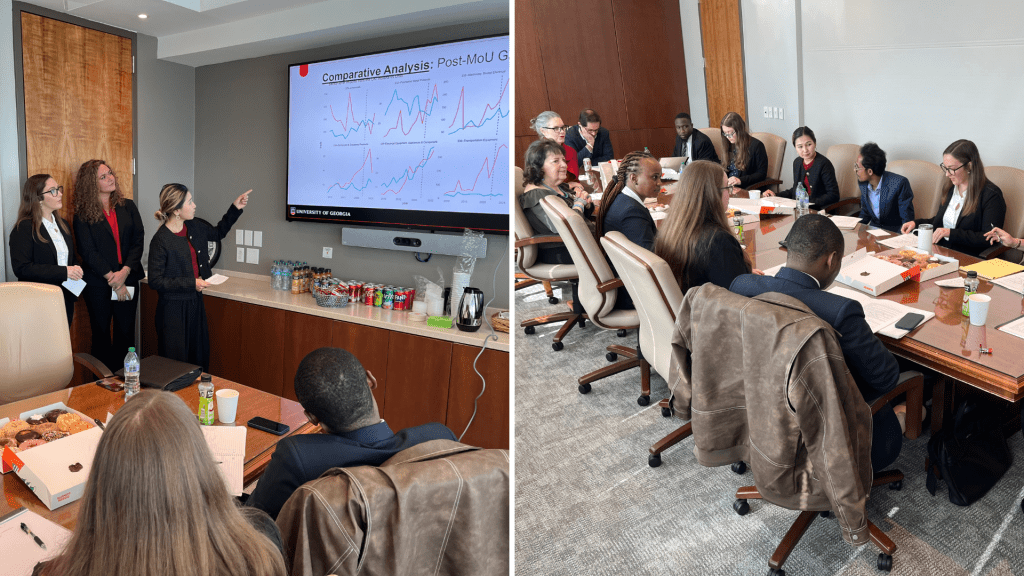
The group’s first stop of the day was hosted by the Georgia Department of Economic Development (GDEcD), the state’s sales and marketing arm, and had in attendance other state representatives.

At the GDEcD, Madina Bekisheva (GCIL student), Sutton Eady (J.D. ’27), Md. Asaduzzaman Jabin (GCIL student), and Jalyn Ross (J.D. ’27) worked together to present their portion of the hypothetical legal instrument. In their presentation, the group argued for greater collaboration and synergies between the state and the United Kingdom to attract, facilitate, and potentially grow trade. Their arguments centered on export and import data from similarly situated states and novel predictive models they had built demonstrating how enhanced collaborations with the United Kingdom could increase trade and job opportunities in Georgia. The students used the model to identify specific sectors in industry, renewable energy, commerce, and agriculture, among others, where Georgia’s economy and workers could benefit.

Eversheds Sutherland

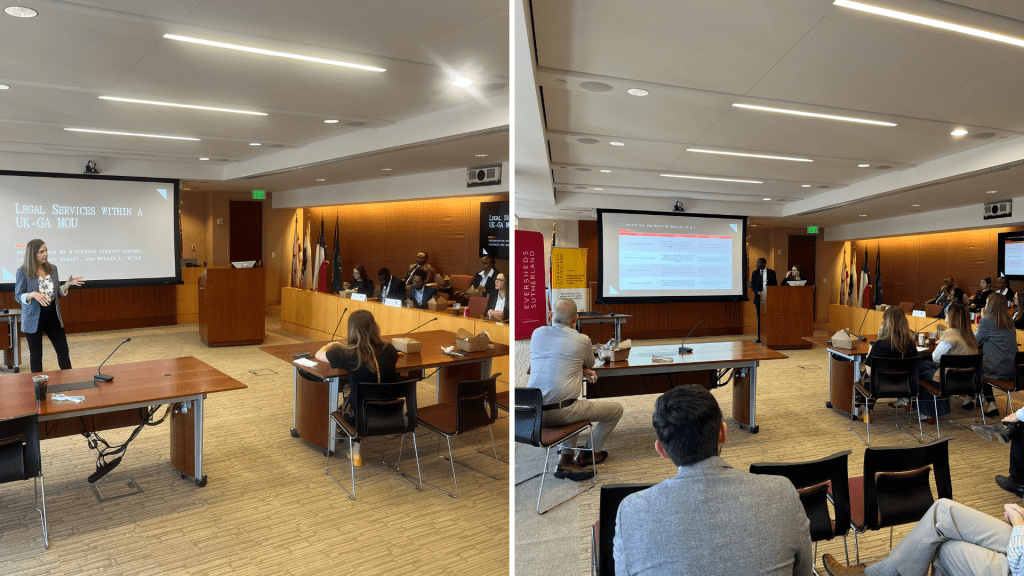
The group’s second stop of the day was the Atlanta office of Eversheds Sutherland, a global law firm specializing in corporate, energy, litigation, tax, and real estate. This firm has a meaningful relationship with the UK, as it is where the Eversheds law firm originated prior to their 1988 merger with Sutherland. The firm’s global headquarters is located in London, and its historic ties to the country are evident in their presence throughout the British legal market. Students Leighlee Mahony (J.D. ’26) and N’Guessan “Clement” Kouame (LL.M. ’24, J.D. ’26) presented. Both students argued that enhanced trade and investment collaboration between Georgia and the United Kingdom could offer reciprocity in sectors, including legal services.

The students were hosted by Jenny Lambert, Partner, and attended by several practicing attorneys in transactional and international work. The students benefitted both from the lunch that Eversheds Sutherland generously provided, as well as in-depth and vigorous questioning by the firm’s attorneys.

British Consulate General Atlanta

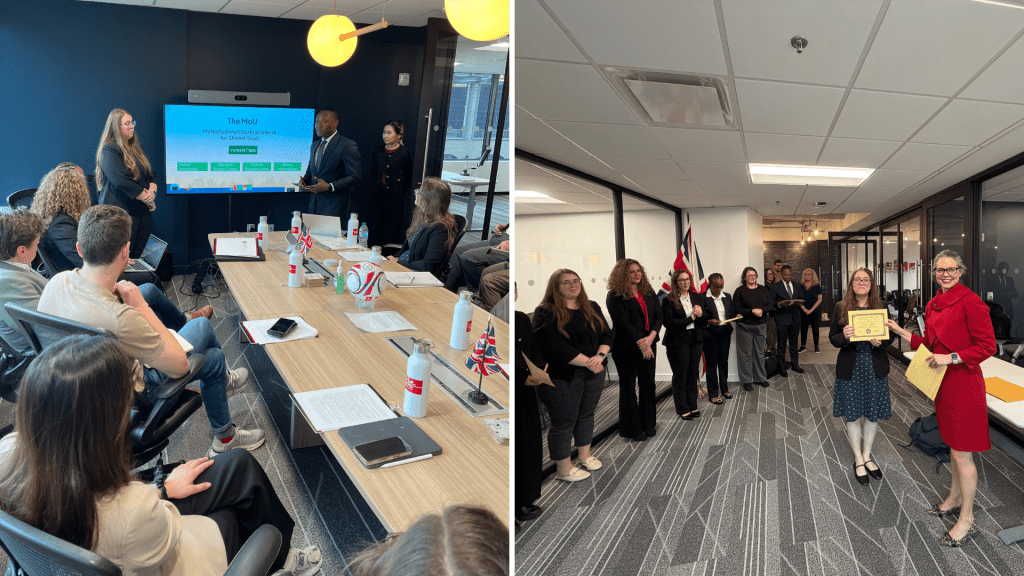
The group’s third and final stop of the day was the British Consulate General Atlanta. Students Maya Roper (J.D. ’27), Victor Azure (LL.M. ’26), Wambui Kamau (LL.M. ’26), and Madina Bekisheva (GCIL student) presented the group’s data and modeling to U.K. diplomats and officials. The group again walked the audience through specific trade and industry sectors, with a special focus on battery production for electric vehicles, the Georgia aerospace industry’s advantage, and veterinary medicine.

Student Reflections

“Coming from a non-law background in Computer Science, I learned that successful trade and partnerships do not thrive on innovation alone. They must be shaped by policy and political realities, economic conditions, population needs, national interests, and stakeholder relationships. The Atlanta trip made this clear by showing how quickly trade negotiations can shift based on context, not on the brilliance of the technology or business itself.” – Md. Asaduzzaman Jabin (GCIL student)

“This course was a great blend of theory and practice, requiring intensive and insightful legal research to understand and gather the materials, as well as concise, precise, and clear drafting of the MoU. The most significant site visit for me was the visit to the Georgia Department of Economic Development. It was a great experience to compare our findings with the department’s work and its vision for improvement. It was also interesting to know that people at the GDDE were doubtful about the use of models for the prediction of growth or value from MoUs. It shows how sometimes new technology may face skepticism for its implementation and convince people to advance or improve their old methods.” – N’Guessan “Clement” Kouame (LL.M. ’24, J.D. ’26)

Georgia Law Professor Diane Marie Amann presents “Child-Taking” at UK’s University of Reading School of Law

University of Georgia School of Law Professor Diane Marie Amann recently gave a public lecture entitled “Child-Taking: Unlawful Transfer plus Identity Alteration, in Ukraine and Beyond,” at the University of Reading School of Law in Reading, United Kingdom, as part of that law school’s Global Law at Reading (GLAR) lecture series.

Her presentation drew upon her just-published article, “Child-Taking,” 45 Michigan Journal of International Law 305 (2024).

Amann is Regents’ Professor of International Law, Emily & Ernest Woodruff Chair in International Law, and a Faculty Co-Director of our Dean Rusk International Law Center here at Georgia Law. This fall, she is spending a research-intensive semester in the United Kingdom, where she is a Research Visitor at the Oxford Faculty of Law Bonavero Institute of Human Rights and Visiting Fellow at Exeter College Oxford.

Rachel Galloway, British consul general in Atlanta, speaks at Georgia Law

In March, the British consul general in Atlanta, Rachel Galloway, delivered a lecture at the University of Georgia School of Law, “From Alexander the Great to NATO, reflections on four years as the UK’s Ambassador to North Macedonia.”

Galloway spoke with students about her diplomatic career, including her post as the United Kingdom’s Ambassador to North Macedonia. She was joined in conversation by Diane Marie Amann, Regents’ Professor of International Law, Emily & Ernest Woodruff Chair in International Law, Faculty Co-Director of the Dean Rusk International Law Center. Galloway’s talk was the most recent installment of the Dean Rusk International Law Center’s ongoing Consular Series, which presents students, staff, and faculty with global perspectives on international trade, cooperation, development, and policy.

Galloway assumed her current post as the British consul general in Atlanta in 2022, replacing former consul general Andrew Staunton. Staunton gave a presentation at Georgia Law in 2019 as part of the Center’s ongoing Consular Series. Galloway has more than 20 years of diplomatic experience; she started her career with the Foreign, Commonwealth and Development Office in 2000 and spent three years chairing the Maghreb working group at the European External Action Service. She has also held roles as the U.K. Permanent Representation to Brussels (2012-15), deputy head of the FCO’s International Organisations Department (2008-11) and head of the Darfur section of the Sudan unit in the FCO’s international development department (2007-08). Galloway spent a brief stint on a provincial reconstruction team in Helmand, Afghanistan, in 2006, that same year serving on the counter-terrorism review team in Her Majesty’s Treasury. Her only prior posting in the U.S. prior to her current role was a four-year assignment in Washington as second secretary in the political section at the British Embassy from 2002-06.

Georgia Law Professor Christopher Bruner presents on corporate sustainability at seminar in London

Christopher M. Bruner, the Stembler Family Distinguished Professor in Business Law here at the University of Georgia School of Law, presented his book, The Corporation as Technology: Re-Calibrating Corporate Governance for a Sustainable Future (Oxford University Press 2022) earlier this month in London, United Kingdom.

The seminar was hosted by the University of Notre Dame’s London Global Gateway and co-sponsored by the University College London Centre for Commercial Law.

Georgia Law Associate Dean Andrea Dennis gives online talk on “Rap on Trial” at Garden Court Chambers, London

Professor Andrea L. Dennis, who is the Associate Dean for Faculty Development and also the John Byrd Martin Chair of Law How here at the University of Georgia School of law, presented this month as part of an online seminar entitled ‘Black Lives Matter – challenging racist stereotypes in the justice system’. and sponsored by the Criminal Defence Team of Garden Court Chambers, a barristers’ set based in London, England.

Dennis presented in a session called “How the US and UK state criminalise Rap and how to combat it,” along with Erik Nielson, Professor of Liberal Arts at the University of Richmond and her co-author in an acclaimed 2019 book, Rap on Trial: Race, Lyrics, and Guilt in America (prior post), as well as several practitioners from the United States and the United Kingdom.

The YouTube recording of the event (screengrab above) is available here.

Professor Ringhand, Center’s Interim Director, takes part in University of Oxford panel on U.S. presidential election

Lori A. Ringhand, J. Alton Hosch Professor of Law and Interim Director of the Dean Rusk International Law Center here at the University of Georgia School of Law, took part earlier this month in a University of Oxford panel discussion on the American electoral process.

The panel, entitled “‘Our Character is on the Ballot’: Reflections on the US Presidential Election 2020,” was hosted by Jesus College at Oxford. Ringhand, an Election Law scholar and recent US-UK Fulbright Distinguished Chair, earned her B.C.L. degree at Oxford. (prior posts)

Georgia Law Professor Kent Barnett on comparative study in “Chevron Abroad,” Notre Dame Law Review article co-authored with Georgia Law 3L student Lindsey Vinson

Pleased today to welcome a contribution from Kent Barnett (near right), J. Alton Hosch Associate Professor of Law here at the University of Georgia School of Law. He reprises his recent Yale Journal on Regulation blog post; it summarizes the forthcoming article, Chevron Abroad, which he co-authored with Georgia Law 3L Lindsey Vinson (above right). An expert on administrative law and related areas—at times using comparative approaches—Professor Barnett’s previous Exchange of Notes contribution is here.

The Kids Will Be Alright—How comparative study can inform U.S. judicial review of agency statutory interpretation

Chevron deference—the U.S. doctrine that calls for courts to defer to reasonable agency statutory interpretations—is under siege. A majority of current U.S. Supreme Court Justices have, at one time or another, expressed concern over its domain, operation, or very existence. Two state courts in the U.S. have overruled their state-law equivalents. Some welcome Chevron’s demise as an antidote to an ever-encroaching administrative state that chafes at statutory limits to authority. Others view Chevron’s internment as nothing but a judicial power grab in the face of ideological hostility to an effective administrative state. For my part, my past research co-authored with Dr. Christy Boyd and Professor Chris Walker suggests that—whatever its downsides—Chevron deference has the benefit of muting ideological judicial behavior. This muting can further national uniformity in lower court decisions concerning agency statutory interpretation.

But is the angst surrounding Chevron worth it? Do we really need to worry that administrative agencies will eventually consume all our liberty if Chevron continues or that the American bureaucracy will become an ineffective wasteland if Chevron ends? Moreover, even those not taken to hyperbolic worry have argued, to varying degrees, that Chevron deference is inevitable—whatever its drawbacks.

To evaluate whether Chevron or something like it exists or is absent in other stable democracies, my co-author, Lindsey Vinson, and I considered judicial review of agency statutory interpretation in five other countries in Chevron Abroad, our forthcoming article in the Notre Dame Law Review. Although we would have liked to see how countries with a presidential system like that of the United States behave, that system is rare, especially among mature legal systems. Instead, we looked at 5 parliamentary systems. These included countries with separation of powers guaranteed in written constitutions, with civil-law legal systems, and with federal systems. Among the countries studied were Germany, Italy, the United Kingdom, Canada, and Australia.

Based on our study, we cannot say that Chevron or something like it is inevitable. Only one of the countries that we studied had a doctrine similar, if not more expansive than, Chevron. One has rejected deference altogether, and one has rejected Chevron specifically in dicta. The others, at best, had some small space for deferring to agency interpretations. This variation among these major legal systems also suggests that the existence or absence of something like Chevron does not mean the end of either democracy or an effective bureaucracy. After all, citizens in both Canada—with a strong form of deference—and Germany—without one—have strong confidence in their governments. Of course, we cannot say that any of these systems are operating optimally, but we can say that Chevron existence or absence alone does not appear as significant as the U.S. administrative law cognoscenti often suggests.

In brief, here’s the variation that we found in our study:

Germany. Influenced by its conscious concern over the relationship between judicial abdication and its Nazi past, Germany has its own 2-step deference doctrine that has a much more limited domain than Chevron. Deference in Germany is significantly limited to certain technical, scientific, or economic matters that the legislature has delegated to the agency.

Italy. Italy has had tumultuous doctrinal shifts in the past few decades. As it stands, it has rejected judicial deference altogether when reviewing agency statutory interpretations. But it sends contradictory signals occasionally.

United Kingdom. For decades, the UK has rejected judicial deference to agency statutory interpretation, after having a doctrine similar to Chevron. Although it defers in some instances for “special” matters decided by entities that U.S. law would characterize as agencies, its limited deference arises under its law on charities.

Canada. Canadian judicial review comes the closest to Chevron, with a highly functional, contextual inquiry into whether deference is appropriate for statutory provisions that can support more than one reasonable interpretation. Canada has applied deference even to questions that implicated constitutional or common-law matters.

Australia. Finally, Australia’s High Court expressly rejected Chevron in dicta. Nonetheless, Australia continues to have a very limited, rarely applied doctrine somewhat similar to Chevron when statutes expressly give agencies exclusive jurisdiction and limit judicial review.

Our study also provides insight on how U.S. courts—whether or not they prefer Chevron—could go about improving Chevron in a way that is more consistent with its theoretical grounding.

For instance, Chevron, like other countries’ deference doctrines, is grounded primarily on notions of legislative delegation and expertise. Chevron relies primarily upon ambiguity in a statute that the agency administers to signal legislative delegation. But the presence of statutory ambiguity somewhere in a statute is not the most direct way of assessing either actual delegation or agency expertise on the matter at issue. Germany focus on expertise. German courts permit deference only in limited circumstances—for certain scientific, economic, or technical matters—as a way of ensuring that deference adheres only to matters in which the agency has likely epistemological advantage over courts. Australia has its limited Hickman deference doctrine that requires that the legislature signal its intent with two statutory clauses that it wants agencies (or inferior courts) to have interpretive primacy over the matter at issue. By doing so, Hickman requires a more direct, although not express, signal of legislative delegation than Chevron. These approaches in other countries suggest how Chevron could better ground itself on its theoretical foundations.

We hope that our article will lead more American scholars to consider how other countries approach administrative law matters. Doing so not only provides examples of possible improvements to the American administrative state, but it also helps lower the temperature of academics and judges who worry over the current or future state of Chevron deference.
UGA Professor Jonathan Peters Participates in Expert Workshop on the ICCPR at Cambridge

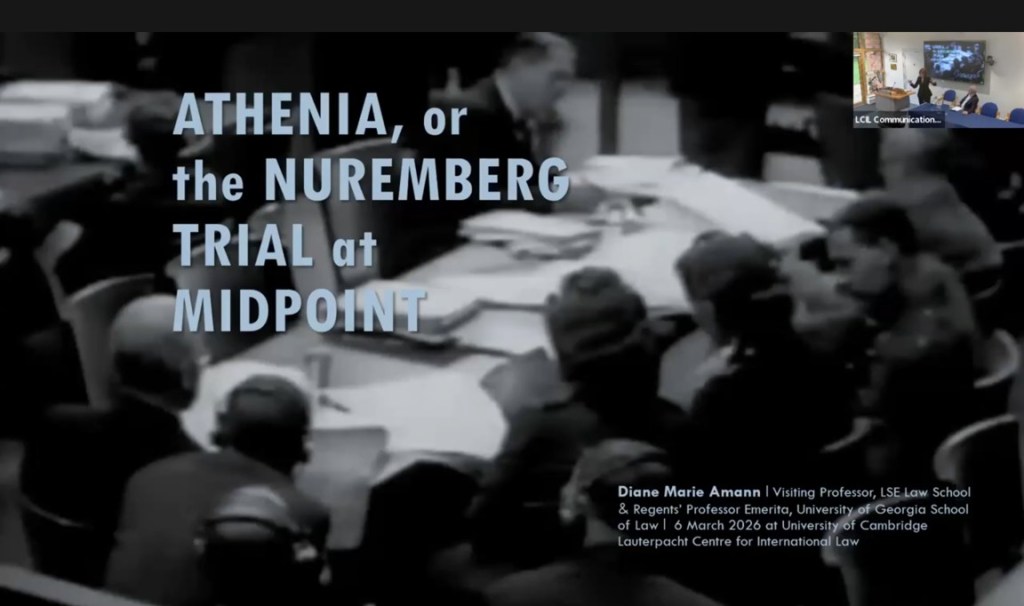
JP headshot (1).jpgJonathan Peters, a media law professor with appointments in the School of Law and the Grady College of Journalism and Mass Communication, was among 34 scholars, policy leaders, and United Nations officials who participated in an expert workshop last week at the University of Cambridge on the right to peaceful assembly.

2019-12-04_11-36-49_243The workshop’s purpose was to support the U.N. Human Rights Committee by informing its drafting of General Comment No. 37 on Article 21 of the International Covenant on Civil and Political Rights. Article 21 guarantees the right of peaceful assembly, and the General Comment will provide an authoritative interpretation of that right as well as substantive guidance to ensure its practical enjoyment.
One significant open question is whether General Comment No. 37 will recognize the Internet as a space where assemblies occur—on social media platforms and through other information and communication technologies. Participants exchanged ideas about whether and how Article 21 could be interpreted to protect virtual assemblies.

Peters, whose research explores digital media and the law, discussed the state action doctrine in U.S. law and how it distinguishes public and private action, along with the history and evolution of the public forum doctrine and its application to physical and virtual spaces.

Other workshop participants came from the U.N. Human Rights Committee, the Office of the U.N. High Commissioner for Human Rights, the Organization for Security and Co-operation in Europe, the Office for Democratic Institutions and Human Rights, the European Center for Not-for-Profit Law, the International Center for Not-for-Profit Law, Amnesty International, Article 19, and numerous universities.

Georgia Law Professor Amann publishes in AJIL on ICJ advisory opinion on Chagos Archipelago

Professor Diane Marie Amann‘s most recent publication appears in the latest print edition of the American Journal of International Law, in the section that analyzes recent judgments. Entitled “International Decisions: Legal Consequences of the Separation of the Chagos Archipelago from Mauritius in 1965,” it may be found at 113 AJIL 784 (2019).

The essay sets forth key aspects of the advisory opinion (available here) that the International Court of Justice issued this past February respecting the Chagos Archipelago, a group of islands located in the Indian Ocean. The archipelago was considered part of Mauritius when both comprised a British colony. But after Mauritius won independence in the mid-1960s, Britain kept the archipelago, ejected its inhabitants, and leased it for a US military base, still there today. The legality and effects of this withholding, or detachment, were at the core of the ICJ proceedings.

Here at the University of Georgia School of Law, Amann holds the Emily & Ernest Woodruff Chair in International Law and serves as Faculty Co-Director of the Dean Rusk International Law Center. (Editor of AJIL’s International Decisions section is our Center’s other Faculty Co-Director, Georgia Law Professor Harlan Grant Cohen.)

Amann’s article, which also forms part of Georgia Law’s Dean Rusk International Law Center Research Paper Series at SSRN, may be accessed at this SSRN link or at the AJIL website. (She surveyed more recent developments related to this issue at her personal blog, in a post yesterday entitled “Chagos islands, at International Court of Justice and on to UK campaign trail.”)

Here’s the AJIL abstract:

“Decolonization and its quite valid discontents lay at the center of the recent International Court of Justice advisory opinion regarding the territory and populations of the Chagos Archipelago, located in the Indian Ocean. Answering questions posed by the UN General Assembly, the concluded that because these islands were detached from Mauritius as a condition of independence, the decolonization of Mauritius had not been completed in accordance with international law. The Court further ruled unlawful the United Kingdom’s continued administration of the Chagos Archipelago and called upon all UN member states to aid completion of the decolonization process. As detailed in this essay, the advisory opinion contained significant pronouncements on decolonization, on the right of all peoples to self-determination, and on the formation of customary rules respecting both.”

Georgia Law Professor Ringhand presents comparative elections law paper on US, UK at Mercer conference

Lori A. Ringhand, J. Alton Hosch Professor of Law here at the University of Georgia School of Law, presented her comparative elections law scholarship last Friday at the “Contemporary Issues in Election Law” Law Review Symposium at Mercer University School of Law in Macon.

Ringhand, an expert in election law, constitutional law, and comparative law, presented a paper entitled “First Amendment (Un)Exceptionalism: US and UK Responses to Online Electioneering.” It’s a product of her Spring 2019 research as a Fulbright Distinguished Chair at the University of Aberdeen, Scotland (prior posts here and here).

Ringhand is presenting the same paper this semester at other law schools, including George Washington University and Marquette University.

The Mercer symposium also featured a paper by a United Kingdom-based scholar who’d spoken at Georgia Law last Wednesday: Professor Jacob Eisler, University of Southampton Law School.