Georgia Law Professor Harpaz presents paper at University of Wisconsin School of Law

Junior Tax Wisconsin

University of Georgia School of Law professor Assaf Harpaz recently presented his draft paper, “Global Tax Wars and the Shift to Cross-Border Taxation”, at the Junior Tax Workshop, held at the University of Wisconsin Law School. Harpaz also served as a discussant at the workshop.

Below is an abstract from the draft paper:

International taxation is at a crossroads. In a rapidly evolving digital economy, intergovernmental organizations are battling to shape the cross-border tax agenda. Global North economies have dominated this regime through the Organisation for Economic Co-operation and Development (OECD), which has drawn backlash due to its undemocratic procedure and unfavorable outcomes for developing countries. Meanwhile, the United Nations has occupied a relatively peripheral role in global tax governance. Nonetheless, in 2023, developing countries overwhelmingly supported the establishment of a new Framework Convention on International Tax Cooperation within the UN. The unprecedented initiative marks a novel challenge to the Global North’s hegemony in international tax policymaking.

This article conceptualizes the contemporary international tax discourse as “tax wars.” It contrasts the taxing powers and interests of the OECD-led Global North with those of the UN-backed Global South. The article argues for a shift towards source-based taxation, drawing on procedural and distributive justice principles. To do so, the article proposes expanding the permanent establishment standard in model treaty language, creating an opportunity for broader taxation of business profits in the source country. This transition will address longstanding disparities and is increasingly warranted in a digital economy that does not rely on physical presence.

Assaf Harpaz joined University of Georgia School of Law as an assistant professor in summer 2024 and will teach classes in federal income tax and business taxation. Harpaz’s scholarly focus lies in international taxation, with an emphasis on the intersection of taxation and digitalization. He explores the tax challenges of the digital economy and the ways to adapt 20th-century tax laws to modern business practices.

Georgia Law Professor Phillips-Sawyer presents at King’s College

University of Georgia School of Law professor Laura Phillips-Sawyer recently presented her work “Reassessing Vertical Restraints:  How Global Value Chains Have Rewritten the Boundaries of the Firm” at the Rethinking Economic Regulation conference at King’s College, London. The conference is organized by the Competition Law Center at the George Washington University, as well as by the Dickson Poon School of Law and the Faculty of Social Science & Public Policy at King’s College London.

Below is the conference precis:

In the 1980s and 1990s, countries in Europe and elsewhere embraced a model of the political economy characterised by privatisation, market competition, and politically-insulated economic regulation. Yet, whilst this model may have performed well on some narrow and aggregate-level objectives, it has raised concerns about unequal outcomes, lack of investment, and market failure, especially in the utility sectors. These concerns have prompted ad hoc policy changes and calls for select re-nationalisation. Yet, what is missing from the debate is a wider systemic analysis of the underlying causes of the disappointing outcomes. This two-day workshop brings together an inter-disciplinary group of established and emerging scholars – in particular, lawyers, economists, historians, and political scientists – who centre on the different causes of the failings of the now dominant political-economic model. The workshop facilitates knowledge production and exchange and will contribute to the production of a special issue on the wider theme.

Phillips-Sawyer is an expert in U.S. antitrust law and policy. Broadly, she is interested in questions of economic regulation, which intersect with legal history, economic thought, business strategy and structure, and political organization. She currently holds the Jane W. Wilson Associate Professorship in Business Law at the University of Georgia School of Law. 

Georgia Law Professor Hellerstein presents on crypto-assets at OECD

Distinguished Research Professor & Shackelford Distinguished Professor in Taxation Law Emeritus Walter Hellerstein co-presented “Global Summary of Jurisdictions’ VAT/GST Treatment of Services Connected to the Trade in Crypto-Assets” at a meeting of the Organization for Economic Cooperation and Development’s Working Party No. 9 on Consumption Taxes in Paris, France, during June.

The Working Party No. 9 on Consumption Taxes is a forum for the discussion of consumption tax policy and administration, working with both Members and non-Members of the OECD to develop appropriate and effective taxation outcomes.

Hellerstein, a recipient of the National Tax Association’s Daniel M. Holland Medal for outstanding lifetime contributions to the study and practice of public finance, is widely regarded as the nation’s leading academician on state and local taxation. He has authored numerous books, textbooks, and law review articles, and has practiced extensively in the field. Hellerstein is currently a Visiting Professor at the Vienna University of Economics and Business, and he remains actively involved in his scholarship, consulting, and, in particular, his work as an academic advisor to the OECD.

Georgia Law 3L Daniel “Tripp” Vaughn reflects on summer research project in Belgium

University of Georgia School of Law student, rising 3L Daniel “Tripp” Vaughn, recently completed a short-term research project in Brussels, Belgium with Atlas Services Belgium (ASB), the holding company of the Orange Group in Belgium. Vaughn edited the updated 2024 version (13th edition) of the Guide to Listing in Belgium, to which former Georgia Law students also contributed– Emina Sadic Herzberger (J.D., ’22) co-authored the 2020 book, and both Starlyn Endres (J.D., ’22) and Alina Salgado (J.D., ’23) conducted subsequent research. The project has been overseen by Georgia Law alumnus Johan Van den Cruijce (LL.M., ’94), who is the Managing Director of ASB. Below, Vaughn reflects on the experience.

For three weeks this summer, I worked with Atlas Services Belgium (ASB), the holding company of the Orange group in Belgium. I edited the updated 2024 version (13th edition) of the Guide to Listing in Belgium. This guide initially began in 2005 as a brief, informal, and internal document detailing the obligations of public companies in Belgium. Following an explosion in EU corporation legislation and growing demand for accompanying guidance, a new version has been updated every 2-4 years until now the 13th edition comprises a formally published book of more than 400 pages.

My work with the guide brought me to the issue at the heart of the public/private divide: despite the fact that private companies suffer a severe discount to their valuation, public companies have increasingly moved to become private in Belgium (and in many other countries). As the EU continues to pass swathes of regulations on public companies, this decline is only expected to accelerate. Experiencing firsthand the enormous amount of work required to simplify and clarify the implications of these regulations demonstrated how even well meaning legislation can dramatically increase the burden on companies genuinely attempting to achieve compliance.

While editing the guide and discussing relevant legislation, I also had an interesting opportunity to compare the approaches to corporate regulation of the EU and the US. I found that in general legislation was surprisingly similar, but in particular areas liability diverged drastically. For example, Europe takes a much harsher approach to director liability for non-compliance of companies but drastically limits the potential for corporate tort liability compared to the US.

Another lesson I took from my experience in Brussels was learning more about the general operations of a holding company like ASB and how they are reflected by the office environment. Evenly divided between an accounting and legal department, the office caught up on all ongoing activities in bi-weekly staff meetings. I had the opportunity to learn how a capital increase in Belgium, a company dissolution in Thailand, a merger in Romania, and a decision to distribute dividends from Côte d’Ivoire all related to balance the finances of a single company. The office was incredibly open and friendly, and everyone was willing to explain why certain transactions were happening in their field.

In addition, we were able to travel to Paris for a day to meet with Cedric Testut, Group General Counsel of Orange. I met many of the lawyers of the Corporate Law and Europe Legal Department at the main office. Afterwards we discussed over lunch the scale of operations required for such a large international company as Orange and how AI might impact European legal work in the future. Diane Nicolas, General Counsel of Corporate Law and Europe, later showed us around the office for a more informal conversation about Orange’s role as the primary partner and telecommunications supplier of the 2024 Paris Olympic Games.

I am incredibly grateful for the opportunity to learn more about corporate compliance and the legal field in Europe. I plan to pursue an LL.M. in Europe after my third year of law school and my experience in Brussels was invaluable for my future plans.

Georgia Law Professor Harpaz submits comments for a UN framework convention on international tax cooperation

University of Georgia School of Law professor Assaf Harpaz recently submitted comments on the Zero Draft Terms of Reference for a United Nations Framework Convention on International Tax Cooperation.

Harpaz’s comments (available here), together with all other inputs, have been published on the Ad Hoc Committee’s website in preparation for its second session.

Assaf Harpaz joined University of Georgia School of Law as an assistant professor in summer 2024 and will teach classes in federal income tax and business taxation. Harpaz’s scholarly focus lies in international taxation, with an emphasis on the intersection of taxation and digitalization. He explores the tax challenges of the digital economy and the ways to adapt 20th-century tax laws to modern business practices.

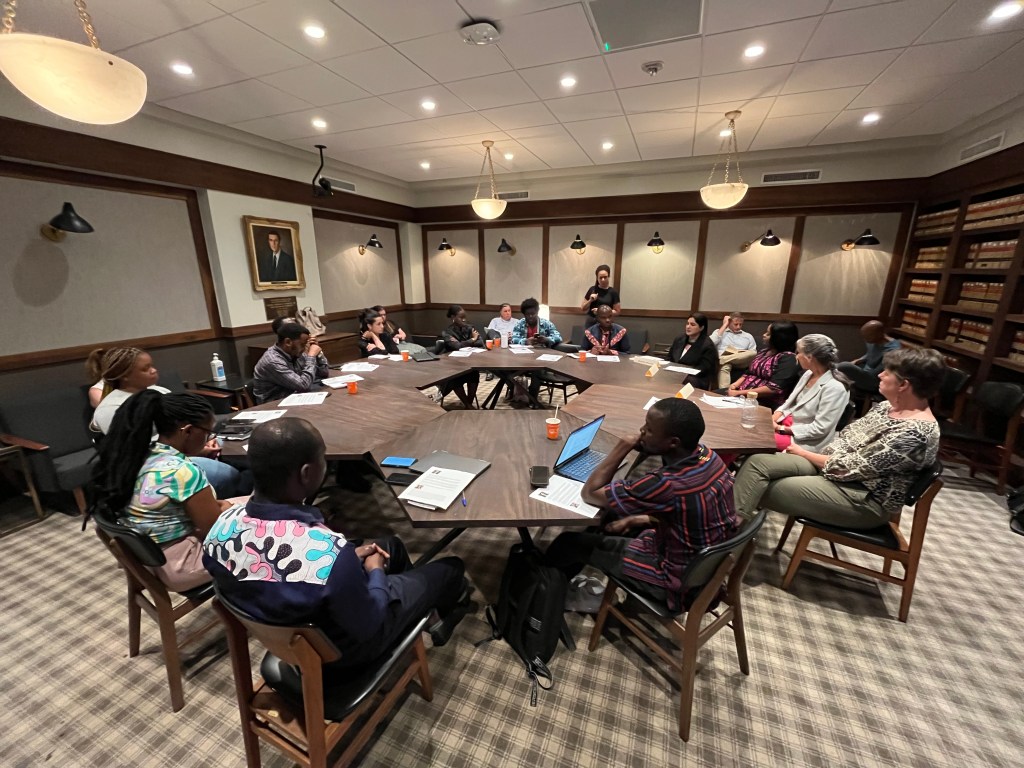
Georgia Law hosts roundtable discussion for 2024 Mandela Fellows

This month, a group of participants from the Mandela Washington Fellowship for Young African Leaders visited the University of Georgia School of Law for a roundtable discussion as part of their 6-week program at the university. The Fellows met with Christine M. Scartz, Clinical Associate Professor & Jane W. Wilson Family Justice Clinic Director; Joan Prittie (J.D. ’93), Executive Director of Project Safe; and two LL.M. alumnae, including Lydia Lartey (LL.M., ’24), a Court Appointed Special Advocate and former Mandela Fellow.

The 10 Fellows in attendance have work experience in anti-human trafficking, advocacy for women and girls, human rights, and refugee and victim assistance, among other topics. A total of 10 countries were represented in this group: The Republic of Congo, Ethiopia, Mali, South Africa, Zambia, Zimbabwe, Kenya, Burkina Faso, Uganda, and the Ivory Coast.

Scartz, Prittie, and Lartey began the roundtable by discussing their respective backgrounds and work, and then answered the Fellows’ questions. This is the second year that the law school has hosted a group of Fellows.

The Mandela Washington Fellowship for Young African Leaders is the flagship program of the U.S. government’s Young African Leaders Initiative (YALI) and sponsored by the U.S. Department of State. Since 2014, nearly 4,200 young leaders from every country in Sub-Saharan Africa have participated in the Fellowship. Mandela Washington Fellows, between the ages of 25 and 35, are accomplished innovators and leaders in their communities and countries. 

In 2019, UGA became a Fellowship Institute Partner and hosted its first cohort of Fellows on the UGA campus. The Mandela Washington Fellowship is delivered through a collaborative effort between the Office of Global Engagement, the J.W. Fanning Institute for Leadership Development, and the African Studies Institute at Franklin College.

Georgia Law Professor Cade featured in The Atlanta Journal-Constitution

University of Georgia School of Law Associate Dean & Hosch Professor Jason A. Cade was recently featured in The Atlanta Journal-Constitution regarding the Southern Poverty Law Center’s Southeast Immigrant Freedom Initiative. The article titled “For migrants in Georgia, fighting deportation will become harder. Here’s why.” was written by Lautaro Grinspan and published 6/26/24. 

As stated in the article:

“Detained immigrants in Georgia tend to be held in remote areas, cut off from society, making it really difficult for them to access representation or have contact with family. [The Southern Poverty Law Center’s Southeast Immigrant Freedom Initiative] was essentially the only resource that existed to help them, and they did excellent work,” said Jason Cade, a professor at the University of Georgia School of Law, in a statement.

Jason A. Cade is Associate Dean for Clinical Programs and Experiential Learning, J. Alton Hosch Professor of Law & Community Health Law Partnership Clinic Director. In addition to overseeing the law school’s 11 in-house clinics and 7 externship programs, Cade teaches immigration law courses and directs the school’s Community Health Law Partnership Clinic (Community HeLP), in which law students undertake an interdisciplinary approach to immigrants’ rights through individual client representation, litigation, and project-based advocacy before administrative agencies and federal courts.

Read the full article here. Additional information about the Community HeLP Clinic can be found here.

Georgia Law Dean Peter B. “Bo” Rutledge elected to prestigious Council on Foreign Relations

University of Georgia School of Law Dean Peter B. “Bo” Rutledge was recently elected to the Council on Foreign Relations. The council is an independent, nonpartisan organization and think tank that is composed of the most prominent foreign policy leaders, including top government officials, renowned scholars, business executives, acclaimed journalists, prominent lawyers and distinguished nonprofit professionals.

Founded in 1921, the CFR is dedicated to promoting a better understanding of the world and the foreign policy choices facing the United States and other countries. To that end, it supports independent research and task forces, and convenes meetings at its headquarters in New York and Washington, D.C., as well as other locations throughout the country. It also publishes Foreign Affairs, one of the preeminent journals of international affairs and U.S. foreign policy.

Rutledge is the second faculty member from the law school to be elected to the Council on Foreign Relations in the last three years. Professor Diane Marie Amann, Regents’ Professor of International Law, Emily & Ernest Woodruff Chair in International Law, Faculty Co-Director of the Dean Rusk International Law Center, was elected to the Council in 2021.

Georgia Law Professor Harpaz presents at UC Davis School of Law

University of Georgia School of Law Professor Assaf Harpaz recently presented his draft paper, “Global Tax Wars and the Shift to Cross-Border Taxation”, at the 2024 National Business Law Scholars Conference, held at the UC Davis School of Law. This is the fifteenth meeting of the NBLSC, an annual conference that draws legal scholars from across the United States and around the world.

Below is an abstract from the draft paper:

International taxation is at a crossroads. In a rapidly evolving digital economy, intergovernmental organizations are battling to shape the cross-border tax agenda. Global North economies have dominated this regime through the Organisation for Economic Co-operation and Development (OECD), which has drawn backlash due to its undemocratic procedure and unfavorable outcomes for developing countries. Meanwhile, the United Nations has occupied a relatively peripheral role in global tax governance. Nonetheless, in 2023, developing countries overwhelmingly supported the establishment of a new Framework Convention on International Tax Cooperation within the UN. The unprecedented initiative marks a novel challenge to the Global North’s hegemony in international tax policymaking.

This article conceptualizes the contemporary international tax discourse as “tax wars.” It contrasts the taxing powers and interests of the OECD-led Global North with those of the UN-backed Global South. The article argues for a shift towards source-based taxation, drawing on procedural and distributive justice principles. To do so, the article proposes expanding the permanent establishment standard in model treaty language, creating an opportunity for broader taxation of business profits in the source country. This transition will address longstanding disparities and is increasingly warranted in a digital economy that does not rely on physical presence.

Assaf Harpaz joined University of Georgia School of Law as an assistant professor in summer 2024 and will teach classes in federal income tax and business taxation. Harpaz’s scholarly focus lies in international taxation, with an emphasis on the intersection of taxation and digitalization. He explores the tax challenges of the digital economy and the ways to adapt 20th-century tax laws to modern business practices.

Georgia Law Professor Bruner gives keynote address at Ghent University Law School in Belgium

Christopher M. Bruner, Stembler Family Distinguished Professor in Business Law and Faculty Co-Director of the Dean Rusk International Law Center, gave the keynote address for a symposium on “Corporate Sustainability Due Diligence (CSDD), Sustainability, and Corporate Law” at Ghent University Law School in Belgium during May. Bruner’s keynote was titled “Developments and Debates on Corporate Sustainability in the US,” and the symposium was co-sponsored by the journal European Company Case Law (ECCL).