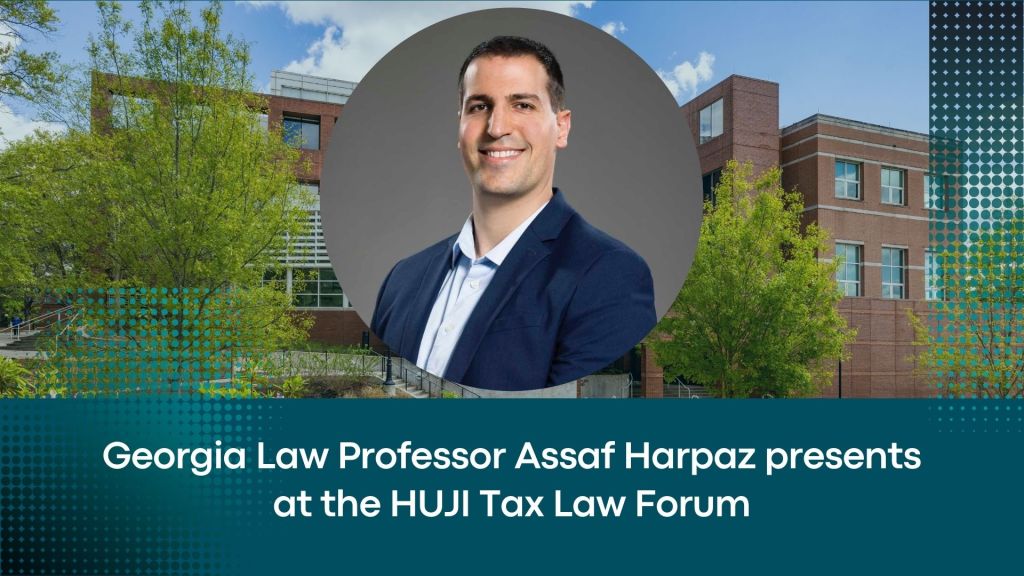
Georgia Law Professor Assaf Harpaz presents at the HUJI Tax Law Forum

University of Georgia School of Law Professor Assaf Harpaz presented his draft paper “Global Tax Wars in the Digital Era” at the Hebrew University of Jerusalem’s Tax Law Forum during December.

Below is an abstract of the paper:

International tax debates often center on how to fairly allocate taxing rights on the profits of multinational enterprises, carrying significant global economic implications. When a business earns income abroad, the country of residence (where the taxpayer resides) and the country of source (where income is generated) both have legitimate, competing claims to tax that income. The international tax system favors residence-based taxation. The source country has the right to tax business profits only if the enterprise carries on a permanent establishment in its borders, which typically requires physical presence. The permanent establishment standard becomes flawed in a digital economy where profit shifting practices are abundant and businesses no longer require a physical presence in the location of their online consumers.

These enduring norms are poised to change with an upcoming United Nations (UN) Framework Convention on International Tax Cooperation – an initiative overwhelmingly supported by Global South economies. The Global North has historically dominated the international tax regime through the Organisation for Economic Co-operation and Development (OECD), informally known as the “World Tax Organization”. A UN framework convention could introduce new standards to address the tax challenges of digitalization, though it would need to bridge the underlying North-South divide.

This article explores the “tax wars” surrounding the leadership for global tax governance, contrasting the taxing powers and interests of the OECD-led Global North with those of the UN-backed Global South. It argues for a shift toward source-based taxation by revisiting the permanent establishment standard. This transition will address longstanding inequities and is increasingly warranted in a digital economy that does not rely on physical presence.

 Assaf Harpaz joined University of Georgia School of Law as an assistant professor in summer 2024 and teaches classes in federal income tax and business taxation. Harpaz’s scholarly focus lies in international taxation, with an emphasis on the intersection of taxation and digitalization. He explores the tax challenges of the digital economy and the ways to adapt 20th-century tax laws to modern business practices.

Coursework to begin for 2025 cohort of students seeking Graduate Certificate in International Law

The start of the spring 2025 semester this week marks the arrival of the fourth cohort of Graduate Certificate in International Law students here at the University of Georgia School of Law.

Administered through Georgia Law’s Dean Rusk International Law Center, postgraduate students from other disciplines within the university will earn this academic certificate following their successful completion, in classes alongside J.D., LL.M., and M.S.L. students, of fifteen credit hours chosen from among the law school’s rich comparative, transnational, and international law curriculum.

Joining the law school’s first previous cohorts (introduced here, here, and here), this fourth class of six students includes:

  • Mari Diaz: Master of International Policy student, School of Public and International Affairs
  • Ben Enyetornye: Ph.D. student in Comparative Biomedical Science, College of Veterinary Medicine
  • Md. Asaduzzaman (“Asad”) Jabin: Ph.D. student in Electrical and Computer Engineering, College of Engineering
  • Kobi Korankye: Ph.D. student in Philosophy, Franklin College of Arts and Sciences
  • Beatrice Robson: Ph.D. student in Agricultural and Applied Economics, College of Agricultural and Environmental Sciences
  • Uyiosa (“Uyi”) Ugiagbe: Ph.D. student in Mathematics Education, Mary Frances Early College of Education

All information about the Graduate Certificate in International Law, including upcoming application cycles and virtual information sessions, can be found here.

International Law Colloquium returns to Georgia Law in Spring 2025 semester

The International Law Colloquium, a time-honored tradition here at the University of Georgia School of Law, returns this spring semester with another great lineup of global legal experts.

In Spring 2025, this for-credit course is designed to introduce students to features of international economic law, broadly defined, through engagement with scholars in the international legal field.  The course broadly defines “international economic law” to include traditional approaches (trade and investment agreements) as well as non-traditional, emerging approaches (examining the effects of IEL on marginalized communities and considering re-distributional policies). This course consists of presentations of substantial works-in-progress on a variety of international law topics by prominent scholars from other law schools. In keeping with a tradition established when the series began in 2006, students will write reaction papers on the scholars’ manuscripts, and then discuss the papers with the authors in class. Leading the class will be Desirée LeClercq, Assistant Professor of Law & Faculty Co-Director of the Dean Rusk International Law Center. Other Georgia Law faculty, including Diane Marie Amann and Christopher Bruner, will join in the dialogues.

Further supporting the colloquium are staff at our Center; in particular, the Center’s Global Practice Preparation team, which includes Catrina Martin and student workers Casey Smith (J.D. ’26) and Aubry Tedford (J.D. ’25). The colloquium further benefits from generous support from the Kirbo Trust Endowed Faculty Enhancement Fund and the Talmadge Law Faculty Fund.

Presenting at the Spring 2025 Colloquium (pictured above, clockwise from top left):

January 17: Harlan Cohen, Fordham University School of Law
“The International Order, International Law, and the Definition of Security”     

January 24: Luwam Dirar, Western New England University School of Law
“Emancipation, Decolonization, and Gender in the Context of African Integration”

January 31: Diane Marie Amann, University of Georgia School of Law 
“Economies of Injustice and the Forced Residential-Schooling of Indigenous Americans”

February 7: Christopher Bruner, University of Georgia School of Law
“Sustainable Corporate Governance and Prospects for a US Value Chain Due Diligence Law”

February 14: Katrin Kuhlman, Georgetown University School of Law
“Micro International Law”

February 21: Olabisi D. Akinkugbe, Schulich School of Law
“Trade and Development in an Era of Geopolitics: A Third  World  View”

February 28: Ben Heath, Temple University School of Law
“Sanctions and Sanctuary: Refuge, Violence, and the Legal Ordering of (Economic) Warfare”

March 14: Weijia Rao, Boston University School of Law 
“Signaling through National Security Lawmaking”

March 21: Julian Arato, Michigan University School of Law
“The Institutions of Exceptions”

April 4: Trang (Mae) Nguyen, Temple University School of Law
“Goods’ Citizenship”

April 11: Rachel Brewster, Duke University School of Law
“Global settlements in the Foreign Corrupt Practices Act”

April 18: Sarah Dadush, Rutgers Law School
“Shared Responsibility in American Contract Law”

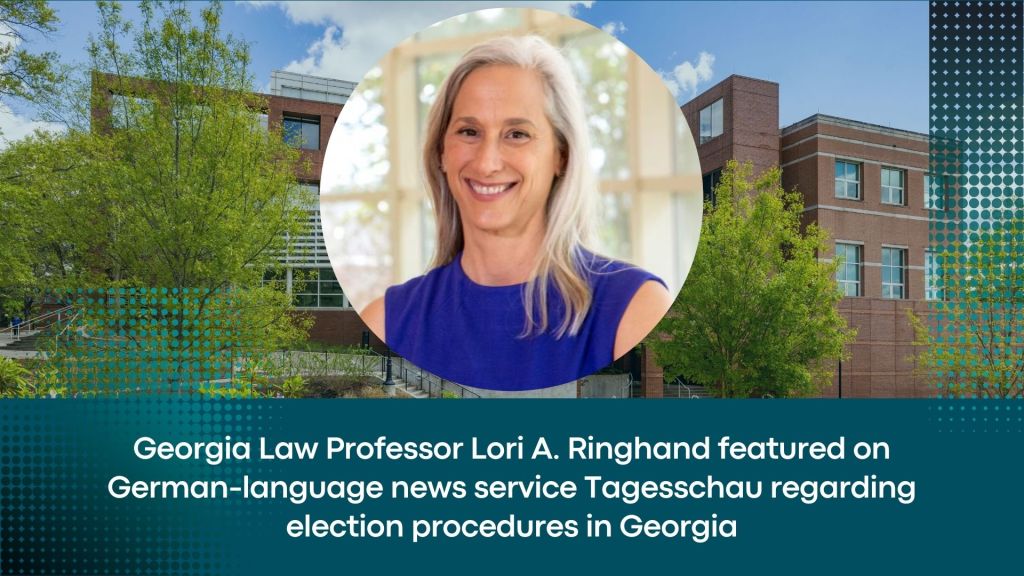
Georgia Law Professor Lori A. Ringhand featured on German-language news service Tagesschau regarding election procedures in Georgia

University of Georgia School of Law Professor Lori A. Ringhand was featured on the German-language news service Tagesschau regarding election procedures in Georgia. The article titled “Wahlhelfer mit ‘Panik-Knöpfen’” was reported by Ralf Borchard and published October 31, 2024.

Ringhand teaches courses on constitutional law and election law. She has been a member of the University of Georgia School of Law faculty since 2008 and was named a Hosch Professor in 2012 and awarded a Josiah Meigs Distinguished Professorship, UGA’s highest teaching honor, in 2021. She is a nationally known Supreme Court scholar and the author of two books about the Supreme Court confirmation process: Supreme Court Confirmation Hearings and Constitutional Change (with Paul M. Collins) published by Cambridge University Press; and Supreme Bias: Gender and Race in U.S. Supreme Court Confirmation Hearings, (with Christina L. Boyd and Paul M. Collins), published by Stanford University Press. She also is the co-author of Constitutional Law: A Context and Practices Casebook, which is part of a series of casebooks dedicated to incorporating active teaching and learning methods into traditional law school casebooks. Ringhand also publishes extensively on election law related issues, and was awarded a Fulbright Distinguished Chair Award at the University of Aberdeen in Scotland to explore the different approaches to campaign finance regulation taken by the United States and the United Kingdom.

2024 Annual Report for the Dean Rusk International Law Center published

As the year draws to a close, we at the University of Georgia School of Law‘s Dean Rusk International Law Center are pleased to share our annual report, detailing a wide range of international activities and achievements that contributed to our #20 U.S. News ranking for international law programs in the United States in 2024. This year’s report highlights:

  • Faculty publications and awards
  • Global Governance Summer School
  • Global Externships Overseas
  • Master of Laws (LL.M.) program
  • Visiting Research Scholars
  • International events and conferences
  • International advocacy
  • Rusk Center Council
  • Global Partnerships
  • And more!

The 2024 annual report can be accessed here.

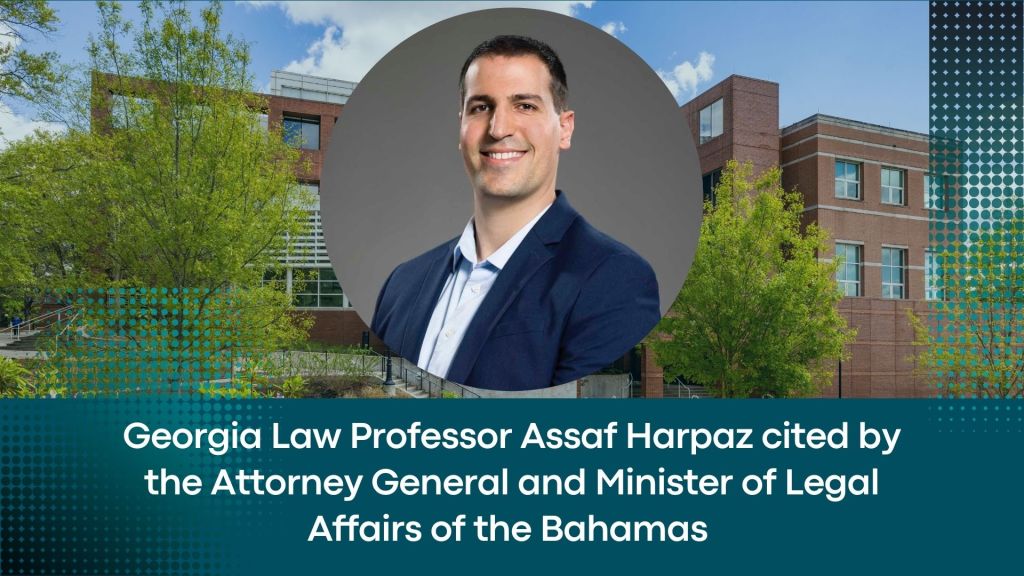
Georgia Law Professor Assaf Harpaz cited by the Attorney General and Minister of Legal Affairs of the Bahamas

University of Georgia School of Law Professor Assaf Harpaz’s article “International Tax Reform: Who Gets a Seat at the Table?” was recently quoted by Senator the Hon. Leo Ryan Pinder, Attorney General and Minister of Legal Affairs of the Bahamas, during the STEP LATAM Conference Remarks on The UN Convention on Global Tax Cooperation.

Below is an abstract of the article:

The international tax framework relies on early-twentieth-century principles and favors the interests of the Global North, which created it. It bases taxing rights on a corporation’s physical presence and mostly allocates profits to the country of residence. Moreover, it has been slow to adapt to modern business practices. In the digital economy, companies shift profits with relative ease and often do not require a physical presence in the location of their consumers. International taxation needs reform, but leading proposals do not reflect meaningful input from the Global South and are unlikely to serve the needs of developing countries.

In 2021, the Organisation for Economic Co-operation and Development (OECD), known informally as the “World Tax Organization,” introduced new rules for the cross-border taxation of multinational enterprises. The new rules intend to address the tax challenges of digitalization and profit-shifting, and they are likely the most significant change to international taxation in several decades. However, the OECD does not represent the interests of developing economies, and the proposed reform has not remedied the historic imbalance which disfavors the Global South.

This Article highlights the shortcomings of the OECD’s multilateral efforts in the context of taxation and digitalization. It analyzes the political lawmaking of the OECD and presents the new rules as a compromise that fails to address inequities in cross-border taxation. The Article argues that the reform undermines tax sovereignty and that the current international tax regime overlooks the involvement of the world’s developing countries. It asserts that attempts to promote inclusivity within the OECD have largely been expressive and that the international tax framework inherently disadvantages developing countries and their interests. The Article proposes steps to promote the equal-footed participation of developing countries in future international tax policy initiatives. First, it recommends expanding voting rights for non-members within the OECD. Second, it supports the creation of a new intergovernmental framework within the United Nations that is better positioned to revisit traditional international tax norms through a genuinely inclusive process.

Assaf Harpaz joined University of Georgia School of Law as an assistant professor in summer 2024 and teaches classes in federal income tax and business taxation. Harpaz’s scholarly focus lies in international taxation, with an emphasis on the intersection of taxation and digitalization. He explores the tax challenges of the digital economy and the ways to adapt 20th-century tax laws to modern business practices.
Georgia Law students attend 2024 ASIL Midyear Meeting in Chicago

Two University of Georgia School of Law students attended the American Society of International Law (ASIL) Midyear Meeting last month in Chicago, Illinois. This year’s meeting was hosted at the University of Chicago Law School.

Attendees included Samuel Kuo (LL.M. ’25) and Eman Mistry (J.D. ’25). Both students received a Louis B. Sohn Professional Development Fellowship to support their attendance of this conference. Awarded by the law school’s Dean Rusk International Law Center, Sohn Fellowships enable students to attend professional development opportunities related to international law.

Both Kuo and Mistry attended numerous panel discussions addressing a range of topics in international law. Kuo reflected on the experience, stating:

“I enjoyed the panel on the topic of disclosure in international arbitration moderated by Kelly Turner at the American Arbitration Association, featuring Dorothy Du from Motorola, Charles Kotuby from Three Crowns, Sarah Reynolds from Reynolds ADR and Javier Rubinstein from Rubinstein ADR LLC. The discussion centered upon the use of generative AI in international arbitration practice.  All areas of the legal profession are preparing for ethical AI use, and it was refreshing to hear a discussion on whether parties should disclose the use of generative AI in anticipating arbitration.”

To read prior posts about prior recipients of Sohn Fellowships, please click here and here.

Georgia Law Professor Thomas Kadri selected as Visiting Fellow of the Law Department of the European University Institute in Florence, Italy

University of Georgia School of Law Professor Thomas E. Kadri was selected as a Visiting Fellow at the Law Department of the European University Institute in Florence, Italy. Kadri’s fellowship will be supported by a Sarah Moss Fellowship and the Rusk Faculty Scholar-in-Residence Program provided by the Dean Rusk International Law Center.

During his time in Florence, Kadri will expand his ongoing research pertaining to the legal and technical regulation of AI-generated “deepfakes” and focus on the European regulatory approaches to this topic. In 2024, Kadri authored his third book, Dilemmas in Digital Abuse, which discusses related topics including harmful technological advancements and the corresponding regulatory responses.

Kadri is an Assistant Professor of Law at Georgia Law Law, and his research focuses on torts and criminal law, with an emphasis on how technology, law, and social norms enable and affect privacy, speech, and abuse. His scholarship appears in journals including the Harvard Law Review Forum, UCLA Law Review, Texas Law Review, Utah Law Review, Maryland Law Review, and Journal of Free Speech Law and he has published shorter pieces in The New York Times and Slate. His course offerings include Torts, Cybercrime, and Regulating Digital Abuse.

Six Master of Laws (LL.M.) students selected as Graduate Editors of the Georgia Journal of International and Comparative Law

Six Master of Laws (LL.M.) students from the University of Georgia School of Law’s class of 2025 were selected to join the Editorial Board of the Georgia Journal of International and Comparative Law as Graduate Editors. The students are: Sara Dorbahani, Michael Faleye, Neethu James, Samuel Kuo, Dzmitry Liasovich, and Ramakrishna Rut Palepu.

As Graduate Editors, each LL.M. student conducts citation checks and writes a Comment or Book Review on the legal topic of their choice. The Graduate Editors further facilitate the Journal’s commitment to “including a diversity of perspectives, experiences, and backgrounds within [its] membership,” according to the Editor in Chief, Jasmine Furin (J.D. ’25).

The Georgia Journal of International and Comparative Law is a preeminent forum for academic discussion on current international subjects. From its inception in 1971 as a student initiative supported by former U.S. Secretary of State and Georgia Law Professor Dean Rusk, the Journal features work by legal scholars and practitioners and student notes written by Journal members.

Georgia Law Professor Desirée LeClercq cited in Financial Times 

University of Georgia School of Law Professor Desirée LeClercq‘s report “Enforcement of the United States-Mexico-Canada Agreement (“USMCA”) Rapid Response Mechanism: Views from Mexican Auto Sector Workers” was cited in the article “How the Democrats Worker-Centred Trade Policy Failed” in the Financial Times.

Below is the article’s abstract:

This study examines whether the RRM empowers workers’ voices in the Mexican auto sector. To this end, between January and March 2024, we interviewed 130 workers across seven supplier facilities (auto plants facilities and logistics facilities) and five assembly plants, for a total of 12 facilities. Three of the facilities were not unionized; nine facilities were unionized. Three of the twelve plants had used the RRM (“RRM facilities”), addressing various violations of labor rights, voting processes to approve or reject collective contracts, voting processes to elect independent unions, and dismissals and intimidation of workers in union activism. All three RRM cases were remediated through plans requiring the facility to hold a new legitimization vote and union election and offer worker-level trainings. Our preliminary results problematize some assumptions that drove RRM implementation. The Biden administration and members of the United States Congress have promoted the RRM as a way to strengthen the Mexican government’s efforts to implement Mexican labor law reform, empower workers in productive export sectors, and give them a voice over their labor conditions. Our results suggest that, four years after the implementation of the USMCA and the reforms of Mexico’s labor legislation, a little more than half of the workers are aware of the labor law reform, and opinions are divided on whether it is strengthening labor rights. Some workers thought the reforms were going well, while many thought the reform process was going poorly or did not know how it was going. The majority of workers we interviewed revealed that they did not understand the new democratic procedures to legitimize their collective bargaining agreements, nor that they could access the RRM platform to express their complaints. Nevertheless, the workers we interviewed at RRM facilities tended to be more knowledgeable of the labor law reforms and its attendant rights and processes than those at facilities that have not undergone RRM investigation and remediation, and they tended to view their bargaining representative and conditions of work more favorably. Our study suggests that when workers are given the opportunity to participate in democratic elections under international supervision, after receiving training on the shop floor about their rights and election procedures, they gain knowledge and ownership over their working conditions.

LeClercq joined the University of Georgia School of Law in 2024 as an assistant professor. She teaches International Trade and Workers Rights, International Labor Law, International Law and U.S. Labor Law, as well as the International Law Colloquium. She also serves as a faculty co-director of the Dean Rusk International Law Center and as the faculty adviser for the Georgia Journal of International and Comparative Law.