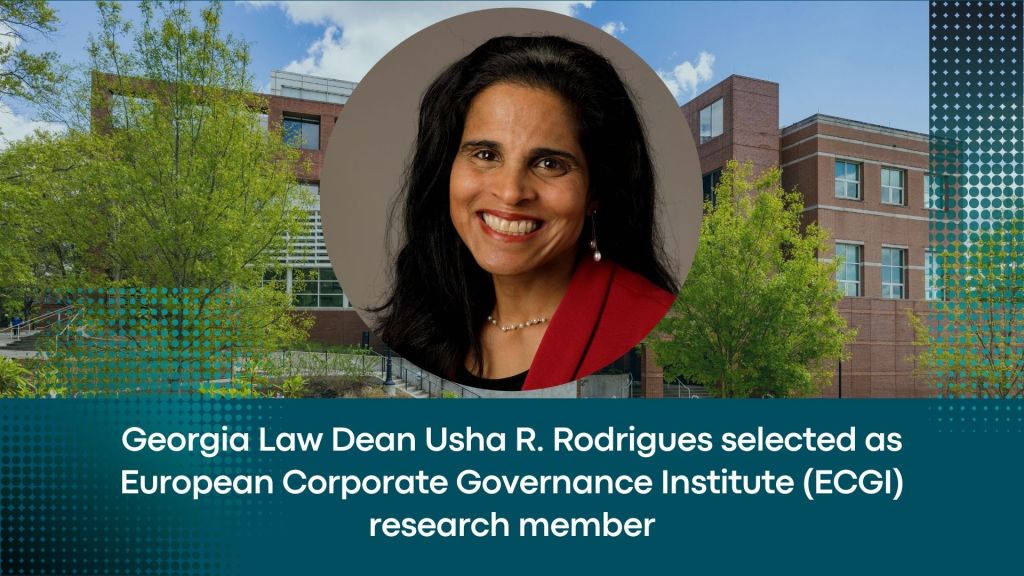
University of Georgia School of Law Dean Usha R. Rodrigues was recently selected as a research member of the European Corporate Governance Institute, an international non-profit established to “improve corporate governance through fostering independent scientific research and related activities.” Rodrigues is one of 74 new members appointed in February.
Founded in 2002, the ECGI provides a platform for debate and dialogue among academics, policymakers, and business leaders, with a focus on major corporate governance, ESG, and stewardship issues. ECGI Research Members, drawn from Europe, the UK, North America, and Asia, are eligible to publish their academic work on corporate governance and stewardship in the ECGI Working Paper Series (Law and Finance), a highly regarded collection of work known for its reliability, breadth, and impact on policymaking and practice.
Rodrigues became dean of the School of Law on January 1st, 2025. Before becoming dean, she joined the School of Law’s faculty in 2005, with her teaching and research focus on corporate law, business ethics, corporations, and securities regulation. She was named the holder of the M.E. Kilpatrick Chair of Corporate Finance and Securities Law in 2014, and her other university honors and roles include service as the law school’s associate dean for faculty development, the University Council’s parliamentarian, and UGA’s interim vice provost for academic affairs.
The University of Georgia School of Law’s spring 2025 International Law Colloquium began last week with Professor Harlan Cohen of Fordham University School of Law. For more than a decade, the International Law Colloquium Series has brought leading scholars to Georgia Law, where they have presented works in progress and invited discussion and comments from students as well as faculty discussants.
This year, Professor Desirée LeClercq is overseeing the colloquium, which is designed to introduce students to features of international economic law through engagement with scholars in the international legal field. The course broadly defines “international economic law,” to include traditional approaches (trade and investment agreements) as well as non-traditional, emerging approaches (examining the effects of international economic law on marginalized communities and considering re-distributional policies).
Cohen presented his working paper titled, “The International Order, International Law, and the Definition of Security.” Cohen, who previously served as the Gabriel M. Wilner/UGA Foundation Professor in International Law at the University of Georgia School of Law and Faculty co-Director of the Dean Rusk International Law Center, specializes in international trade, international law, international legal theory, global governance, and U.S. foreign relations law.
As economic security has seemingly moved to the center of American and European foreign policy, both the United States and the European Union have broadened their interpretation of international law rules governing security, coercion, and intervention. These broadened interpretations have supported a bevy of new sanctions, trade restrictions, investment controls, and industrial policies that have turned the global economy into an increasingly weaponized space. But these interpretations are not exactly new, echoing developing state interpretations of international law that developed states had long ago seemingly rejected. How are these once moribund interpretations of security, force, and coercion being brought back to life?
This essay argues that these interpretative shifts highlight the role of the international order as an interpretative mechanism within international law. Borrowing from the work of Robert Cover, it explains the ways that the international order acts as a jurispathic agent within the system, judging which interpretations live on and which are cast aside. As global power shifts, the international order shifts with it, potentially reopening interpretative fights over international law. Today’s fights over the meaning of security, force, and coercion thus reflect both the realities of a changing order and the battle to shape the one to come.
To view the full list of International Law Colloquium speakers, visit our website.
This program is made possible through the Kirbo Trust Endowed Faculty Enhancement Fund and the Talmadge Law Faculty Fund.


 exchange of notes